

The Election Commission Filed 16 Lakh Appeals Against Included Bengal Voters Over Just 3 Days as the Rolls Froze


The Wire has reported on how the Election Commission filed appeals against the inclusion of half of those Bengal voters whose names judicial officers had cleared during the Special Intensive Revision (SIR) of rolls. The poll body has appealed against 16,08,175 of the 32,53,401 cleared voters, or 49.4%. These numbers have emerged from appeal records individually collected and verified by the Civic Research Group, an independent group of researchers, analysts and field contributors in West Bengal, and provided to The Wire.
Almost all of those 16 lakh appeals were lodged over the period of three days in April. And this is where their significance emerges. To understand the timeline, it is necessary to delve deeper into the identification of the appeals.
Civil rights activists working on the SIR have deciphered a structure in the appeal IDs that appear to reveal the date and time on and at which an appeal was filed.
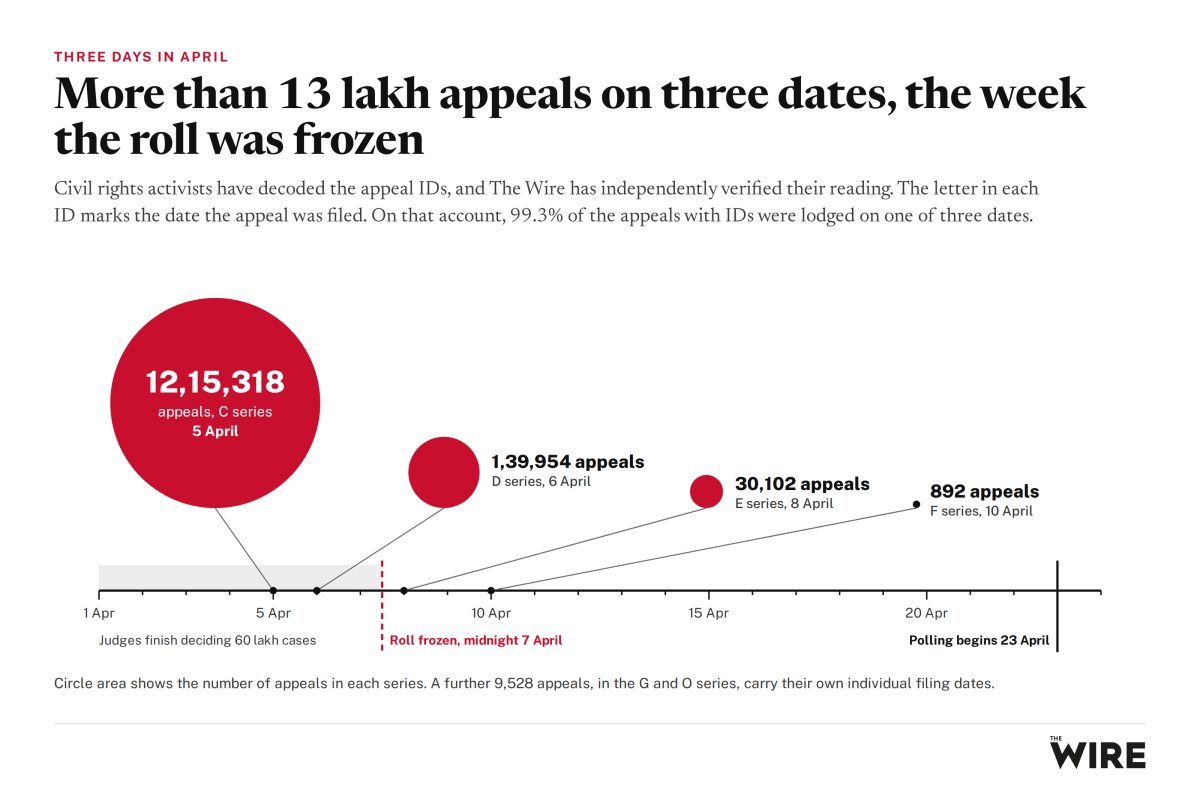
The Wire independently verified the claim of this structure and found that there is indeed a timestamp in the numbers in these appeals. All appeal IDs are unique. I found that 99% of the appeals IDs carry one of three timestamps – that of April 5, 6 and 8, 2026. These dates put the appeals at a time when judicial officers were finishing their work on the SIR and days before the rolls were frozen for the assembly election. The largest batch, more than 12 lakh appeals from the ECI, carries a single date, April 5.
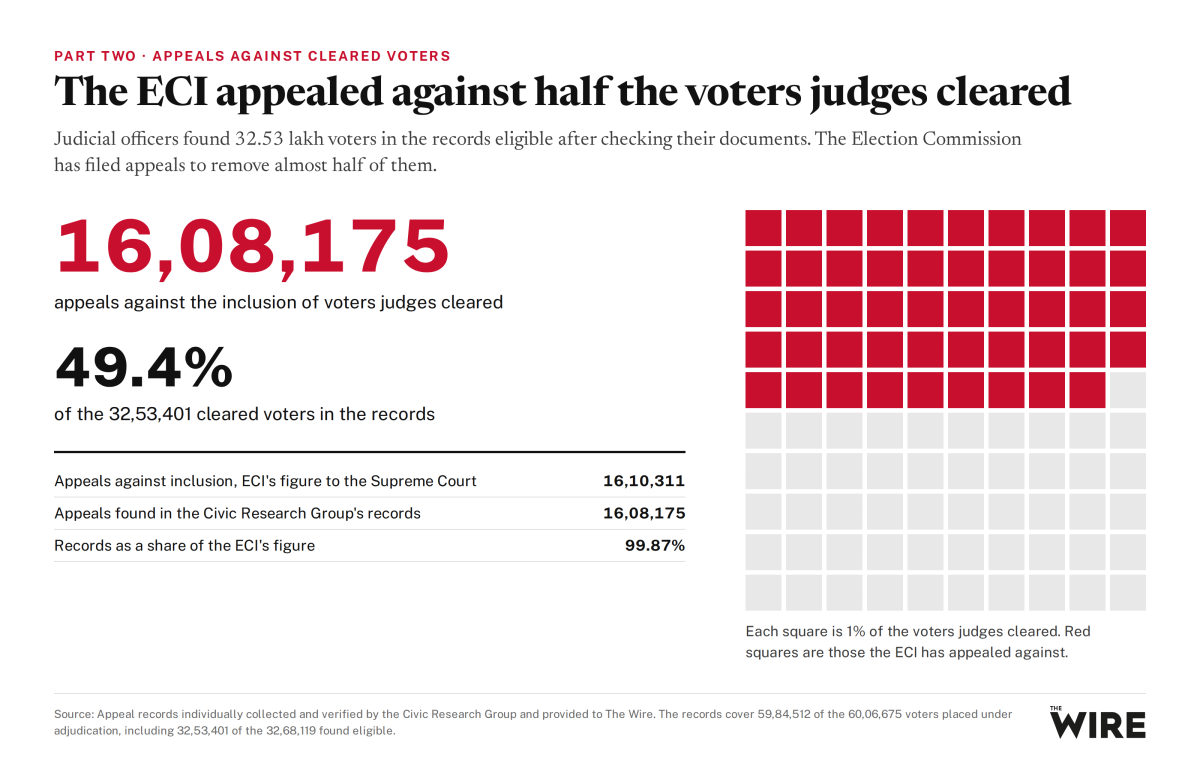
The Civic Research Group’s latest studies cover 59,84,512 of the 60,06,675 voters placed under adjudication in Bengal, or 99.6%. They include 27,06,096 of the 27,16,393 voters judges marked ‘not eligible’ (99.6% of the official total), and 32,53,401 of the 32,68,119 they found ‘eligible’ (99.5%) during the SIR.
Against the names of these ‘eligible’ voters, the Civic Research Group has so far found 16,08,175 appeals from the Election Commission against inclusion, almost exactly the 16,10,311 that the Election Commission reported to the Supreme Court.
The detailed analysis of appeal IDs below is based on a slightly earlier extract of the records, as of October 17, covering 30,00,541 cleared voters and 14,75,885 appeals.
Also read: In Bengal, the Judicial Review of Voters Under Adjudication Fell Six Times Harder on Muslim Areas
A numbering system built for volume
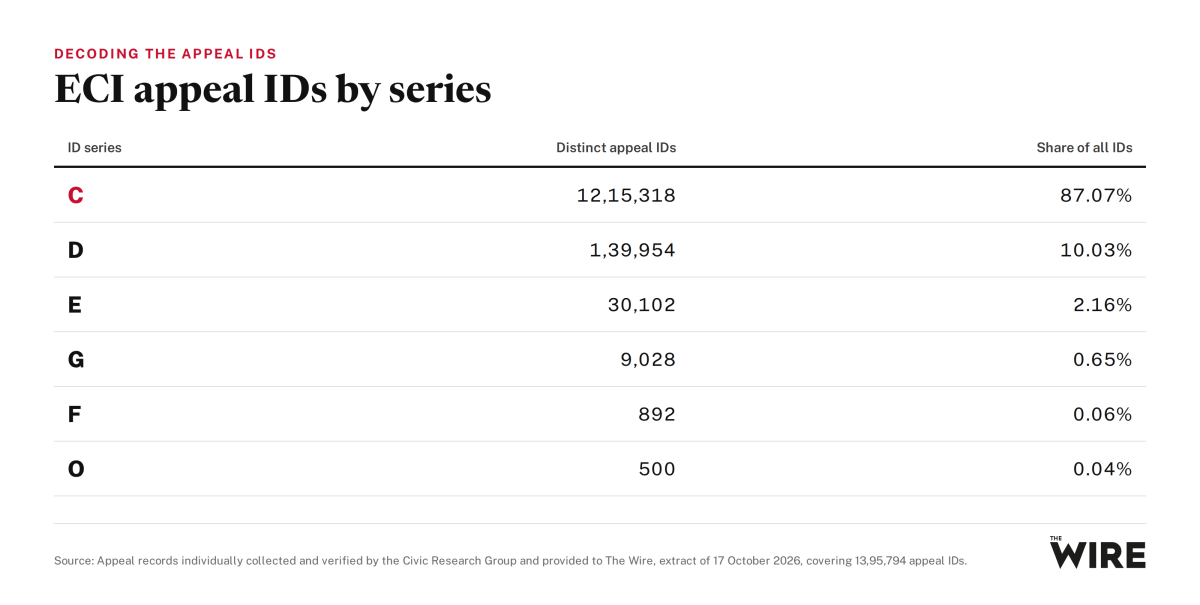
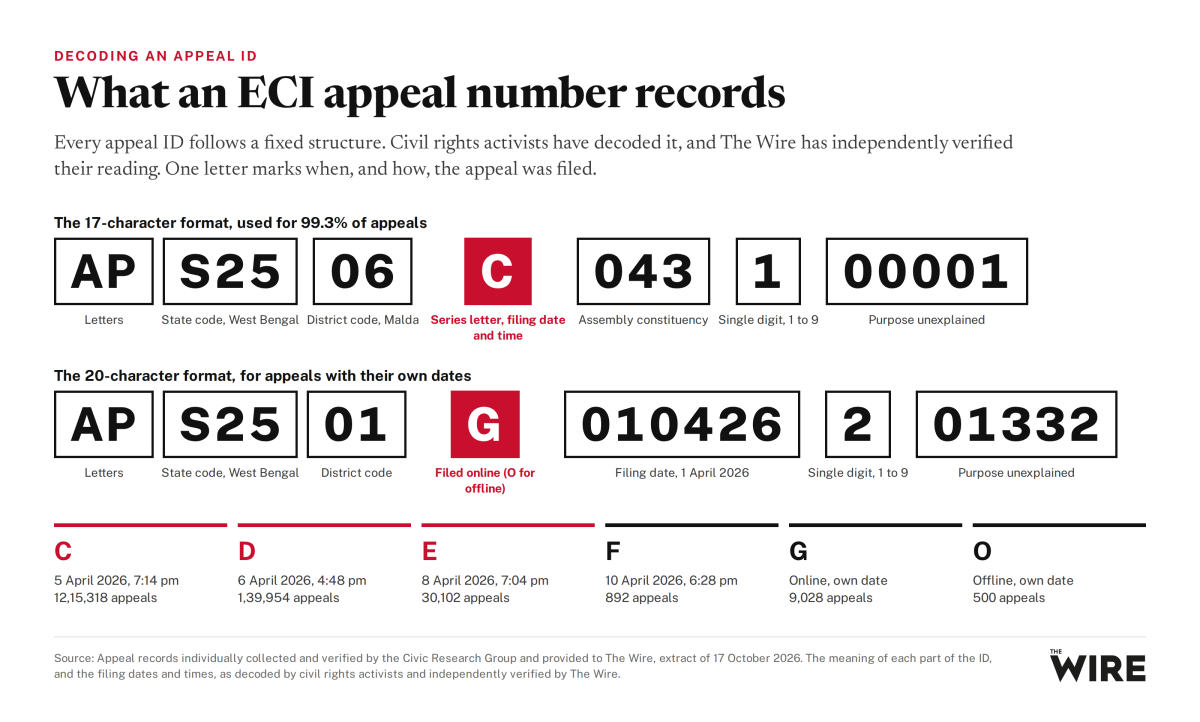
As per the Civic Research Group’s findings, the appeal IDs fall into six formats, each marked by a letter. The filing dates were, as noted, deciphered by civil rights activists and independently verified by The Wire.
| ID series | Distinct appeal IDs | Share of all IDs | Filed, according to the pattern |
| C | 12,15,318 | 87.07% | April 5, 2026 |
| D | 1,39,954 | 10.03% | April 6, 2026 |
| E | 30,102 | 2.16% | April 8, 2026 |
| F | 892 | 0.06% | April 10, 2026 |
| G | 9,028 | 0.65% | Online, on the date written into the ID |
| O | 500 | 0.04% | Offline, on the date written into the ID |
Most IDs are 17 characters long. An example is APS2506C043100001. According to Election Commission sources, after the letters AP comes S25, the state code for West Bengal. The next two digits, 06, are the district code. 06 covers the 12 constituencies of Malda, and 07 the 22 of Murshidabad. Then comes the series letter, C, and then 043, the number of the assembly constituency. The last six digits are a single digit from 1 to 9 followed by a five-digit number, whose purpose the sources could not explain.
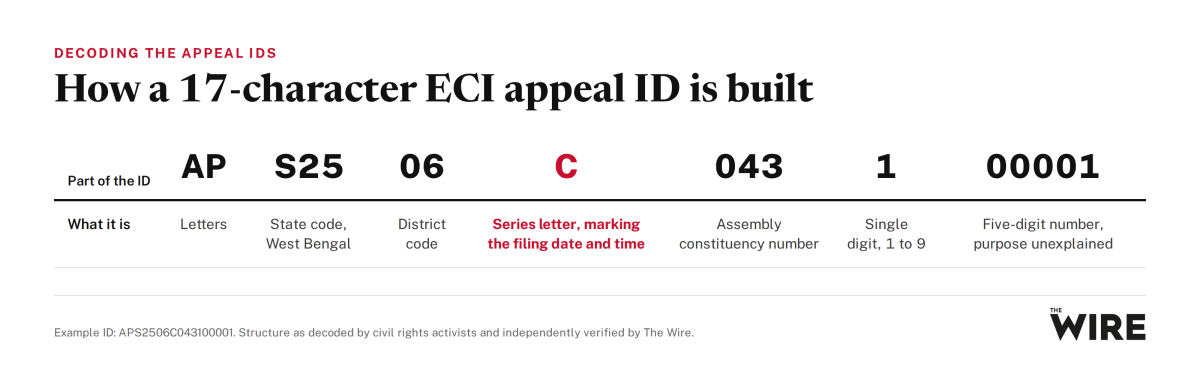
| Part of the ID | AP | S25 | 06 | C | 043 | 1 | 00001 |
| What it is | Letters | State code, West Bengal | District code | Series letter, marking the filing date and time | Assembly constituency number | Single digit, 1 to 9 | Five-digit number, purpose unexplained |
In the C, D, E and F series, the constituency block matches the seat in almost every case. Of 12,15,319 C-series records, all but one carry the right constituency number. A single prefix, APS2506C, comes before all the 2,95,634 appeals filed across Malda’s 12 seats.
The G and O series are different. They are 20 characters long, and after the district code and the letter they carry a six-digit date in day-month-year form. According to Election Commission sources, G marks an appeal filed online and O an appeal filed offline. APS2501G010426201332 was filed online on April 1, 2026, and APS2501O080926386465 offline on September 8, 2026.
The C, D, E and F letters work differently, the sources say. Each marks a single filing date and time. So every C-series appeal, 12,15,318 of them, carries the same timestamp, April 5, 2026. The D series, 1,39,954 appeals, carries April 6, and the E series, 30,102 appeals, carries April 8. Together, those three timestamps cover 13,85,374 of the 13,95,794 appeal IDs, or 99.3%. Only 9,528 appeals, in the G and O series, carry individual filing dates.
| ID series | Distinct appeal IDs | Share of all IDs |
| C | 12,15,318 | 87.07% |
| D | 1,39,954 | 10.03% |
| E | 30,102 | 2.16% |
| G | 9,028 | 0.65% |
| F | 892 | 0.06% |
| O | 500 | 0.04% |
This series is confusing to follow and a reader may wonder what the merit is in reading so much into this. However, the timing is important.
 By the first week of April, judicial officers had finished deciding more than 60 lakh cases. The roll was frozen for the assembly election at midnight on April 7, and the first phase of polling followed on April 23. The Election Commission’s appeals against the voters whose names judicial officers had cleared were lodged in this period. The assembly election was won by the Bharatiya Janata Party.
A single timestamp shared by more than 12 lakh appeals is hard to reconcile with appeals prepared and filed one at a time. It points to appeals created or uploaded as a batch. It does not, by itself, show who authorised them, or whether each was reviewed before it was filed, although one can take educated guesses on the latter. Since the timestamps rest on the sources’ account of the ID system, it is only the Election Commission which is in a place to confirm these facts.
Who filed them
The appeal records do not name the appellant in any case as these appeals are filed by the Election Commission. Earlier reporting by The Wire records retired judge, Justice Indrajit Chatterjee, sitting as Appellate Tribunal No. 11 for the district of Murshidabad, saying on record that a substantial proportion of the appeals before his tribunal had been filed by the Additional Chief Electoral Officer. The Wire has seen multiple notices appear before the tribunal for defending against appeal for exclusions filed by the Additional CEO.
The pattern of filing points the same way. As part one of this report showed, the Election Commission appealed against the inclusion of 40% to 60% of cleared voters in 222 of the state’s 294 constituencies.
The Election Commission’s own count
In a submission to the Supreme Court in September, the Election Commission reported 16,10,311 appeals against voters’ inclusion, alongside 22,21,118 appeals from excluded voters seeking to be restored.
| Number | |
| Appeals against inclusion, ECI submission, September | 16,10,311 |
| Appeals against inclusion found in the Civic Research Group’s records | 16,08,175 |
| Difference | 2,136 |
| Records as a share of the ECI figure | 99.87% |
The match independently confirms the scale. The Commission has appealed against 49.4% of the cleared voters in the records, almost exactly half of everyone the judges found eligible.
Note: The appeal records were individually collected and verified, voter by voter, by the Civic Research Group, which provided them to The Wire. The latest records cover 59,84,512 of the 60,06,675 voters placed under adjudication, including 32,53,401 found eligible and 27,06,096 marked not eligible. The analysis of appeal IDs and decided cases uses an earlier extract, as of 17 October 2026, covering 30,00,541 voters found eligible.
A series on how the adjudication process of the Special Intensive Revision in West Bengal continues in Bengal unfurls this truth. Read part one, here, part two, here, and part three, here, part four, here, and part five, here.
For our full coverage on the SIR and the issues it has brought to citizens, click here.
This article went live on October twenty-fourth, two thousand twenty six, at zero minutes past eleven in the morning.The Wire is now on WhatsApp. Follow our channel for sharp analysis and opinions on the latest developments.


