

As Telangana Bus Strike Continues, KCR's Popularity Takes a Beating


Hyderabad: “Bangaru Telangana” ('golden Telangana'), which the Telangana Rashtra Samithi (TRS) chief K. Chandrasekhar Rao promised to deliver before the formation of the state, is now on the boil under his rule.
The strike by the Telangana State Road Transport Corporation (TSRTC) employees, which saw a fleet of over 10,000 buses go off the road since October 5, is continuing. There are no signs of the deadlock being broken.
Chandrasekhar Rao, who became a widely-accepted people’s leader through the statehood movement, has taken a harsh approach to the strike. After first announcing that all striking employees would be sacked, their salaries for the previous month were also not disbursed, in what appears to be a vindictive action.
The chief minister's refusal to concede to the demands of the TSRTC employees – merger of their services with the government, pay revision and ruling out privatisation – was blamed on the corporation’s poor financial status and alleged non-performance of its employees.
Also Read: Telangana Bus Strike: No Thaw Between Government and Employees
The chief minister's hard stance was reportedly the reason why two staffers – Srinivasa Reddy, a driver from Khammam and Sudarshan Gowd, conductor in Hyderabad – took their own lives. Three others reportedly died of cardiac arrest during the strike period, while at least two have tried to kill themselves.
The strike has also taken a heavy toll on public life. Commuters in the state capital and in the rest of the state were left stranded during the Dussehra festival season. In this scenario, autos and private services charged exorbitant fees, according to reports. The government was forced to extend the Dussehra school holidays by a week as students did not have access to public transport.

TSRTC buses at a station. Photo: Twitter/@tsrtcbuses
Hark back to Telangana protests
Meanwhile, as the employees and opposition parties called for a state bandh on October 19, the state was under siege. Huge contingents of armed forces were deployed to crush the protests with a heavy hand. Leaders like Kodanda Ram and RTC Joint Action Committee (JAC) chairman Aswathama Reddy – KCR’s one-time associates in the Telangana movement – were arrested in pre-dawn crackdowns. A CPI (ML) New Democracy leader, P. Ranga Rao, had his thumb cut off during a police attack in Hyderabad.
With protests also underway in Osmania University, the scenes ring all too familiar for anyone acquainted with the Telangana statehood movement. Opposition leaders have observed the similarities between the Telangana government's handling of the TSRTC protests and the clampdown on protestors during the statehood movement.
Leaders have also caustically observed that from promising to create 1 lakh jobs to unemployed youth in the run-up to the creation of Telangana, KCR has now sacked 48,000 employees.
The chief minister has defended his move, saying that over the past six years, the TSRTC has run into losses of Rs 7,500 crore. While KCR blames the employees, the RTC JAC leaders say the government is facilitating the corporation’s slow death by levying a slew of taxes. They also accuse the government of failing to finance the subsidy in fares extended to certain sections of passengers as per government policy.
Governor Tamilisai Soundararajan called up transport minister Puvvada Ajay Kumar, asking him to brief her on the measures in place to end the strike. The governor’s response came after the Telangana high court took a serious view of the government’s poor handling of the agitation. But even the high court's suggestions have not prompted the government to negotiate.

A protestor holds a placard which reads, "Instead of creating new jobs, sacking those who have jobs...". Photo: PTI
A sharp change in fortunes
The high-handed action has spurned other sections of society to also protest. JACs have been formed by students, teachers, advocates, gazetted and non-gazetted officers to support the RTC employees.
These scenes would have been unthinkable even a year ago. In December 2018, the TRS romped to victory in the state elections, winning 90 of the 119 seats and KCR's dominance seemed to have been cemented.
During the statehood movement, KCR acquired the image of “Telangana Gandhi” for the sustained and bloodless agitation. But during the past six years, during his reign as chief minister, this image has taken a beating. During protests, effigies of KCR are being burnt.
Jakeer, an analyst who was closely associated with the Telangana movement, told The Wire that KCR was once viewed as a voice of Telangana and a crusader against the ruling establishments. "After coming to power, he has become part of the establishment. His government has stifled dissent by prohibiting protests at Indira Park in Hyderabad and also decimated the opposition by encouraging defections," he said.
Also Read: KCR and Modi, a Tale of Two Leaders Who Are Different But Similar
Analysts feel that KCR’s failure to deliver on his many promises, including creating 5 lakh jobs, providing double bedroom flats and distributing three acres of land to each Dalit family, has led to disenchantment across the spectrum. Welfare schemes such as Rytu Bandhu (input support for farmers), pensions for the elderly and 'KCR kits' for pregnant women, initiated by the TRS government, have many gaps, which has also changed the tide.
His critics accuse Rao of running administration from his farmhouse and claim that he is inaccessible to common people. They say because of the one-man show, the administration is straddled by red tape and that a large number of government files keep gathering dust. This notion was reinforced when KCR failed to constitute a cabinet for more than two months after his re-election in December 2018.
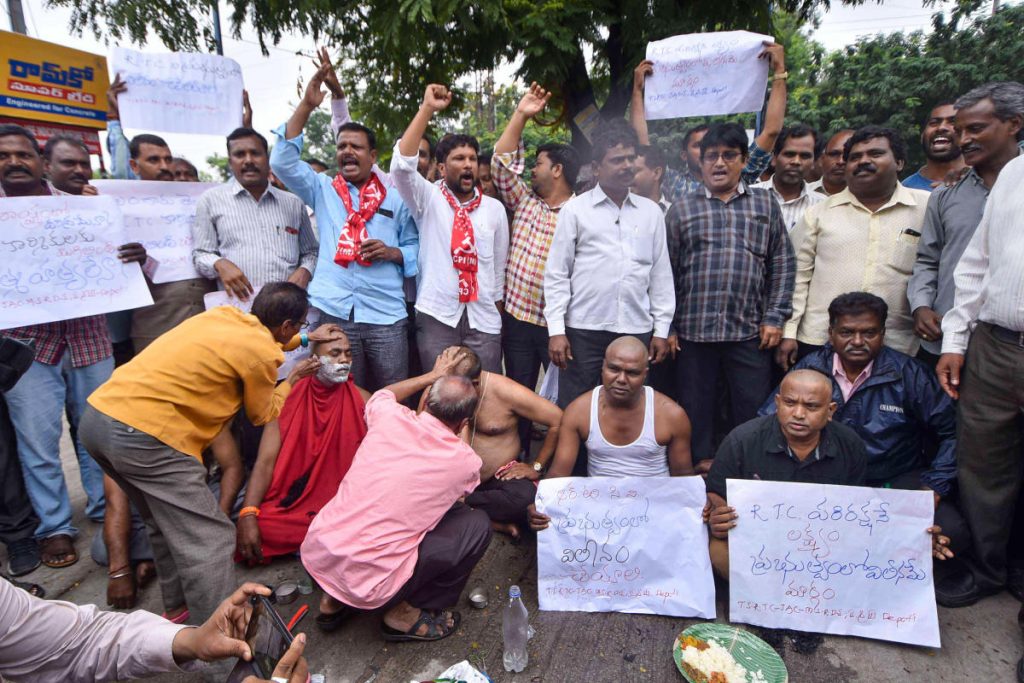
Agitating TSRTC employees get their heads shaved during their ongoing strike. Photo: PTI
Accusations of nepotism and cronyism
Another charge that has dogged Chandrasekhar Rao is that of promoting nepotism and cronyism. The RTC JAC chairman Aswathama Reddy accused the CM of bleeding the RTC, with one eye on its assets –which he estimates is worth over Rs 1 lakh crore. A couple of ministers were allegedly handed out huge chunks of lands owned by the corporation on lease for more than 60 years at nominal rates. He says these steps are part of the government’s plan to privatise the corporation.
The TRS government is also charged with plans to deploy electric buses supplied by P.V. Krishna Reddy of the Mega Engineering and Infrastructure Limited (MEIL), a close associate of KCR, on the RTC's routes. Lending credence to the allegations, Chandrasekhar Rao himself unfolded his plan of “restructuring” of RTC. The plan, according to him, envisages pruning the RTC-owned fleet by 50%. The gap would be filled by introducing hired services and private operators.
Journalist and former TV9 CEO was recently arrested, after his website Tolivelugu aired two video interviews in which KCR and Krishna Reddy were accused of corrupt practices. Colleagues of Ravi Prakash say the arrest was in retaliation for Prakash's refusal to take down the videos.
The unending agitation by the RTC employees may have helped the opposition build. The BJP has particularly been making efforts to find a foothold in the two Telugu states and won four Lok Sabha seats, up from just one in 2014. Its rise was eased by the fact that KCR and his party ensured the Congress is reduced to the role of an insignificant opposition party.
With voting underway for the Huzurnagar assembly bypoll on Monday, the result may be viewed as a mini-referendum on the state's mood. While the seat was held by the Congress, KCR and his party have made all efforts to snatch it. A failure to do so could mean leave the party fretting ahead of the municipal elections due in December this year.
Gali Nagaraja is a freelance journalist who writes on the two Telugu states.
This article went live on October twenty-first, two thousand nineteen, at zero minutes past five in the evening.The Wire is now on WhatsApp. Follow our channel for sharp analysis and opinions on the latest developments.


