

Global HIV Drive Hampered Without Drugs for 'Neglected' West and Central Africa


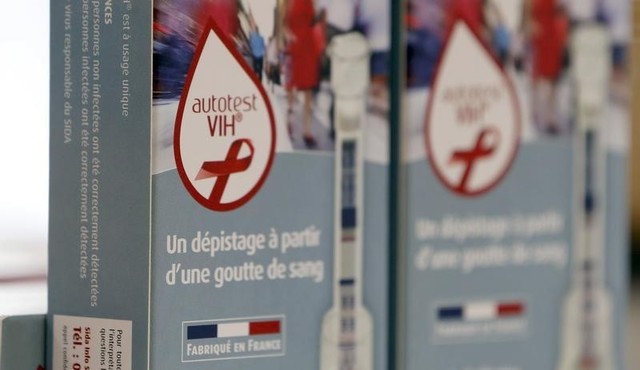
HIV self tests are displayed in a pharmacy in Bordeaux, France, September 15, 2015. Credit: Reuters/Regis Duvignau
Dakar: A global drive to help curb the HIV epidemic by 2020 will fail unless millions of people with the virus in West and Central Africa receive life-saving drugs, Medecins Sans Frontieres (MSF) said on Wednesday.
The United Nations AIDS programme (UNAIDS) launched a five-year treatment programme in 2014 to ensure that by 2020 almost all people with HIV worldwide know their status and receive treatment.
The drugs used to treat HIV also help to curb the spread of the virus.
Only one in four adults and one in 10 children living with HIV in west and central Africa have access to antiretroviral (ARV) drugs, compared to almost half of HIV sufferers in eastern and southern Africa, MSF said.
HIV treatment is not considered a priority in west and central Africa by donors or governments, as the region has a smaller percentage of people infected with HIV than eastern and southern Africa, said Mit Philips, health policy advisor at MSF.
"Donors focus mostly on high prevalence countries, like in southern Africa, where everyone knows someone affected by HIV," Philips told the Thomson Reuters Foundation by phone from Brussels.
Parts of southern Africa have the world's highest HIV rates, including Swaziland where 27% of people aged 15 to 49 have HIV, and South Africa which has a prevalence rate of nearly 20%.
"People with HIV in west and central Africa are neglected ... the low prevalence rate is misleading but means there is a lack of interest and that the disease is less visible in society," Philips added.
Two percent of people in west and central Africa have HIV, yet the region accounts for one in five new infections annually worldwide, one in four AIDS-related deaths and almost half of all children born with HIV, according to MSF.
While conflict across the region and epidemics of other diseases like Ebola have hindered HIV treatment, stigma, weak health systems and lack of political will have worsened the situation, MSF said in a report published on Wednesday.
"Many people face an obstacle course to obtain ARV drugs - they face stigma within society and even prejudice from health workers, struggle to pay transport or consultation fees, and often find there are low stocks of the drugs," Philips said.
Some 36.9 million people worldwide are living with HIV, which is spread through blood, semen and breast milk and causes AIDS, and more than half of them do not have access to treatment. Many do not know they have the virus.
UNAIDS said in November that its treatment programme, called 90-90-90, was starting to show results as the nearly 16 million people being treated by June 2015 was double the number in 2010.
(Reuters)
This article went live on April twentieth, two thousand sixteen, at forty-six minutes past twelve at noon.The Wire is now on WhatsApp. Follow our channel for sharp analysis and opinions on the latest developments.


