

At Home in the August House, N.G. Ranga’s Soul Was With the Peasant


For those who like parliamentary nuggets, here’s a quick quiz: which parliamentarian made it to the Guinness Book of Records for the longest service?
Answer: Nidubrolu Gogineni Ranga Nayukulu or N.G. Ranga, who was a freedom fighter, professor of economics and politics, journalist, writer and kisan leader. An exponent of the peasant philosophy, Ranga came to be considered – after Swami Sahajanand Saraswati – as the father of the Indian peasant movement.
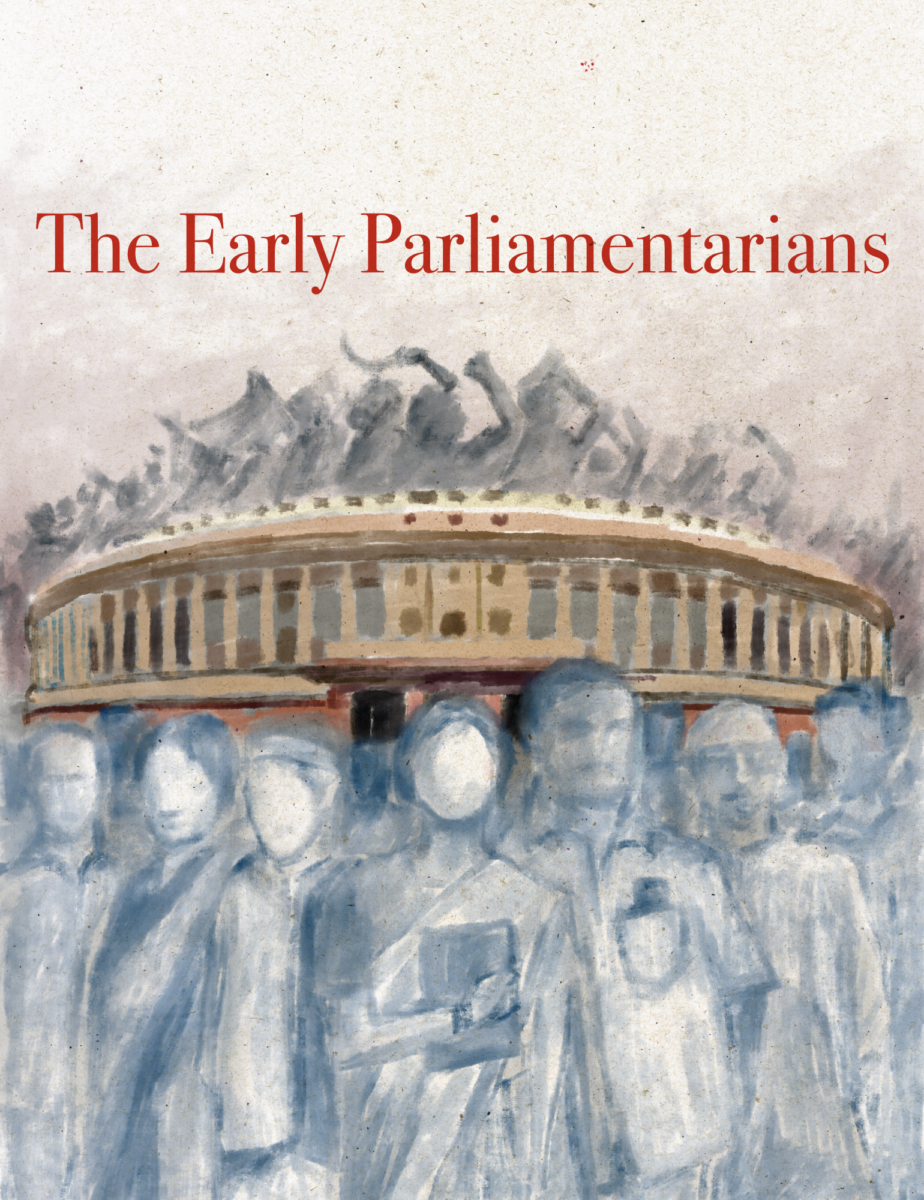
Illustration: Pariplab Chakraborty.
Ranga served the Indian Parliament for six decades from 1930 to 1991, entering the record book now known as the Guinness World Records. He pulled off the feat by getting elected to either the Lok Sabha or the Rajya Sabha from 1952 till 1991. Although he was defeated in the Lok Sabha polls a couple of times, he could immediately go to the Rajya Sabha. Ranga was a member of the Lok Sabha from 1957 to 1962, 1962 to 1967, 1967 to 1970 and 1980 to 1991. He was elected to the Rajya Sabha twice, from 1952 to 1957 and 1977 to 1980.
He was born in a middle-class peasant family at Nidubrolu village in Guntur district, Andhra Pradesh, on 7 November 1900. His family, Kamma Hindu by caste and religion, had migrated from Gogineni Palem in Krishna district where Ranga’s father Nagaiah Gogineni had been the Tehsildar.
During his school days, Ranga was exposed to the reformist literature of Kandukuri Veeresalingam and Tripuraneni Ramaswami. The non-Brahmin movement was proceeding apace, and Ranga attended a couple of meetings and conferences of non-Brahmin and Kamma conventions.
Ranga went to school in his native village and the neighbouring village Ponnur, and graduated from the Andhra-Christian College, Guntur. During his education at Guntur, Ranga was guided by a librarian and a social reformer. Thanks to the librarian, he developed a thirst for literature and avidly devoured the Ramayana, the Mahabharata and Plato’s Republic, among other books.
The social reformer profoundly influenced Ranga, particularly on the need to fight social injustice. Thus, the socialist ideas imbibed from western socialist thinkers merged with the early training at Guntur to produce the amalgam that was Ranga, who emerged as the doughty champion of the peasantry.
After graduating, he went straight to England in 1920. It was while at Oxford that Ranga came under the influence of socialist thinkers like J.J. Malen, G.D.H. Cole, H.H. Brailsford, Ellen Cicely Wilkinson, Rajni Palme Dutt and Clement Dutt. Ranga was impressed with the socialist movements of England and the rest of Europe. He also studied Marxism.
The Indian freedom struggle attracted his attention and, while in England, he became a member of the Colonial People’s Freedom Front and the African, Asiatic and European People’s Congress. He returned to India as a champion of the downtrodden peasants and to participate in the freedom movement. By the time Ranga returned to India, the Madras state was under the rule of the Justice Party. Ranga joined Pachaiyappa College in Madras (Chennai), which was managed by the Justice Party. He took up teaching as Professor of Economics at Pachaiyappa's College in the then Madras from 1927 to 1930. Then Ranga was appointed as adviser to the state government on economic affairs.
After returning from the UK, he married Bharati Devi. He enrolled himself as a member of the Congress party in 1930 after resigning from the posts of college lecturer and the state adviser. He started wearing Khadi and Gandhian caps.
Ranga joined the freedom movement, inspired by Mahatma Gandhi's clarion call in 1930. Ranga, along with his wife Bharati Devi, was arrested for the first time in 1931 in connection with the freedom struggle. He led the ryot agitation in 1933. He invited Gandhi to inaugurate a political school for peasants, workers and artisans with the first institute starting in Nidubrolu, the native place of Ranga. Three years later, he launched the Kisan Congress Party.

Illustration: Pariplab Chakraborty
Ranga was one of the founders of Congress Socialist Party and was a member of its national executive and drafting committee from 1934. He founded the All India Adult Education Institution and became its vice-chairman from 1926 to 1930.
Ranga started his own political journal, Vahini, in Telugu in 1937. He contributed articles to the magazine, Comrade, which drew the attention of
Gandhi. Ranga met Gandhi a few times and observed the conditions of agriculture, labour and handlooms. From then on, the fight for national freedom and the amelioration of the lot of the peasantry became his sole concern. Ranga, along with many of his associates, had to undergo several rounds of imprisonment for his part in the freedom struggle.
Ranga was a member of the All India Congress Committee for many years. He was president of the Andhra Pradesh Congress Committee in 1946, one of the secretaries of the Congress Legislature Party. He parted ways with the Congress, temporarily in 1952 (and founded the Krishikar Lok Party), and later in 1959 when the Congress adopted a resolution on joint co-operative farming.
Parliamentarian
Ranga was elected for the first time to the central legislature in Delhi in 1930. The vacancy arose due to the resignation of T. Prakasam. Those days, the voters were confined to taxpayers. He was a member of the Central Legislative Assembly, the Constituent Assembly and the Provisional Parliament. In the Constituent Assembly, Ranga proposed the name of Dr. B.R. Ambedkar to the chairmanship of the drafting committee.
Once Ranga quit the Congress for good in 1959, he – along with Rajaji (C. Rajagopalachari who was a trenchant critique of cooperative farming – founded the Swatantra Party. Ranga became the founder-president of the Swatantra Party and held that post for a decade. In the general elections held in 1962, the party won 25 seats and emerged as a strong Opposition. He had been the leader of the Swatantra Group in Parliament from that date except for brief periods in 1962 and again in 1967 when he was defeated in the General Elections.
The Swatantra Party attracted the business community, the upper class and traders. It remained in that position for a decade. Gradually, Ranga drifted. Rajagopalachari called him Bolshevik and Minoo Masani emerged as a strong leader in the Swatantra Party. Ranga was, however, returned to Parliament in later by-elections.
During the 1971 elections, Ranga contested against the Congress but lost. He decided to leave the Swatantra Party and rejoin the Congress in 1973 – by when Indira Gandhi had emerged as a powerful leader.
Ranga was one of the founders of the International Federation of Agricultural Producers. He represented India at the Food and Agriculture Organisation (Copenhagen) in 1946, the International Labour Organisation (San Francisco) in 1948, the Commonwealth Parliamentary Conference (Ottawa) in 1952, the International Peasant Union (New York) in 1954 and the Asian Congress for World Government (Tokyo) in 1955. He toured extensively in Europe, the Soviet Union and the US.
The peasant was his one passion in life. His decisions to resign from the Congress, rejoin it a few years later and again exiting might look to some as opportunistic. But to understand Ranga’s action, it is necessary to realise that his loyalty to the Indian peasant transcends all other instincts and any action by any group which he considered harmful to the peasantry invoked his opposition.
Throughout his political career, Ranga stood for peasants, their self-respect, right of their property and economic freedom. He was of the opinion that before removing peasants from their farmlands, alternative employment sources should be provided so that they can sustain themselves and live with dignity.
His other demands included: all agrarian reforms should be conducive to the agriculturists; distribution of national wealth and income should be rationalised in such a way that the agriculturists are not exploited with unequal distribution; there should be parity in the evaluation of the services rendered by farmers and other sectors; and co-operative farming and collective cultivation under state supervision would lead to dictatorship. Ranga opposed coercive reforms that sought to curb the freedom and dignity of peasants. The agriculturist was at the centre of Ranga’s political and economic philosophy. He calls it the Peasant (Kisan), Worker (Cooli), Artisan (Kalakar) Kingdom (Rajya).
The N.G. Ranga Farmer Award for Diversified Agriculture was instituted by the Indian Council of Agricultural Research in 2001 in his memory, and the agricultural university of Andhra Pradesh is named in his honour and memory as Acharya N.G. Ranga Agricultural University.
Ranga was awarded the second highest civilian award, Padma Vibhushan, in 1991. He passed away on June 9, 1995.
Qurban Ali is a trilingual journalist who has covered some of modern India’s major political, social and economic developments. He has a keen interest in India’s freedom struggle and is now documenting the history of the socialist movement in the country.
This article went live on September thirtieth, two thousand twenty five, at forty-one minutes past eleven in the morning.The Wire is now on WhatsApp. Follow our channel for sharp analysis and opinions on the latest developments.


