

H.V. Kamath, the Performer Who Set up Parliament’s Tryst With ‘Nature’s Gift’


This article is part of a series by The Wire titled ‘The Early Parliamentarians’, exploring the lives and work of post-independence MPs who have largely been forgotten. The series looks at the institutions they helped create, the enduring ideas they left behind and the contributions they made to nation building.
Indian Civil Service entrant (1929), assistant commissioner (1931-1932), additional district judge (1934-35), undersecretary (1936), additional district magistrate (1937-38)... freedom fighter (1938-47), political gadfly (until death in 1982).
Hari Vishnu Kamath wore many hats but one had a particularly snug fit: that of an irrepressible intervenor, if not disruptor, in parliament. Such was Kamath’s brio that he could not restrain himself even on the momentous occasion when Jawaharlal Nehru delivered the timeless “Tryst with destiny” speech.
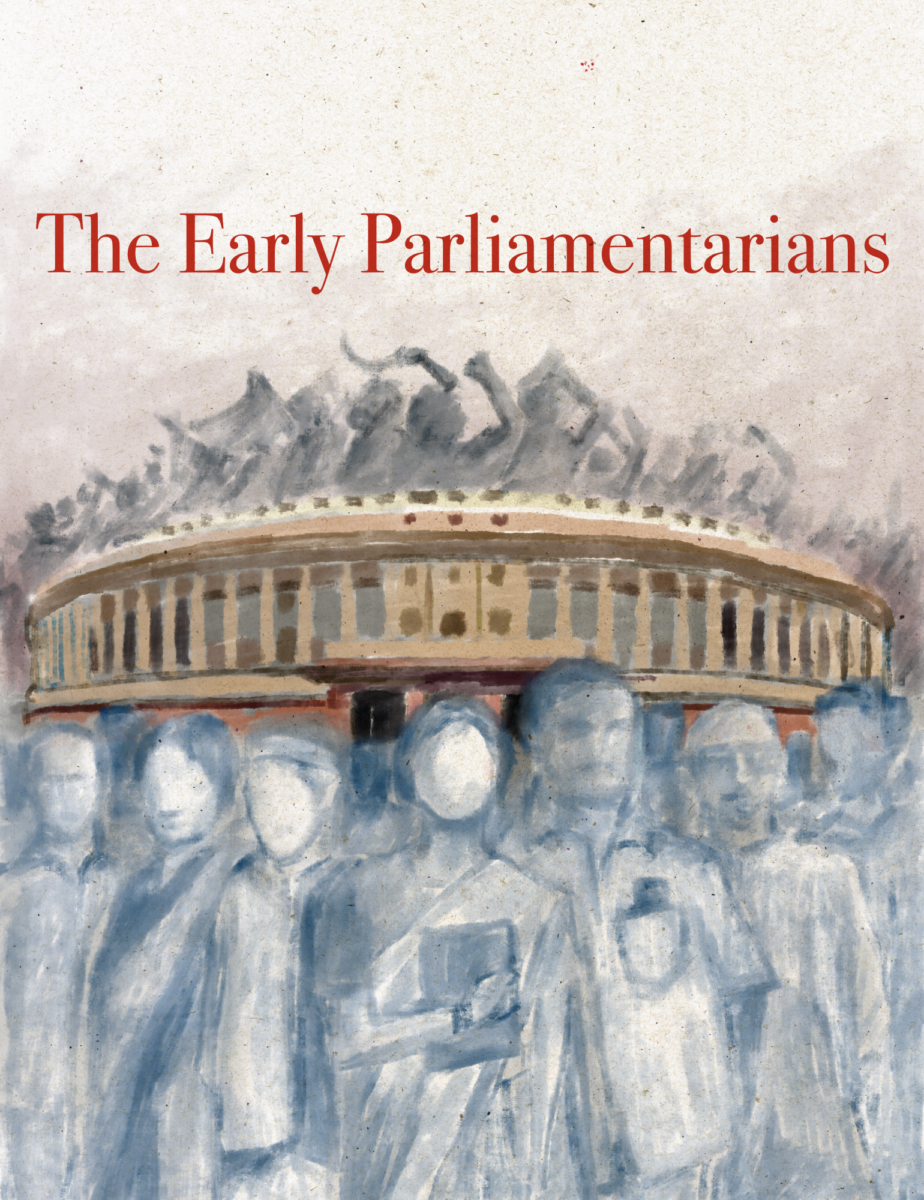
Illustration: Pariplab Chakraborty.
On August 14, 1947, Prime Minister Nehru had completed his speech and President Rajendra Prasad was about to call on the members to pledge themselves to the new nation. Never to miss the moment, Kamath got up to point out that two proposed amendments were listed in his name.
A magnanimous Kamath then told Prasad that “since you have invoked the holy name of God in your address” and as it was almost midnight, “I do not propose to move my amendments”. It was entirely gratuitous and only made to establish Kamath’s presence at the historic event. The reaction of the Assembly was not recorded but in the 2014 TV serial, Samvidhaan, that dramatises the creation of the Constitution, members are plausibly heard shouting at Kamath to shut up.
This was a sentiment that many, particularly Prasad and other presiding officers, often felt. Kamath was industrious, energetic and, in hindsight, could be seen as prescient in many of his proposed amendments. But he also had a talent for wasting time – on August 31, 1949, he suggested that the assembly consider India’s position on interplanetary travel, prompting T.T. Krishnamachari to exclaim in consternation that debating this “would be reducing the proceedings of this House to absurdity”.
Kamath was undaunted, as he appears to have been all his life. Little apparently dented his confidence in his own views as well as a desire to make them known and a talent in achieving this.
A close associate of Subhas Chandra Bose who himself had resigned from the ICS (Indian Civil Service), Kamath was a great freedom fighter and one of the most eminent parliamentarians of his time, a social worker and freelance journalist.
Kamath was born on July 13, 1907 in Mangalore, Karnataka. He studied at the Canara High School and the Government College before pursuing further studies at Presidency College, Madras. His eventual degrees included those from the London School of Economics, University College London and the then School of Oriental Studies.
In 1929, Kamath was one among the 48 to qualify for the ICS in the open examination and served under the British government in various capacities that included assistant commissioner, additional district judge, undersecretary and additional district magistrate.
In 1938, Kamath took a momentous decision – he left his ICS career behind to participate in the freedom movement, joining the Indian National Congress in 1938 as secretary, National Planning Committee, under the then Chairman, Nehru. Kamath was first imprisoned in 1940-41, triggering a chain of incarcerations between 1940 and 1945 for participating in the freedom struggle. During the Quit India Movement, Kamath was lodged at the Seoni Central Jail and, on his release, he spoke out against the atrocities of the British.
Later, he joined Bose’s Forward Bloc as its general secretary in 1940. Kamath would later push Nehru to have Bose’s disappearance investigated.

Illustration: Pariplab Chakraborty
Kamath was elected to the Constituent Assembly from the Central Provinces and Berar on a Congress ticket. He was a member of the Constituent Assembly of India from 1946-49 and the Provisional Parliament from 1950-52.
Anyone who reads the debates of the Constituent Assembly of India is unlikely to miss Kamath. He was one of the most frequent interjectors, objectors and demanders of divisions – the formal votes for which members had to record their choice, rather than just raise hands.
After 1950, Kamath parted ways with the Congress. He joined the Praja Socialist Party and contested India’s first general election that he lost by174 votes. After challenging the credibility of the elections in the Supreme Court, he secured a fresh election and made his way to the Lok Sabha. He won two more terms (1955-1957 and 1962-67).
Kamath was the prototype of the performative politician, always ready for the eye-catching moment, alert to the potential for publicity and aggressive in his actions. He would become one of the first lawmakers to be temporarily barred from Parliament for being disruptive. In 1955, The Times of India reported that when the deputy Speaker admonished him for shouting, Kamath replied insouciantly: “It is nature’s gift.”
He was elected to the lower House of Parliament, the Lok Sabha, from Hoshangabad, Madhya Pradesh, thrice. In 1955 and 1962, Kamath was elected from the Praja Socialist Party and in 1977, as a member of the Janata Party. He also contested without success the 1969 vice-presidential election as an Opposition candidate.
Kamath would happily make full use of his seat in Parliament as a pulpit from which to hit the headlines. In 1948, he questioned the health benefits of Vanaspati ghee and in 1950, he wondered about the safety of vaccines. In 1963, he ingeniously protested the endless amendments to the Constitution by suggesting an amendment to ban further amendments.
In 1965, Kamath introduced a bill to stop the supply of free electricity, water and furniture to ministers. In 1966, he suggested that Parliament reserve seats for members from Pakistan-Occupied Kashmir. Kamath was the rare voice that rang out against prohibition. It would, he noted in 1978, “be a complete success only for the enforcement staff and bootleggers”.
But Kamath did get opportunities to represent India at international forums that included the World Government Conference in London, the Conference of Socialist International in Israel and the United Nations General Assembly session. He was steadfast in his support to Jewish State Israel.He pressed the Indian government to recognise Israel and have friendly diplomatic relations with it.
Kamath’s many provocations are mostly forgotten today. Even the one time he made an impact on wider culture is little remembered. In 1977, when the Janata Party government had kicked Coca-Cola out of India and came up with a desi version, it was Kamath who suggested calling it 77 to mark the party’s moment of electoral triumph. But soon the Congress was back in power, and 77 started being sidelined, first named Double Seven, which was then to become Double Cola, and finally it was dropped altogether.
Kamath did win Rs 10,000 for proposing the name, one of the rare occasions when he seems to have benefited monetarily from his career. When he died in 1982, aged 75, he left behind a Central Bank account, the funds from which, he directed, should be used to fund student scholarships. He never married.
Kamath is now remembered mainly by readers of the Constituent Assembly debates. Some of the readers are annoyed and sometimes amused by his antics — and occasionally impressed by the moments of prescient political thinking that a career of confirmed contrarianism is likely to bring forth.
During the Emergency, he was arrested on October 2, 1975, from the Gandhi Samadhi in Rajghat, jailed and prosecuted under the Defence of India Rules. He was acquitted in May 1976 after a month’s trial.
Kamath himself was a person of faith but he always supported the core message of secularism in the Constituent Assembly – that everyone should be free to profess the belief they want to and the State should not favour or discriminate against any particular religion.
A prolific writer, Kamath’s works include Communist China Colonizes Tibet, Invades India, Principles and Techniques of Administration (1971) and Last Days of Jawaharlal Nehru (1977).
Kamath passed away on October 9, 1982 in Nagpur. He was 75.
Qurban Ali is a trilingual journalist who has covered some of modern India’s major political, social and economic developments. He has a keen interest in India’s freedom struggle and is now documenting the history of the socialist movement in the country.
This article went live on August thirtieth, two thousand twenty five, at eight minutes past one in the afternoon.The Wire is now on WhatsApp. Follow our channel for sharp analysis and opinions on the latest developments.


