

Nath Pai, a Socialist Leader Remembered for His Speeches and His Causes


This article is part of a series by The Wire titled ‘The Early Parliamentarians’, exploring the lives and work of post-independence MPs who have largely been forgotten. The series looks at the institutions they helped create, the enduring ideas they left behind and the contributions they made to nation building.
Nath Pai was a freedom fighter, barrister and excellent orator. As a prominent face of the Praja Socialist Party, he was also a parliamentarian for 13 years.
Pai was born on September 25, 1922 in Vengurla of Ratnagiri district, Maharashtra as the youngest son of a postmaster. After completing his primary education at Vengurla, he moved to Belgaum for higher studies. During the Quit India movement in 1942, he and his friends raided a police station in Belgaum and escaped only to be caught later, beaten up and imprisoned for 19 months, disrupting his education. He completed his matriculation in 1940, did his intermediate in college in 1945 and got his degree in 1947. He then went to London at the age of 25 to become a Barrister-at-Law and spent the next four years here.
It is here that he became the president of the Indian Majlis and the vice-president of League Against Imperialism. When in 1951 a ‘British Asian Socialist Fellowship’ was organised in London, Clement Attlee became its president and Nath, the vice-president. He got to witness the welfare regime of the Labour Party at close quarters and was sufficiently impressed by its compassion-driven politics. His complete faith in parliamentary democracy found strength during these years.
In 1954, at the Copenhagen conference of the International Union of Socialist Youth, a front organisation of the Socialist International, elected him as the president and Nath continued to preside for four years. It is here that he met his match, Crystle, a young socialist from Austria, and married her. Pai had mastered German and French languages too.
As a parliamentarian
Pai shot into eminence at a very young age and became a major voice from the opposition benches for three consecutive terms – from 1957 to 1971. He was elected from the Rajapur Lok Sabha constituency in 1957, 1962 and 1967.
One could see his brilliance and unparalleled eloquence even during his first term in the Lok Sabha. When he made his maiden speech in the Lok Sabha in 1957, Speaker Sardar Hukam Singh rushed to congratulate him. Prime Minister Jawaharlal Nehru was so impressed that he invited him to his chamber and told him to use the Lok Sabha as a platform to be the voice of the voiceless and marginalised. Nehru often invited him for breakfast and discussed issues of national importance with the young parliamentarian.
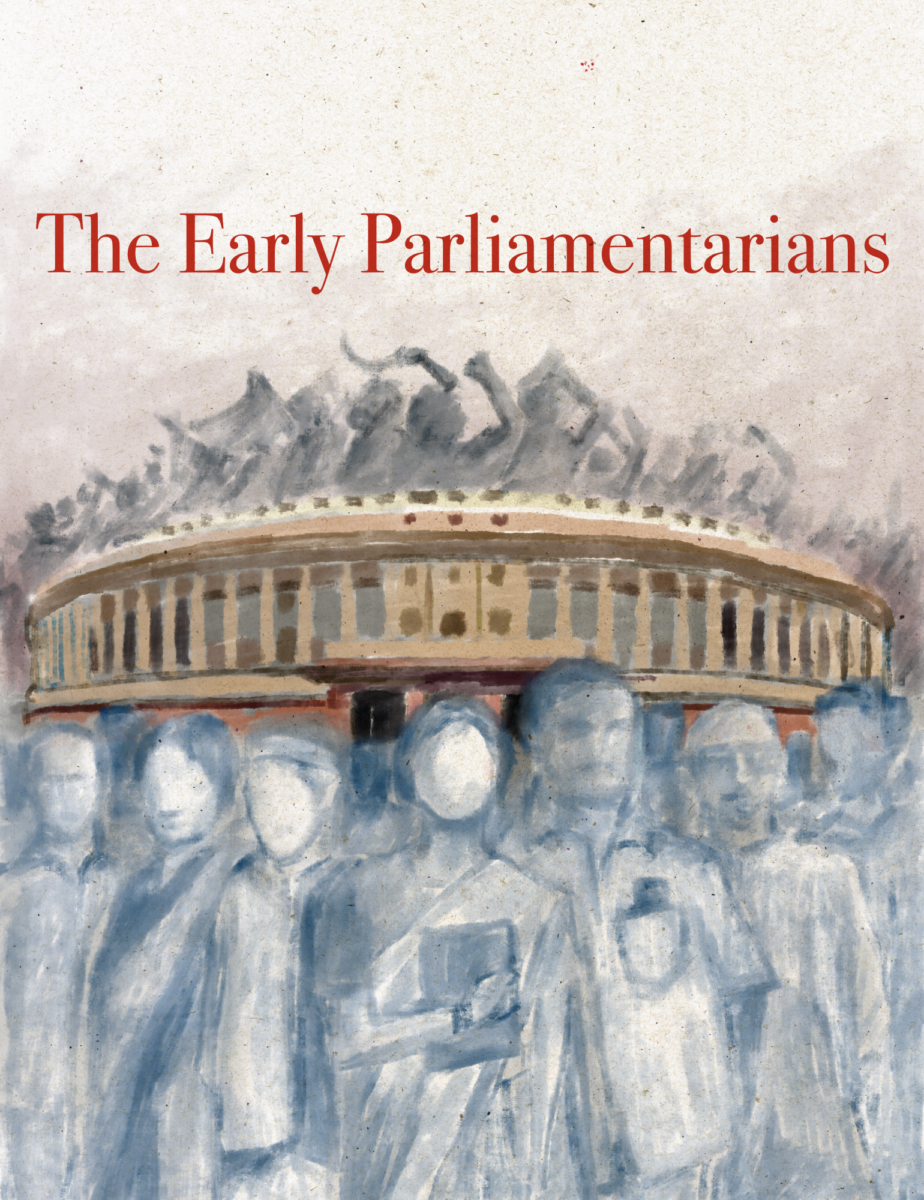
Illustration: Pariplab Chakraborty.
Expert Lok Sabha watchers believe that if one considers overall calibre and level of performance as yardsticks, then the third and the fourth Lok Sabha prove to be pivotal in Indian politics. The opposition in those days had stalwarts like Hiren Mukherjee, A.K. Gopalan, Indrajit Gupta, Acharya Kripalani, Nath Pai, Rammanohar Lohia, Minoo Masani, Madhu Limaye, Atal Bihari Vajpayee, Piloo Mody and many others. Nath Pai made his mark in the Parliament by subjecting the treasury benches to gruelling scrutiny.
Journalist H.K. Dua says that "Nath Pai could hold the House spell-bound commenting on foreign policy." Others compared his speeches in parliament to ‘ikebana’ – the art of beautiful assembly. Writing in The Hindu on April 17, 2012, Gopalakrishna Gandhi used the word "excoriating" for Pai’s speeches. Another journalist called him ‘Nehru’s Nemesis’. But this nemesis was not acerbic but gentle and without rancour. Nehru himself called Pai a ‘gentleman politician’.
Not just English, Pai was known for excellent oratory in Marathi as well.
During a debate on the Chinese aggression of 1962, Pai said, “There was a thrombosis of the will on the part of some of our leaders. There was a thickening of the emotional arteries and that was the cause of all the mischief, all the misfortune and all the tragedy that befell our nation.”
Pai introduced several private members’ bills in parliament. He tabled a bill for setting up a permanent commission for redressing grievances in connection with the linguistic reorganisation of states. He also tabled a bill to set guidelines for the appointment of governors. On August 28, 1970, he introduced a bill to include the ‘right to work’ in the chapter on Fundamental Rights in the Constitution. Foreseeing the abuse of power during a possible ‘Emergency’, he tabled a bill to preserve fundamental rights even during the declaration of emergency. Though foreign relations were Pai’s forte, he is known for his Constitution Amendment Bill.
Any student of law would be familiar with the feud between the parliament and the Supreme Court regarding property rights. The family of Henry and William Golak Nath held over 500 acres of farm land and under the Punjab Security and Land Tenures Act of 1953, the family was allowed to keep only 30 acres for each member and the rest was taken over by the State. The Golak Naths challenged the law on the ground that the Punjab law deprived them of their constitutional right to acquire and hold property. On February 27, 1967, the Supreme Court declared that parliament had no power to amend fundamental rights and thereby protected the right to property.
Thereupon, Pai introduced a Constitution Amendment Bill in parliament on April 7, 1967 to annul the judgment and restore to parliament its power to amend the fundamental rights.
The Bill was debated on the floor of the House and also in the Select Committee. The debate brought out Pai’s erudition. When some critics said that the passage of the Bill would open the floodgates for a totalitarian regime, Pai replied:
“A totalitarian regime is not prevented from coming here because there is a Supreme Court; but because my countrymen are committed to democracy. We remain a democracy, not because of the charity or interpretation of a court.”
Pai’s political foresight proved prophetic.
Eventually, the then government accepted Pai’s Bill on December 10, 1968. The Union Cabinet decided that the government must go ahead with its proposal to support the Bill as was originally promised.
Pai was not only a democrat, he was also a socialist. He was the leader of the Postal Employees Union and the Northern Railwaymen’s Union. He also led the strike of Central Government Employees in 1960. He also played an important role in the liberation of Goa from Portuguese rule.

Illustration: Pariplab Chakraborty
It was Pai who had dreamt of the ‘Konkan Railway’ as part of his plan for the overall development of the Konkan region and as a member of parliament had insisted for it. Demands for an Indian West Coast railway line were continuously raised by Pai as he actively voiced the concerns of the region.
His efforts bore fruit when in March 1970 he received a letter from the then railway minister, Govinda Menon, that a detailed survey of the ‘Apta-Mangalore’ line was being taken up and would be completed speedily. Later it was Pai’s political heir Madhu Dandavate, as the railway minister in the Janata government in 1977, who realised Pai’s dream of a Konkan Railway.
When in the scheme of linguistic reorganisation of states, Belgaum was made part of Karnataka and not Maharashtra as the Marathi speaking people of Belgaum had demanded, Pai took up their cause and agitated for inclusion of Belgaum in Maharashtra.
Some Marathi speakers died in a police firing in Belgaum during the agitation. On January 17, 1971, on the anniversary of the martyr’s day, Pai spoke at a public meeting in Belgaum for one hour in spite of his ill health and against doctor’s advice. He reminded them that he had fought for them inside and outside parliament, and after saying that he had at last repaid the debt of love and affection showered on him by the Marathi-speaking people, collapsed on the stage and died the next day on January 18, 1971 at the age of 48, just before the general elections. His socialist friend Madhu Dandavate succeeded him as Lok Sabha member from the Rajapur seat.
Qurban Ali is a trilingual journalist who has covered some of modern India’s major political, social and economic developments. He has a keen interest in India’s freedom struggle and is now documenting the history of the socialist movement in the country.
This article went live on July twenty-eighth, two thousand twenty five, at eight minutes past one in the afternoon.The Wire is now on WhatsApp. Follow our channel for sharp analysis and opinions on the latest developments.


