

'No Excavation Leads to Any Confusion, Excavations Give New Evidence': Amarnath Ramakrishna


Thiruvananthapuram: An archaeological site nestled amidst coconut groves on the banks of the Vaigai river in southern Tamil Nadu. A whole tranche of excavated materials, from terracotta ring wells to cornelian beads, which tells the story of a sophisticated urban settlement flourishing parallel to the Gangetic plains. A profusion of potsherds engraved with the Tamil-Brahmi script, possibly pushing back the age of the Sangam period. And a 982-page document containing layers and layers of science-backed evidence that is yet to be released officially. Keeladi in Sivagangai district has been in the news not only because it could transform the cultural identity of South India but also for becoming yet another attempt to arm-twist history as a political project.
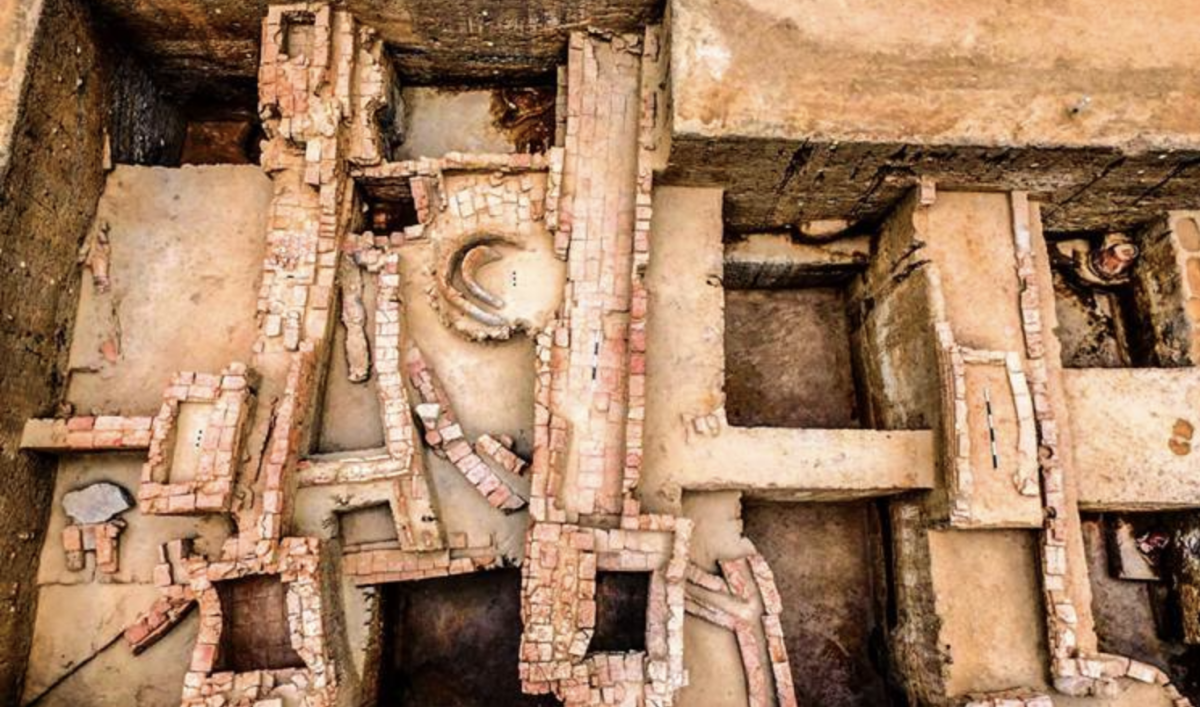
Exposed brick walls at Keeladi site. Photo: keeladimuseum.tn.
K. Amarnath Ramakrishna was the exploration director of the Archaeological Survey of India (ASI) at Keeladi from 2014 to 2016, during the first two seasons of the excavations. After submitting two interim reports, he was taken off the project and transferred to Assam, ahead of the third season in 2017. Following an intervention from the Madurai Bench of the Madras high court, Ramakrishna submitted his final report to the ASI in January 2023. Earlier this year, the ASI asked Ramakrishna to “rework” his report citing lack of “concrete justification” for putting his findings in an earlier time bracket. He refused, insisting that his final report comprised all documentary evidence. Ramakrishna delivered an erudite lecture on the Keeladi excavations in Thiruvananthapuram at the tenth Kerala History Congress recently.
Excerpts from an interview on its sidelines follow.
In your lecture, you said history needs evidence, not myths. Could you elaborate?
Myth is the construction by human beings. If we are reconstituting our history through myth, it will not stand. History has to be constructed with material reference.
We study history as how a king lived, his victory, or his heroism. But we have never seen the conditions of the people; how they lived. Without the contributions of the society or community, how can a king achieve such a high position? So, the common people of the society contributed enormously for the development of historical evidence. But we have never seen this evidence. For example, we see the Thanjavur temple, a gigantic temple constructed by Rajaraja Chola.
But what is its background? How was it constructed? How many people were employed? How were the resources for the construction obtained? How was it completed? We have never known about it all. These facts are available from archaeology. In archaeological excavations, we find common people’s objects. They have left behind something, and that has given us a new idea of study.
There was linguistic evidence found on the potsherds. Could such evidence eventually lead to the deciphering of the Indus script?
Unless and until we get a bilingual script, nobody will be able to decipher the Indus script, which is a pictographic one.
Coming to the script that was used all over India, it is popularly called Brahmi. In the North, they mostly used Brahmi script for Prakrit language. In South India, it was used for Tamil language (Tamil-Brahmi or Tamili), and we are finding it on the potsherds. But it is entirely different from the North.
In North India, we do not find anything on the excavated potsherds. We find it only in the form of huge inscriptional panels. Asoka inscriptions, for example. All over the northern part of India, we find rock edicts, pillar edicts, minor edicts, and major edicts. They give no history of Asoka, and were basically used for propagating Buddhist ideology and Buddhist thought. None of them carry Asoka’s name. He appears only as Devanam Priyadarshi (beloved to the Gods). Nowhere is he referred to as Asoka. The only Asoka inscription available in the South is in Sannathi, in Karnataka. The Sannathi excavations revealed a stupa that portrays a royal figure with Raya Asoka, meaning Raja Asoka. He is mentioned as such only in the South. So, there are potsherds and inscriptions in South India, but they are entirely different.
These inscriptions on the potsherds are neither created by kings nor administrative heads. That is the difference between the North and the South. The Northern inscriptions are engraved by some authority, like a king. Some authority that had propagated a religion.
Asoka propagated Buddhism in various forms, like pillar inscriptions and rock inscriptions in North India. They used the Brahmi script for that purpose. That is the earliest available script in North India.
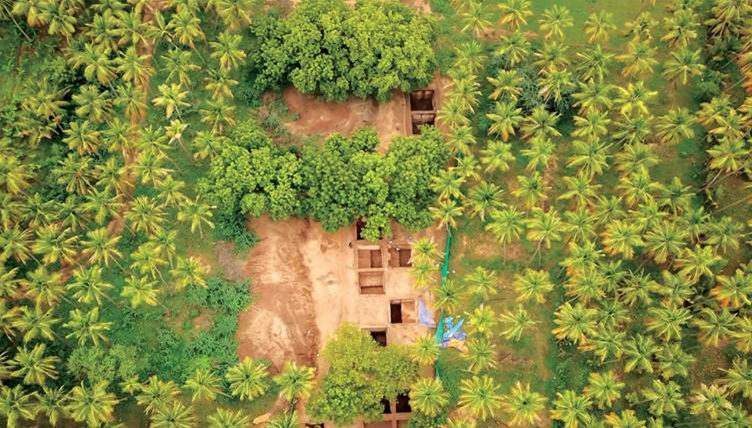
An aerial view of the Keeladi Excavation Site. Photo: keeladimuseum.tn.gov.in.
But here, the same script was used by the commoners. For what, we are yet to know. They used it to write their names on the pottery and that provides an idea about the widespread literacy that existed here in the South. There must have been a universalisation of the script. Only then would they be able to write, which could be comprehended by all. This means there was education for the common people. We find no government order, no royal chart here.
The next development is Jain inscription. In and around Madurai, you may find Jain rock inscriptions, that too only a line or two, giving evidence of the donations made. That could have been written by any trader. Because, had it been a raja sasanam (king’s order), it would be perfectly composed, perfectly edited, perfectly designed, and perfectly engraved.
So, who were the primitive here? The South Indians were. The North Indians were in the advanced stage. They took the script and utilised it in an organized way. But here, the commoners used it. The practice was known to everybody in the entire southern Tamil Nadu. Of course, we do not know the entire story yet; some gaps are there. For filling them, further archaeological investigations are required.
So, it has been found only on the potsherds?
Yes. That is why we found the evidence. If it was written on palm leaves, it would not have survived. Literacy existed here. Script was developed and used here. We can say that there was a literate society here. This society paved the way for the evolution of Sangam literature. Of course, the Sangam literature could not have appeared all of a sudden.
It is not religious literature, but social. It does not speak about Saiva or Vaishnava. It speaks about people. It speaks about agam and puram, inside and outside, love as well as fight. Puram is the external fight and activities of the people. So, when that literature developed, certainly there was some backdrop.
That is why we are saying that the script probably originated in the South and travelled to the North. Then they utilised it for writing the royal Prakrit language.
Coming to the Indus script, it is a pictography. That is, the letters are like pictures, like signage. The problem is, it is available only on a few seals, maybe a maximum of five letters. Unless and until we get a bilingual script, we can't decipher the Indus script.
But archaeologist K. Rajan has found that these symbols of the pictography were used here also. Similar symbols are available in the graffiti found here.
Graffiti is basically a practice; a practice for designing the script. So many graffiti are available all over Tamil Nadu. They indicate some evolution of the script that has happened here. From the graffiti, phonetic script was developed. Phonetic means, according to the sound. According to the sound, they practised writing so many symbols, so many patterns.
From those patterns, there evolved a permanent script. That is what happened in South India. This is explained by Rajan. In his recent publication too, he is saying that there is a sixty per cent similarity between the Indus script and the southern graffiti. That means there was a continuity for the Indus script.
Could you tell me what is the current state of your report on the Keeladi excavations?
I have given my report. My duty is completed. Now, the government has to decide and they have to publish it.
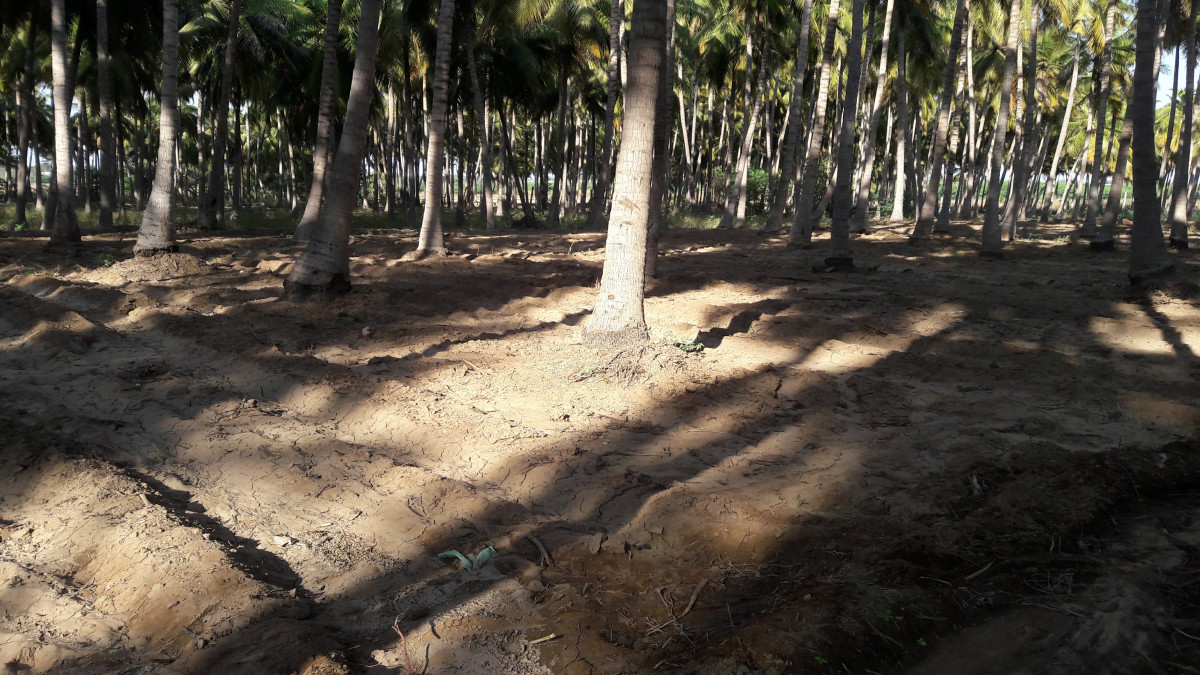
Keeladi archeological site Madurai. Photo: Ssriram mt, CC BY-SA 4.0 via Wikimedia Commons.
Excavators’ duty is to do the excavation and properly document it. Based on the documentation, they produce a report and submit it. I have submitted the report as per the direction of the honourable court. My work is completed. If they publish it, the report shall give more evidence for future research.
Is there a precedent of such reports being questioned or corrected?
No. Generally, once the report is ready, only proofreading is done. Mistakes are corrected.
But now, they ask me to change the content, the chronology. How is it possible?
The evidence came through the excavations. I have no right to change that. I have derived facts based on the excavation, stratigraphical sequence, and available material culture. The AMS (Accelerator Mass Spectrometry) dates were correlated and the cultural sequence has been reconstructed based on that.
Methodologies of archaeological reconstruction have been followed. Telling me that it is not done this way and asking me to reduce the time frame of the findings – how is that possible? If that is the aim, I would say please re-excavate and find new evidence. I have recorded my findings based on the outcome of the excavations. If you have any doubt, please redo the excavations and verify. Redoing an excavation also gives us new clues. We do not know what will come out from the earth and what it will speak about. But this is not the way something like this has to be treated.
The report should be released. I invite criticism. We can improve, go further, only if we are criticised. But before publishing it, how can you suggest corrections?
In your opinion, in the interest of protecting archaeological sites, what should be done urgently?
We are unable to protect archaeological sites all over India. My request is to try and do some more excavations in the South. We are not concentrating on excavations here.
Now we are reconstructing our historical past with material evidence. Our past generations could never do that. My request is to do more excavations.
What about Keeladi?
Keeladi too needs further excavations. It is a 110-acre mound and only five per cent of the area has been excavated till date. That gave us new theories and new thoughts. So, we should do more.
Also read: Keeladi Sparks Fresh Political Firestorm as Archaeologist Cries Foul
Right now, the entire area is not protected. The Tamil Nadu government is acquiring some parts and they are continuing the excavations now. The ASI has stepped out of the project after the third season of excavations, undertaken by P.S. Sriraman. [He reported no continuity of structures, which led to allegations that Keeladi was being deliberately sidelined.]
The ASI is not connected to the excavations now. But my request and my suggestion is that the ASI should do it. It is one of the premier institutions in India.
Our country is a pluralistic country. We have to see all cultures on an equal platform. Why we are not doing that, I do not have any answers.
As a connected question, are there any current initiatives to coordinate excavations in South India?
No. In my view, people in the region should come forward to do excavations. Universities, state authorities, etc. Everybody's contribution is required, not only ASI’s.
Will different agencies engaging in excavations lead to confusion?
No excavation leads to any confusion. Excavations give new evidence. Of course, the findings have to be verified. The ASI may do that.
Rasmi Binoy is pursuing a PhD at Sciences Po, Paris, and was formerly with The Hindu.
This article went live on December third, two thousand twenty five, at zero minutes past four in the afternoon.The Wire is now on WhatsApp. Follow our channel for sharp analysis and opinions on the latest developments.


