

Situating Trump in America’s Historical Experience


Donald James Trump is the 47th president of the United States. He belongs to the Republican Party, which came into being during the days before the Civil War, 165 years ago.
Ever since, the Republicans have shared power almost equally with their rival, the Democrats. Although ideologically the parties do not differ by much, in terms of political contestation they are like any two rabid rivals anywhere. Large numbers of Americans are traditionally pro-Republican or pro-Democrat, though there is a huge cusp zone for otherwise the two parties would not have alternated in power so routinely.
Trump is now in his second term and during his eight months in power he has already shaken global politics beyond imagination. His role in the recent conflict between Israel and Iran has been partisan in favour of Israel, which was expected, and his clean chit to the Israeli genocide of the Palestinians in Gaza has earned him huge disapprobation across the world. The only outliers everywhere are the rabidly anti-Muslim elements, which includes a large section of the Hindutva brigade in India.
Trump's economic blitzkrieg in the form of his tariff wars has disturbed the global economy, which is now forced to adjust to his maverick steps. How the whole structure will eventually shape up no one knows. At the moment, it is in flux and India is seemingly one of the worst sufferers. During Trump’s first presidential campaign, Prime Minister Narendra Modi had untiringly called him ‘my friend’ and violated all diplomatic norms by openly campaigning for him on both American and Indian soil. Perhaps that is why everyone is flabbergasted at Trump’s glee in announcing such cruel tariffs on India.
Given the fact that Trump has been like the proverbial bull in the China shop, let us try to situate him in America’s 250-year history. Though the subject warrants a book-length analysis, a modest beginning may be made here.
Let us consider Trump’s second term from four perspectives.
One, Trump is not the first president to have won a second presidential term after having lost his first attempt at reelection.
Two, Trumpism resonates with but is distinct from the McCarthyism of the early days of the Cold War.
Three, Trump is but yet another Zionist president, since Zionism has deep roots in American politics. And finally, in international politics, Trump’s ideological moorings are fundamentally confrontational, unlike most of his predecessors.
Before Trump there was Grover Cleveland. After winning the presidency in 1884, Cleveland went on to lose it in 1888, only to win it again in 1892, thereby serving two non-consecutive terms (1885-89, 1893-97). But unlike Trump, Cleveland neither sold national anxiety to the Americans (America is losing out to other nations) nor any dreams of rejuvenation (Make America Great Again or MAGA). Cleveland’s return was primarily attributed to his alliance with top notch bankers and ranchers as well as his support for the Cuban nationalists who were then fighting their colonial masters, Spain. For the latter, he had drawn a parallel to America’s own liberation war against the British.
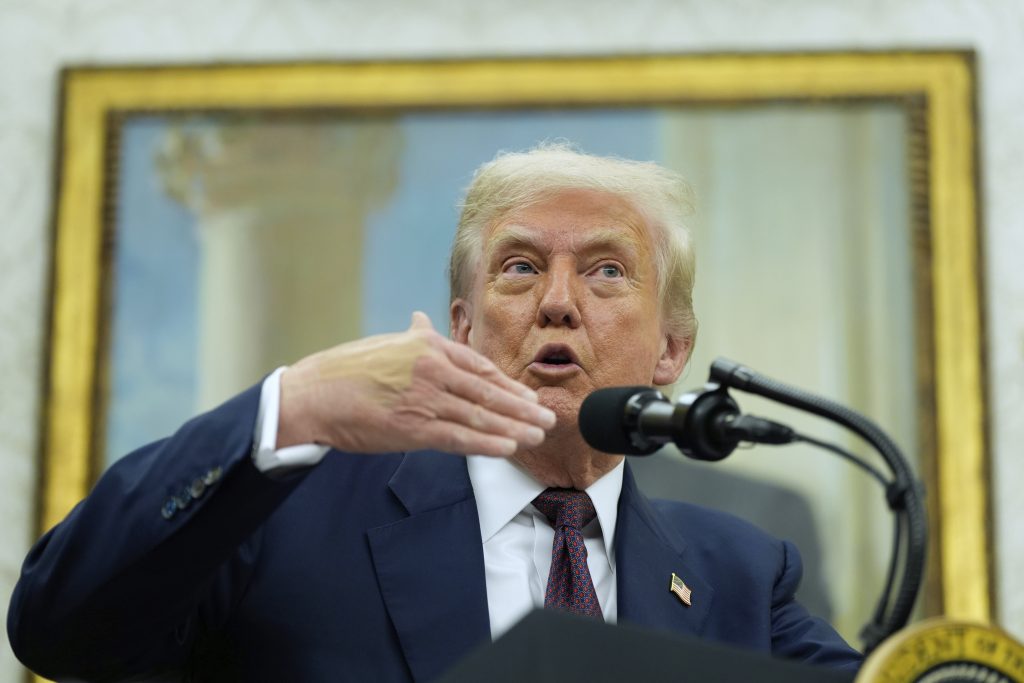
President Donald Trump speaks in the Oval Office, Aug. 6, 2025, in Washington. Photo: AP/PTI
Trumpism is not McCarthyism (American witch-hunting of Communists in the aftermath of the “fall” of China to Communists in 1949), even if the resemblance evokes such a conclusion for many. Some go further and even rope in the Red Scare (American anxiety of a Communist takeover in the aftermath of the Bolshevik Revolution of 1917) in the same context. At the centre of Trump’s political logic is the spectre of a Chinese-Russian challenge to American superiority. Notably, however, neither country is Communist any more in actual terms. That Cold War is long over.
Arguably, therefore, Trumpism is worse than McCarthyism. The latter had targeted particular individuals or institutions for their alleged sympathy for Communism. But the Trumpian hostility targets American liberalism as a whole, and also includes supporters of abortion, LGBTQ rights, Diversity and Equity, and much else that is not exclusively a ‘left-wing’ cause. The future of liberal education is also under unprecedented threat. Leading universities, which have earned global repute for their liberal values, are today under the Trumpian scanner. They are being coerced into curbing anything that even remotely smacks of liberalism. Foreign students will increasingly find American education unattractive.
This leads us to our third point, that is Zionism and its Trumpian connection. Zionist philosophy has deep roots in American politics. It predates the creation of Israel in 1948 and offers evidence that the idea can thrive even outside a Jewish nation. It all began in 1940, when the Zionist headquarters were shifted from Great Britain to the United States. Ever since, the US has remained the prime centre of Zionist activities.
Jewish immigration to America started in the late nineteenth century, when the pattern of European immigration to America was changing. It was no longer Irish and Germans in large numbers but poorer Europeans like Italians, Russians, Greeks as well as eastern and southern Europeans who began migrating to America. Since Jews were oppressed in many of these societies they too were migrating to America in good numbers.
The process was not without societal tensions. On July 30, 1902, when the Jewish community of New York took out a funeral procession for an important Rabbi, the city’s predominantly Irish police force was visibly hostile. Since in those days Jews were by and large the underclass of American society, many of them were supporters of the country’s socialist movement. No wonder, therefore, when in the beginning of the twentieth century, ethnic quotas were being fixed for immigration, Jews were not at all a favoured community, unlike, say, Anglo-Saxons.
Against the background of Adolf Hitler’s anti-Jewish tirade, Zionism picked up momentum and America soon became home to a powerful lobby thanks to an increasingly influential Jewish presence in academia, media, and business. This lobby has only grown in influence, and during the Trump regime it has reached unprecedented heights, as is evident from the way leading American universities are being forced to stifle any anti-Zionist expression at the teaching or research levels. The strategy has been to equate anti-Zionism (or any criticism of Israel) with anti-Semitism.
Recently, Professor Rashid Khalidi wrote an open letter in the Guardian addressed to the President of Columbia University, which read inter alia. ‘[Your] decisions, taken in close collaboration with the Trump administration, have made it impossible for me to teach modern Middle East history, the field of my scholarship and teaching for more than fifty years, 23 of them in Columbia.... Specifically, it is impossible to teach this course (and much else) in light of Columbia’s adoption of the International Holocaust Remembrance Alliance (IHRA) definition of anti-Semitism. The IHRA definition deliberately, mendaciously and disingenuously conflates Jewishness with Israel, so that any criticism of Israel, or indeed description of Israeli policies, becomes a criticism of Jews.’
It is not just Columbia, but Harvard and Brown universities have also seen their funding canceled for not doing enough to curb “anti-Semitism” on their campuses. Columbia University has already been forced to cough up 200 million dollars to the Trump administration as a penalty. Brown is reportedly going to pay 50 million dollars. And Harvard may follow suit by paying 500 million dollars.
The India question
In so far as India-US relations are concerned, the Trump regime does not display any radical departure from the past, although its expressions, say, in terms of building the tariff wall against India, may tend to give that impression. In a similar vein, America’s love for Pakistan, which in its latest avatar has found expression in the joint US-Pakistan exploration for offshore oil reserves, has Cold War roots.
In the late forties and early fifties, US academia tended to be pro-India even as their military-strategic counterparts in government were avidly pro-Pakistan. The following hilarious conversation between journalist Walter Lippmann and Secretary of State John Foster Dulles, the greatest Cold Warrior of his time, drives home the point: ‘Look Walter ... I have got to get some real fighting men into the south of Asia. The only Asians who can really fight are the Pakistanis.... We could never get along without the Gorkhas.’ When Lippmann reminded Dulles that the Gurkhas are Indian, not Pakistani, Dulles replied, ‘Well they may not be Pakistanis, but they’re Moslems.’ Lippmann once more corrected Dulles, saying, ‘No, I am afraid they’re not Moslems either, they’re Hindus.’ Dulles merely replied, ‘No matter,’ and proceeded to lecture Lippmann for half an hour on how SEATO would plug the dike against Communism in Asia.
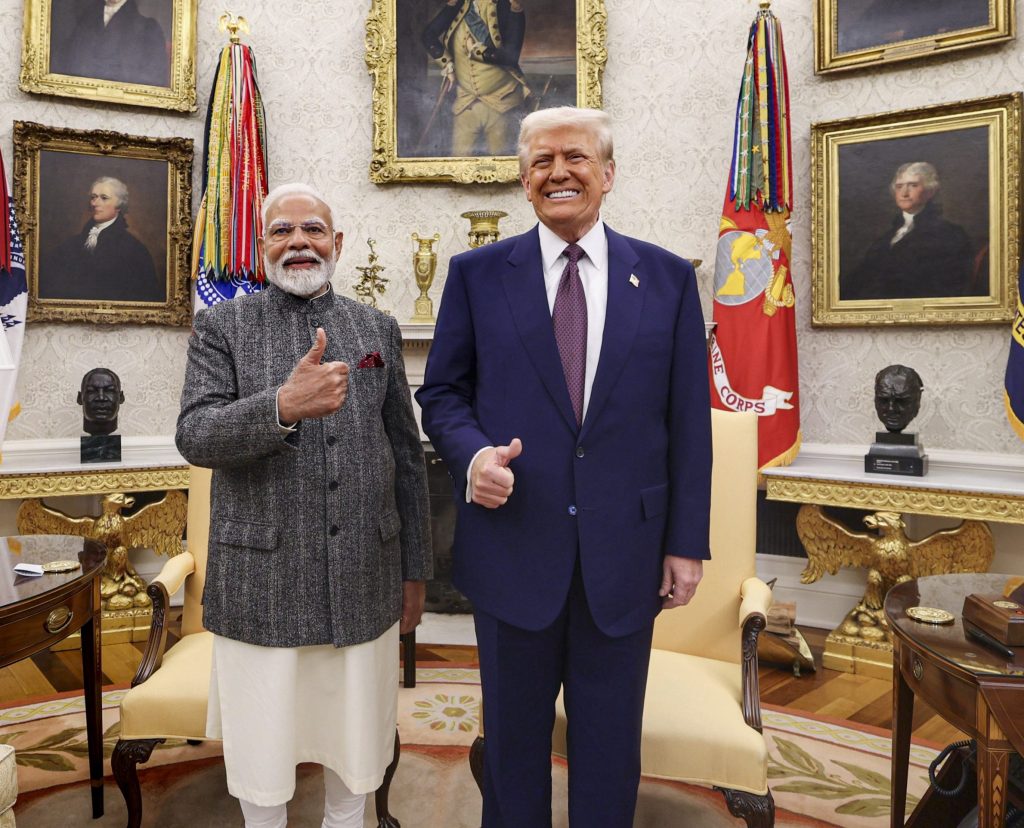
In this image by PMO on Friday, Feb. 14, 2025, Prime Minister Narendra Modi with US President Donald Trump at the White House, in Washington, DC, USA. Photo: PTI
In later years, because of the Islamic terrorist angle there were some cracks in the US pro-Pakistan edifice. But the Afghan war in the late seventies once again necessitated US-Pakistan bonhomie. It beggars belief that the secret US operation of May 2011, in which Osama bin Laden was killed on Pakistani soil, was carried out without the connivance of the Pakistan government. Nor should one ever forget how the Nixon-Mao rapprochement of 1972 was facilitated by the Yahya Khan government. It is only propaganda engineered by this Indian government, supplemented by the Indian diaspora in America, that shows America as favouring India.
President Donald Trump will be remembered as one of those rare US presidents who simultaneously disappointed both liberals and corporations. There may be comparable examples in American history, but none have matched Trump’s blitzkrieg against American liberal values on the one hand, and against global trade norms, on the other.
Trump may well repeat the mistakes of the 1920s, which led to the Great Depression. The three Republican presidents in the inter-war period, Warren Harding (1921-23), Calvin Coolidge (1923-29) and Herbert Hoover (1929-33) all believed in economic policies similar to what Trump now prescribes. President Coolidge had famously said: ‘After all, the chief business of the American people is business. They are profoundly concerned with producing, buying, selling, investing and prospering in the world.’
I hope that President Trump unlearns Coolidge’s model.
Partha S. Ghosh is a retired JNU professor.
This article went live on August tenth, two thousand twenty five, at thirty-six minutes past six in the evening.The Wire is now on WhatsApp. Follow our channel for sharp analysis and opinions on the latest developments.


