
Modi's Bullet Train Project Runs Into Initial Land Acquisition Trouble
The Wire Staff


Real journalism holds power accountable
Since 2015, The Wire has done just that.
But we can continue only with your support.
New Delhi: The Narendra Modi government’s pet project, the Mumbai-Ahmedabad bullet train system, is facing serious hurdles, with villagers rejecting the compensation package offered for parting with their land.
If the problem persists, the project might not be ready for commissioning on August 15, 2022, a schedule insisted upon by the Indian government.
Work started on the high-speed rail project last September.
According to media reports, the National High Speed Rail Corporation (NHSRC), the implementing agency, is facing protests from villagers and farmers over acquisition of land. The NHSRC has to acquire over 850 hectares of land in Gujarat, Maharashtra and Dadra and Nagar Haveli (UT), with a majority of the land to be acquired from Gujarat (612.17 ha).
Against that, it has so far acquired just 0.9 hectares in Bandra Kurla Complex that forms the originating station from Mumbai.
The “stakeholders’ meetings”, organised by the NHSRC in several towns of Gujarat, have witnessed protests by farmers, who say that the government has not been clear about the compensation package. In Gujarat, the NHSRC plans to complete land acquisition procedures by December 2018.
In Maharashtra, the corporation’s talks with the affected families in Palghar and Thane districts have failed to move ahead.
According to farmers’ outfits, 192 villages in Gujarat and about 120 in Maharashtra will be affected by the project.
Japan flags concerns
The Japanese government has agreed to provide Rs 88,000 crore loan for financing the project, which is estimated to cost Rs 1.1 lakh crore.
But land acquisition hurdles have triggered fears of delays in project completion, leading Japan’s Consul General at Mumbai, Ryoji Noda, to publicly flag his country’s concern. According to a report in The Indian Express, Noda said India needs to immediately solve the land problem, and added that the bullet train project will only be operational by the end of 2023.
“The bullet train project should be completed by the end of 2023. So there are only five years. We do not have much time. The land problem issue should be solved immediately… Japan and India are in very close collaboration to establish this high-speed train,” Noda said.
Consult meet woes
The NHSRCL had called for a second stakeholders consultation meet for the project in Vadodra early last month. But NHSRCL officials had to face angry protests from farmer representatives, who did not even allow officials of Delhi-based consultancy firm – Arcadis India Private Limited – to make a presentation.
Members of the Paryavaran Suraksha Samiti and Gujarat Khedut Samaj had already made a representation against the short notice period of one day which the NHSRCL had issued in a vernacular newspaper. “It is clear that the intent of the notice was not to publicise the public consultation for stakeholders properly but to merely fulfil a formality. In practical terms, the attempt was to ensure that the ‘notice’ is not noticed by stakeholders,” Rohit Prajapati, an activist, told the Times of India.
“During the consultation meeting at Nadiad, the hearing was held in an unseemly haste with farmers not being given a proper opportunity to voice their concerns,” he was quoted as saying.
At the consultative meeting last month, some farmers questioned the absence of government officials including the Vadodara collector, while others wanted to know why the meeting was called on such short notice (24 hours).
According to reports, Hasmukh Bhatt, a leader of the Ekta Gramin Praja Vichar Manch, a farmers’ body, raised questions over whether a "socio-economic impact assessment" had been carried out for the train project. “The state government which has taken exemption from the impact assessment study should declare that the compensation will be given according to the new jantri rates, which have not been revised since 2011. If not, we will not allow the project to move forward,” said Bhatt.
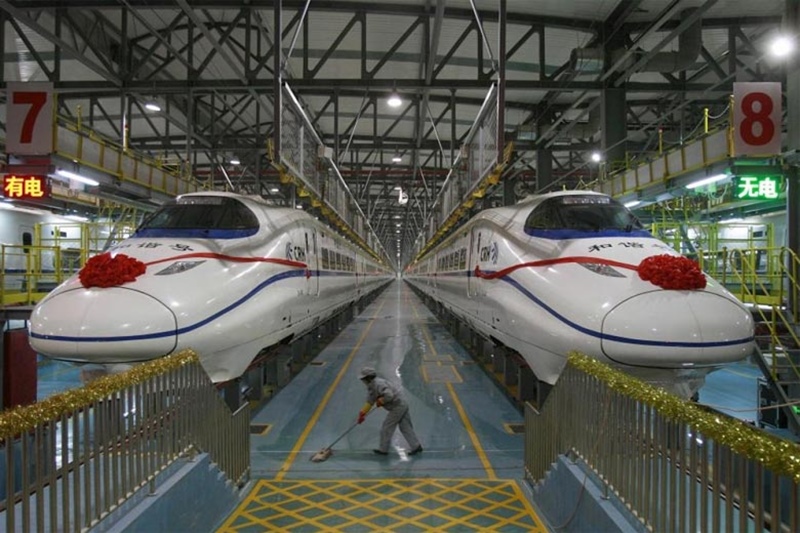
The bullet train will run at an average speed of 320 km per hour with a maximum speed of 350 km per hour. Initially, the train will have ten coaches with a total seating capacity of 750 passengers. In the future, it is proposed to have 16 coaches with a seating capacity of 1,250 passengers.
A total of 12 stations have been proposed which include Mumbai, Ahmedabad, Virar, Boisar, Thane, Vapi, Bilimora, Surat, Bharuch, Vadodara, Anand and Sabarmati. The distance of 508 km will be covered in two hours and seven minutes by the bullet train if it stops at four stations – Ahmedabad, Vadodara, Surat and Mumbai.
The Modi government has advertised the project as a symbol of 'New India' that would significantly reduce travel time (from seven hours to about two hours) between Mumbai and Ahmadabad and spur economic growth in the region.
But critics say it is difficult to justify a grandiose and expensive project like the bullet train at a time when the existing rail infrastructure in the country is creaking and train derailments and accidents have become a daily occurrence, instilling fear among passengers.
This article went live on May first, two thousand eighteen, at thirty-eight minutes past four in the afternoon.The Wire is now on WhatsApp. Follow our channel for sharp analysis and opinions on the latest developments.