

Panchayat Sahayaks Reject Pay Hike From Rs 6,000 to Rs 9,000, Vow to Teach Yogi Govt a Lesson in 2027


New Delhi: The Adityanath-led Uttar Pradesh government on September 16 announced an increase in the monthly honorarium for panchayat sahayaks from Rs 6,000 to Rs 9,000 – a figure significantly below the Rs 30,000 demanded by the workers.
The government’s decision came more than a week into an indefinite strike launched by thousands of panchayat sahayaks or panchayat assistants at Lucknow’s Eco Garden. However, protesting workers appeared rejected the 50% hike, and ambiguity remains over whether the proposal will bring a permanent end to their dharna, which has drawn widespread support from major Opposition parties. The protestors had left the dharna site on September 16 evening.
With over 57,000 panchayat sahayaks deployed across the state, the government's decision is being viewed as an attempt at damage control with less than five months remaining before the 2027 Uttar Pradesh assembly elections.
Addressing a press conference on September 16 alongside a delegation of panchayat sahayaks, state panchayati raj minister Om Prakash Rajbhar described their demands as “justified” and announced a slew of concessions. Rajbhar stated that following a discussion with Chief Minister Adityanath, the state government decided to raise the monthly honorarium to Rs 9,000.
In addition to the pay hike, Rajbhar announced that panchayat sahayaks would now be eligible for maternity leave, direct wage payments into their accounts via Direct Benefit Transfer, and cashless healthcare benefits. To appease the demonstrators further, the minister promised that all criminal cases registered against protesting workers during the agitation would be withdrawn and any panchayat sahayak terminated during the strike would be reinstated.
'How will we ever accept the DM’s power over us?'
The government also said that now village pradhans and panchayat secretaries would not be able to sack panchayat sahayaks arbitrarily. Now, they can only be removed after an inquiry conducted by a committee under the District Magistrate.
Puneet Singh, spokesperson of the Panchayat Sahayak Karmachari Union (PSKU), Uttar Pradesh, which has been leading the protest, however, said that they were not happy with the government’s concessions. “We don’t accept it. We won’t accept anything less than Rs 30,000 or the minimum wage provided to skilled workers in the state,” said Singh. Talking to The Wire, Singh said that the provision that panchayat sahayaks would be removed on the recommendation of the DMs was also not acceptable. “How will we ever accept the DM’s power over us? If we can be removed by the DM, how will a panchayat sahayak ever raise their voice against the government,” asked Singh.
He reiterated the stand of the PSKU saying that they be granted formal status as Grade C State Employees by abolishing the contractual agreement system and formulating permanent service rules. “Without a permanent position, anyone can scare us and put us under pressure with the threat of getting us removed,” said Singh.
The Wire tried to speak to the members of the delegation that met the minister but they were not available. Most of their phones were switched off.
Singh alleged that the delegation may have been put under pressure to accept the increase of honorarium from Rs 6,000 to just Rs 9,000. While speaking to The Wire earlier, PSKU office-bearers had said that they wanted a monthly wage of Rs 30,000, at par with the salary of the gram panchayat secretary. In the worst case, they would not settle for anything less than Rs. 15,224, which is the minimum monthly wage of skilled workers in the state.
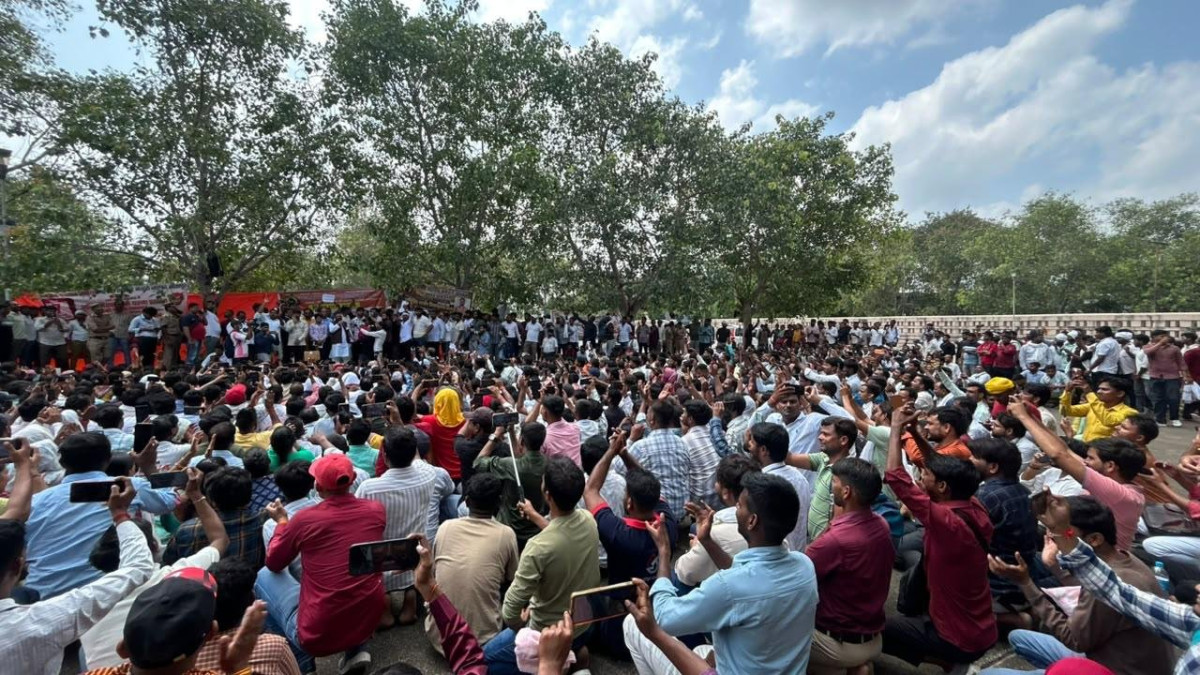
The panchayat sahayaks' protest. Photo: By arrangement.
In a series of posts on X on September 17, the PSKU, UP, said that it did not accept the honorarium of Rs 9,000 and declared that they would not accept anything less than Rs. 15,224.
“You simply flipped the 6 to make it a 9. But this is not an enhancement to their livelihood; a joke has been played on the Panchayat Sahayaks,” said PSKU.
The panchayat sahayaks also threatened to teach the government a lesson in the 2027 assembly election if their demands were not met.
“The Cabinet must not pass a proposal for Rs 9,000; it should be no less than Rs 15,224. Otherwise, all of us Panchayat Sahayaks will show you in 2027 exactly what a Panchayat Sahayak is capable of,” the PSKU said.
In another post on September 17, the PSKU said if the government does not implement the minimum wage of Rs 15,224, then they would consider supporting the manifesto of the political party that promises regularisation and a proper pay scale for them.
“There is still time; implement the minimum wage instead of the current Rs 9,000. Otherwise, Panchayat Sahayaks and their families will not support you. This is the pledge of over 57,000 young Panchayat Sahayaks,” the PSKU said.
Workload expands and more
In 2022, the state government appointed roughly 57,000 Panchayat Sahayaks – officially designated as Panchayat Sahayak/Accountant-cum-Data Entry Operators – to streamline administrative operations across Gram Panchayats. Designated as Village Level Entrepreneurs (VLEs), they are tasked with delivering over 243 government services directly to rural citizens. The state initiative aimed to decentralise service delivery and make administrative governance accessible to rural populations.
Panchayat sahayaks are selected on the basis of their class 10 and 12 marks. Only the village toppers are appointed. The candidate has to be a resident of the same gram panchayat and must have cleared Class 12. The selection process adheres to the reservation policy applicable to the respective gram panchayats.
Due to rampant unemployment, youth were compelled to treat this as a full-time job, though most remain desperate to switch careers if an opportunity arises. They argue that Rs 6,000 per month is grossly inadequate to sustain a family or build a career. The PSKU said that Panchayat Sahayaks are no longer mere contractual support staff but have evolved into the digital and administrative backbone of rural governance in the state. From data management and online scheme implementation to public service delivery and inter-departmental coordination, nearly every grassroots digital operation relies on them.
Panchayat sahayaks say that while they were initially hired strictly as data entry operators at the panchayat bhawan, over time their workload expanded dramatically while their honorarium remained frozen, with no provision for overtime pay. Panchayat sahayaks report being given strict targets to issue Ayushman Health Cards. The Agriculture Department tasks them with conducting crop surveys three times a year, while the Revenue Department enlists them for the Swamitva Scheme survey to issue land ownership cards to villagers. Additionally, they are appointed as Booth Level Officers (BLOs), tasked with generating Family IDs, and were previously deployed for COVID-19 vaccination drives.
Rival group, tussles and an FIR
Their protest, however, has also been marred by alleged factionalism with members of a rival group, the Panchayat Sahayak Kalyan Samiti (PSKS) UP at odds with the PSKU. A criminal case was lodged against PSKU president and panchayat sahayak of Saherua gram panchayat in Pratapgarh district Brijesh Mishra on the complaint of PSKS president Shivendra Pratap Singh.
In his complaint, Singh demanded an impartial investigation into the operations, registration, illegal fundraising (bank accounts), and financial activities of the PSKU. Singh alleged that PSKU was collecting funds from Panchayat Sahayaks in the form of membership fees and contributions in the name of the organisation but without any clear financial transparency. He also alleged that Mishra and the PSKU were inciting panchayat sahayaks online attendance system for departmental work and spreading confusion by publicising the protests through various social media groups and meetings. The FIR invoked charges of criminal breach of trust by a public servant, extortion, organised crime and promoting Enmity and Public Mischief.
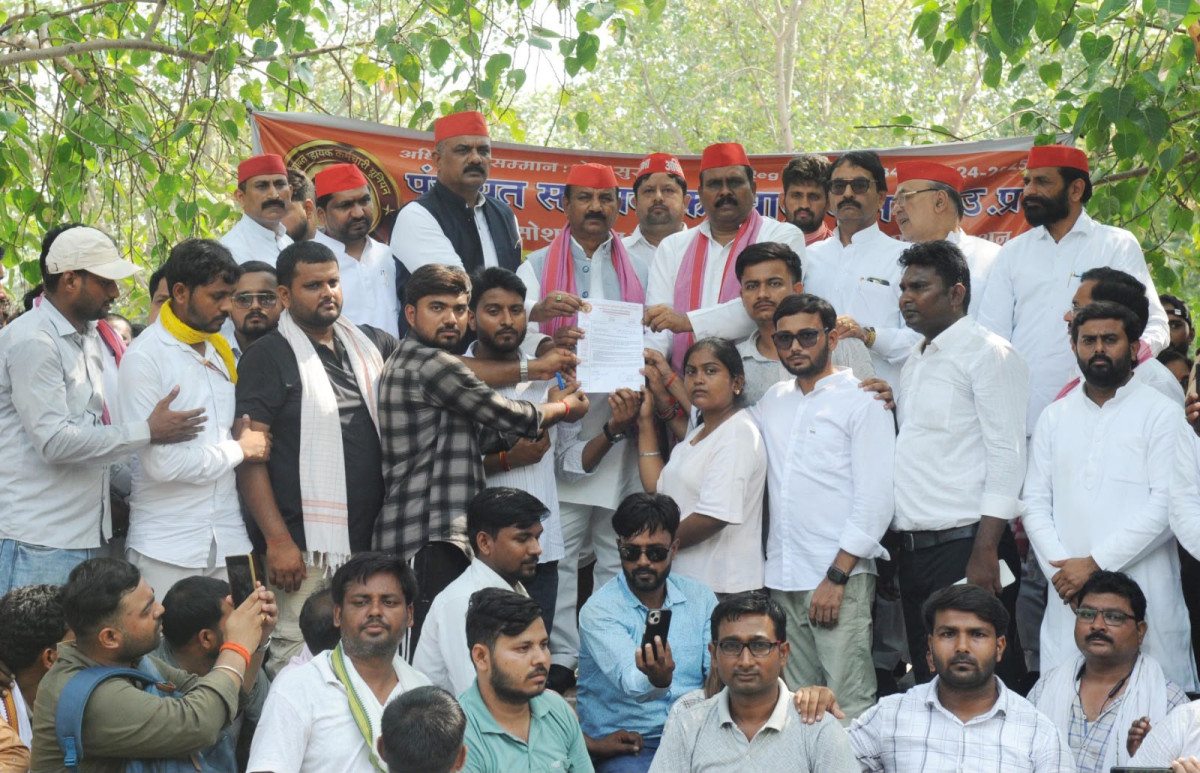
File image of Samajwadi Party leaders at the panchayat sahayaks' protest at Lucknow. Photo: By arrangement.
A criminal case was also lodged in Lucknow against 18 members of the PSKU and hundreds of other panchayat sahayaks on September 12 on the complaint of a Panchayati Raj department official for allegedly threatening officials and obstructing their work and shouting anti-government slogans. PKSU president Brijesh Mishra, Satendra (organisation secretary)
Sandeep (secretary), Navneet Gangwar (treasurer) and Puneet Singh (spokesperson) were among those named in the FIR. They were booked for unlawful assembly, rioting, criminal intimidation, extortion and obstructing public servants in discharge of public functions.
According to the FIR, lodged on the complaint of the district Panchayat Raj officer, the official had gone to the Eco Garden on September 11 to resolve the grievances of the protestors but that when he was negotiating with them, PSKU office bearers started shouting anti-government slogans and unanimously declared that they would end the protest only when a written order for a monthly salary of Rs 30,000 was received. The FIR accused them of illegally staging a sit-in for “their unreasonable demands” of salary hike. The official alleged that the PSKU members threatened them, shouted anti-government slogans, obstructed their work, and engaged in shoving and pushing.
The official further alleged that the union employees were forcing panchayat sahayaks to abandon their official duties and engage in social media platforms on their mobile phones to fulfil their demands. The official also alleged that they were misusing their funds by making illegal collections from panchayat sahayaks and compromising the safety of women by creating pressure through the protest.
The Wire called and sent a message to Shivendra Pratap Singh but he did not respond.
Singh said that they would hold a meeting with the PSKU members and continue the sit-in even as they vacated the protest site on September 16.
Panchayat sahayaks have also demanded a 50% horizontal reservation in upcoming recruitments for Village Development Officers (VDO) and Gram Panchayat Officers. Furthermore, they are demanding maternity leave facilities for female workers, alongside a clear transfer and adjustment policy.
This article went live on September seventeenth, two thousand twenty six, at three minutes past two in the afternoon.The Wire is now on WhatsApp. Follow our channel for sharp analysis and opinions on the latest developments.


