

43 Years, 20 Massacred, 1 Conviction: What Became of the Phoolan Devi Case


New Delhi: February 14, 1981. Babuji Singh was too young to remember the details but the faintest memory he retained of that day, when he was barely five years old, fills him with regret.
Dacoits led by bandit leader Phoolan Devi – who later went on to gain iconic status as a backward caste bandit-turned-parliamentarian – dressed in police fatigues had entered the village from the banks of the Yamuna River, which cradles it.
The dacoits, or baaghis (rebels) as they liked to be called, rounded up all the men and held them at gunpoint.
Babuji's father Himmat Singh was holding him, a child barely five years old, when the dacoits asked him how many children he had. When Himmat Singh told them that Babuji was his only son, they told him to let go of the boy. "They spared me because I was his only son. My father dropped me and the only thing I remember is that he told me, ‘Son you go home, I will not be coming back'," said Babuji.
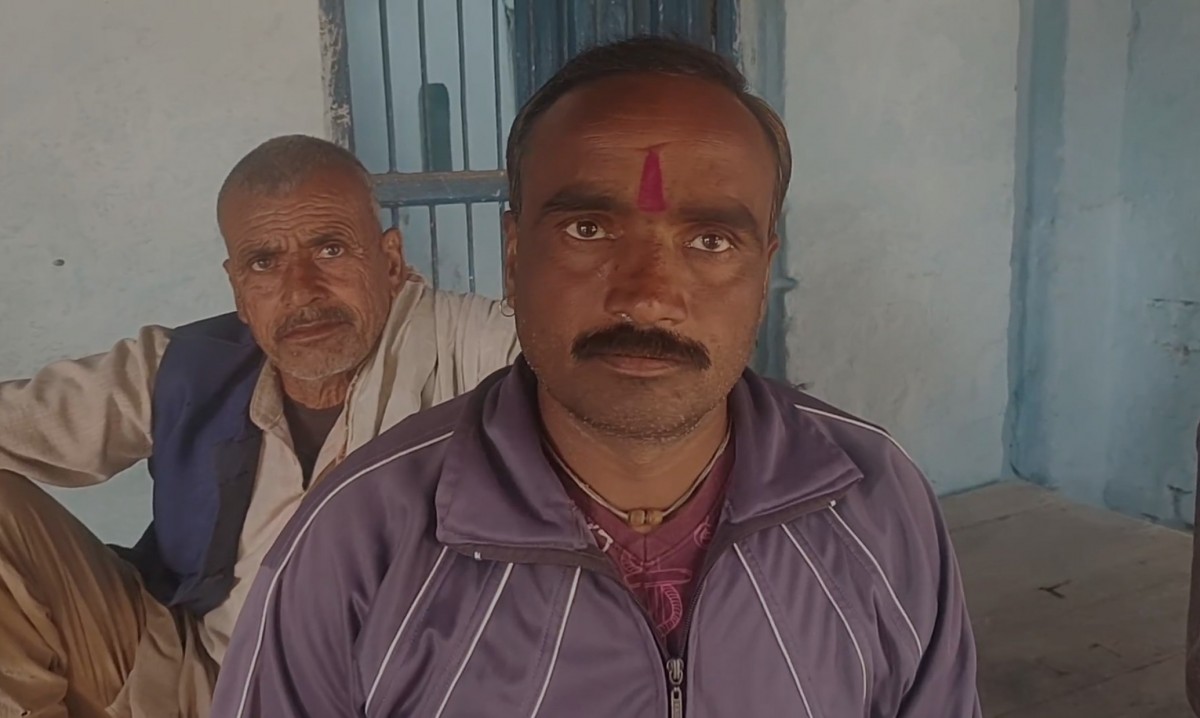
Babuji Singh (Right). Photo: Omar Rashid
Himmat Singh and Babuji’s two cousins were among the 20 villagers who were executed by Phoolan Devi and her gang of bandits in Behmai village, which is today located in Uttar Pradesh's Kanpur Dehat district. His father's death sprung back into Babuji's consciousness not only because February 14, 2024 – Valentine's Day to the world – was the 43rd anniversary of his loss, but also the day when a court in Kanpur Dehat finally pronounced the verdict in the Behmai massacre case.
A special judge (dacoity affected areas) convicted one of the five accused who were chargesheeted in the case. Shyam Babu Kewat, the convicted member of Phoolan Devi's gang, was sentenced to life imprisonment under the charge of murder during dacoity (Section 396 of the Indian Penal Code).
While 35-36 dacoits from four different gangs had been booked for the crime in 1981, eventually, only five faced trial and only two survived to see the verdict. While Shyam Babu, a native of Auraiya, was convicted, another accused Vishwanath alias Putani was acquitted as he got the "benefit of doubt" for being a minor at the time of the crime, said Raju Porwal, district government counsel.
In 2015, a local court ruled that Vishwanath was indeed a minor – 15 years, seven months and 13 days old, to be precise – at the time of the massacre and declared him a "delinquent juvenile."
The popular narrative is that Phoolan stormed the village in search of two Thakur gang leaders who had raped and brutalized her and also shot dead her paramour. She wanted to punish the villagers for providing them shelter.
Local Thakurs, however, contested this version and said that they paid a price for getting caught in the war between backward caste and Thakur dacoit gangs.
Babuji said the delayed verdict – after an excruciatingly long wait of more than four decades – and the conviction of just one of the dozens of accused, was a mockery of justice. "We did not get justice. They have played with us. What use is convicting one person and sentencing him for life after 43 years? What's left in it for us now? Even my mother is dead," Babuji said.
He feels the only way he and other surviving kin of those murdered in Behmai would get solace was if the accused received a death penalty. "He should be hanged. Only then will our atmas get shanti," Babuji told The Wire.
Behmai is nestled in the ravines of the Yamuna valley near Chambal. In the decades where dacoits ruled the ravines, the village, due to its undulated topography, dense overgrowth and access to the river for escape, served as a getaway and safe haven for dacoits. Today, the ravines have been cropped to accommodate pucca roads but the village still struggles without basic amenities. Most of the men serve as migrant workers.
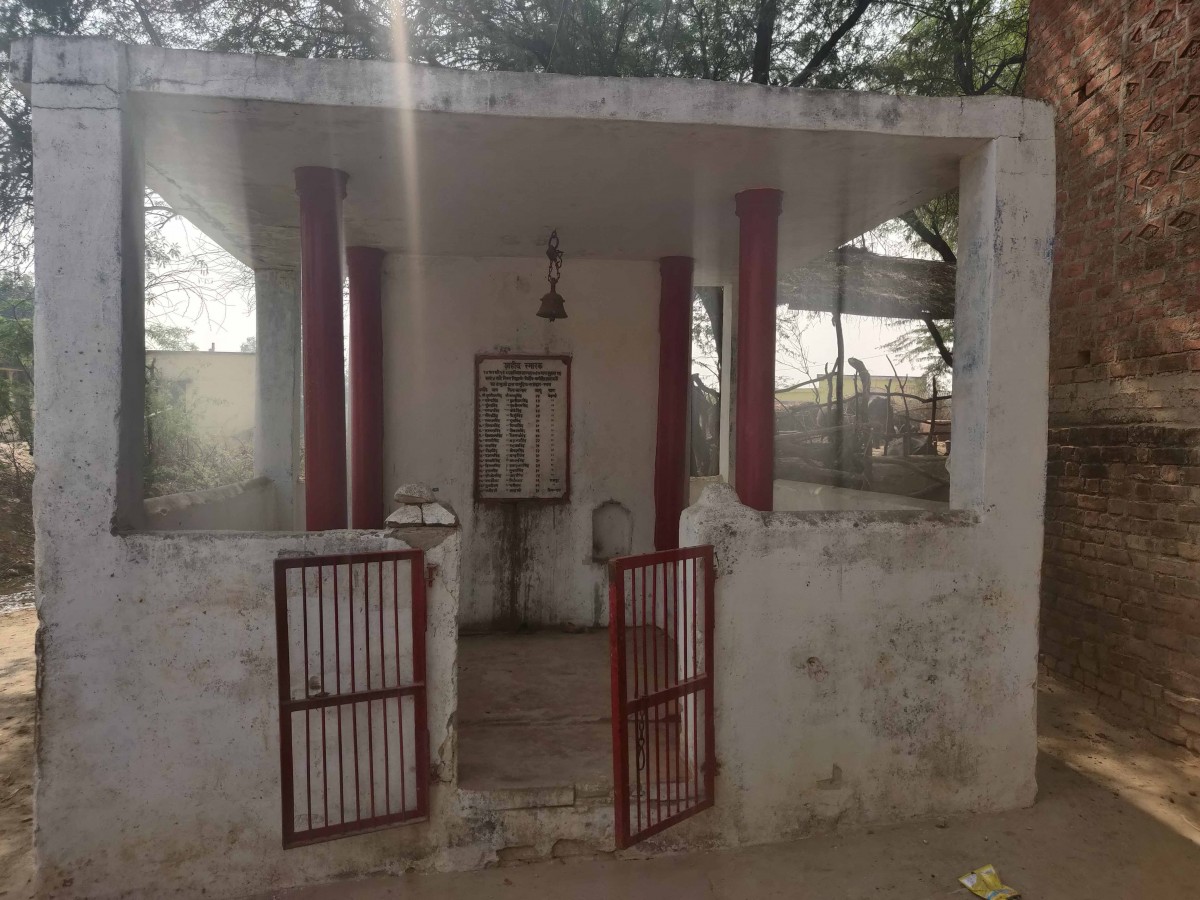
Shahid Smarak. Photo: Omar Rashid
A police outpost and a memorial – Shaheed Smarak – at the entrance of the village is the only remnant of the 1981 incident and those treacherous times. The memorial has the list of all 20 persons who were killed. It refers to them as “unarmed, innocent and noble” men who were killed at 4 pm on February 14, 1981.
All 20 who were killed were men, aged 16-55. Seventeen of them belonged to the Thakur community. Dalit labourers from Rajapur and a Muslim from Sikandara, who were in the village on assignment, were also killed. Six others, including an uncle of Babuji, were injured.
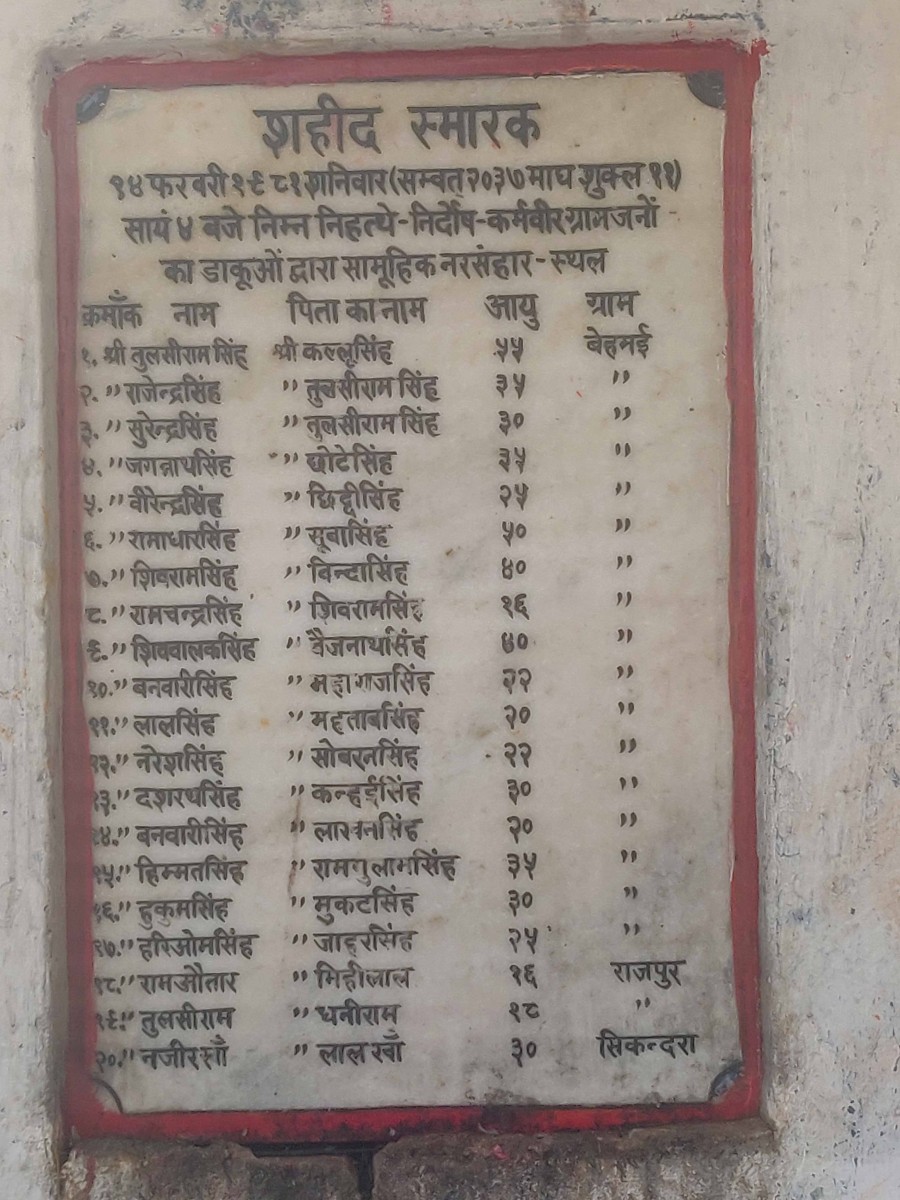
Names on the Shahid Smarak. Photo: Omar Rashid
As one can imagine, the legal case in the crime moved at an agonizingly slow pace, exposing the slow mechanism of grievance redressal in our country, especially in smaller towns away from daily media glare.
The charges against the five surviving accused Maan Singh, Vishwanath, Posa, Ram Ratan and Shyam Babu were framed only in August 2012. The trial started five years after that.
The initial FIR lodged at Sikandara police station, which was then in undivided Kanpur, was lodged against four dacoits including Phoolan Devi and bandit leader Mustaqim, and 36 unnamed others.
Maan Singh, Phoolan's close aide, never appeared before the court despite having charges framed against him and being summoned. A few years ago, the prosecution had even submitted that Maan Singh was running a restaurant in Chaura but never appeared before court. Summons were served to him and, last April, a court even issued a non-bailable warrant against him and gave orders to attach two of his identified properties. But it is suspected that Singh may have passed away in the meantime
Most of the other accused either died or were shot dead by police or rivals over time.
Phoolan had surrendered to the Madhya Pradesh police. After spending 11 years in jails in MP, she was released in 1994 after the Mulayam Singh Yadav government in UP withdrew the cases against her. Phoolan, who belonged to the Nishad OBC riverine community, then went on to win two Lok Sabha elections from Mirzapur in Purvanchal in 1996 and 1999.
A local court, however, set aside the Mulayam Singh government decision. This was upheld by the Allahabad high court as well as the Supreme Court. But before Phoolan Devi could surrender before the trial court to avail any sort of relief, she was murdered outside her official residence in 2001. A Thakur man Sher Singh Rana, who despised her for murdering Thakur men, was later convicted for her murder.
It is widely believed that Phoolan allegedly committed the Behmai massacre to avenge her rape and humiliation in the village by Lala Ram and Sri Ram, two Thakur gang leaders and her rivals who had also shot dead her alleged paramour Vikram Mallah.
The two brothers, like other dacoits, would often frequent Behmai, which was dominated by their caste fellows. Shekhar Kapur’s well-known movie Bandit Queen (1994), which traces Phoolan’s journey, plays out this sequence, albeit in a fictionalised manner. She had herself refuted the narrative and some of the events shown in the movie, and even approached court seeking a ban on the showcasing of the film.
Locals in Behmai refute the revenge for rape theory. “Who can rape a badmaash (dacoit)? One with guns and a gang! It was only after she got fame through the film Bandit Queen that this narrative spread,” said Babuji.
He insists that the Behmai massacre took place as Phoolan suspected that the local Thakurs were providing refuge to her rival Thakur gangs. “Bas badmasho ka vivaad tha (It was all about a dispute between the dacoits),” he said.
This year too, the villagers of Behmai gathered at the Shaheed Smarak at 11 am on February 14 to remember those who were killed in 1981. A second gathering was organized for later in the day in hope that the court would sentence the accused to death. “But the verdict was nothing great. It's just a formality,” said Babuji. “In the last 43 years, the entire country has changed. But Behmai remains the same.”
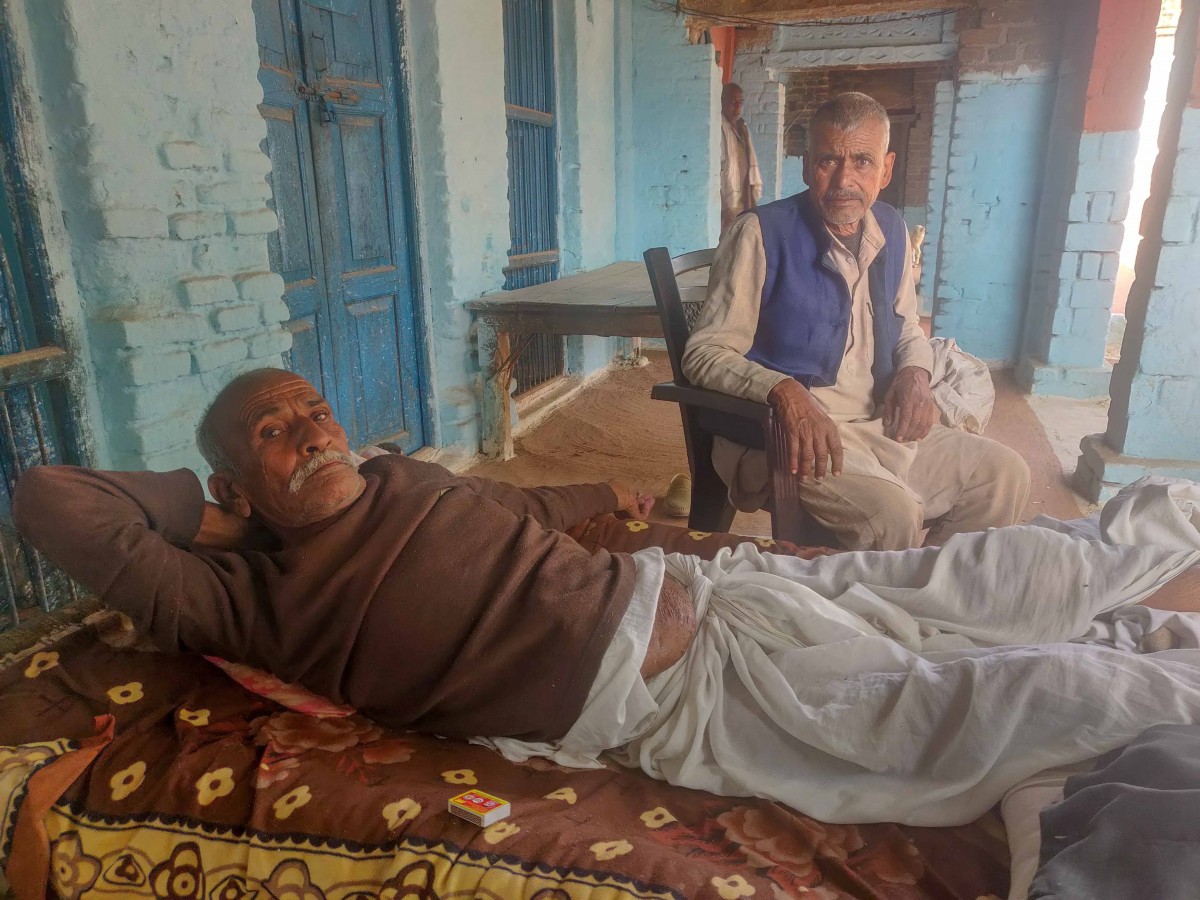
Rajaram Singh, man in brown cardigan, the main plaintiff amd witness in the Behmai massacre. He died in 2020. Photo: Omar Rashid
In 2020, Rajaram Singh, an eyewitness to the massacre and one who led the legal fight for decades, had shared a similar narrative with me when I met him in his house. He did not have any sympathy for Phoolan and claimed that dacoits shot the villagers because some of them had acted as informants for the police. He also dismissed the rape theory. Rajaram lost seven relatives, including his brother Banwari Singh on February 14, 1981. In January 2020, a special court (dacoity) fixed a date for pronouncing the verdict, igniting a hope for justice in him. But the verdict was deferred on grounds that the original case diary was curiously found missing in the court records.
Rajaram was returning from the fields when he spotted the dacoits storming the village. To save his life, he hid in the bushes and witnessed the bloodshed from there."She [Phoolan] shouted Jai Kali Mai ki and the badmash started firing,” Rajaram told me in December 2020, as he recounted the incident.
Rajaram died later in the same month, less than two weeks after we last met, with his quest for justice unfulfilled. In October 2021, Jantar Singh, the last surviving witness in the case, also died in his seventies.
Following that, Babuji took over as the plaintiff in the case.
Porwal said Shyam Babu was convicted after the prosecution proved in court the “entire circumstances” of the incident. The conviction was also based on the identification parade of the accused carried out in different jails following the incident and on statements of the surviving witnesses, said Porwal. A detailed order of the verdict is not yet accessible. A key question in everyone’s mind is what does the court say on the role of Phoolan Devi and the motivation behind the crime, known to us as the Behmai massacre.
This article went live on February seventeenth, two thousand twenty four, at zero minutes past eight in the morning.The Wire is now on WhatsApp. Follow our channel for sharp analysis and opinions on the latest developments.


