

A Year After Military's Massacre in Nagaland, Focus Turns to the Supreme Court


Last week marked the one-year anniversary of the indiscriminate shooting of civilians by Indian armed forces personnel in Mon, Nagaland. Indian military special forces ambushed and killed a group of civilians on their way home from work. Following the incident, more civilians were killed indiscriminately, in what we now understand was an attempt by special forces personnel to destroy critical evidence from the crime scene.
Since the incident, a formal report has been filed by a SIT formed to investigate the case. While the report has not been made public, it has been reported that the SIT report concluded that armed forces personnel shot and killed six civilians on purpose during a military operation. The State Police of Nagaland filed a suo-moto FIR following the incident. The personnel involved in this case have been charged with murder, destruction of evidence and criminal conspiracy. The Indian military justified their actions by claiming that the personnel mistook civilians for militants.
Shortly after the incident, I wrote a column in which I expressed concern that the Union government would use Armed Forces (Special Powers) Act's legal provisions to shield the accused personnel from prosecution. I also argued that the investigation could not be entrusted to the military, which has a shady track record of investigating allegations of human rights violations committed by its personnel. As I mentioned in my previous column, AFSPA is a controversial legislation that the Union government uses to deploy armed forces personnel within the country's states. Its provisions grant immunity to personnel accused of human rights violations such as sexual assault, torture and murder. Several human rights organisations and international bodies have advocated for the repeal of AFSPA in light of these concerns. The demand to repeal and revise AFSPA was most recently renewed by Belgium and Norway during India's Universal Periodic Review (UPR) before a United Nations working group.
A year after the killings in Nagaland, the concerns I expressed in my column have proven to be correct. According to reports, the Union government has refused to allow the accused personnel to stand trial for the crimes they are accused of committing. The Indian military's internal investigation, on the other hand, appears to have yielded no surprising results. According to reports, the military has yet to make a decision on next steps following the completion of its internal investigation, and the accused personnel are still on active duty.
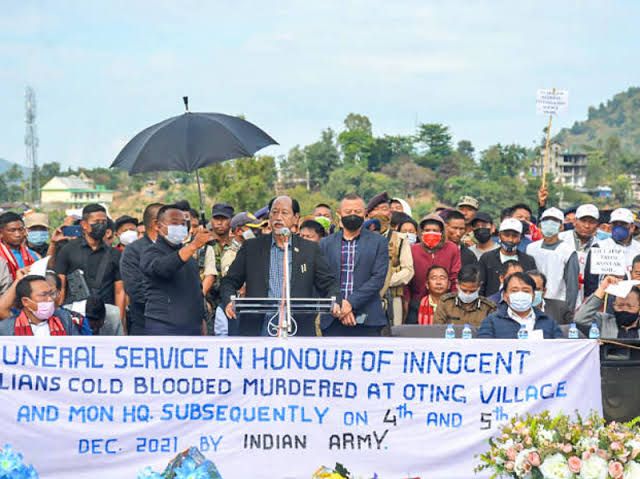
The Nagaland chief minister addressing the victims' families soon after the ambush. Photo: Special arrangement
The refusal of the Union government to grant permission to prosecute the accused personnel has created yet another roadblock to justice for the victims. This refusal was the sole basis upon which the Supreme Court of India decided to stay the FIR and SIT report. While the Supreme Court is still hearing this case (it is scheduled to be heard again in January 2023, according to the Supreme Court registry), I believe the Supreme Court made a grave error in deciding to stay these reports, which form a critical basis for prosecuting the accused personnel.
The decision of the Supreme Court will have an impact on the State's ability to hold these personnel accountable under the law. It is critical to remember that the State of Nagaland's evidence against the accused personnel is substantial. According to news reports based on an analysis of the SIT report, post mortem reports of victims revealed that the accused personnel shot at victims from close range, with some victims receiving fatal gunshot wounds to the heads. The SIT report is supported by eyewitness accounts and forensic evidence, and it appears to prove that the personnel committed serious human rights violations, which are crimes under Indian law. To be clear, this is not a case in which the prosecution tells a fictional story in which the Indian military commits actions for which it is not responsible. These are serious allegations that, under normal circumstances, would result in a successful prosecution.
Also read: Nagaland Killings: English Newspaper Editorials Slam AFSPA, Question Army's 'Logic'
In cases like these, it is critical that the Supreme Court balances the victims' families' concerns with any allegations made by the accused personnel using established human rights principles. For far too long, the judiciary has often stood by and watched as serious allegations of this nature were swept under the rug. A year after the brutal killing of civilians in Nagaland, the onus is now on the Indian Supreme Court to ensure that the victims and their families receive justice.
Jade Lyngdoh is currently at National Law University, Jodhpur, where he has been a Meta India Tech Scholar (2021-22). He is interested in the intersection of technology law and policy and human rights. The views expressed by the author are personal.
This article went live on December twelfth, two thousand twenty two, at thirty minutes past one in the afternoon.The Wire is now on WhatsApp. Follow our channel for sharp analysis and opinions on the latest developments.


