

Justice Chanda’s Recusal in Mamata-Nandigram Case – Right Decision, But for the Wrong Reason


During a hearing in the Calcutta high court last month on her petition challenging Suvendu Adhikari’s win in the recently concluded Vidhan Sabha elections, West Bengal chief minister Mamata Banerjee sought the recusal of Justice Kaushik Chanda. Though the judge recused himself from the case through an order pronounced on July 7 – thereby upholding the rule of law and the administration of justice – we believe the reasoning given is fallacious and contradictory to established principles.
Banerjee alleged that there is likelihood of bias on the part of Justice Chanda for two reasons: first, that he had been an active member of the BJP and second, that she had conveyed her reservations on confirming him as a permanent judge of the Calcutta high court.
The impartiality of judges is the cornerstone of a fair judicial process. It is an important part of rule against personal bias, affirming the principles of natural justice. The first principle of personal bias is that if the judge is a party to a litigation or has some interest in the dispute, then it will be deemed to be sitting as a judge in his own cause. In such a case, the mere fact of his presence will be sufficient to cause his automatic disqualification. However, in the Indian judicial system, there is no provision for removing a judge from a case on likelihood of bias. A judge can only recuse himself in such cases.
Second, ‘justice should not only be done but manifestly be seen to be done.’ It is the duty of the judge to remove every sense of injustice and possibility of appearance of bias from the minds of the parties. Non-recusal of judges in cases where there is an allegation or apprehension of bias will diminish public confidence in the judiciary system.
Judicial bias
In India, the courts have laid down some principles on recusal of judges in cases indicating bias. In Ranjit Thakur v. Union of India, the appellant made a representation of ill treatment against his commanding officer. The commanding officer conducted the trial of the appellant and sentenced him to punishment under Section 80 of the Army Act. On appeal to the Supreme Court, it was contended that the commanding officer was not biased in his mind and delivered an unbiased judgment.
Justice Venkatchaliah laid down the test of real likelihood of bias where the relevant factor is the reasonableness of bias in the mind of parties rather than the judge asking himself, ‘Am I biased?’ Moreover, mere likelihood of biasness is sufficient to request recusal as held by the court in Ashok Kumar Yadav v. State of Haryana.
In the present case, Mamata Banerjee’s allegation had been affirmed by BJP officials (through their Twitter accounts) that Justice Chanda had been an active member of the party. This fact is important as the matter at hand is not only limited to Mamata Banerjee and Suvendu Adhikari but is a dispute between two parties, i.e. BJP and TMC.
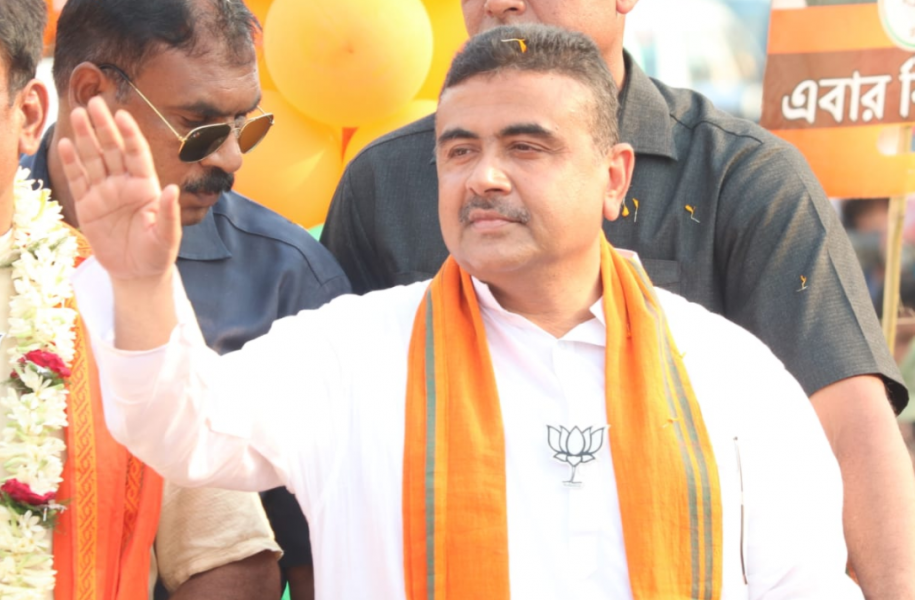
Suvendu Adhikari. Photo: Twitter/@SuvenduWB
Following the Ranjit Thakur judgment, it is irrelevant if Justice Chanda believed that he could have remained impartial because the foremost consideration should be that there is a reasonable apprehension of bias in the mind of reasonable person as he has been associated with the BJP and represented the party as a lawyer in the past.
In his order of July 7, Justice Chanda took note of this principle (para. 16). However, he examined the bias from the perspective of a judge rather than a reasonable man, which is contradictory to what he initially opined. He said: “A lawyer’s mind is trained not to identify himself with his client and at the same time be loyal to his duty towards his client. When a lawyer moves from bar to bench, he carries with him the same sense of detachment already in-built in him.”
After perusal of the quoted remarks, it is reasonable to interpret that the judge is examining bias not from the perspective of a reasonable man but from a qualified lawyer’s/judge’s perspective. However, the concerned party did not question the integrity of the judge but only asked to remove any apprehensions.
In Supreme Court Advocates on Record Association v. Union of India (NJAC case), recusal of Justice Khehar was asked for since he was an active member of the collegium at that point in time and the dispute in question pertained to substitution of the collegium system with the National Judicial Appointments Commission. Even though Justice Khehar refused to recuse and other judges gave primacy to his opinion, this case gave interesting observations with regards to judges’ recusal in some unavoidable circumstances.
Also read: A New Custodian in the Supreme Court: A Hope for India’s Broken Democracy?
We refer to the opinion of Justice Kurian (para. 68-69), where he remarked that in cases where there exists a pecuniary interest, affinity or adversity with the parties in the case, or some direct or indirect interest in the outcome of litigation, the judge ought to recuse himself from the adjudication since his presence will have a substantial bearing on the fairness of the outcome. Apart from ruling in this case, there have been certain instances where a judge has recused himself on minor interests in matters like Justice U.U. Lalit recusing himself from the Babri case, as he had appeared in a related criminal case.
In the instant case, the judge remarked that “the past association of a judge with a political party by itself cannot form apprehension of bias.” However, as explained earlier, Justice Chanda was an active member of the BJP by serving as its lawyer until 2016. Since he was actively furthering the interests of the BJP as a lawyer, he could be reasonably presumed to be politically skewed rather than politically inclined, as remarked by him in the judgment. Therefore, we argue that justice Chanda holds a major interest in the instant case and he made a right decision to recuse himself but for the wrong reasons.
Furthermore, we also believe that Justice Chanda possesses a personal bias against Mamata Bannerjee since she had previously opposed his appointment as permanent judge. On this issue, the court in, Kumaon Mandal Vikas Nigam Ltd. (2001), held that a real possibility of bias might arise if there is a possible animosity between the judge and any party involved in the case.
In this case, the managing director of a firm was hostile towards the appellant (because of his impeccable career trajectory) and a relative of the managing director was made the inquiry officer. It was alleged that since a fair opportunity of being heard was not awarded to the appellant, the termination of employment of the appellant was illegal. Applying this case to the present situation, there is a visible animosity between the judge and Mamata Banerjee given that she has publicly opposed his appointment and there is a possibility that the judge might use this case as a form of retribution.
Justice Chanda’s reasoning that “It is ludicrous to believe that the petitioner would expect a favourable order from a judge whose appointment she has consented to and vice versa” is inaccurate because the chief minister not only refused his appointment as a permanent judge, but also expressed her disapproval publicly, which is the main contention of the petitioner. The chief minister of a state only has a minuscule role to play in the appointment of a high court judge.
The argument advanced by Justice Chanda does not hold merit as the issue raised by Mamata Banerjee was not only that he might be biased because she had resisted his judgeship but that she had attacked him in public. Further, Justice Chanda’s remark itself that ‘most’ (not all) of the judges would be disqualified to hear the case as Mamata Banerjee had either objected to or gave consent to appointment of most judges proves that an unbiased judge may be appointed. It is reasonable to deduce from the history between Mamata Banerjee and Justice Chanda that a judge with considerably less conflict can be appointed. Given that the judge expressed his disappointment against media trials and public vilification in the judgment, he might also be perturbed by the public disapproval of his appointment and thus, might be biased.
Also read: Restoring Public Trust In the Indian Judiciary Calls for More Scrutiny, Not Less
In the proceedings held on June 24 on this matter, the judge expressed his reservation on recusal and asserted that “there is a media trial already ongoing before this issue came up before court. Hundreds of tweets have already been posted saying he should recuse. If I recuse now, will I be giving in to this media trial?” However, in the judgment delivered by him on July 7, he remarked that “since the two persons involved in this case belong to the highest echelon of state politics, in the name of saving the judiciary, some opportunists have already emerged. These trouble-mongers will try to keep the controversy alive and create newer controversies. The trial of the case before this bench will be a tool to aggrandise themselves. It would be contrary to the interest of justice if such [an] unwarranted squabble continues along with the trial of the case, and such attempts should be thwarted at the threshold.”
This reasoning is contradictory to his remarks made earlier on June 24 as he is recusing himself in light of the controversy in this case, rather than an apprehension of bias present against him. The judge’s consideration for recusal must be administration of justice, not the public tweets and disapproval in the surrounding circumstances.
In 2019, Justice Gogoi had refused to recuse himself in the Assam Detention Centre case, despite the fact that being an Ahom from Assam, he had a personal interest in the NRC. Also, Justice Arun Mishra has been at the centre stage of this debate because of his refusal to recuse from cases where he had a direct interest. These two examples had been criticised by academicians and lawyers, even though the judges, unmoved by the public perception, held on to their reasoning. Unlike the aforementioned cases, we appreciate the fact that Justice Chanda had recused himself – even though his reasoning could have been more legally coherent.
The authors are third year, B.A. LL.B. (Hons.) students at National Law School of India University, Bengaluru.
This article went live on July tenth, two thousand twenty one, at zero minutes past nine at night.The Wire is now on WhatsApp. Follow our channel for sharp analysis and opinions on the latest developments.


