

Ghazala Jamil's Occupation With Political Sadness


Ghazala Jamil believes that the idea of violence inevitably leads one to think about history, especially in India, with its history of colonialism and the controversies surrounding the colonial experience. She said she understood the present conundrums in India and elsewhere better when she looked at colonialism as "something which was not a phenomenon of the past that was done and dusted."
Jamil, who is an assistant professor at the Jawaharlal Nehru University, argued that forms of violence resembling those of the colonial period continue to persist, often concealed beneath a veneer of constitutionalism and various other forms of sophistry that obscure the continuity of such violence.
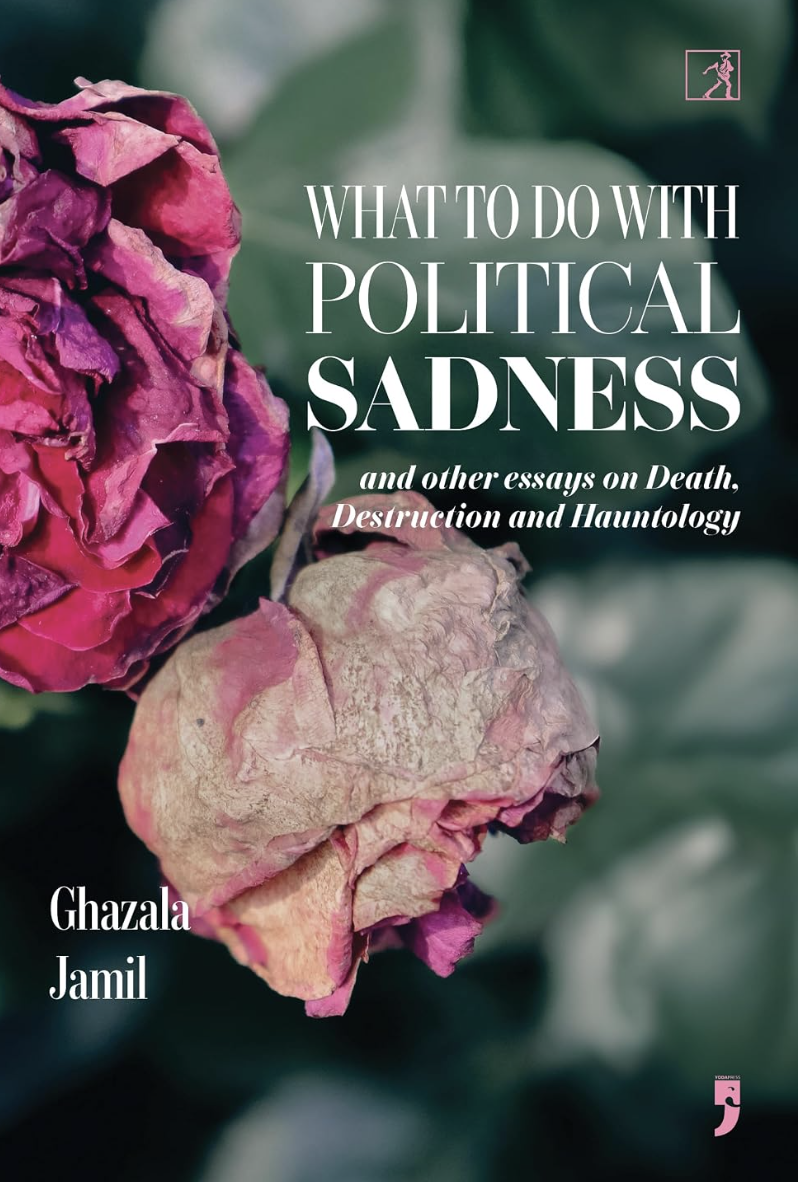
'What to Do with Political Sadness: And other Essays on Death, Destruction and Hauntology' bu Ghazala Jamil.
On September 25, Friday, TheDaak Baithak, a weekly online speaker and book discussion series, organised a discussion on What to Do with Political Sadness: And other essays on Death, Destruction and Hauntology, written by Jamil. The book is a collection of essays exploring the theme of death, violence and destruction.
The idea behind the book
One of the most important things Jamil wanted to understand was the idea that “discursivity and discursive nuances do not stop the violence.” Through her essays, she attempts to explore connections between different phenomenon and convey them to people who may have experienced or observed them but do not have access to the vocabulary to articulate them.
She has tried to write a book that is accessible to non-academic readers as well. The essays reflect her observations and the connections she has drawn, rather than attempting a comprehensive investigation into a singular subject.
Jamil also reflects on her time as a PhD scholar and recalled her supervisor's words, which gave her the confidence to write the book. Her supervisor said,
“Ideas are not really products of your gray cells or brain matter. Ideas are products of their own time. It’s the moment in history that throws up a certain idea and anybody who catches those ideas, writes them up, commits them to ink and paper, it becomes their ideas.”
She further said the prevalent notions of originality and individual ownership of ideas are, in her view, inventions of capitalist times. In that sense, she suggested, the ideas in the book belong to everybody.
The political economy of culture
While looking at the political economy of culture, Jamil became interested in how human rights regimes and international law often treated culture and cultural rights as a "sideshow." In her observations, however, cultural rights were at the root of some of the most prominent and devastating disputes of our times.
This concern with sophistry and the ways in which things are obscured led her to pay particular attention to the gap between violence and discourse.
She illustrated this through the discourse surrounding the rights of marginalised and indigenous people in democracies, particularly in postcolonial contexts.
Jamil explained that these discourses have become increasingly nuanced and powerful over time. However, she questioned their effectiveness in addressing actual violence and abject conditions.
She cited feminist discourse as an example, observing that people can increasingly be called out for sexist or patriarchal statements. However, when attention is turned to the violence against women that continues to exist in society, she suggested that the picture is less encouraging. In her view, violence against women has arguably increased rather than decreased over the past half-century.
During the session, Jamil also shared her academic journey from studying science to pursuing social work. She explained that training in social work differs from disciplinary training in other social sciences, as it focuses more on intervening in the social world.
Her book, she said, is an attempt to look for resources that can help understand the violence embedded in various phenomena witnessed in recent times.
Why political sadness?
One of the discussants asked Jamil about her choice of the word “sadness” in the book's title:
“Why not grief? Why sadness? And is it just the semantics? Is it just a choice of word or were you thinking closely about the analytical category here?"
Jamil explained that what particularly appealed to her about the word “sadness” was that it was not a technical term, but rather an everyday expression that psychologists might perhaps not take as seriously.
She said there were other ways to think about the choice, but that “grief” felt more overwhelming to her, something that could stop a person from doing anything. She also wanted to distinguish political sadness from clinical depression, which can make it difficult for people experiencing it to continue with their everyday lives.
One reader shared how it was one of the best books they had read in a while, saying they could not put it down as the thoughts flowed like a stream of consciousness.
Tamanna Kaul is a student at the Campus Law Centre and was an editorial intern at The Wire.
This article went live on October second, two thousand twenty six, at thirty-two minutes past one in the afternoon.The Wire is now on WhatsApp. Follow our channel for sharp analysis and opinions on the latest developments.


