

Slow News Day? Invent a Fatwa. Here's How ANI Did It.


“Darul-Uloom Deoband has issued a fatwa against Muslim women using nail polish as it is un-Islamic and illegal.”
This tweet by ANI on morning of November 5 kept news rooms and social media busy throughout the day ridiculing this latest fatwa. What are these fatwas all about? How do they come up every now and then providing a sensational story to the media? Alt News decided to dig deeper and uncovered a shocking tale of how news is manufactured. Lets take you with us on a fatwa trail.
Saharanpur: "Darul-Uloom Deoband has issued fatwa against Muslim women using nail polish because it is un-Islamic and illegal . Rather women should use mehendi on their nails,"Mufti Ishrar Gaura, Darul-Uloom Deoband (4.11) pic.twitter.com/u6TnE8ADy7
— ANI UP (@ANINewsUP) November 5, 2018
A misleading Quote
Soon after the tweet by ANI, social media users called out the bluff saying that the man in the picture is neither a mufti (a religious scholar authorised to issue fatwa/opinion on topics related to Islam) nor connected in any way to Darul-Uloom Deoband.
Fatwa did not say Nail Polish is Un-Islamic
So the identity of the person in the ANI tweet was corrected but this still left us with the open question as to where is the fatwa issued by Darul-Uloom? Has anyone seen it? Does it actually say that using nail polish is un-Islamic and illegal as claimed in the ANI tweet?
Darul-Uloom has an online service where anyone can ask a question and get fatwa or opinion from the mufti about it. This particular fatwa could not be found online and this pointed us to the possibility that either it didn’t exist or it could have been asked in writing by an individual.
Alt News contacted ANI again, this time to ask for a copy of the fatwa after which ANI uploaded it online to their website. The new tweet was worded differently from the original one. The fatwa against “Muslim women wearing nail polish” had now become a fatwa against “women and men of the community proffering Namaz or prayer, wearing nail polish”.
Darul Uloom Deoband, one of the most respected Muslim seminaries in India, has issued a fatwa or a decree, against women and men of the community proferring Namaz or prayer, wearing nail polish
Read @ANI Story | https://t.co/iTxtDFrE4spic.twitter.com/zYYQwWJGWl
— ANI Digital (@ani_digital) November 6, 2018
The official definition of fatwa is a non-binding, yet authoritative legal opinion given by a mufti (legal scholar) in response to a question posed by an individual or a court of law. In this specific case, the question posed was, “Is it permissible to apply nail polish? Many women apply nail polish when they go to parties and weddings. A lot of women apply nail polish and grow their nails. Is it permissible for men and women to grow nails and apply nail polish?” (translated)
The name of the person requesting this opinion is Mohammed Tufail from Muzaffarnagar. The response given was “Yes, they can apply nail polish provided it doesn’t contain any impure material. Moreover, since the act of applying nail polish creates a layer, till the time it is not cleaned, water doesn’t reach the nail. Unless it is removed, neither Wuzu (ablution before Namaz) nor Ghusl (ritual washing of the body) can be completed. That is why it is necessary to remove this layer prior to Wuzu or Ghusl. Men and women can grow nails up to 40 days and after that you have to cut the nails.” (translated)
The fatwa doesn’t term nail polish as un-Islamic or illegal as claimed in ANI’s tweet.
Also Read: The Amritsar Train Accident and the BJP 'Witness' Who Wasn't
The title of ANI’s online story was amended accordingly from “New Fatwa: Don’t wear nail polish” to “Fatwa against wearing nail polish during Namaz”. The revised ANI article carried comments of Qari Syed Ishaq Gaura with corrections of his name and relationship to Darul-Uloom.
A Manufactured Story
After we confirmed that the fatwa exists, we sought an answer to the critical question – how did ETV get hold of a fatwa that was not in public domain? The fatwa is handwritten and not uploaded on the website. If it was a clarification sought by an individual, how did it get to the media? This is where the story gets murkier.
Alt News decided to contact the person who had asked for Darul-Uloom’s opinion on the issue. The fatwa mentioned his name as Mohammed Tufail and provided his phone number too. However, upon looking up the number on Truecaller, the number look-up service suggested that the name was Tasleem Qureshi.
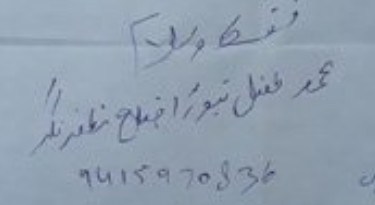
When Alt News called the number, it was answered by a person called Tasleem Qureshi. During the course of the conversation, we discovered that Qureshi is associated with Eenadu / ETV Urdu and he had asked for the fatwa in the name of his relative so that he could do a story on it. Since he can’t approach Darul-Uloom as a journalist, he poses questions to them in a relative’s name, acting as a common Muslim seeking their advice on a matter. You can find links to his other fatwa stories on his YouTube channel and Instagram account – from fatwas about whether women could go to the market for putting mehendi to whether women could wax. The person being asked an opinion in his videos on these fatwas also appears in the photos of his Instagram account.
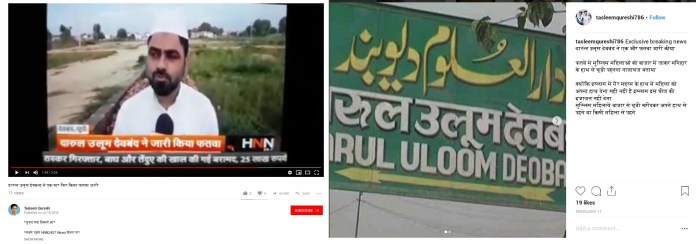
When we questioned Qureshi about his actions, “I’m a journalist.” Qureshi told Alt News. “Is there any rule forbidding me from asking for a fatwa? Am I not a Muslim?” he asked. The point about journalistic ethics was totally lost on him. He insisted that ANI had misreported his story.
Also Read: 2017's Top Fake News Stories Circulated by the Indian Media
A fatwa always makes a great story and offers the opportunity to keep the focus of the nation on religion. A journalist in Saharanpur has figured this out and requests for fatwas in the name of others, so he can write a story. The story is eagerly picked up by news agencies and splashed all over the media with a sensational headline – “Breaking: New fatwa against Muslim women wearing nail polish". None of the editors across all the media houses that reported this story wondered how the personal communication in form of a hand-written letter between an individual and a seminary had become public information and who was behind it.
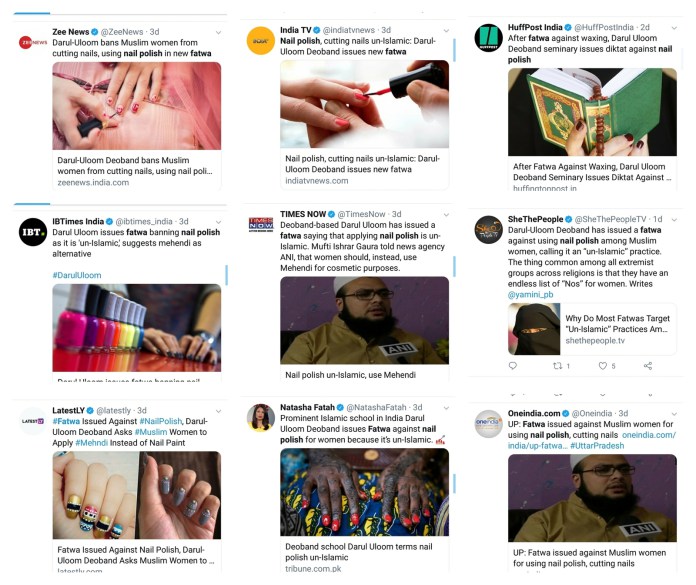
This is how the story about this fatwa got manufactured. This is not the first such story, nor will it be the last. As long as such stories make headlines and have an eager audience, they will continue to thrive.
This article originally appeared on Alt News. You can read the original article here.
The Wire is now on WhatsApp. Follow our channel for sharp analysis and opinions on the latest developments.


