

Kerala Police File FIR Against Journalists, Activists Who Gathered to Protest Crackdown on Media


Mumbai: On September 13, a group of journalists, activists and advocates gathered in Kochi, Kerala, to voice their concerns about the increasing crackdown on journalists and their arbitrary arrests. The meeting was organised as part of an ongoing campaign to demand the release of 26-year-old Kerala-based journalist Rejaz M. Sheeba Sydeek, who was arrested by the Maharashtra Anti-Terrorism Squad (ATS) on May 7.
However, shortly after the meeting, the Kerala Police took the very actions the group had been protesting against, registering a case against the event’s organisers and speakers.
Despite having proper permission to hold a public event, the Kochi Police booked them under several sections of the Bharatiya Nyaya Sanhita (BNS) and the Kerala Police Act for “unlawful assembly” and “for obstructing police from performing their duties”. The most peculiar of all the charges, however, is that of “threatening, obstructing, or assaulting a police officer with the clear intention to prevent them from performing their duties” – a claim that the organisers have explicitly denied.
Those named in the FIR are journalists Siddique Kappan, Ambika, Baburaj Bhagavathy and Mrudula Bhavani; activists Niharika Pradaush, Dr. Hari, Shaneer, C.P. Rasheed, Sajid Khalid, V.M. Faisal; and advocate Pramod Puzhangara.
Kappan, a Kerala-based journalist, was previously arrested by the Uttar Pradesh Police in 2020 while on his way to Hathras to cover a Dalit girl’s rape and murder. He spent nearly two years in jail before being released in 2022 on conditional bail. He was one of the keynote speakers at the event.
Pradaush, one of the organisers, told The Wire that they had followed the standard procedure of applying for permission from the municipal corporation. “This was not the first time we were organising a public event. We followed the usual process and informed the corporation that a small gathering of about 30-40 people was expected at Vanchi Square,” she said. However, by the time the event began, over 60-70 policemen surrounded the venue, Pradaush claimed. “They began obstructing the attendees,” she added.
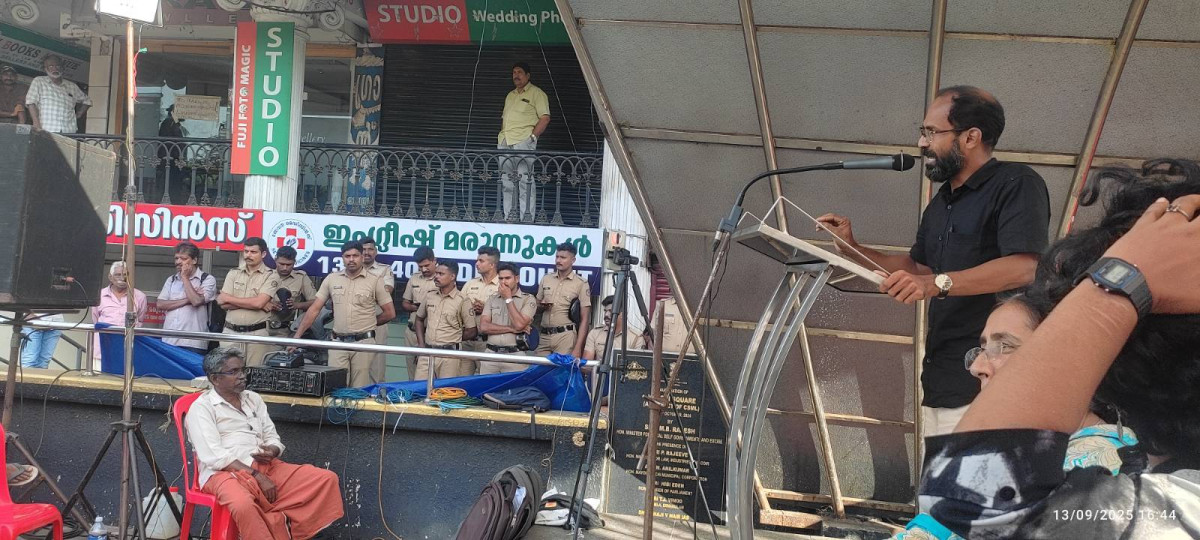
Siddique Kappan speaking at the gathering. Photo: Mrudula Bhavani
In his speech, Kappan said that due to health issues, he had considered dropping out of the event, but upon reading a news report about pro-BJP activist Martin Menachery’s complaint against him, he decided to attend. Pradaush said that Menachery had been writing to the collector and other government officials to have Kappan’s bail cancelled. “The bail was granted by the Supreme Court, but Menachery has been writing baseless things and called Siddique a terrorist,” Pradaush told The Wire.
Another speaker, Mrudula Bhavani, who is also named in the FIR, said her decision to attend the event stemmed from a deep concern over the state of journalism in the country. “Journalists coming together to demand the release of a fellow journalist booked under the UAPA is a normal reaction to such an arrest. Only through the collective efforts of journalists can such cases be countered. In this solidarity meeting, journalists spoke alongside activists and political leaders. Standing up for Rejaz is also standing up for the kind of journalism he pursued,” she said.
Bhavani says that although the FIR is based on flimsy grounds, the Kerala government is sending a loud and clear message: “You can’t speak up for the wrongs happening to Muslims. Rejaz is clearly targeted for his identity, and we pointed that out in our speeches. He had been reporting on the state agencies’ crackdown on Muslim and other marginalised communities, among other issues.”
The Maharashtra ATS has made several claims in their remand applications, alleging associations with the banned CPI (Maoist) group and support for the Kashmiri separatist movement. “The case might not even withstand the scrutiny of a court. But can we let him languish in jail until then?” she asked.
Ambika, a senior journalist and activist also named in the FIR, is no stranger to such police actions. She has been booked in 12 other cases, most initiated by right-leaning activists in the state. “There are around 12 cases against me, many of them for my activism,” Ambika said. She noted that even months after Rejaz’s arrest, there has not been large-scale mobilisation demanding his release. “We had gathered to raise this concern, and the police registered a case against us. Kerala is sadly becoming a state where one can’t protest any more,” she told The Wire.
Ambika said the attitude of both the Kerala government and civil society was no different when Kappan was arrested. Most protests, she points out, were organised outside Kerala. “We are seeing the same attitude repeated with Rejaz,” she said.
Just weeks before Rejaz’s arrest, he and other young journalists had organised a pro-Palestine protest in Kochi. At the protest, only a handful of people had gathered, holding posters. The police booked them all for “rioting”.
Baburaj Bhagavathy, a senior journalist also named in the FIR, said the Kerala government has increasingly become averse to any form of dissent. He recalls a case during the anti-Citizenship (Amendment) Act protests, where several activists and journalists were booked. “Journalists, activists and people from marginalised identities have all been viewed with suspicion. The Kerala Police have time and again proven that they are anti-people,” he said.
This article went live on September sixteenth, two thousand twenty five, at six minutes past four in the afternoon.The Wire is now on WhatsApp. Follow our channel for sharp analysis and opinions on the latest developments.


