
Catalan Election Will Fail to Resolve Political Crisis, Says Poll
Sonya Dowsett


Real journalism holds power accountable
Since 2015, The Wire has done just that.
But we can continue only with your support.
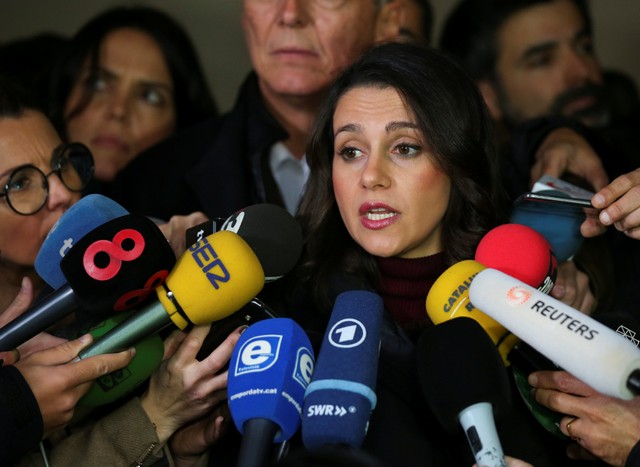
Ciudiadanos party leader in Catalonia, Ines Arrimadas, speaks to journalists during a campaign stop in Figueres, Spain, December 15, 2017. Credit: Reuters/Albert Gea
Madrid: An election in Catalonia will fail to conclusively resolve a political crisis over an independence drive in the region, the final surveys before the December 21 vote showed on Friday.
The ballot will result in a hung parliament, a Metroscopia poll showed, with parties favouring unity with Spain tipped to gain a maximum of 62 seats and pro-secession factions 63, both short of a majority in the region's 135-seat legislature.
Spain's worst political crisis since its transition to democracy four decades ago erupted in October when Madrid cracked down on an independence referendum it had declared illegal and took control of the wealthy northeastern region.
The standoff has bitterly divided society, has led to a business exodus and tarnished Spain's rosy economic prospects, with the central bank on Friday blaming events in Catalonia for a cut in its growth forecasts for 2018 and 2019.
Both the Metroscopia poll, published in El Pais, and a second survey in another newspaper, La Razon, predicted a record turnout for a Catalan election.
But the vote looks likely to trigger weeks of haggling between different parties to try to form a government.
Former Catalan leader Carles Puigdemont is campaigning from Brussels, where he moved shortly after he was fired by Madrid following a unilateral declaration of independence by the region.
With Friday the last day polls were permitted before the ballot, the El Pais survey – which questioned 3,300 people in Catalonia between December 4 and December 13 – showed his party winning 22 seats.
Pro-unity party Ciudadanos, which has backed the minority central government of Mariano Rajoy's People's Party (PP) in parliamentary votes, will win most seats, closely followed by pro-independence ERC.
But at a maximum of 36 for Ciudadanos and 33 for ERC, both fall far short of the 68 seats needed for a majority.
The survey's inconclusive split between pro-unity and pro-independence parties would leave the regional offshoot of left-wing party Podemos, which supports unity but wants a referendum on independence, as potential kingmaker.
Further muddying the waters, its leader Xavier Domenech favours a left-wing alliance across parties that both back and reject independence.
The La Razon poll, which surveyed 1,000 Catalans also between December 4 and December 13, showed parties in favour of independence winning 66 seats and unity supporters 60, leaving the Catalan Podemos arm with nine.
(Reuters)
This article went live on December sixteenth, two thousand seventeen, at ten minutes past one in the afternoon.The Wire is now on WhatsApp. Follow our channel for sharp analysis and opinions on the latest developments.