

German Coalition Talks Miss Deadline as Parties Remain At Odds


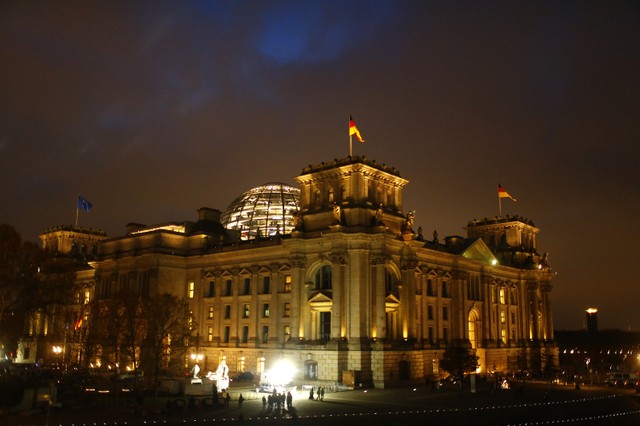
A picture shows the Reichstag building, seat of the German lower house of parliament (Bundestag) during exploratory talks about forming a new coalition government in Berlin, Germany, November 16, 2017. Credit: Reuters/Hannibal Hanschke
Berlin: Chancellor Angela Merkel's efforts to forge a three-way ruling coalition could stretch into the weekend after the parties missed Merkel's Thursday deadline and failed to reach agreement on key issues such as migration and finances.
Merkel's conservatives, the pro-business Free Democrats (FDP) and the environmentalist Greens told reporters around 4 am that they were taking a break of several hours and would resume talks around midday on Friday.
"We still believe that it's worth it to work at it with our full energy," said Peter Tauber, secretary general of Merkel's Christian Democratic Union (CDU). "On the other hand, it's evident that it's difficult."
Wolfgang Kubicki, deputy leader of the FDP, told reporters he was "extremely frustrated" after four weeks of negotiations that have failed to produce an agreement.
"If things stay like this, we won't get any further," Kubicki said. "It's frustrating when you sit together and then you realise that you're right back where you started."
Michael Kellner, a top official with the Greens, said there was much to be done yet. "Nothing is agreed, nothing has been decided," he said.
Merkel had wanted to wrap up exploratory talks on Thursday about the coalition – untested at the national level – but the mood soured soon after the meetings began.
The parties broke off to huddle in their respective caucuses, and party officials traded accusations of blame.
FDP leader Christian Lindner said some progress had been made on digitalisation, Europe and other issues, but the parties remained divided over migration and finances.
Failure to reach agreement on a "Jamaica" coalition, so named because the parties' colours match those of the Caribbean island's flag, could lead to new elections.
That is a scenario none of the negotiating parties wants, given predictions that the far-right Alternative for Germany (AfD) could make further gains after surging into parliament in the September 24 national vote.
A new election could also weigh heavily on the euro.
Merkel could still reach out to her previous coalition partners, the Social Democrats (SPD), but they have vowed to remain in opposition after suffering their worst election result since 1933 in the September elections.
The chancellor is under pressure from her own conservative bloc, particularly the Bavarian CSU sister party, to hold the line on key issues in the talks, especially on migration.
The CSU, worried about losing further ground in a 2018 state election, wants to cap the number of people Germany will accept per year on humanitarian grounds at 200,000, a limit the environmental Greens reject as unconstitutional.
The Greens and CSU are also at odds over the issue of family reunion - the ability of refugees already living in Germany to bring in immediate relatives.
If negotiators agree to a deal, it must still pass muster with lower-ranking party officials. A key test would be a Greens conference on November 25, when the party's rank and file would examine any coalition pact.
(Reuters)
This article went live on November seventeenth, two thousand seventeen, at fifty-seven minutes past twelve at noon.The Wire is now on WhatsApp. Follow our channel for sharp analysis and opinions on the latest developments.


