

Mexico's PRI Allows Party Outsiders to Run for President in 2018


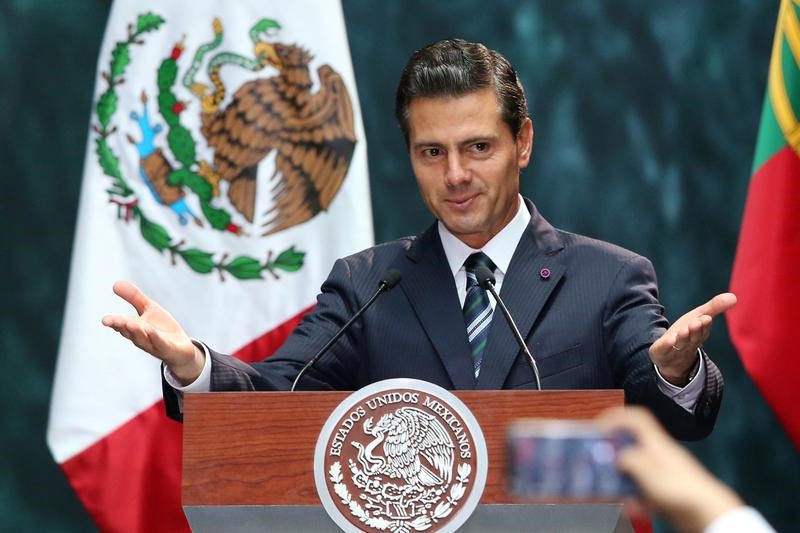
Mexico's President Enrique Pena Nieto gestures as he delivers speech during a welcome ceremony at the National Palace in Mexico City, Mexico July 17, 2017. Credit: Reuters/Edgard Garrido
Mexico City: A move by Mexico's ruling party to allow an outsider to run for president strengthens the hand of beleaguered leader Enrique Pena Nieto, granting him more power to pick his own candidate and opening a path for his finance minister, Jose Antonio Meade.
Mexico's ruling Institutional Revolutionary Party (PRI) loosened its rules on Wednesday, allowing illustrious, non-party figures to lead the party in the 2018 vote and eliminating a requirement for candidates to have been 10-year party members.
A full party ballot on Saturday is likely to enshrine the statute.
Stained by graft, tepid growth and rising violence, the centrist PRI faces an uphill battle to win the election, and party figures concede the new rules may reflect its best chance of retaining the presidency.
The obvious beneficiary is Meade, a soft-spoken civil servant whose lack of PRI membership and ties to the conservative National Action Party (PAN) had barred him from being the party'scandidate.
However, many believe education minister Aurelio Nuno, the president's former chief of staff, also benefits from the removal of the ten-year membership bylaw, despite his assertions on Thursday that he has been a PRI member for 13 years.
Experts say the rule change represents a deft maneuver by the traditionalist Pena Nieto, furnishing him with a better cast of potential candidates, while allowing him to keep PRI presidential hopefuls on their toes.
"The winner is Pena Nieto because he opens the deck, but he doesn't show his cards," said former government intelligence official Gustavo Mohar. "It's a smart play by the PRI and the president."
The PRI, which controlled Mexico with a mix of patronage, authoritarianism and graft for an uninterrupted 71 years until its ouster in 2000, has cast its efforts to allow outsiders as evidence of a sensitive, modernizing party in tune with global democratic trends.
But the change also harks back to the years when PRI presidents, constitutionally shackled by a single six-year term, would personally choose their successor via an opaque process known as the "dedazo," or finger point.
While Mexico's competitive democracy means Pena Nieto cannot choose the next president, the decision to allow outside candidates was seen by some as a similar imposition.
"This confirms that we're going back to the future." Mohar said.
Tough election
Although hurt by his proximity to the unpopular Pena Nieto and criticisms of his time as education minister, which was marked by tough battles with teachers unions, Nuno is more palatable to the PRI rank-and-file than Meade, who has served in two PAN administrations.
Meade is also a possible candidate to replace Banco de Mexico Governor Agustin Carstens when he steps down this year.
Still, with corruption likely to be a hot topic in 2018, the unblemished, technocratic Meade is seen as a solid choice.
"Meade strikes me as very good, a winner," said a PRI senator, speaking on condition of anonymity given party sensitivities over favoring a candidate at this stage. "He would lure PAN voters."
Whoever ends up as the PRI candidate is likely to face the current presidential front-runner, leftist Andres Manuel Lopez Obrador. The PRI is currently polling in third place, well behind Lopez Obrador's National Regeneration Movement (MORENA).
A victory for the nationalist-leaning Lopez Obrador could stoke tensions with the administration of U.S. President Donald Trump, just as the United States, Mexico and Canada seek to seal a renegotiation of the North American Free Trade Agreement.
Mexican diplomatic sources say many in the US government are wary of Lopez Obrador and favor a president close to foreign minister Luis Videgaray, who leads Mexico's NAFTA talks and has a working relationship with Trump's son-in-law and senior adviser, Jared Kushner.
Interior minister Miguel Angel Osorio Chong, a former state governor, polls well as a potential candidate, despite an inability to control spiraling violence, while bookish health minister Jose Narro is among others also being spoken of.
(Reuters)
This article went live on August eleventh, two thousand seventeen, at twenty minutes past twelve at noon.The Wire is now on WhatsApp. Follow our channel for sharp analysis and opinions on the latest developments.


