
Syria: Clashes in Northwest After De-Escalation Zones Takes Effect
Ellen Francis


Real journalism holds power accountable
Since 2015, The Wire has done just that.
But we can continue only with your support.
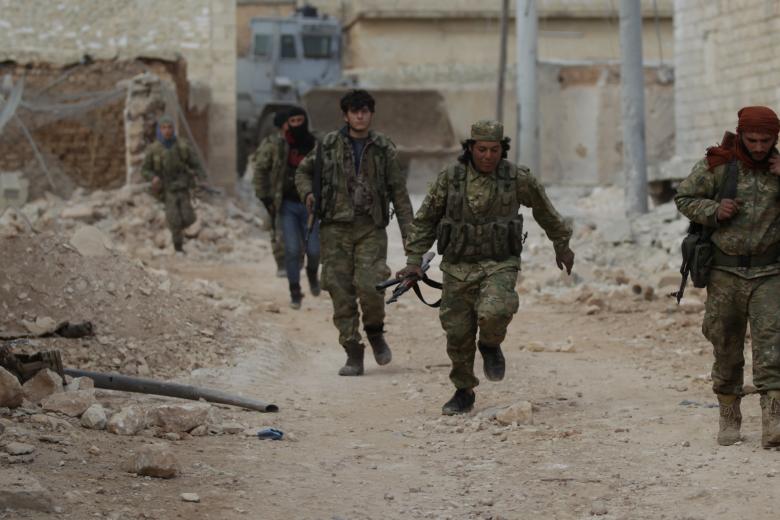
A rebel fighter runs with a weapon on the outskirts of the northern Syrian town of al-Bab, Syria January 26, 2017. Credit: Reuters/Khalil Ashawi
Beirut: Syrian government forces and rebels clashed in the northwestern province of Hama on Friday shortly after a Russian-led deal to establish de-escalation zones took effect, a monitor and a rebel official said.
Fighter jets fired at the rebel-held village of al-Zalakiyat and nearby positions in the Hama countryside, where the combatants exchanged shelling, the Syrian Observatory for Human Rights said.
The Britain-based war monitoring group said government forces shelled the nearby towns of Kafr Zita and Latamneh. There was no immediate comment from the Syrian army.
Mohammed Rasheed, a spokesman for the Jaish al-Nasr rebel group based in Hama, confirmed that fighting had broken out after midnight.
Iran and Turkey agreed on Thursday to a Russian proposal for de-escalation zones in Syria, but the memorandum the three guarantors signed has not been made public, leaving its details unclear.
The zones appear intended to halt conflict in specific areas between government forces and rebels, and would potentially be policed by foreign troops.
The Russian defence ministry had said the agreement would come into force as of midnight on Friday. The first and largest zone in northern Syria includes Idlib province and adjoining districts of Hama, Aleppo and Latakia with a population of over one million, Russian news agencies cited the ministry as saying.
The Syrian government supported the de-escalation plan, but said it would continue to fight what it termed terrorist groups. Rebels rejected the deal and said they would not recognise Iran as a guarantor of any ceasefire plan.
With the help of Russia and Iranian-backed militias, the Syrian government has gained the military upper hand in the six-year conflict. The wide array of rebel groups include some supported by Turkey, the US and Gulf monarchies.
The main Syrian opposition body, the HNC, which includes political and armed groups, denounced the plan earlier as vague. The High Negotiations Committee said the deal "was concluded without the Syrian people" and "lacks the minimum basics of legitimacy".
The deal marks the latest diplomatic effort to quell the fighting. Several truces and agreements have fallen apart during the multi-sided war, in which hundreds of thousands of people have been killed.
(Reuters)
This article went live on May sixth, two thousand seventeen, at twenty-seven minutes past three in the afternoon.The Wire is now on WhatsApp. Follow our channel for sharp analysis and opinions on the latest developments.