

US Raises Pressure on China Over North Korea, South China Sea


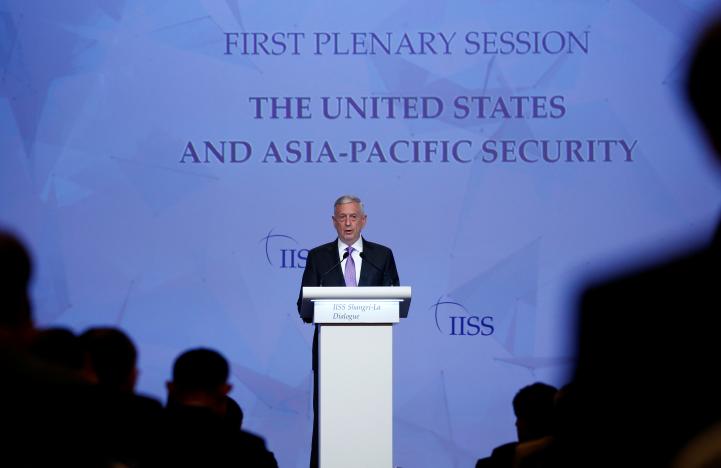
U.S. Secretary of Defense James Mattis speaks at the 16th IISS Shangri-La Dialogue in Singapore June 3, 2017. Credit: Reuters/Edgar Su
Singapore: The US is encouraged by China's efforts to restrain North Korea but Washington will not accept Beijing's militarisation of islands in the South China Sea, US defence secretary Jim Mattis said on Saturday.
The comments by Mattis, during the annual Shangri-La Dialogue, show how US President Donald Trump's administration is looking to balance working with China to restrain North Korea's advancing missile and nuclear programmes while dealing with Beijing's activities in the South China Sea.
Trump has actively courted support from Chinese President Xi Jinping to restrain North Korea, raising concern among Asian allies that Washington might allow China a more free rein elsewhere in the region.
Speaking at the dialogue, Asia's premier security forum, Mattis said the threat from North Korea was "clear and present" and that Pyongyang had increased its pace of pursuing nuclear weapons.
The US has struggled to slow North Korea's nuclear and missile programmes, which have become a security priority given Pyongyang's vow to develop a nuclear-tipped missile capable of hitting the US mainland.
The Trump administration has been pressing China aggressively to rein in its reclusive neighbour, warning all options are on the table if North Korea persists with its weapons programmes.
"The Trump administration is encouraged by China's renewed commitment to work with the international community toward denuclearisation," Mattis said.
"Ultimately, we believe China will come to recognise North Korea as a strategic liability, not an asset."
However, Mattis said seeking China's cooperation on North Korea did not mean Washington would not challenge Beijing's activities in the South China Sea.
"There is a lot more between [China] and the United States than just two issues. We are working with China on North Korea because that is also a problem for China."
The UN Security Council on Friday expanded targeted sanctions against North Korea after its repeated missile tests, adopting the first such resolution agreed by the US and China since Trump took office.
In another sign of increased pressure on North Korea, Japan's navy and air force began a three-day military exercise with two US aircraft carriers in the Sea of Japan on Thursday.
Japanese defence minister Tomomi Inada, speaking at the Singapore forum, said Tokyo backed the US using any option to deal with North Korea, including military strikes, and was seeking a deeper alliance with Washington.
Alliances and South China Sea
Allies around the world have been concerned about the commitment of the US since Trump took office on January 20 because of his 'America First' rhetoric and expectations that he would concentrate on a domestic agenda.
More specifically, Mattis sought to ease concerns for allies in the Asia-Pacific, saying the region was a priority and the primary effort was alliance building. He added, however, that countries must "contribute sufficiently to their own security."
In a sign of the US commitment to the region, Mattis said that soon about 60% of overseas tactical aviation assets would be assigned to the region and he would work with the US Congress on an Asia-Pacific stability initiative.
The Pentagon says it supports "in principle" a proposal by senator John McCain, the head of the US Senate's Armed Services Committee, to increase military funding for the Asia-Pacific by $7.5 billion.
Mattis said the US welcomed China's economic development, but he anticipated "friction" between the two countries.
"While competition between the US and China, the world's two largest economies, is bound to occur, conflict is not inevitable," Mattis said.
While eager to work with China in dealing with North Korea, Mattis said the US did not accept China placing weapons and other military assets on man-made islands in the South ChinaSea.
"We oppose countries militarising artificial islands and enforcing excessive maritime claims," Mattis said. "We cannot and will not accept unilateral, coercive changes to the status quo."
China's claims in the South China Sea, through which about $5 trillion in ship-borne trade passes each year, are contested by Brunei, Malaysia, the Philippines, Taiwan and Vietnam.
Mattis also said "extremist groups" must be defeated not only in Iraq and Syria but also in Southeast Asia.
The US was training and advising troops in the south of the Philippines, he added. The US has a small number of rotational troops in the country.
Philippine troops have been battling rebels owing allegiance to ISIS in a southern city for the last 12 days.
(Reuters)
This article went live on June third, two thousand seventeen, at five minutes past eleven in the morning.The Wire is now on WhatsApp. Follow our channel for sharp analysis and opinions on the latest developments.


