

US Mulls Sanctions on Venezuela to Pressurise President Maduro: Source


The best tool for making the Venezuelan government feel economic pain, US government sources say, is through “sectoral” sanctions.
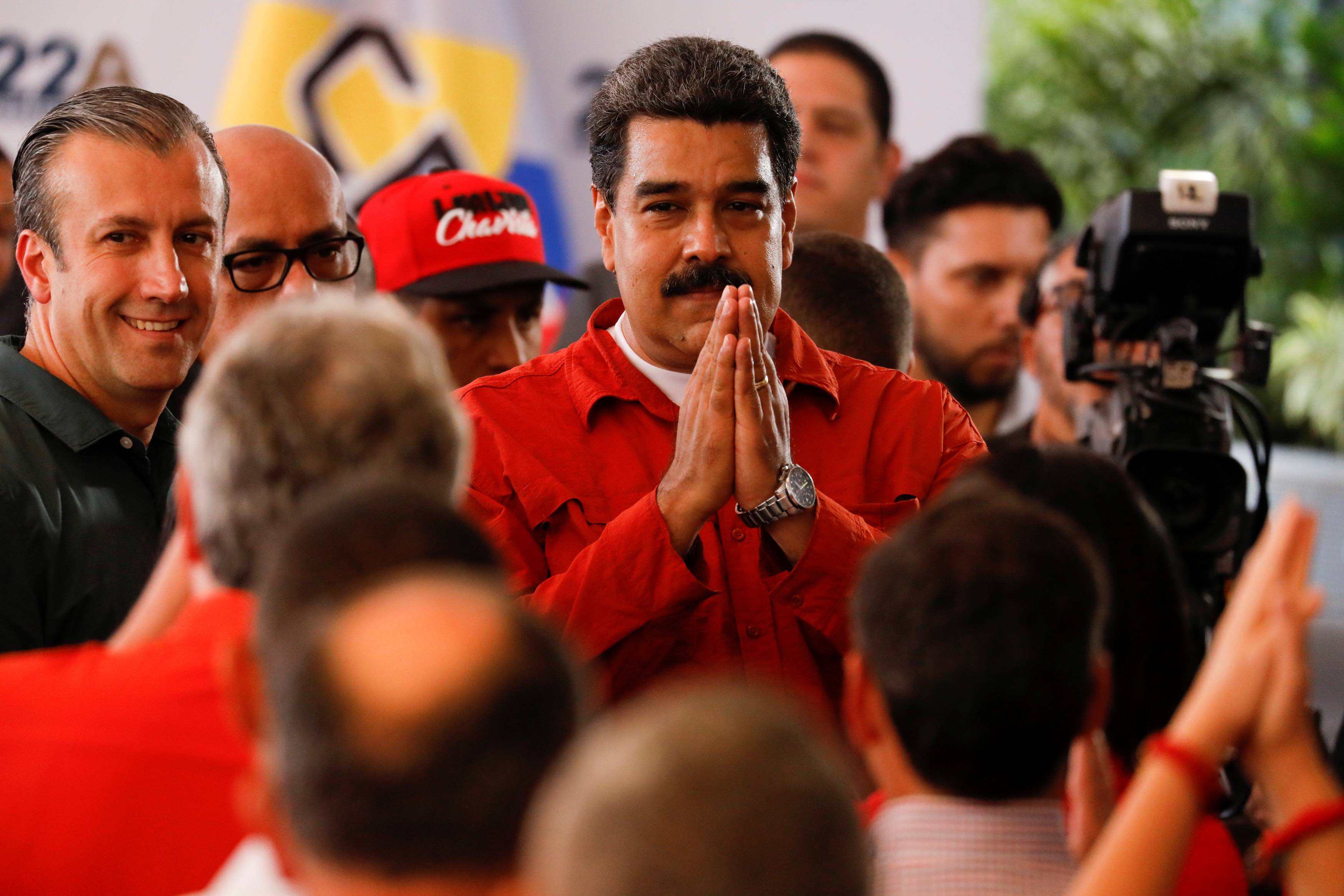
President Nicolas Maduro gestures as he registers his candidacy for re-election at the National Electoral Council (CNE) headquarters in Caracas on February 27. Credit: Reuters/Marco Bello
Washington: The Trump administration is considering sanctioning a Venezuelan military-run oil services company and restricting insurance coverage for Venezuelan oil shipments to ratchet up pressure on socialist President Nicolas Maduro, a US official said on Wednesday.
With Maduro running for another term in an April election that Washington and its allies oppose as a sham, the US is weighing sanctions that would target Venezuela’s vital oil sector beyond what has been done before, the official told Reuters. Some measures could come before the vote and others could be imposed afterwards.
The official, who is close to US internal deliberations on Venezuela policy and spoke on condition of anonymity, would not rule out an eventual full-scale ban on Venezuelan oil shipments to the US, among the toughest of oil-related sanctions.
“I think (it would cause) a fairly strong shock to the oil market in the short term,” the official said.
The official stressed that no decisions have been made and that any US action would take into consideration potential harm to ordinary Venezuelans, already suffering from food shortages and hyperinflation, and the country’s neighbours as well as the impact on the US oil industry and American consumers.
Venezuela was the fourth largest supplier of crude oil and products to the US in 2017, according to the US Energy Information Administration. Its crude oil sales to the US last year were the lowest since 1991, according to Thomson Reuters trade flows data.
“Oil sanctions are not taken lightly,” the official said. “This would be a fairly strong escalation for US policy, whether it’s a complete oil sanction or salami slices of different graduated steps.”
The administration of President Donald Trump is also weighing possible sanctions against additional senior military and political figures, including Socialist Party No. 2 Diosdado Cabello, the official said.
Experts say individual sanctions have had little or no impact on the Venezuelan government’s policies. Maduro, himself sanctioned last year, regularly laughs off Washington's disapproval and blames the US "empire" for Venezuela's economic woes.
Venezuela’s Information Ministry did not respond to a request for comment on potential further sanctions.
Washington’s crafting of new sanctions comes as Venezuela’s opposition coalition is boycotting the April 22 election, citing “fraudulent” conditions including a ban on its top two candidates from running.
Even if Venezuelan authorities delay the election by a month or two, the official said, that likely would not prompt the US administration to hold back on sanctions.
Economic plan
The best tool for making the Venezuelan government feel economic pain, US government sources say, is through “sectoral” sanctions, such as financial measures announced in August that barred US banks from any new debt deals with Venezuelan authorities or state-run oil giant PDVSA.
Venezuela's foreign minister, Jorge Arreaza, said in Geneva on Tuesday that US sanctions are making foreign debt renegotiation more difficult and causing "panic" at global banks.
New sanctions under consideration, according to the administration official, would be intended to “to make the world a little smaller for these corrupt officials.”
Among the possible new US targets is Camimpeg, Venezuela’s military-run oil services firm, the official said. With Maduro’s approval, Venezuela’s powerful military in 2016 founded Camimpeg, which is geared to providing PDVSA with assistance in drilling, logistics and security.
Little is known about Camimpeg's activities. The opposition says the armed forces are a nest of corruption and the unpopular Maduro has sought to buy the support of military chiefs by giving them increasing control of the OPEC nation’s crude reserves, the world’s largest.
Another option would be sanctions aimed at putting restrictions on insurance coverage for oil tankers and oil cargos involving PDVSA, the official said.
Oil exports are typically protected by insurance on tankers as well as on the actual cargo. Without insurance, a vessel cannot navigate in international waters, which means Venezuela’s oil exports would likely be curtailed. Sanctions on cargo insurance would also hurt because PDVSA has a limited tanker fleet.
In addition, the Trump administration is continuing to consider blocking the sale of lighter US crude and refined products that Venezuela mixes with its heavy crude and then exports, the official told Reuters.
"There's a host of additional sanctions that could be imposed. The president has all those before him,” said US senator Marco Rubio, who has played a key role in pushing for Trump’s more assertive approach to Venezuela than his predecessor, Barack Obama.
“The goal here is to continue to pressure an illegitimate regime so that they would leave power or be removed from power,” Rubio told Reuters in an interview on Wednesday.
(Reuters)
This article went live on March first, two thousand eighteen, at thirty-seven minutes past three in the afternoon.The Wire is now on WhatsApp. Follow our channel for sharp analysis and opinions on the latest developments.


