

In Charts: Inequality in India Among Highest in the World, Top 1% Holds 40% National Wealth


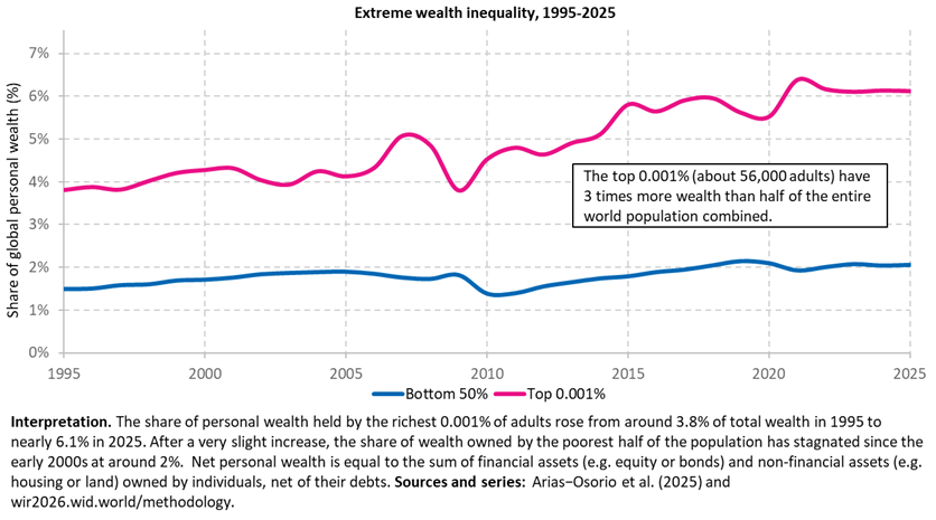
New Delhi: The top 10% of the world’s income earners earn more than the other 90% combined. Additionally, less than 60,000 people in the world control three times more wealth than the combined wealth of half of the world’s population. That means that of the over 8.2 billion people in the world today, just 60,000 control 3x the wealth controlled by 4.1 billion people combined.
These striking statistics are just some of the details brought out by the World Inequality Report 2026, edited by economists Lucas Chancel, Ricardo Gómez-Carrera, Rowaida Moshrif and Thomas Piketty of the World Inequality Lab based in Paris. The report not only points to the extreme – and growing – wealth concentration in today’s world, but also to other kinds of persistent global inequalities that are shaping lives.
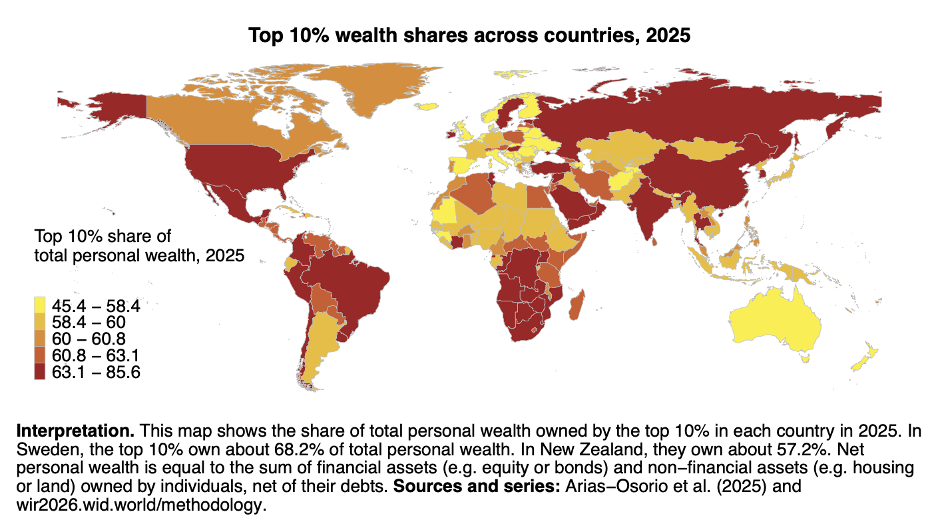
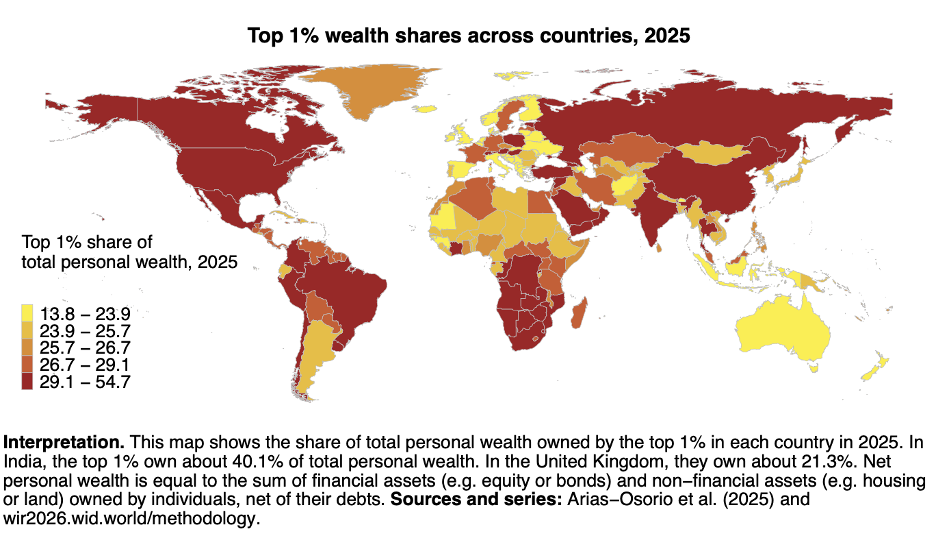
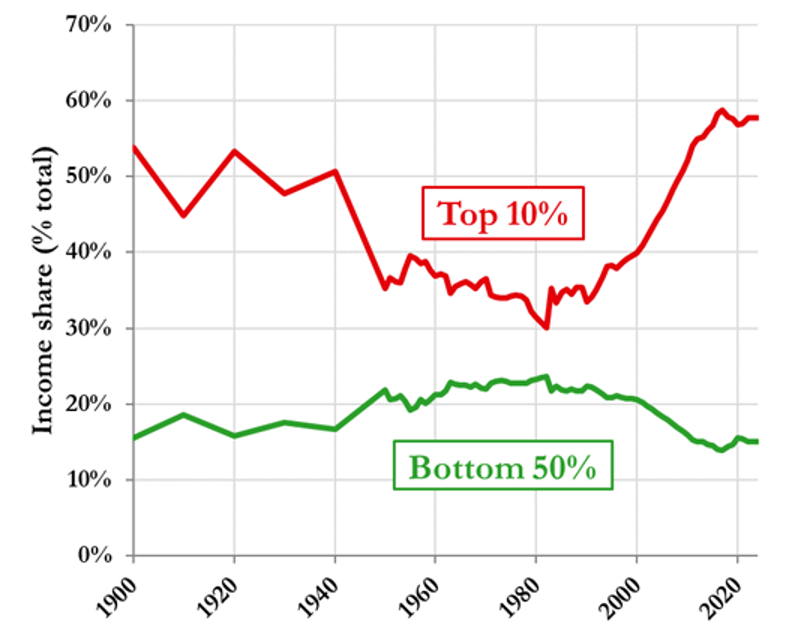
India is one of the most unequal countries in the world, the report says, and this doesn’t appear to be changing. “The top 10% of earners capture about 58% of national income, while the bottom 50% receive only 15%. Wealth inequality is even greater, with the richest 10% holding around 65% of total wealth and the top 1% about 40%.”
One of the report’s main arguments is that this status quo is fixable – provided a concerted global effort is made. “Inequality is a political choice. It is the result of our policies, institutions, and governance structures. The costs of escalating inequality are clear: widening divides, fragile democracies, and a climate crisis borne most heavily by those least responsible. But the possibilities of reform are equally clear. Where redistribution is strong, taxation is fair, and social investment is prioritized, inequality narrows. The tools exist. The challenge is political will. The choices we make in the coming years will determine whether the global economy continues down a path of extreme concentration or moves toward shared prosperity.”
Here are seven of the report’s main findings, with a focus on India.
1. Extreme global wealth inequality not only exists but grows
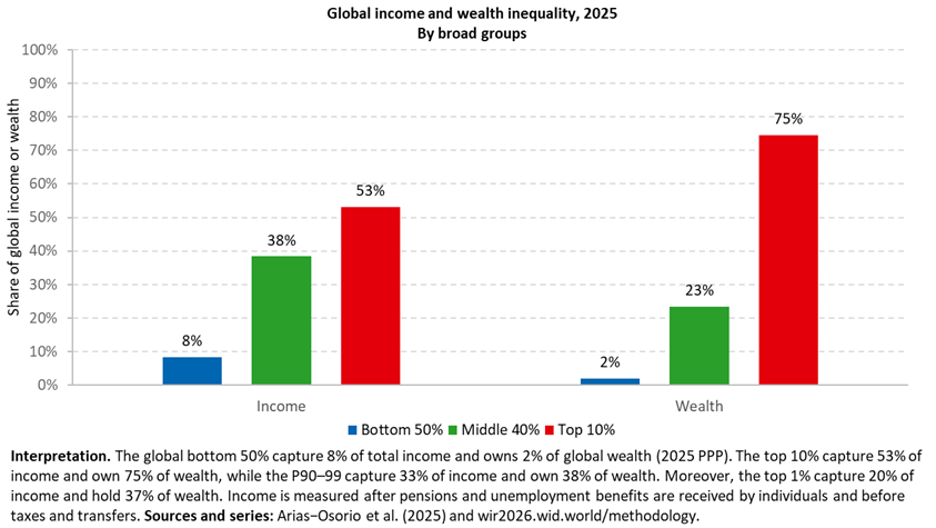
Concentration of wealth and income continues, with the bottom 50% of the world’s population controlling only 2% of wealth and earning 8% of income.
The amount of wealth controlled by the top 0.001% of the population is increasing steadily, up from about 4% in 1995 to about 6% by 2025.
 2. India is one of the most unequal countries in the world
India is one of the worst performers globally when it comes to wealth concentration in the hands of a few. Income inequality looms large over India, and wealth inequality even larger. The richest 10% hold 65% of the wealth in the country; the top 1% alone holds about 40%.
The top 10% of income earners capture about 58% of national income, while the bottom 50% receive only 15%.
3. Climate change: unequal emissions, unequal risks
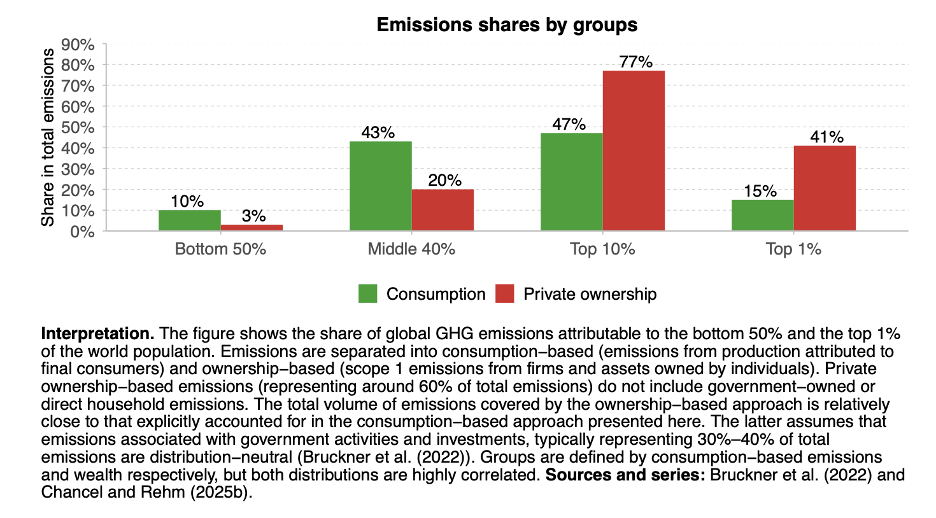
The poorer 50% of the world accounts for just 3% of carbon emissions associated with private capital ownership, while the top 10% account for 77% of such emissions, the report notes. However, when it comes to bearing the brunt of climate change-associated costs and risks, the wealthy are able to insulate themselves to a degree.
 4. Women’s share of labour income at 25% – about the same as it was in 1990
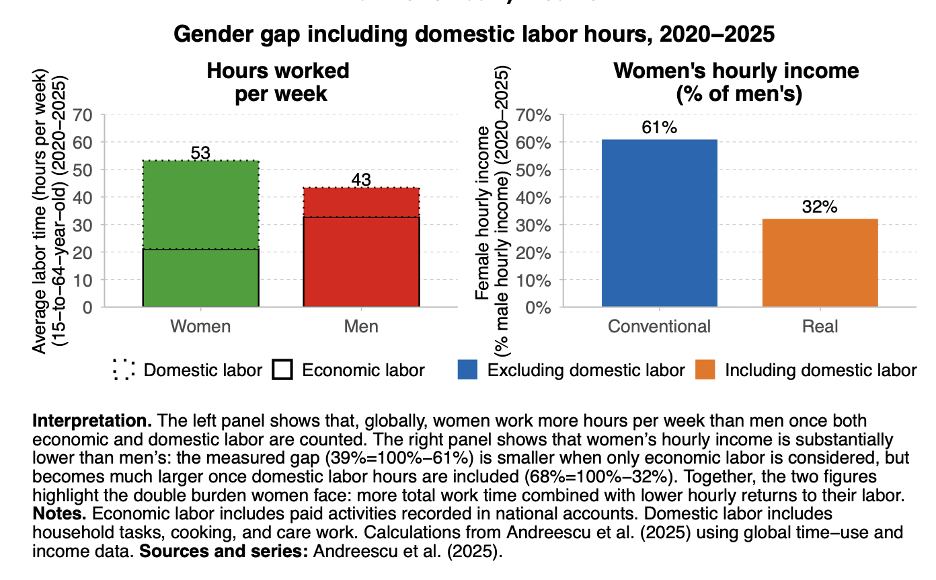
Gender inequality continues to be a cause for concern across the world, as “Women continue to work more and earn less than men.”
“Excluding unpaid work, women earn only 61% of men’s hourly income; when unpaid labor is included, this figure falls to just 32% [globally]. These disproportionate responsibilities restrict women’s career opportunities, limit political participation, and slow wealth accumulation,” the report states.
5. Regional inequalities across the world persist
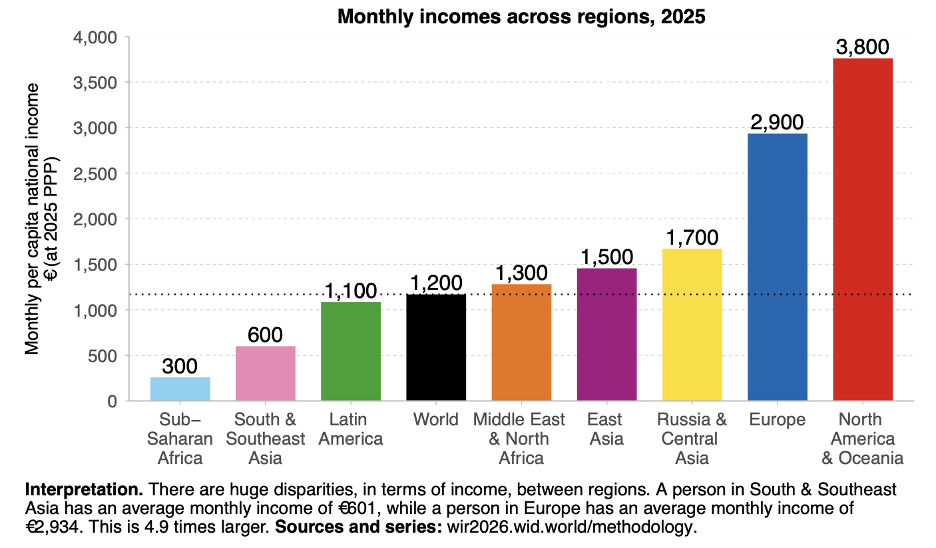
Global averages on income numbers hide the persistent regional disparities that continue to plague the world, the report notes. The “average daily income in North America & Oceania is about €125, compared to only €10 in Sub-Saharan Africa. And these are averages: within each region, many people live with far less”.
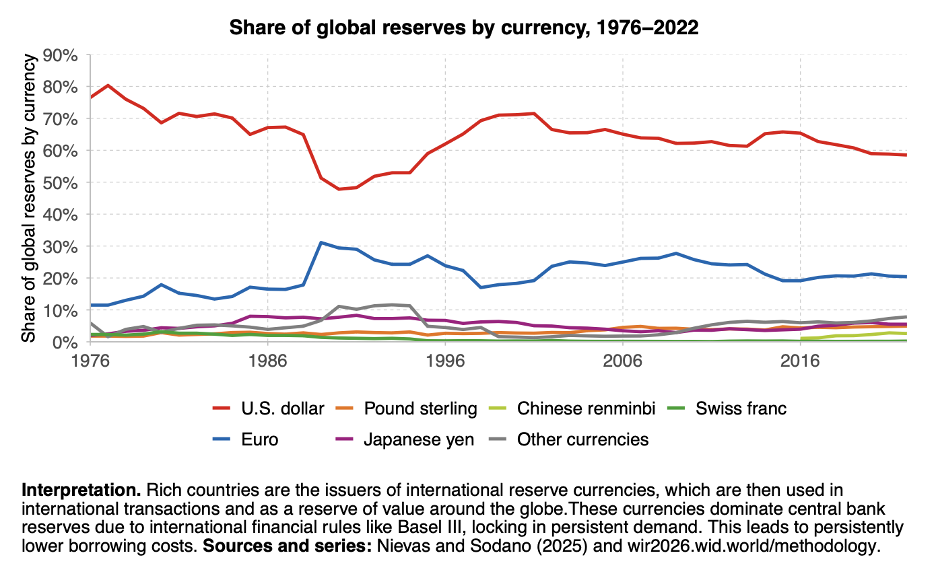
6. The global financial system is rigged in favour of rich countries
That regional inequality exists is not a coincidence, the report notes. The systems we all used are to blame:
“...the current international financial architecture is structured in ways that systematically generate inequality. Countries that issue reserve currencies can persistently borrow at lower costs, lend at higher rates, and attract global savings. By contrast, developing countries face the mirror image: expensive debts, low-yield assets, and a continuous outflow of income.”
It’s not “market efficiency” that is creating this situation, the report notes, but “institutional design that places reserve currency issuers and financial centers at the core of the international financial system, to the benefit of wealthy economies”.
7. Change is possible: A case for progressive taxation and a global wealth tax
Inequality should not be taken as a given, the report argues, and measures like progressive taxation and redistributive steps have shown success in reducing inequality, “particularly when systems are well designed and consistently applied”.
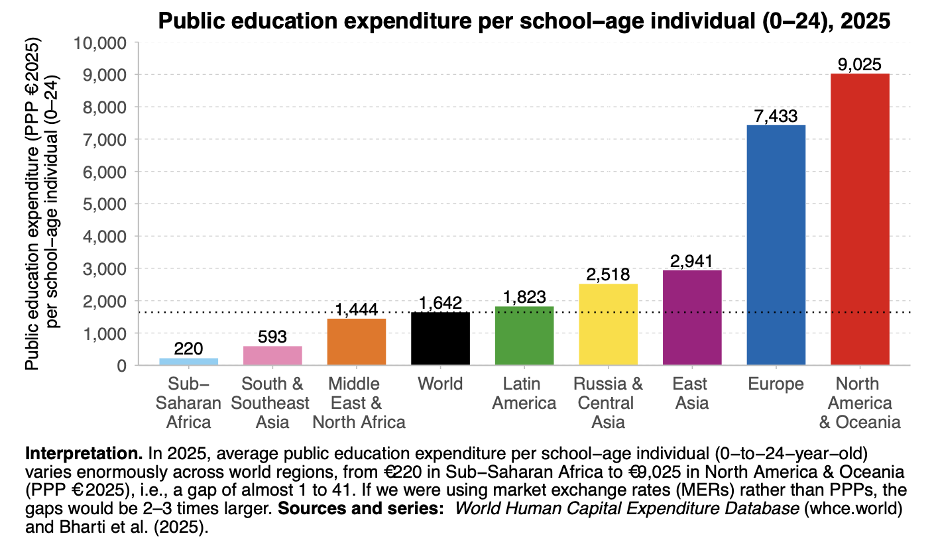
Inequalities persist because spending on human capital varies so widely across countries, the report notes, and also because taxation often fails to target those who can afford it the most – the richest. “Effective income tax rates climb steadily for most of the population but fall sharply for billionaires and centi-millionaires. These elites pay proportionally less than most of the households that earn much lower incomes. This regressive pattern deprives states of resources for essential investments in education, healthcare, and climate action. It also undermines fairness and social cohesion by decreasing trust in the tax system. Progressive taxation is therefore crucial: it not only mobilizes revenues to finance public goods and reduce inequality, but also strengthens the legitimacy of fiscal systems by ensuring that those with the greatest means contribute their fair share.”
“Even a moderate 3% global tax on fewer than 100,000 centi-millionaires and billionaires — a group small enough to fit inside a single stadium — would raise over $750 billion per year, an amount comparable to the total education budgets of low- and middle-income countries,” the report notes.
All charts courtesy the World Inequality Report, 2026.
This article went live on December tenth, two thousand twenty five, at thirty minutes past twelve at noon.The Wire is now on WhatsApp. Follow our channel for sharp analysis and opinions on the latest developments.


