

The Critics of 'Povertarianism': Let Them Eat Cake, for Now


One amongst the several buzzwords that the 2014 election spawned was “povertarianism”. Coined by senior journalist Shekhar Gupta, it conveys the idea (broadly speaking) that the Congress Party is committed to keeping people poor so that it can ‘save’ them with welfarist schemes. It postulates that the party is not interested in ushering real economic freedom because that would negate large parts of its welfarist/populist appeal.
In contrast, such an analysis argues, the country needs economic policies that would create equality of opportunity and render schemes such as the rural job guarantee scheme, MGNREGA, the Food Security Act and the Right to Education Act, superfluous. In this vein, tech entrepreneur Rajesh Jain, for instance, calls upon the country to elect its “First Prosperity Prime Minister”.
Following the Congress’s 84th plenary session, commentators are once again accusing the Congress of ‘povertarianism’. Author and columnist Gurcharan Das, for instance, believes the Congress’s DNA is itself non-aspirational. Economist Narendar Pani believes that the Congress’ growth-by-any-means strategy generates costs that welfare measures cannot always paper over. Journalist Ruhi Tewari finds a contradiction between the Congress’ focus on economic growth and its commitment to social welfare.
Yet, these accounts neither explain their criticism in clear terms nor lay down an alternative vision. Critically, they also fail to take account of India’s long-held commitment to welfare and the universal acceptance of ‘povertarianism’ across party lines.
First, it is not clear what ‘povertarianism’ really means in terms of economic policy. For a term used so frequently, there is a startling lack of clarity accompanying its use. ‘Povertarians’ seem to view laws guaranteeing education, healthcare, food security and employment as unnecessary doles meant to secure votes. The government would be better advised to spend this money on building highways and ports, railway lines and high-speed internet connectivity, judicial reforms and bureaucracy modernisation.
‘Povertarians’ also seem to view big government as evil; they seem to want greater private participation and a rapid retreat of the Indian state from most sectors of the economy. But apart from this, there is little clarity on what a ‘non-povertarian’ government’s economic policies would look like. Would such a government, for instance, not pursue welfare schemes? Would it charge private players with the task of even providing key public goods? Would it eschew social security safety nets in favour of guaranteeing universal basic income? We can speculate, but ‘povertarians’ have not spelt out in clear terms what economic policy should be like. Large parts of their economic ideas are about what should not happen. Even then, such criticism appears to be sporadic and issue-based.
Second, ‘povertarians’ seem to most closely resemble Rajaji’s (C. Rajagopalachari) Swatantra Party that sought to create a real free market economy in India. But they fail to address the well-documented problems that such policies brought with them in other countries. Their argument is not (as it cannot be) that the United Progressive Alliance failed to spend on physical infrastructure aimed at spurring growth. Their argument is that the government ought never to have enacted laws guaranteeing education, food security, healthcare or rural jobs. In other words, they seem to want the government to rely entirely on trickle-down economics, effective public distribution systems and better governance to make essential public goods available to the aam aadmi. Their answer to India’s massive poverty is to grow rapidly and generate jobs that enable the masses to feed, educate, clothe and house themselves. But if this be their economic vision, they have failed to explain the growing track record of economic and (in view of recent developments), political failure of trickle-down economics. They do not explain overwhelming evidence that trickle-down economics has been disastrous in many countries (most notably, in Latin America). They also offer no solution to addressing the immediacy of inequalities and poverty that is so endemic to India.
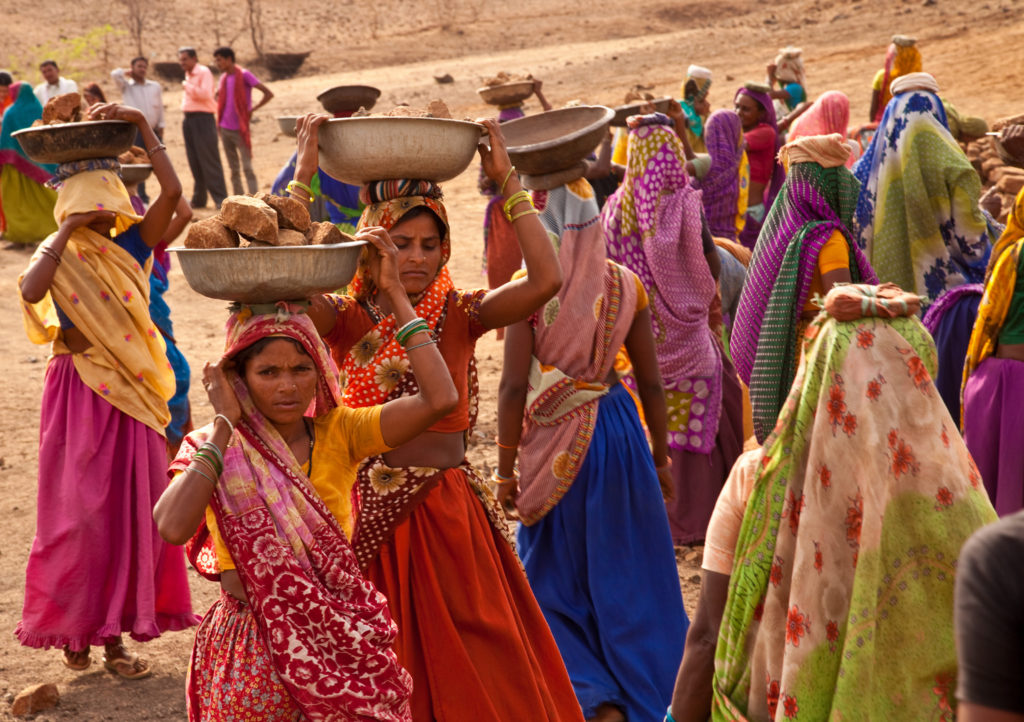
Women working on an NREGA site building a pond in Gopalpura, Jhabua, Madhya Pradesh. Credit: UN Woman/Gaganjit Singh/Flickr CC BY-NC-ND 2.0
Third, it is not clear whether their problem with welfarism is welfarism per se; or whether they believe that the UPA government wrongly prioritised welfarism over measures such as land, labour and banking sector reforms. In other words, it is unclear whether they support welfarism at all or whether they view welfarism as populism. In either scenario, however, their critique does not stand up to scrutiny.
‘Povertarians’ fail to recognise that welfarism is not just a political necessity, it is a humanitarian necessity which enjoys constitutional mandate. The welfare statutes and schemes they term ‘povertarian’ are in fact aimed at making public goods available to all. Education, food security, employment guarantee, healthcare were not dreamt up by the UPA government. These are constitutional mandates. These are rights that have long been made justiciable by the Supreme Court as part of its Right to Life jurisprudence; rights that the Supreme Court routinely enforces (with well-publicised admonishments to the government) in individual cases. Indeed, these have been defined as the raison d’etre of our Constitution. The many ‘povertarian’ measures that are pilloried are in fact enforceable constitutional rights that were in any event available, albeit — until the enactment of these statutes— to only resourceful litigants, capable of taking on the government and India’s byzantine legal system.
UPA’s welfare statutes have not created new ‘populist’ rights; those have merely provided a legislative framework to existing constitutional rights which, until the creation of these welfare statues, were enforceable in an ad hoc, haphazard way in individual litigations before the Supreme Court. Further, these statutes are not large-scale doles. These are structured to serve as safety nets. The statutes do not guarantee every Indian a right to employment; only to those Indians that are unemployed. These do not undertake to provide food to all; only to those who are likely to starve. Proponents of the ‘povertarian’ narrative fail to make clear whether they expect India to give up on its welfarism altogether or, how they seek to reformulate welfarism consistent with their worldview.
If ‘povertarians’ support welfare rights but believe that the UPA prioritised these over critical reforms, their problem is not with the UPA’s economic policy so much as with its politics. Their critique then does not need a special new term like ‘povertarianism’, it can be properly explained as populism. They view the UPA’s rights paradigm not as an attempt to make public goods available to the citizenry as a matter of right, but as a dole meant to corner votes from the poor. They would have the government spend its capital on increasing national prosperity rather than on redistributing wealth.
This is not to deny the many populist economic measures that have substituted sound policy. It also cannot be denied that job creation has consistently lagged and remains India’s biggest economic challenge for the next decade. In both cases, however, criticism cannot be levied only against Congress/UPA. The critique of welfarist ‘povertarianism’ may have held salience in the early days of the Narendra Modi government when it appeared likely that a radically different economic path would be charted. One year away from re-election, however, the BJP has proven even more ‘povertarian’ than the Congress. This then is a function of India’s demography and of India’s politics.
In 2015, Prime Minister Modi mocked MGNREGA in Parliament. He referred to it as a "monument" of Congress’s failure and vowed to keep it alive only to remind the people that in lieu of real jobs they were forced to dig holes under MGNREGA 60 years after Independence. By 2016, at the 10-year anniversary of MGNREGA, the Modi government was hailing the scheme as a symbol of national pride. The rural job guarantee scheme secured its highest budgetary allocation in 2017-18 with Rs 48,000 crore (up from about Rs 38,000 crore in 2012-13). Similarly, the Food Security Act garnered Rs 1,45,338 crore for the 2017–18 fiscal, which further increased to Rs 1,69,323 crore for 2018-19.
If welfare schemes guaranteeing employment, education, food and healthcare are indicators of ‘povertarianism’, it is a sin not simply borne out of pragmatic politics. Perhaps India’s neo-liberal ‘povertarians’ do not grasp the sheer moral compulsion of pursuing immediate welfarism in a society as deeply unequal as ours.
Jeet H. Shroff is a Mumbai based lawyer. He practices dispute resolution and advises on legal policy.
This article went live on March twenty-eighth, two thousand eighteen, at zero minutes past eight in the morning.The Wire is now on WhatsApp. Follow our channel for sharp analysis and opinions on the latest developments.


