

Trump-Putin Summit Reveals Geopolitical Contradictions, Intense Struggle to Carve Up Ukraine’s Resources


The Trump-Putin summit in Anchorage, Alaska, on August 15 – intended but failing to broker a ceasefire in the Ukraine war – is a stark revelation of multiple imperialist rivalries, struggles over Ukraine’s vast mineral wealth, the balance of power in Europe, and Sino-US competition.
The relative impasse at Anchorage is a manifestation of heightened inter-imperial competition and the contested reconstruction of global hegemony. The US, under Trump’s elite populism, and Russia, under Putin’s neo-imperial autocracy, vie for control over Ukraine’s resources while marginalising its workers and people and European allies. Trump’s Russia gambit is driven by a “reverse Kissinger moment” to split Russia away from China to enable the US to focus on the rising power’s increasing strength. The summit’s apparent ‘breakdown’ exposes the contradictions of capitalist power, the fragility of hegemonic consent, and the centrality of Ukraine’s minerals in shaping a volatile global order.
Lenin’s return: The resource scramble
Lenin’s Imperialism: The Highest Stage of Capitalism frames global conflicts as struggles among capitalist powers for markets, raw materials, and strategic advantage. Ukraine, with its $12.5 trillion in mineral wealth – including 20% of global titanium, significant lithium, and rare earths – stands as a prize in this imperialist contest. Russia’s 2022 invasion and occupation of Donetsk, Luhansk, Zaporizhzhia, and Kherson, which hold coal, gas, and rare earths, reflect Moscow’s drive to dominate strategic resources critical for energy and tech industries. Putin’s summit demands – Ukraine’s neutralisation beyond NATO’s reach, and demilitarisation – aim to secure these assets for Russia’s ruling oligarchy, ensuring Moscow’s leverage over Europe’s energy markets and China’s mineral supply chains.
The US, under Trump’s second administration, counters with its own imperialist agenda. The April 2025 Ukraine-United States Mineral Resources Agreement ties Kyiv’s economic recovery to American corporate access, framed as repayment for $120 billion in aid. This deal echoes Lenin’s critique of capital export to peripheral nations, by subordinating Ukraine’s resources to US firms seeking to counter China’s dominance in rare earth processing. Trump’s summit proposal – ceding occupied territories for a ceasefire – was a gambit to stabilise Ukraine for Western investment while securing a populist “win” for his domestic base. The failure to reach agreement underscores Lenin’s point: inter-imperial rivalries, driven by resource competition, preclude stable cooperation when profits are at stake.
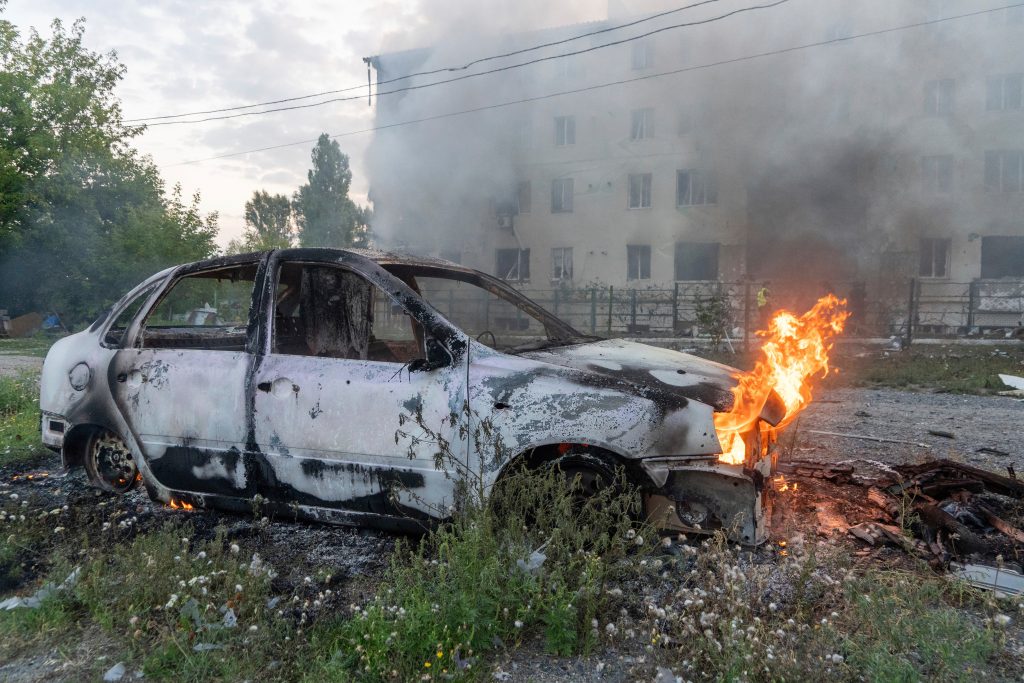
A car burns against the background of a damaged residential building following Russia's missile attack in Kharkiv, Ukraine, Monday, Aug. 18, 2025. Photo: AP/PTI.
Gramscian hegemony: Coercion and consent
Gramsci’s concept of ruling class hegemony – dominance through a mix of coercion and persuasion – sees the Anchorage summit as a stage for both leaders to project hegemonic power. But its collapse reveals the fragility of their consent-building strategies. Trump’s elite populism, blending spectacle with blunt force, seeks to construct a US-led hegemonic order by rallying his base against “globalist” elites while coercing allies and adversaries alike. His summit rhetoric – promising peace “in one day” while threatening “severe consequences” – was a populist performance to win consent from his domestic electorate, who see him as a champion against establishment betrayal. Yet, his exclusion of Ukraine and Europe alienated key allies, undermining the consensual alliances needed for US hegemony.
Putin, conversely, builds hegemony through autocratic coercion and selective consent. His presence in Alaska, complete with red-carpet optics, was a bid to legitimise Russia’s neo-imperial project, portraying Moscow as a great power despite Western sanctions and an ICC warrant. Domestically, Putin secures consent through nationalist propaganda, framing Ukraine as a historical extension of Russia and its resources as rightfully Moscow’s. His summit demands – Ukraine’s subordination – reflect a coercive approach to regional hegemony, but his refusal to compromise signals confidence in Russia’s battlefield leverage and economic resilience. Russian propagandist Vladimir Solovyov’s claim that “this war is for a long time” underscores Putin’s strategy: prolong conflict to extract consent from a war-weary global audience while consolidating control over Ukraine’s minerals.
This war has all the hallmarks of a ‘frozen conflict’ not unlike that between North and South Korea.
Ukraine’s workers pay while oligarchy profits
The marginalisation of Ukraine’s working class and people in this imperialist drama is rarely mentioned or investigated. Yet, imperialism is based on exploiting the workers of both oppressor and oppressed nations. Ukrainian workers – miners in Zhytomyr’s titanium fields, factory hands in Kirovohrad’s graphite plants – bear the war’s brunt, with millions displaced and cities like Mariupol and Bakhmut destroyed. The US minerals deal, while promising reconstruction, channels surplus value to American capital, not Ukrainian workers. Russia’s occupation similarly funnels Donbas’s coal and gas wealth to Moscow’s oligarchs, leaving Ukrainian and Russian workers impoverished.
Some old oligarchs have lost out, new oligarchs are emerging. Oligarchs like Rinat Akhmetov lost out as his wealth plummeted from $14 billion to $4.3 billion due to destroyed steel plants. Akhmetov and Ihor Kolomoisky lost industrial assets, with the latter’s oil refinery and PrivatBank nationalised. Petro Poroshenko, with fewer eastern assets, retains influence through patriotic posturing, though his wealth fell to $700 million. Meanwhile, reconstruction deals promise windfalls for elites tied to Western firms, with agriculture and minerals eyed for profit. Western aid, such as the 2025 US-Ukraine Mineral Resources Agreement, channels reconstruction funds to elites tied to Zelenskyy’s government, ensuring surplus value flows to American and Ukrainian capitalists’ interests. Zelenskyy’s de-oligarchisation laws, including the 2021 Anti-Oligarch Law, stripped figures like Kolomoisky of citizenship and media control, consolidating state power under martial law. Yet, elites like Viktor Pinchuk, who donated $45 million to war efforts, maintain influence through Western-aligned philanthropy, securing consent from global capital. Reconstruction deals, such as those with BlackRock, favour Zelenskyy’s allies, potentially birthing a new oligarchy. This war-driven centralisation risks replacing old oligarchs with state-aligned elites, further undermining democratic pluralism let alone workers’ precarious conditions of life and death. They live and work in industrial regions and mining areas, they are the bulk of the conscripted armed forces, of the dead and wounded: canon-fodder without end.
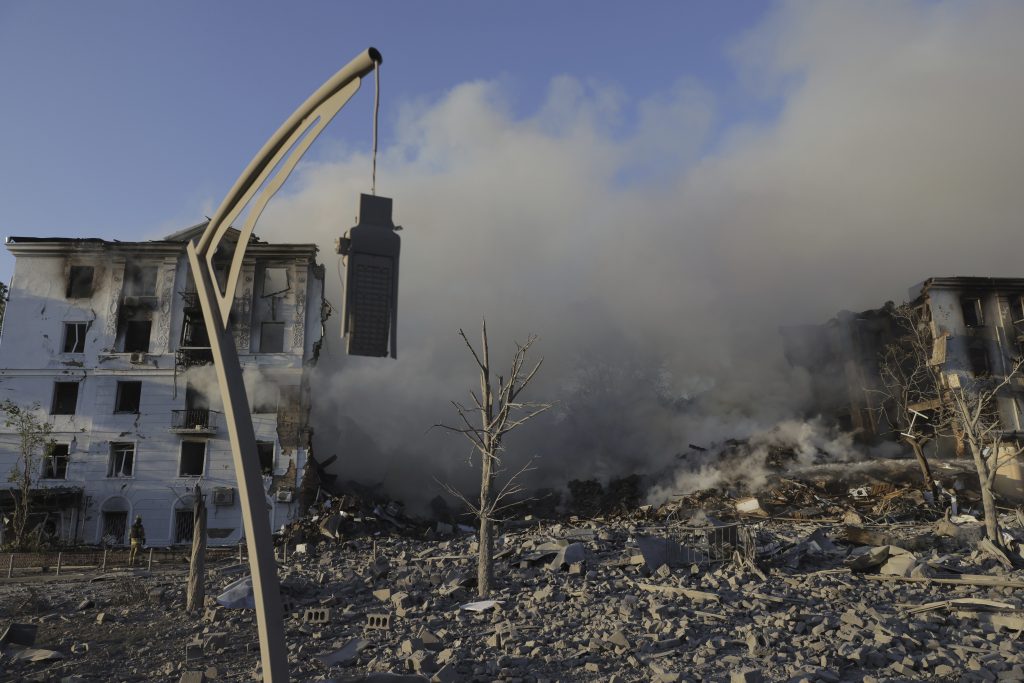
A smoke rises over a residential house destroyed by a Russian air strike on Kramatorsk, Ukraine, on Thursday, July 31, 2025. Photo: AP/PTI.
Europe and the Global South: Hegemonic fractures
The summit’s failure also exposes fractures in global hegemonic structures. Europe, sidelined in Alaska, struggles to assert its own hegemonic project. NATO’s Mark Rutte and EU leaders like Olaf Scholz and Emmanuel Macron demanded Ukraine’s inclusion, reflecting a consensual model of hegemony rooted in multilateralism. Trump’s unilateralism – echoing his 2018 Helsinki deference to Putin – threatens NATO’s cohesion, risking a fragmented Western alliance. Europe’s elite-driven integration absorbs dissent but fails to counter U.S. or Russian coercion, leaving Ukraine vulnerable. While European commentators warn of NATO’s erosion, Trump’s base cheers his “America First” stance, highlighting the contested nature of Western hegemony.
The Global South, meanwhile, observes with scepticism. India and China’s virtual silence on the summit reflects their resistance to US-led hegemonic norms, as both nations secure Russian oil and minerals to fuel their own capitalist growth. Lenin’s prediction of imperialist rivalries spilling into peripheral regions finds resonance here, with Ukraine’s resources becoming a flashpoint for multipolar competition. Trump’s tariffs on India for buying Russian oil – a coercive bid to isolate Moscow – further alienate emerging powers, weakening U.S. hegemonic consent.
Markets and minerals: Capital’s contradictions
The summit’s failures reverberated through global markets. Ukraine’s bonds dipped, while defence stocks like Lockheed Martin surged, profiting from prolonged conflict. Russia’s pivot to Asian energy markets bolsters firms like Gazprom, but US shale producers like Chevron gain from Europe’s energy crunch. Ukraine’s minerals – titanium for aerospace, lithium for batteries – are central to this economic war. The US seeks to wrest control from China’s rare earth dominance, while Russia aims to monopolise Europe’s supply.
Toward a counter-hegemonic future?
The summit’s failure reveals the contradictions of imperial interests and the fragility of hegemonic consent. Trump’s elite populism and Putin’s autocratic imperialism prioritise resource control over human security, sidelining Ukraine’s workers and Europe’s multilateralism. Yet, these contradictions sow seeds for resistance. Ukrainian workers, through grassroots defiance, and European activists, via calls for solidarity, could form a counter-hegemonic bloc to challenge US-Russian dominance. A revolutionary path, would redirect Ukraine’s mineral wealth to its people, not foreign capital. Gramsci’s emphasis on cultural-ideological struggle suggests the need for a new narrative – one that amplifies the Ukrainian working class and people’s voice against imperial exploitation.
For now, the Anchorage impasse entrenches a world of competing hegemonies, where Ukraine’s resources and geostrategic location fuel capitalist rivalries. The urgency of the situation demands the building of a global solidarity that transcends imperial borders.
Inderjeet Parmar is a professor of international politics and associate dean of research in the School of Policy and Global Affairs at City St George’s, University of London, a Fellow of the Academy of Social Sciences, and a columnist at The Wire. He is an International Fellow at the ROADS Initiative think tank, Islamabad, and author of several books including Foundations of the American Century. He is currently writing a book on the history, politics, and powers of the US foreign policy establishment.
This article went live on August nineteenth, two thousand twenty five, at six minutes past ten in the morning.The Wire is now on WhatsApp. Follow our channel for sharp analysis and opinions on the latest developments.


