

100 Years After Naujawan Bharat Sabha, Bhagat Singh's Words Meet a New Youth Movement


Not long ago, a young girl stood amidst the crowds protesting at Delhi’s Jantar Mantar with a book about Bhagat Singh in her hands. When asked why she was reading him amid a contemporary youth mobilisation, her answer reached back almost a hundred years.
She said, “It is written here that after the failure of the non-cooperation movement, young leaders were gaining recognition among patriotic people, while established leaders were, in a way, being left behind. What Bhagat Singh wrote back then we can see happening today. I have been feeling his presence since morning. Perhaps he was writing about a moment like this.”
Her observation may be an interpretation, but the figure she was referring to – Bhagat Singh – did leave an unusually direct message for the youth on political leadership, communalism and responsibilities of a new generation.
September 28 marks the birth anniversary of Bhagat Singh. In 2026, his anniversary acquires another historical resonance. A century has now passed since the formation of Naujawan Bharat Sabha, the youth organisation associated with Bhagat Singh, Sukhdev and Bhagwati Charan Vohra.
The Naujawan Sabha emerged in Lahore in March 1926 as a radical youth organisation associated with a socialist orientation and revolutionary programme. Its manifesto explains what it aimed to do: provide the freedom movement with ideological and social support. Thus, it mobilised students, workers and peasants to strengthen the anti-imperial movement.
According to historical records, Naujawan Sabha sought to break intercaste and religious barriers through community dining where people ate together irrespective of caste or religion. It worked for social unity and equality.
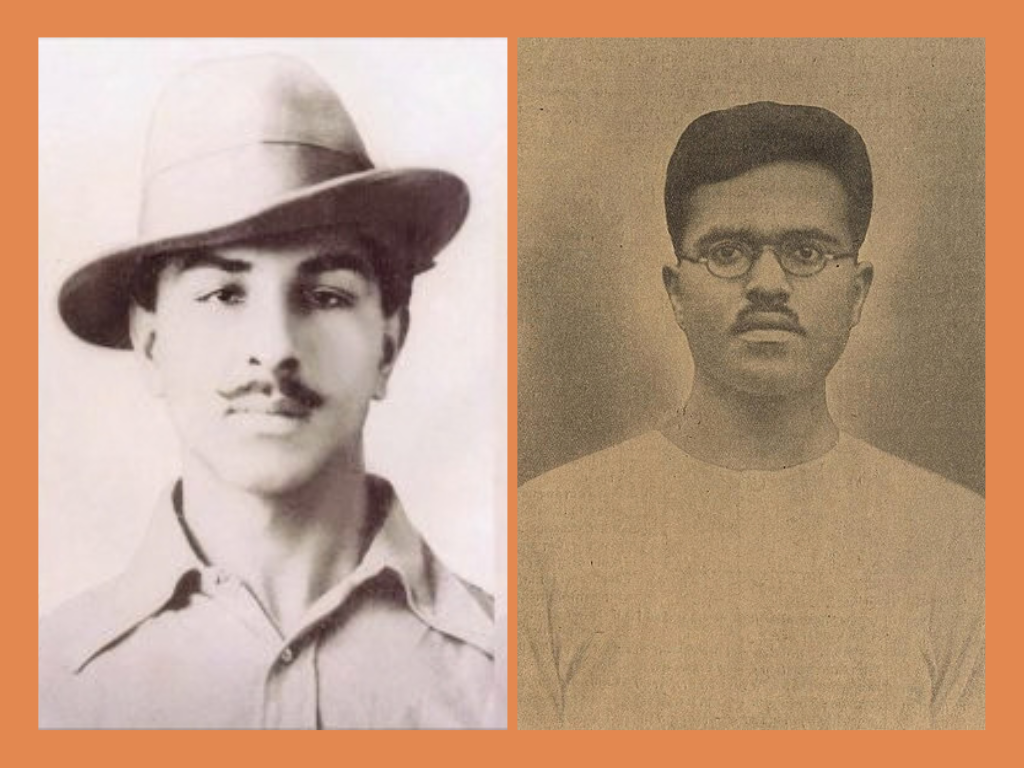
Bhagat Singh and Bhagwati Charan Vohra, founders of Naujawan Bharat Sabha. Credit (B.C. Vohra): Bhavisya Akhbaar, National Archives, CC BY-SA 2.5, via Wikimedia Commons. Bhagat Singh: Public domain.
In 1928, Bhagwati Charan Vohra published the ‘Manifesto of Naujawan Bharat Sabha’, laying down its vision and mission during India’s freedom struggle.
The manifesto is a scathing critique of the politics of religion. It says:
“A branch of a peepal tree is cut and religious feelings of the Hindus are injured. A corner of a paper idol, tazia, of the idol-breaker Mohammedans is broken, and ‘Allah’ gets enraged, who cannot be satisfied with anything less than the blood of the infidel Hindus. Man ought to be attached with more importance than the animals and, yet, here in India, they break each other’s heads in the name of ‘sacred animals’.”
It also vehemently opposed religious bigotry and said:
“Religious superstitions and bigotry are a great hindrance in our progress. They have proved an obstacle in our way and we must do away with them. The thing that cannot bear free thought must perish. The conservativeness and orthodoxy of the Hindus, the extra-territorialism and fanaticism of the Mohammedans and the narrow-mindedness of all communities in general are always exploited by the foreign enemy...Young men with revolutionary zeal from all communities are required for the task.”
Lastly, it makes an uncompromising appeal:
"Let young men think independently, calmly, serenely and patiently. Let them adopt the cause of Indian independence as the sole aim of their lives. Let them stand on their own feet. They must organise themselves, free from any influence and refuse to be exploited any more by the hypocrites and insincere people who have nothing in common with them and who always desert the cause at the critical juncture. In all seriousness and sincerity, let them make the triple motto of ‘service, suffering, sacrifice’ their sole guide."
A century later, every word of the manifesto stands relevant in a reality check. It is tempting to draw a straight line from the Naujawan Bharat Sabha to the young protesters of 2026.
Also read: Remembering Bhagat Singh as One of India's Foremost 'Dimaagi Naxals'
But Bhagat Singh and his comrades were working under colonial rule. Their organisation belonged to an anti-imperial, anti-colonial revolutionary movement. The young protesters of 2026 are an inherent part of a constitutional democracy that uses public protest, social media and adapts to the contemporary forms of mobilisation.
At the same time, the historical circumstances have changed but the fundamental challenges that have been tormenting Indian society remain the same.
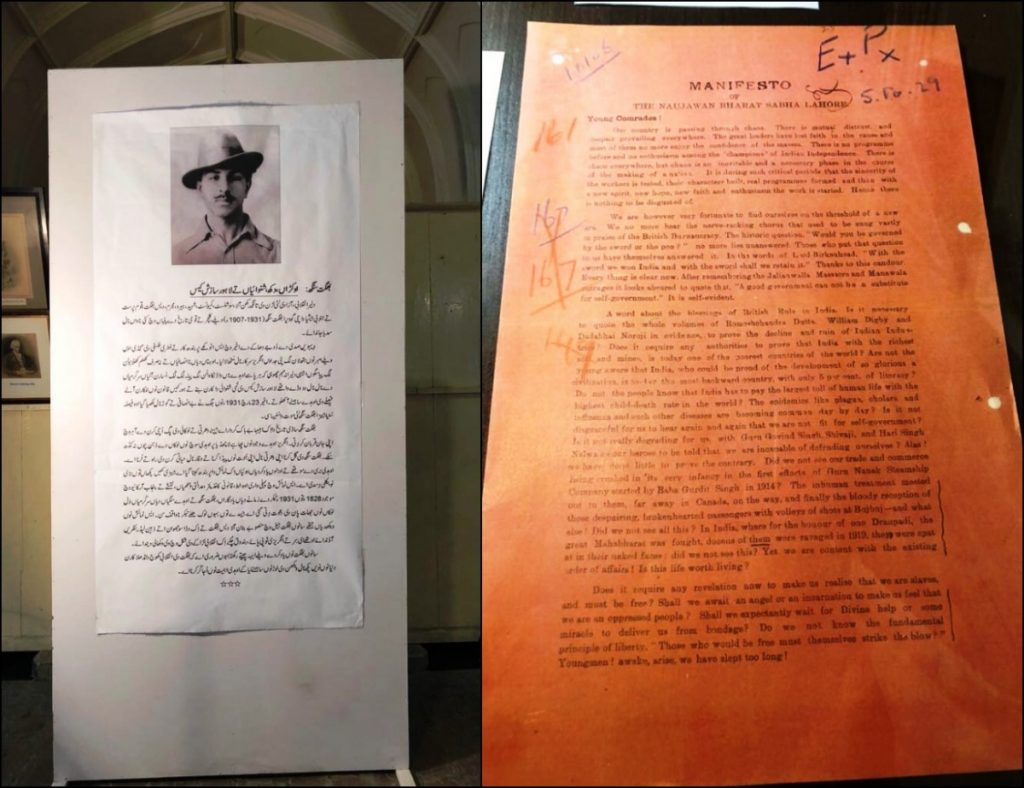
(L) Exhibition by Punjab Archives Lahore on Bhagat Singh files in 2018 (R) Front page of Naujawan Bharat Sabha manifesto from Bhagat Singh files in Punjab Archives Lahore exhibition 2018. Photo: Nusrat Manto
It is in this context that the Naujawan Bharat Sabha’s insistence on working for political freedom while keeping social relations at the centre acquires significance for today’s youth. The sabha’s community dining, its criticism of communal divisions and its appeal to young people from different communities were part of a larger project.
What it really sought was to build a political community that did not get defined by any inherited social divisions.
Bhagat Singh’s suggestion to the youth was: “Young men, do not get disheartened when you find such a great battle to fight single-handed with none to help. You must realise your own latent strength. Rely on yourselves and success is yours”.
Also read: 'Why Should We Not Rid Ourselves of This Entire Problem?': Bhagat Singh on Religion
He advised them not to hesitate, not to let fears of incarnation haunt their mind and break their courage. “Everybody can become great if they strive,” he said. He urged them not to lose patience one day and hope another day. “Try to make stability and determination a second nature to yourselves,” he said.
This advice leads back to the central message of the Naujawan Bharat Sabha’s manifesto, which said:
“Let young men think independently, calmly, serenely and patiently. Let them adopt the cause of Indian independence as the sole aim of their lives. Let them stand on their own feet. They must organise themselves free from any influence and refuse to be exploited any more by the hypocrites and insincere people who have nothing in common with them and who always desert the cause at the critical juncture.”
In all seriousness and sincerity, they were asked to make the triple motto of ’service, suffering, sacrifice’ their sole guide.
The call of the Naujawan Bharat Sabha was therefore not merely for a change of individuals but for the youth to understand the deeper causes behind the problems of their time and think of correcting the underlying causes.
Merely calling for a change of individuals does not repair the underlying fault. Fundamental issues must be addressed to secure the great future of all Indian people, irrespective of any distinction, as enshrined in the Constitution.
The revolutionary spirit of Bhagat Singh and his comrades interrupts society’s acceptance of an unjust order. And that is why Bhagat Singh has an enduring appeal among the young even a century later. He refused to accept injustice in any form as inevitable, and when today’s young people raise his slogans, they give it context from their own time – from the inequality, unemployment and insecurity they see and experience.
In this sense, Bhagat Singh gives the young a purpose: the unjust order must change.
Professor Jagmohan Singh is the maternal nephew of Shaheed Bhagat Singh and secretary of the Shaheed Bhagat Singh Research Committee and chairperson of the Shaheed Bhagat Singh Creativity Centre, Punjab.
Saurav Kumar is a member of the Shaheed Bhagat Singh Research Committee and a journalist working with Kanal Media, covering India’s banking and finance sectors.
This article went live on September twenty-eighth, two thousand twenty six, at eight minutes past eleven at night.The Wire is now on WhatsApp. Follow our channel for sharp analysis and opinions on the latest developments.


