

Not a Personal Win, It's the Win of Anti-CAA Forces in Assam: Ajit Bhuyan on Bagging RS Seat


New Delhi: In the March 26 elections to the Rajya Sabha, Assam had three vacancies. With the ruling BJP and its allies – the Asom Gana Parishad (AGP) and the Bodo People’s Front (BPF) – joining forces, two of the seats went uncontested to the National Democratic Alliance (NDA).
The third seat too was won uncontested – by senior journalist of the state and a known commentator against the Citizenship (Amendment) Act, Ajit Bhuyan.
Bhuyan, till recently the editor of Prag News, who had to quit from the Assamese news channel under “pressure” from the BJP-led government, came across to several political observers of the state as somewhat a ‘surprise’ candidate. He was jointly backed by the MLAs of the Congress and the All India United Democratic Front (AIUDF).
Speaking to The Wire, Guwahati-based Bhuyan said he himself was a bit surprised at the sudden developments, adding, “I never thought that one day I would become a member of the Rajya Sabha. It was never in my mind.”
However, political observers are looking at Bhuyan’s election to the Rajya Sabha – as a consensus candidate of the anti-CAA forces – as a possible precursor to what might unfold in the 2021 assembly elections in the state. Bhuyan, on his part, thanked the anti-CAA agitation for the win. “It is not a personal win for me; it is a win for the anti-CAA forces of Assam,” he told this correspondent.
Excerpts from the interview:
In the anti-CAA protests that broke out in Assam since last December, you addressed several public meetings, took a stand against the amendment to the Citizenship Act as it went against the Assam Accord. Then, we suddenly saw you stepping down from the position of editor-in-chief of Prag News. Can you confirm if you had resigned because the state government was not too happy with you for going against its stance on CAA?
I have been against the CAA and have boldly spoken out against it at different fora. But as the editor-in-chief of the Prag News, I saw to it that all kinds of views and news were aired through the channel within its limitations. We hosted many programmes on the CAA and extensively covered the massive anti-CAA protests in Assam. But our coverage was never one-sided. Of course, we didn't toe the government’s line and therefore the government was not happy with it. The government tried to put pressure on the management through various ways. I realised it on a number of occasions and finally decided to quit.
I had similar experiences during some earlier regimes too.
Also read: Upcoming Rajya Sabha Polls to See Unusually Tight Contest Between BJP, Opposition
You, thereafter, decided to contest the Rajya Sabha elections as an independent member. how did that decision come about?
I never thought that one day I would become a member of the Rajya Sabha. It was never in my mind. After resigning from my job, the only thing I did was to address anti-CAA rallies all over the state. Over the last few months, almost every day I got an invitation from different organisations to address such rallies all over the state. Though it was not possible for me to go everywhere, I might be the only one who addressed a record number of protest rallies over the course of just a couple of months.
Another thing, I am also the executive president (acting president, as our president is in the United States) of Axom Nagarik Samaj, a prominent civil society organisation of Assam which has been at the forefront of the anti-CAA movement. So you can say, I have been committed to my opposition on the CAA. I don't know, maybe to an extent I became a rallying point for the anti-CAA forces in Assam.
So when opposition parties in Assam looked for a joint candidate for the Rajya Sabha, they zeroed in on me and I suddenly became a member of the upper house of parliament.
Frankly speaking, it is not a personal win for me; it is the win of the anti-CAA forces of Assam. The credit goes to the anti-CAA agitation.
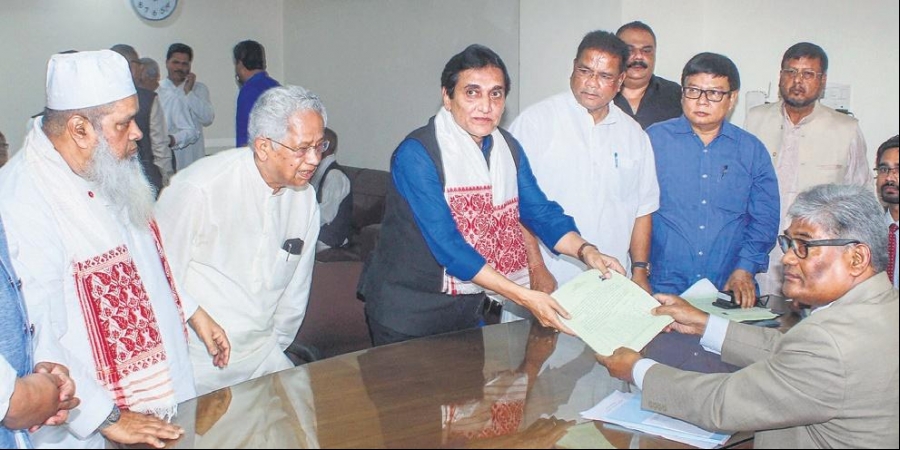
Ajit Bhuyan filing his nomination papers for the Rajya Sabha elections in the presence of former Assam chief minister Tarun Gogoi (second from the left) and AIUDF chief Badaruudin Ajmal (extreme left). Photo: PTI
That the Congress and the AIUDF came out in support of you in the elections has raised several eyebrows.
The Congress and the AIUDF are against the CAA. I neither belong to the Congress nor to the AIUDF. But yes, I am vehemently opposed to the CAA. When both the parties wanted to field an anti-CAA consensus candidate for the Rajya Sabha, and approached me, I said yes. And all my friends and well-wishers welcomed it.
You may perhaps recall that my candidature was supported by all anti-CAA forces in Assam. It became evident the day I submitted my nomination papers. Besides the top leaders of the Congress and the AIUDF, other opposition leaders, leading citizens and intellectuals, were also present there too.
Also, what can I say about AIUDF? They support the Indian constitution and also the Assam Accord. It supports the update of the National Register of Citizens (NRC) and is against the CAA.
What can the people of Assam look forward to from you as a member of the Rajya Sabha?
I really don't know as an independent member what significant role I can play in the Rajya Sabha, because, as you may know, as an independent, my scope will be limited. But of course, I shall try my best to represent the voice of Assam as far as the issues of national questions and Assamese identities are concerned. And outside the parliament too, I shall try to lobby for Assam through various civil society fora and platforms.
Recently, the Clause six committee – set up by the central government to define who are ‘Assamese people’ under the Accord and what ‘constitutional safeguards’ they should be granted – submitted its report to the Sarbananda Sonowal government. The report is not in the public domain. As a public figure and a close watcher of Assamese society, if I can ask you, who, according to you, is an Assamese?
I am not at all hopeful about any outcome from the Clause six committee set up by the Ministry of Home Affairs. The way it was hurriedly constituted and re-constituted, it seemed the sole purpose of having the committee was to defuse the anti-CAA movement.
As far as the definition of ‘Assamese’ is concerned, I would like to quote a portion of the recommendations submitted to the Clause Six Committee by the Axom Nagarik Samaj because I was also a party to it. To the question: Who are the indigenous Assamese, the Samaj said:
a) All the communities which were included as indigenous communities in the census of 1891;
b) All the communities enlisted by the Census Commissioner in the census report of 1951;
c) The people who identified themselves as one of the indigenous communities of Assam in the 1971 census and pledged to do so in future.
d) The tea tribe communities who were brought to Assam in the British colonial period. Again, all the communities who were considered Original Inhabitants (OI) at the time of the preparation of the updated NRC.
Also read: Oppose the NRC, but Not Just for the Bureaucratic Incompetence Accompanying it
Finally, political observers in Assam are already looking at the 2021 assembly elections as an important due to the huge anti-CAA protests in the state. Do you think there is a possibility of a united opposition against the ruling BJP? Also, do you think Congress will join hands with AIUDF and, if that happens, BJP would try and take advantage of it by terming AIUDF as a communal force – something that the Hindu right wing party has often done? In the 2016 polls, AIUDF chief Badaruddin Ajmal's statement that he would be the 'kingmaker' did help the BJP in polarising the elections and pocket Assamese votes.
It is difficult to answer all of these questions definitively at this moment. It would be at the risk of being speculative.
Still, I must add that I see every possibility of forming an alliance against the BJP by all the anti-CAA forces for the next assembly elections. I also see a possibility of Congress and AIUDF coming together. But again, I am also not the right person to give a definitive answer this question.
The BJP's allegation against the AIUDF as a ‘communal’ party doesn't hold good. AIUDF represents the interests of the religious minorities of Assam. Only because it represents such a voice, you cannot call the party ‘communal’. But BJP is an out and out communal party.
This article went live on April third, two thousand twenty, at zero minutes past seven in the morning.The Wire is now on WhatsApp. Follow our channel for sharp analysis and opinions on the latest developments.


