

Bihar: Was the Cabinet Reshuffle an Exercise to Cut Nitish Kumar Further to Size?


Patna: Soon after retaining power in 2019, Prime Minister Narendra Modi offered Janata Dal (United) a ministerial berth but its then chief, Nitish Kumar, refused.
The Bihar chief minister said the offer was not proportionate to his party’s strength. The JD(U) has 16 MPs against the BJP’s 17 from Bihar.
Two years down the line, JD(U)’s new president, Ram Chandra Prasad Singh or 'RCP', who had also been one to articulate the reasons for the party not to have a Union minister in 2019, took the oath as Union minister among others on Wednesday.
He was the only member from JD(U) to do so.
Now the question arises as to how Nitish Kumar made this decision, despite BJP not accommodating at all Nitish’s demand for “proportionate representation”.
Has BJP’s central leadership, through the cabinet reshuffle, cut Nitish further to size? Is BJP keen to reward anti-minority voices in Bihar?
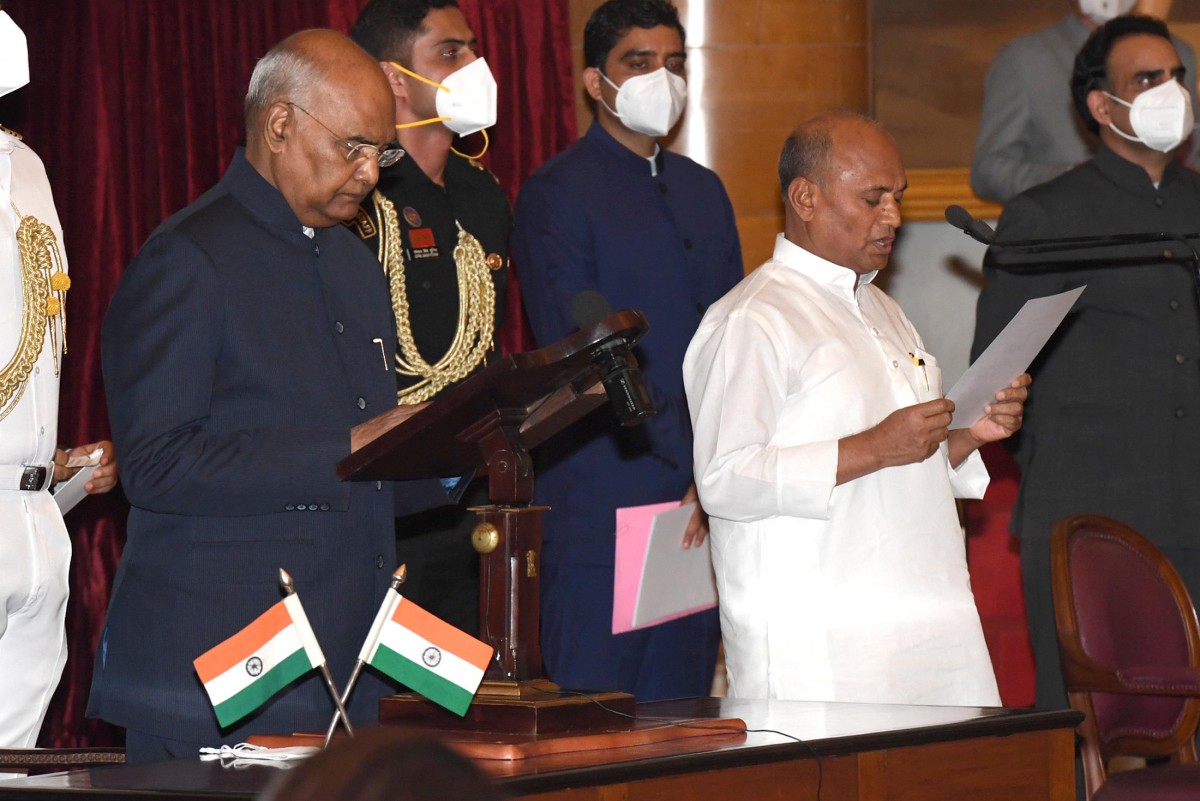
President Ram Nath Kovind administers oath to Ramchandra Prasad Singh as a Cabinet Minister, at a swearing-in ceremony at the Rashtrapati Bhavan, in New Delhi Wednesday, July 7, 2021. Photo: PTI
Operation against Nitish
Nitish's desertion of the RJD-JDU-Congress mahagathbandhan in the background of the Rs 2000-crore Srijan scam and return to the BJP under Narendra Modi-Amit Shah was nothing if not sudden. Nitish had rebelled against Modi’s rise and deserted the BJP in 2013.
But the BJP has, very systematically, been cutting Nitish to size ever since his return.
The Central Bureau of Investigation (CBI) filed a charge-sheet against the former IAS officer-turned-JD(U) leader and close aide of Nitish, K.P. Ramaiah, eroding Nitish’s image of running a corruption-free dispensation ahead of 2020 assembly elections in the state.
The Modi-Shah duo sharpened their political manoeuvres against Nitish even more after the 2020 assembly elections. It replaced the BJP stalwart and Nitish’s ‘friend’, Sushil Kumar Modi with two lesser known party leaders, Renu Devi and Tarkeshwar Prasad – identified with hard-line Hindutva – as deputy chief ministers.
In fact, Sushil Modi – a product of the JP movement who grew in the era of Atal Bihari Vajpayee and L.K. Advani and appeared to adhere to an accommodative and comparatively liberal politics – was the key link between Nitish and the erstwhile BJP high command.
Plus, Nitish had Arun Jaitely – who too had grown tall under the tutelage of Advani and Vajpayee – as his “friend” who advocated for Nitish at the BJP’s central high command.
Also read: A Cabinet Reshuffle That Holds Out No Promise of Good Governance
It was when Jaitely was in charge of the BJP’s affairs in Bihar that BJP had given more seats to the JD(U) and Advani had declared Nitish as NDA’s prospective chief minister ahead of 2005 assembly elections. Jaitely was reasonably powerful in the Modi-Shah era too when Nitish returned to the BJP. Jaitely’s death took away Nitish's staunch advocate at the BJP.
What has surprised one and all in Bihar is that the Prime Minister has left out Sushil Modi – who was sent to the Rajya Sabha after losing his deputy CM’s position – in his cabinet reshuffle on Wednesday.
By far, Sushil has played the pivotal role in building the BJP and also the NDA against the mighty Lalu Prasad Yadav in the last three decades. Sushil had emerged as the face of Bihar BJP in 1990s when Narendra Modi was struggling to get a foothold in Gujarat BJP and Amit Shah was a persona non grata.
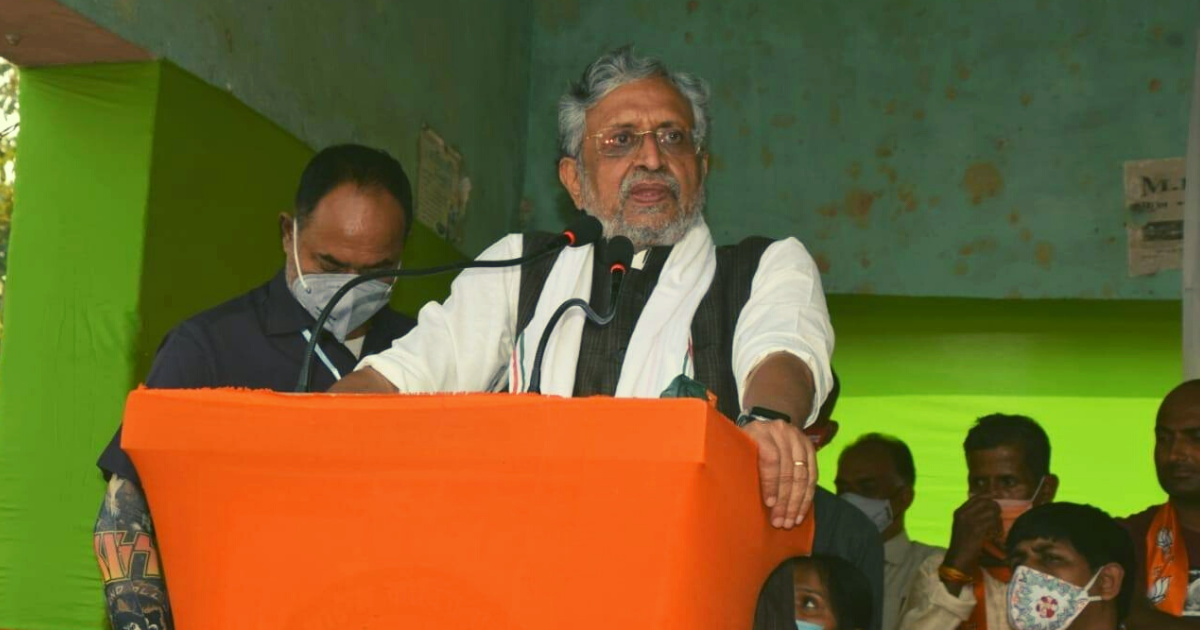
Sushil Kumar Modi at an election rally during the Bihar state assembly elections 2020. Photo: Facebook/ Sushil Kumar Modi
The circumstances in which Ram Chandra Prasad Singh has been inducted in the central cabinet suggests that RCP has been “rewarded” for playing ball with the prime minister and Union home minister more than working for the interest of his own party.
Before deserting the mahagathbandhan, Nitish had incidentally visited Rajgir with RCP. It’s believed that Modi-Shah used RCP – who is from the same caste and Nalanda district as Nitish – in getting Nitish back to the BJP fold. Nitish had ditched the mahagathbandhan soon after returning with RCP to Patna in July 2017.
After Nitish’s return to the BJP, RCP has invariably been championing the BJP’s line more than his own party’s. For example, he had spoken more vociferously than even the BJP leaders in supporting the Citizenship Amendment Act (CAA) in parliament and has been extremely soft on the NRC and Uniform Civil Code too – which were seen as key differences between the JD(U) and BJP.
He is also believed to have played a pivotal role in getting Nitish to sack the former diplomat Pavan K. Varma and election strategist Prashant Kishor who opposed the NRC and CAA. The grapevine has it that RCP is “Narendra Modi’s and Amit Shah’s man” in the party of Nitish who now has no one to represent him in the BJP.
Promoting anti-minority voices
Within a week after the RSS chief Mohan Bhagwat said, “Those asking the Muslims to go to Pakistan are not Hindus”, the PM has drafted Anurag Thakur – who gained infamy for his “goli maaro…ko” jibe – in his cabinet as information and broadcasting minister.
But what is important in Bihar’s context is that the prime minister has pampered Giriraj Singh who had joined the Centre as a minister of state but now holds the key rural development portfolio which the RJD leader and socialist stalwart Raghuvansh Prasad Singh once held. Giriraj had openly asked Muslims to "go to Pakistan” before the 2014 Lok Sabha, 2015 assembly elections and 2019 Lok Sabha elections.
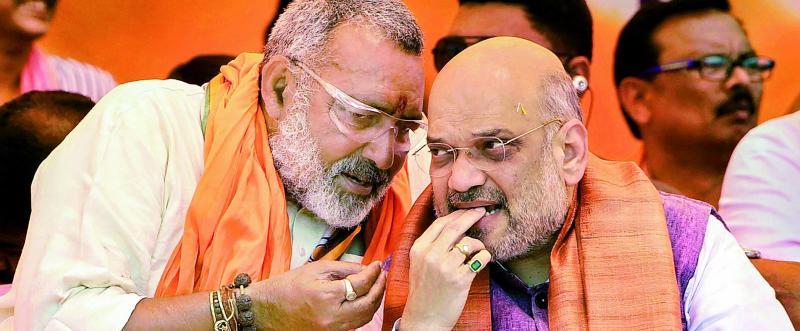
BJP president Amit Shah and Giriraj Singh during an election campaign rally in Begusarai district. Photo: PTI
He was an eyesore for Nitish even when the latter was more powerful in the pre-Modi Shah era. The prime minister has also dropped Ravi Shankar Prasad, the Patna Sahib MP, from his ministry. Though a product of the Advani-Vajpayee era, Ravi Shankar has, of late, tried his best to catch up with the new BJP by attacking the farmers’ stir and launching a war against and on Twitter.
A surprise inclusion in the cabinet is the leader of the breakaway Lok Janshakti Party, Pashupati Kumar Paras. The saffron party had, apparently, used the LJP chief, Chirag Paswan against Nitish’s JD(U) in 2020 assembly elections. It is said that Nitish played from behind the scenes to engineer a split in the LJP as revenge against Chirag.
Pashupati and the group had expressed faith in Nitish’s leadership. The grapevine has it that the prime minister has, in fact, made Pashupati minister from the JD(U)’s “quota”.
Nalin Verma is a senior journalist, author and professor of journalism and mass communication at Invertis University, Bareilly, Uttar Pradesh.
This article went live on July eighth, two thousand twenty one, at thirty minutes past eight in the evening.The Wire is now on WhatsApp. Follow our channel for sharp analysis and opinions on the latest developments.


