

Sultan Modi's Slave Dynasty is No Better than the Family Dynasties in Other Parties


From time immemorial, heredity has been the accepted principle for succession in monarchies. With the advent of democracy and the abolition of absolute monarchies, rulers are born, as the saying goes, not from the womb of a queen but out of the ballot box.
Yet, there are many democracies, including our own, where political families have held sway and have provided leadership, generation after generation. One of the more famous examples of this in India is of the Nehru-Gandhi family, of which the fifth generation is now leading the Congress party, after having ruled it for four generations – three directly and one indirectly.
Today, the family and the principle of heredity in a democracy are directly under attack by no less a person than the prime minister of the country himself. He wants the people to reject the whole concept of dynasty in a democracy for good. I fully agree with him. But replace it with what? Let us examine this important issue in some detail.
Also read: BJP's Illiberalism Resembles a Ruling Party in an Autocracy: Study
The Nehru-Gandhi family is not the only dynastic political family in India today. There are now many of them in various parts of the country. Some of them started as staunch opponents of the dynastic principle but fell prey to it when they themselves got the opportunity. Should the dynastic principle be opposed in a democracy? Certainly. But what if people bless a dynast and he wins elections? In the recent Bihar assembly elections, Tejashwi Yadav, son of Lalu Prasad Yadav, fought spiritedly and nearly caused an upset. He came in for praise from the people, specially the media, and nobody held his lineage against him, except the prime minister and his party.
But what is the state of affairs in the BJP, which prides itself on the fact that it is a party where internal democracy prevails, elections to various party posts are held regularly and workers make progress in the party on the basis of merit and hard work, not heredity? Having spent many years in the BJP, I know how hollow its claim of inner party democracy is.
Internal elections, even if held, are a sham. The future incumbents, specially at the top levels, national as well as in the states, are pre-decided by a nameless coterie consisting of some of the top leaders of the party and the RSS. Then a show of election is held and the chosen one is declared elected unanimously.
Once, I chose to challenge this prevailing practice. Nitin Gadkari was the president of the party. It was decided by the bosses that he would get a second term. I decided to play the spoiler. The electoral arrangements were fully in place. A returning officer had been duly appointed. The election schedule had been announced. Anyone could approach the returning officer for nomination papers. I knew that not only had I no chance of ever winning the election, I might not even have got the required support to even file my nomination papers. Yet, I decided to ask for the nomination papers.
The news that I had asked for the nomination papers was soon all over in the media. This simple act forced the bosses to reconsider their decision and they did. It was immediately decided that Gadkari would not get a second term; instead Rajnath Singh would be made the party president. I had made my point and left the matter at that. Rajnath Singh was declared elected unanimously.
While the BJP at least goes through the motions of internal elections, the Congress party and many others could not care less and have not held inner party elections for decades. In the great democracy of India, there is no inner party democracy anywhere. Except, perhaps, the Left.
Also read: Apparatchik Who Called Modi ‘Supercomputer' Named as India’s Ambassador to UNESCO
The situation in the BJP has worsened considerably in recent years with the ascendance of a single most powerful person, both in government and in the party. Dynasties are bad for democracies, specially if they go on and on, as in the Congress party today. Rahul Gandhi does not want to lead the party, yet the party would not let go of him. The grand old party’s utter dependence on one family is pathetic, to say the least. And as long as this continues, Modi is fully secure in power. But what about inner party democracy in the BJP?
The BJP has today become a party of slaves. Does that surprise you? It should not because we have an example of this in our own history. There was a time when India was ruled by the ‘Slave dynasty’ for many decades. Qutbuddin Aibak was the favourite slave of his master Muizzuddin and became the sultan of Delhi. He was succeeded by his favourite slave, Iltutmish. Then came Balban, the favourite slave of Iltutmish. Degeneration set in after that, and after Razia Sultan the slave dynasty disintegrated. But the fact that it provided three or four generations of sultans in Delhi is a recorded fact of history.
Many people may have forgotten the circumstances under which Modi was anointed the prime ministerial candidate of the BJP in the Goa national executive meeting of the party. But they may not have forgotten how protest demonstrations were held in front of L.K. Advani’s residence in Delhi because he did not go to Goa to attend that meeting and it was assumed by the Modi supporters that he was opposed to this move. This was a precursor of things to come.
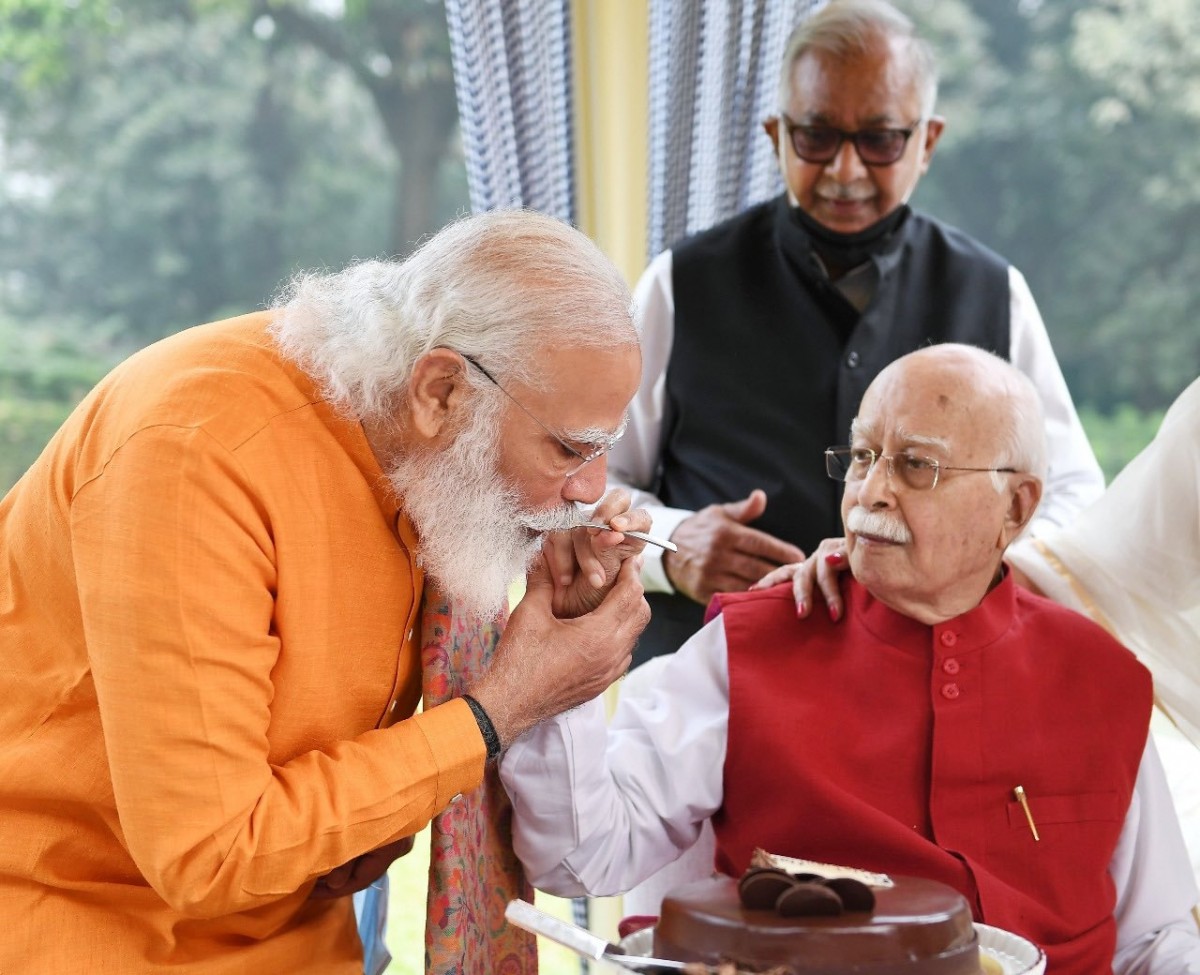
Narendra Modi and L.K. Advani. Photo: Facebook/Narendra Modi
Soon the party surrendered completely before Modi. His stunning victory in the Lok Sabha elections of 2014 made him the supreme leader of the party and he could do as he pleased. He asserted his authority in many ways. The seniors were shown the door; some of them were made members of the ill-fated marg-darshak mandal, which never met. The others fell in line in no time.
The ruler could pick his favourite slaves and appoint them to whatever post he liked. So, a mere minister of state in a state government was made the party president and the second most important leader of the party. Other favourites also prospered. The structure of the party at the top today is – one sultan and a bunch of slaves. Will someone enlighten me on how this slave dynasty is better than a family dynasty?
The answer to this question is we need more democracy. Indian democracy is incomplete without full inner party democracy. We must reject both family dynasties as well as slave dynasties.
In the New India of today there is no room for protests. A protestor is immediately damned as a traitor. People do not even ask questions because they are too scared. Institutions of democracy are either dead or devalued. Those who raise their voice against the government are more under scrutiny in the media than the rulers.
One question about Nazi Germany has always baffled me: one can understand the madness of one man, but not the lunacy of a whole nation. We are in that stage now. India badly needs a new opposition. The present scattered and ineffective opposition will not do. Will those who are active in politics today, both in the BJP and in the opposition, apply their mind to it and fill this much needed gap to save our democracy, our values and our country?
Yashwant Sinha is a former finance minister and former external affairs minister of India.
This article went live on November twenty-fourth, two thousand twenty, at thirty-nine minutes past two in the afternoon.The Wire is now on WhatsApp. Follow our channel for sharp analysis and opinions on the latest developments.


