

Digvijaya Singh – Congress's Kingmaker in Madhya Pradesh


Some months before actual campaigning started in Madhya Pradesh, ticket-seekers were knocking on every possible door while Shivraj Singh Chouhan's head was too far in the clouds to really see what was actually happening on the ground.
Fifteen years after he had left the shores, a Raja was being feted in his own backyard by enthusiastic crowds in Rajgarh. It was a simple dinner organised for all karyakartas by the district Congress. A crowd of about 10,000 turned up and Digvijaya Singh – the erstwhile Raja of neighbouring Raghogarh, shook hands and posed for a selfie with all of them individually. He stood on the crowded stage for more than six hours, spoke and admonished the unruly crowd, cracked jokes with familiar faces and generally enjoyed his time with the people.
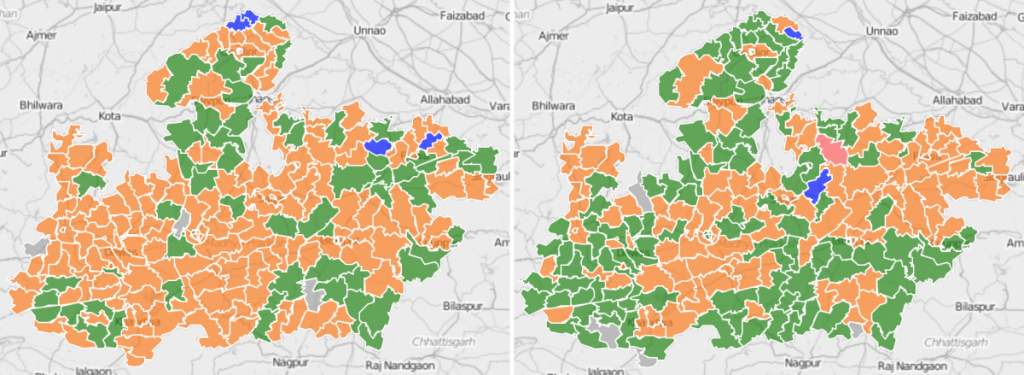
Assembly election results for 2013 (left) and 2018 (right)in Madhya Pradesh. Credit: newsclick.in
Even his worst detractors will begrudgingly accept now that the Congress victory in Madhya Pradesh was almost single-handedly chalked out on the ground by Digvijaya Singh. If you examine how the colours have changed on the map of Madhya Pradesh from saffron to green, one thing stands out: most victories for the Congress have come from the Narmada belt – stretching from the east to the west of the state – and from the Gwalior-Chambal region. Vindhya Pradesh, Madhya Bharat and the Mandsaur regions, despite the Kisan agitation, remained outside its grasp.
What could be the reason behind this turn-around?
The unsuspecting BJP – with its penchant to berate him and depressed and deflated Congressmen – didn't take particular notice when Singh returned in 2017 doing what he had done in 1992 as PCC president. He had toured the state and met the masses and almost every Congress worker individually. He had felt the pulse of the land and brought down the entrenched Sunderlal Patwa government – heady from the Ayodhya movement.
Also read: My Chief Ministership is Absolutely Out of the Question: Digvijaya Singh
This time, at the age of 70, he had an even more elaborate and physically demanding plan. He had decided to do a Narmada Parikrama Padyatra over six months – which involved walking about 30 kms every day accompanied with his wife by his side.
Politically, the parikrama traversed about 128 of the 230 constituencies in the state. The BJP has for long worked on beguiling the circuit – having both religious and political significance. The parikrama covers the rich agricultural plains of the Narmada river. Anil Madhav Dave, former Union minister and RSS worker, had for long worked on his own Narmada Parikrama project.
Shivraj Singh Chouhan tried to implement parts of that by planting trees along the Narmada's banks and making a road network for the parikrama yatris. But much of the effect was lost in histrionics and publicity. While he flew around in his chopper, Singh decided to meet the people directly. He contacted his people, followers and party workers. Night-halts, ashrams, villages and people who would walk with him were chosen with care.

Kamal Nath is said to be close to Digvijay Singh. Credit: PTI
Two things became immediately clear after The Wire walked with him in the Raisen district during the fifth month of his yatra in March this year: one, people still loved and believed in him and brought their issues to him, and two, he successfully garnered social acceptability for his young wife. He talked sparsely of politics, had lost at least ten kgs, but his smile was back.
The padyatra taught him a few things. He shortlisted issues he was going to barb Chouhan and the BJP with: mostly about farmers, price rise and the Vyapam scam. He was going to distance himself from Delhi and Bhopal as much as possible – eluding the spotlight. Tongue firmly in cheek, he even said that if he opens his mouth, Congress will lose votes.
Refraining from commenting on national issues altogether, he did not address the BJP at all. In a year which began in September 2017 and ended with the elections last fortnight, Singh must have travelled thousands of miles and met almost anyone willing to meet him.
Also read: In Late-Night Move, Congress Stakes Claim to Form Government in MP
But he had made his candidate lists. Kamal Nath and he go way back, and he has often said that he owed his first chief ministership to Nath. Now was his time to return the favour. They both sat down and dug out every Congress leader worth his or her salt from the 1990s and gave them a ticket. The sons, wives and relatives of the dearly departed came next and they chalked out regional responsibilities for every leader –from Scindia in the North to Ajay Singh in the Vindhya, Pachauri in the Hoshangabad region to Yadav in the west. That’s how the Congress has always worked in the state and his primary objective was to keep the district satrapy united.
One of the best ways of doing so was to remain in the background.
Let people talk about his declining clout rather than flock to him with complaints. Because of him being on the field, Nath was able to entrench himself in the Bhopal head office and direct other senior leaders to remain in their territories. Vivek Tankha monitored every movement for Nath and emerged as the key player in this elections.
However, their operational freedom was ensured by the backup Digvijaya Singh provided on the ground. There is little doubt among long-term observers that key ministries and bureaucratic offices in the state will be manned by his people. This is Digvijaya’s second coming.
This article went live on December nineteenth, two thousand eighteen, at fifteen minutes past one in the afternoon.The Wire is now on WhatsApp. Follow our channel for sharp analysis and opinions on the latest developments.


