

Durga Puja and the War for Bengal’s Political Soul


The streets of West Bengal, particularly in Kolkata, are a spectacle during Durga Puja. But beyond the artistic brilliance of the pandals and the devotional fervour, this annual festival has become the central theatre for a high-stakes political contest coupled with economic incentivisation, and exercising club-based control.
The contest is not just about winning votes; it is about owning the cultural narrative of Bengal itself. The Trinamool Congress (TMC) and the Bharatiya Janata Party (BJP) are locked in a sophisticated battle, each employing distinct and calculated strategies to harness the festival's immense cultural and emotional capital. For example, in a north Kolkata pandal, the focus is on assault of the Bengali language and Bengali pride. In contrast, at the famous Santosh Mitra Square, Operation Sindoor is the theme. The festival, for decades seen as an inclusive social event, is now an intricate web of patronage, symbolism, and cultural appropriation, marking a new, more intense phase in Bengal's political history.
The TMC's strategy is rooted in the political economy of festivals. Its approach can be best understood as a form of patronage politics, where the state, under the guise of cultural promotion, distributes largesse to a network of loyalists who, in turn, ensure political compliance and control. The government's escalating financial grants, electricity waivers, and fee exemptions for thousands of puja clubs are a case in point. What began as a modest sum in 2018 has grown exponentially, cementing the TMC's role as the benevolent patron of the state's most cherished cultural institution. This generous support, while seemingly aimed at bolstering the estimated $4.5 billion creative economy of the festival, is in fact a strategic investment in a vast and influential grassroots network.
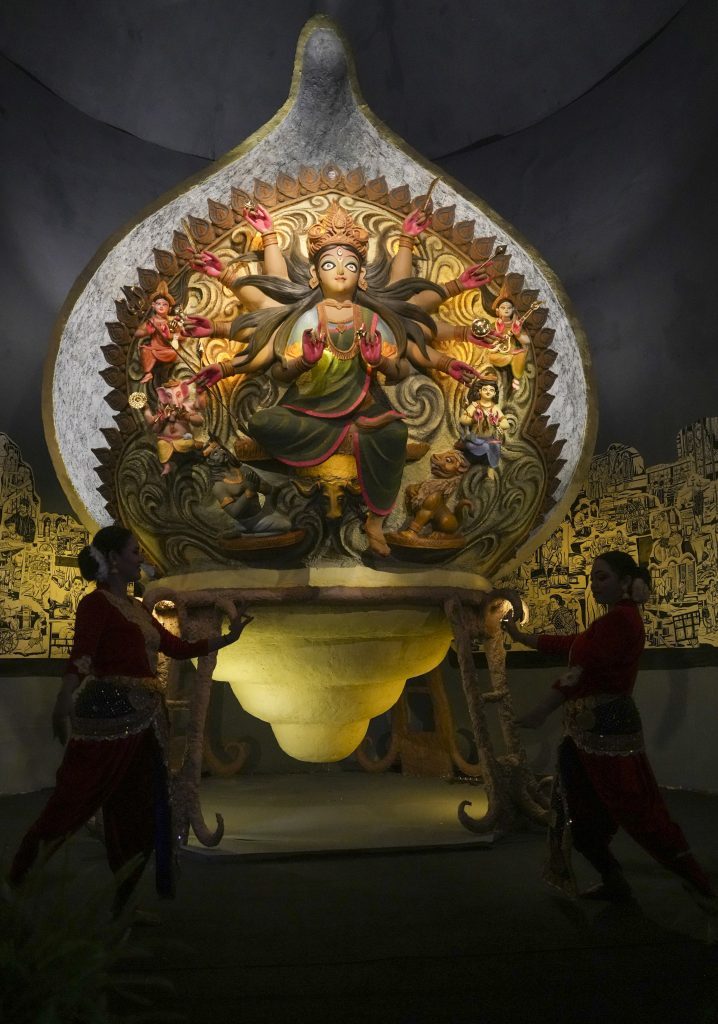
Artists perform at Chaltabagan Durga Puja pandal themed on 'mool' (roots) and the 'evolution of Bengali language', in Kolkata, Saturday, Sept. 27, 2025. Photo: PTI.
These puja clubs are more than just festive committees; they are deeply entrenched power grids within Bengal’s neighbourhoods, or paras. Their influence extends far beyond the festive season, often acting as local nodes of political control. Allegations of extortion, particularly in the lucrative real estate sector, and their role as de facto moral police in their communities are well known. By funnelling public funds through these clubs, the TMC effectively transforms them into an extension of its political machinery. The grants provide political capital, ensuring the loyalty of these local power brokers who can mobilise support, intimidate opponents, and ensure electoral victories at the grassroots level.
This system also serves as a potent political shield. The TMC, long accused by its opponents in the BJP of "Muslim appeasement," uses its public and generous patronage of Durga Puja to demonstrate its Hindu bonhomie. The grants become a public spectacle of inclusivity, a carefully curated image designed to counter a politically damaging perception and appeal to the state's majority Hindu electorate without alienating its traditional Muslim vote bank. Cultural celebration, in this process, becomes a casualty, its sanctity and essence overshadowed by the transactional nature of power and the politics of cultural recognition.
The BJP, on the other hand, has been engaging in a full-fledged cultural offensive aimed at the very heart of Bengali identity. Recognising that its North Indian "Jai Shri Ram" slogan has limited resonance in a state with a rich and distinct cultural heritage, BJP is attempting a strategic rebranding. It is actively co-opting and re-contextualising Bengali religious symbols to expand its pan-Indian Hindutva narrative. Instead of a distant and culturally alien deity, the party is now centring its narrative around Ma Durga and Ma Kali, deities who hold immense personal reverence for many Bengalis. The BJP’s aim is to portray itself as the true protector of this cultural and religious identity, accusing the TMC of political betrayal and cultural negligence.
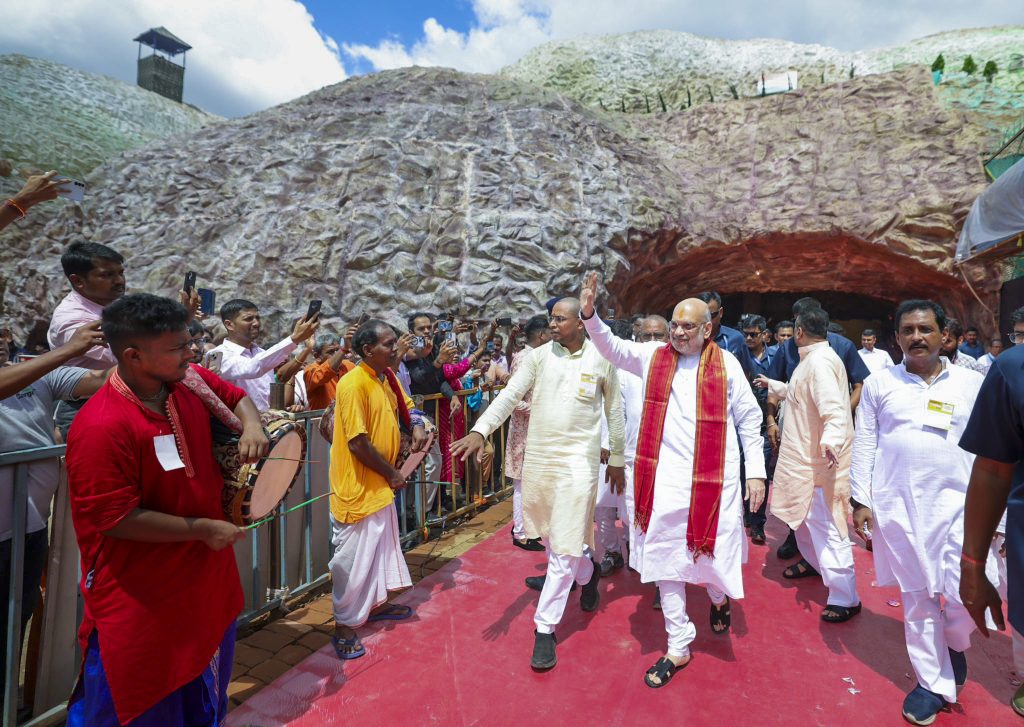
In this image posted on Sept. 26, 2025, Union Home Minister Amit Shah during inauguration of the Durga Puja pandal of Santosh Mitra Square, in Kolkata. Photo: @AmitShah/X via PTI.
This strategic shift is executed on two major fronts:
The BJP is actively organising and participating in its own Durga Puja pandals. These are not just spaces for worship; they are stages for ideological projection. The themes are often nationalist and muscular, such as Operation Sindoor which pays tribute to the armed forces, or depictions of nationalistic figures and moments in history. This stands in stark contrast with the TMC's focus on Bengali pride and the celebration of local art and craftsmanship. By sponsoring pujas and announcing plans to attend more than 100 pujas, BJP leaders have sought to legitimise the party's presence and demonstrate its commitment to Bengali culture, thus establishing a powerful counter-narrative to the TMC's local dominance.
The BJP also consistently criticises the TMC for actions it deems to be culturally insensitive or anti-Hindu. It accuses TMC of inaugurating pujas during the inauspicious Pitru Paksha and earlier, it accused it of restricting immersion processions to accommodate Muharram rallies. These criticisms are designed to frame the TMC as not genuinely committed to Hindu traditions, thereby highlighting the BJP as the more authentic choice for Hindu voters.
In this high-stakes competition, the sacred and the political have become inextricably linked. The TMC's approach is to control the festival from the ground up through a system of patronage that ensures the loyalty of local power brokers. BJP's strategy is to capture the cultural narrative from the top down, a strategic manoeuvre to convince Bengali voters that it is the true custodian of their religious identity.
This dynamic is a compelling case of the terrain of symbolic and political anthropology, which explores how cultural objects and rituals are used to negotiate power and meaning in society. Both parties are treating Durga Puja as a form of cultural capital to be leveraged and deployed in the political arena, creating and further capitalising on what is known as ‘cultural misrecognition’. It is a mechanism which drives people’s focus away from issues of public service delivery to primordial cultural apparatuses. While the TMC is using it as a symbol of its grassroots strength and benevolent leadership and subtly ensuring continuous club patronage over a large social spectrum, the BJP is using it as a symbol of its ideological purity and nationalistic vision. The goddess herself has become a political symbol, a divine force invoked by opposing parties to secure electoral victory.
The political battle over Durga Puja is not a mere clash of ideologies. It is a sophisticated fight for the very soul of Bengali culture. Both parties are attempting to harness the immense emotional and cultural power of the festival to secure political dominance. In this process, the vibrant essence of Durga Puja risks being overshadowed by a high-stakes competition for cultural ownership and electoral supremacy.
Suman Nath is a political anthropologist and teaches in Government General Degree College, Keshiary, Paschim Medinipur, West Bengal.
This article went live on September twenty-ninth, two thousand twenty five, at thirty-seven minutes past one in the afternoon.The Wire is now on WhatsApp. Follow our channel for sharp analysis and opinions on the latest developments.


