

Is Azam Khan the Wildcard for Opposition Success in the 2027 Uttar Pradesh Polls?


Since his release from Sitapur Jail on September 23, Mohammad Azam Khan has swept through Uttar Pradesh politics like a whirlwind, delivering a torrent of interviews filled with biting satire, raw anguish and unfiltered accusations.
In one especially caustic remark, played on platforms like NDTV and Aaj Tak, he mockingly called himself a “murgi chor” – chicken thief – a sardonic jibe aimed at the Yogi Adityanath-led government, which has slapped over 70 cases against him. From land grabbing to hate speech, Khan faces it all – but deftly frames it as vendetta against him and his rise by the Bharatiya Janata Party (BJP) government.
Khan also doesn't seem to tire of invoking his undying loyalty to the Samajwadi Party, of which he was a founding member, having joined its tallest leader, Mulayam Singh Yadav, in 1993. Never once did Khan shift allegiance, even as Mulayam’s own brother switched to its biggest rival, the BJP.
Khan’s humorous takes on his legal troubles, which include prolonged incarceration – wrongly, he says, and deservedly, his critics insist – have amplified the sympathy he once enjoyed in Rampur, though without the added burden of legal cases.
In fact, Khan’s entire family has seen the inside of prisons, wife Tazeen Fatima and son Abdullah Azam included. But his ability to poke fun at himself despite it all appears to have triggered widespread sympathy. Some even wonder if his influence might now grew beyond his bastion and birthplace, Rampur.
It would be a fond hope of Azam Khan for the state’s 3.8 to 4 crore Muslims – 19% of the 20 crore total population – to see in him a mirror of their own marginalisation. This would be his particular wish for the Pasmanda or backward Muslims, whom the BJP has assiduously tried to woo over the last three years.
As Rohilkhand and western Uttar Pradesh gear up for the 2027 assembly election in the state, the question is inevitably being asked: will Khan return like the phoenix to rebuild the Samajwadi Party’s dwindling fortunes in Rampur? And how much further could this influence extend geographically?
Pasmanda Muslims make up roughly 80% of Uttar Pradesh’s Muslim population and about 15% of the state’s population. It is believed that they can see in Khan a person who can truly understand what living under the sharpened edge of Hindutva has meant to them.
At the same time, Khan’s quips to TV channels have left people guessing at the future: will he ever let himself be harnessed by the Samajwadi Party again, even help it reclaim and fortify its fortunes? Unlikely, say his admirers, and very likely, say those who hope Uttar Pradesh’s Muslim voters will, in the 2027 election, consolidate behind a unified opposition. That consolidation can only secure a victory for the BJP's rivals if Khan is included in the opposition grouping and actively contests on its behalf. After all, the BJP has, in 2017 and 2022, secured nearly 40% and over 41% of the popular vote, respectively.
But ultimately, the choice of Azam Khan's future rule will be Akhilesh Yadav’s. The former chief minister of Uttar Pradesh is expected to grant Azam Khan his “due place”, but nobody has yet been able to define or predict what that is.
Pasmanda icon, secular fold
At 77, Azam Khan has a personal history that backs the gritty, unapologetic ethos of Pasmanda politics: Born in 1948 in Rampur to a Sheikh (Ajlaf or backward) family, he clawed his way from rickshaw-puller and labourer to barrister. He has mobilised bidi workers, weavers and madrasa students against Ashraf (elite) Muslims – such as Rampur's former nawabs.
His identity, thus, can be the Samajwadi Party’s bridge to the PDA or ‘Pichhda, Dalit, Alpsankhyak’ – backward, Dalit, minority – electoral formula. That propelled the Samajwadi Party to 111 seats (32% of popular votes) in the 2022 assembly election and 37 in the 2024 Lok Sabha election.
But being Azam Khan also means being the ‘sher’ (lion) of Rohilkhand, a Muslim-Yadav heartland where he scripted his party’s 2012 landslide through minority scholarships schemes and infrastructure projects. Uttar Pradesh has 403 Assembly seats and the Rohilkhand region has 57, where the Samajwadi party scored an over 35% vote share.
Azam Khan is a polarising figure, accused of feudalism and often embroiled in controversies – such as political feud with actress Jaya Prada, a former Samajwadi leader who has shifted to the BJP, that took on deeply personal and sexist tones after 2004. Recall that Khan was convicted by an MP-MLA court for provocative remarks about Chief Minister Yogi Adityanath, which then cost him his membership of the Uttar Pradesh assembly.
Also read: Who’s Afraid of Azam Khan? Of 87 FIRs Pending, 84 Filed Since Yogi Became UP CM
Khan’s post-release persona highlights this duality – he may make light of his incarceration, but his remarks have meant the loss of Rampur for him, his family – son Abdullah was also convicted, leading to his disqualification from the assembly – and the Samajwadi Party.
Seen in this context, Khan’s latest expressions of fealty to Mulayam – who is no more – evokes his origins from the socialist roots of the party, and sets him apart from today’s opportunism. This, too, has made him a sympathetic figure. Post-poll surveys like CSDS-Lokniti in 2022 showed that around 79% of Muslim voters had consolidated behind the Samajwadi Party in Uttar Pradesh, up from 19-28% in 2017’s fragmented election.
Some even say that Khan’s jail saga boosted the Pasmanda turnout in favour of Uttar Pradesh to over 90% in 2023.
For the Samajwadi Party, Azam Khan symbolises more than ‘pasmanda appeal’. He symbolises resilience against the ‘anti-Muslim’ policies and ‘bulldozer justice’ of the ruling party, such as the Citizenship Amendment Act (CAA), the economic distress and the vitriol directed against Muslims, that have created a climate of fear among minorities.
But Khan is also a liability: In 2024, he wrote a letter accusing the INDIA bloc parties of ‘conspiracy’ and hinted at defection to newcomer Chandrashekhar Azad's Aazad Samaj Party (ASP). He can potentially splinter 5-10% of the Dalit-Muslim votes away from the bloc.
In essence, being Azam is to be the Samajwadi Party’s electoral wildcard – useful for mobilisation, risky for optics.
From Rampur’s Electoral Colossus to Downfall
Rampur, the cultural jewel of Rohilkhand, has an over 50% Muslim population in its roughly 23 lakh residents. Khan's clout here is near-mythic: a ten-time MLA from the Rampur Sadar seat (1980-2022, including 1985, 1989 as Janata Dal, then Samajwadi Party), he trounced the Rashtriya Lok Dal’s Nawab Kazim Ali Khan in the 1980, ending aristocratic dominance.
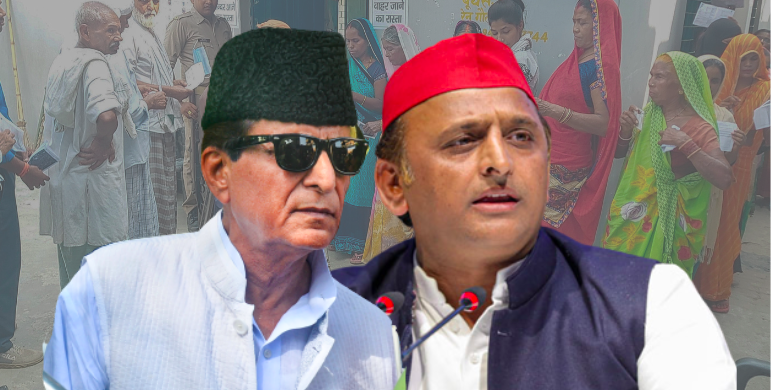
Azam Khan and Akhilesh Yadav. In the background are voters queuing to vote in the Rampur bypoll. Photos: PTI
As Member of Parliament from 2004-19, he delivered highways, hospitals and a university, cementing loyalty among locals. In 2012, his machine powered the Samajwadi sweep of Rampur’s segments. In 2022 – from inside prison walls – he orchestrated Abdullah’s victory in the Suar segment of Rampur, and his own in Rampur proper, both by margins upwards of 20,000 votes. Those wins contributed to Akhilesh Yadav’s 13 seats in Rohilkhand, just one less than 14 in 2017.
The downfall began after the BJP swept Uttar Pradesh in the 2017 election, winning 312 seats statewide, including over half the seats in Rohilkhand, and 39.7% of the vote share. That election, held against the backdrop of the polarisation triggered by the Muzaffarnagar violence, was marred by a speech Khan allegedly delivered. His conviction on that "hate speech" charge was a seven-year jail term in 2022.
By 2024, a ten-year term in a land case had confined his family too, eroding Samajwadi Party’s hold over the Rampur Lok Sabha seat. Jaya Prada won in 2019 on the BJP ticket by 1.8 lakh votes.
In the 2024 Lok Sabha election, the Samajwadi Party ignored Azam Khan’s candidate preference, fielding Mohibbullah Nadvi, who won by 1.4 lakh. But Khan's shadow loomed over the constituency and region. The Samajwadi victory in Rampur in 2024 was attributed to the 70-80% Muslim voters whom he had mobilised.
Now, post-release in 2025, Rampur simmers in a silence before the storm. On October 8, Khan went into a two-hour huddle with Akhilesh in a Rampur decorated with posters proclaiming him the Samajwadi Party’s “foundation”. That hints at revival of ties, but there have been no rallies yet. Instead, Khan has delivered interview after interview, building suspense.
If unleashed, he could reclaim five to seven assembly segments – including old faithfuls Rampur, Suar and Shahabad. That would flip the BJP’s 41 Rohilkhand seats won in 2022 by 10-15%.
But for the moment, the storm brews quietly, amid whispers of defection. At the same time, the BJP has been talking up its welfare schemes among the public – Ujjwala gas cylinders, free rations – chipping away at the Pasmanda edges of the Samajwadi Party's base.
Rampur’s 2027 fate – Samajwadi Party resurgence or ASP incursion – will test if Khan’s clout endures or dissolves into nostalgia.
Game-changer for Samajwadi Party?
Rohilkhand and western Uttar Pradesh account for 57 and 117 assembly seats respectively, or a combined roughly 25% of the state’s 403 assembly seats. Rohilkhand's demographic distribution also mirrors the Samajwadi Party’s strengths: roughly 80% of the regional population is Muslim and Other Backward Classes, including the Yadavs and Jats.
In 2022, the Samajwadi Party and the Rashtriya Lok Dal’s (RLD) vote share of 40.2% yielded 21 seats (up from 14 in 2017), eroding the BJP’s 34.1% share.
In the future, Khan could target the BJP’s 30 remaining seats by trying to pull an additional 10 to 15% votes in the regions where Muslims and Yadavs are numerically dominant. For instance, in the 2024 Lok Sabha election, the Samajwadi Party won by 1.1 lakh votes in Moradabad and by 1.2 lakh votes in Sambhal.
Could Azam Khan do this? Why not – even from jail, he influenced six out of Rohilkhand’s 11 Lok Sabha triumphs, including Rampur and Bijnor. Else, joint Akhilesh-Khan rallies could mirror 2012’s 36% dominance and consolidate the nearly 80% Muslim votes (CSDS, 2022) against BJP’s 6-8%.
In western Uttar Pradesh, which has 25-30% Muslims and is socially and electorally Jat-dominated, Khan’s direct clout is thinner. But it is symbiotic with the Samajwadi Party’s own influence. After the RLD switched over to the BJP’s camp in 2022, he could become the glue for Jat-Muslim ties, maybe even boosting 5-8% in 15-20 seats.
Also read: RLD-BJP Alliance: What Does the Changed Political Equations Now Hold for Western Uttar Pradesh?
For example, Samajwadi Party won Kairana in 2024 by 1.5 lakh votes, while the ASP, an INDIA bloc ally, won by a 1.3 lakh margin.
Certainly, Khan’s narrative of anguish counters the BJP’s Pasmanda outreach, such as through the weavers’ cells it has created. This might lift the Samajwadis from 31.5% votes (28 seats in 2012) to 40% or more, yielding 30-35 combined seats.
Akhilesh’s calculus: utility vs. unease
Akhilesh Yadav and his Samajwadi Party stand at a crossroads. After the 43 Lok Sabha seats the INDIA bloc won in the 2024 Lok Sabha election, the party eyes a majority in the 2027 assembly polls. But internal fault lines – including Khan’s ignored preferences – simmer.
Khan could fortify the Samajwadi Party’s underrepresentation – it only had 34 Muslim MLAs in 2022, not even 10% of its total strength in the assembly. And, Akhilesh’s visit to Rampur, pledging withdrawal of cases against him, signals an intent to mend fences. Perhaps Akhilesh would hope to position Khan as an advisory elder, perhaps leave him to run Rampur for the party.
Azam Khan’s future: storm or swan song?
In the short term, leading to the 2026 by-polls, expect a storm: there will be rallies reclaiming Rampur that will test the Samajwadi Party’s unity. But, if embraced, Azam Khan could cement his own and his party's legacy as architect of the PDA – the party, with his aid, could hit 150+ seats statewide. But in the long term, the legal shadow (his appeals before the Supreme Court) may sideline him, leaving him to mentor Abdullah.
But a snub? That would mean a swan song for Khan and a fragmented opposition.
Ultimately, Khan’s future is the Samajwadi Party’s mirror: In an Uttar Pradesh of 60-70% Hindus polarising for the BJP, the opposition will need all its supporters and constituents to unite and consolidate. It is in this context that the Pasmanda spark could reignite secular flames, or flicker out in silence.
Saurabh Chauhan is an independent journalist.
This article went live on November eighth, two thousand twenty five, at forty-six minutes past three in the afternoon.The Wire is now on WhatsApp. Follow our channel for sharp analysis and opinions on the latest developments.


