

J.P. Nadda Should Know, the Hills Are Not an Afterthought


On December 13, J.P. Nadda stood in Shimla and confidently declared that the BJP returning to power is the only way forward in Himachal Pradesh. The setting was familiar, the cadence rehearsed, the claim emphatic. Yet, behind the declaration lay a deeper political unease – less a statement of certainty, more an assertion born of compulsion. When national leaders begin speaking like state aspirants, it is rarely just about electoral confidence. It is often about political gravity shifting under their feet.
Nadda’s renewed visibility in Himachal Pradesh is not a coincidence of calendar or courtesy. It marks a moment when a leader long ensconced in Delhi’s organisational corridors is testing the firmness of ground back home. The question, however, is not whether he can speak of power in Himachal – but whether he still understands how power is actually earned in the hills.
Delhi’s plateau, Himachal’s promise
For over a decade, Nadda has been a product of centralised authority rather than popular mandate. His long tenure as BJP president – extended beyond precedent – signalled trust, but also stasis. In an era where the party revolves tightly around two poles, organisational continuity often masks political immobility. Nadda survived, but he did not expand. He endured, but he did not define.
It is in this context that Himachal Pradesh reappears in his political imagination – not merely as home, but as possibility. State politics offers something Delhi no longer does: the illusion of authorship. In the hills, one can still aspire to be a principal actor rather than a well-managed functionary.
But Himachal has never been kind to leaders who arrive with authority but without intimacy.
A home state that never fully felt like home
Despite his early political beginnings in Himachal, Nadda’s relationship with the state has always been transactional rather than organic. Unlike mass leaders shaped by the rhythms of local agitation, disaster and everyday grievance, his political training came from the disciplined ladders of the Sangh parivar. That difference matters deeply in a mountain state where memory, proximity and emotional presence shape legitimacy.
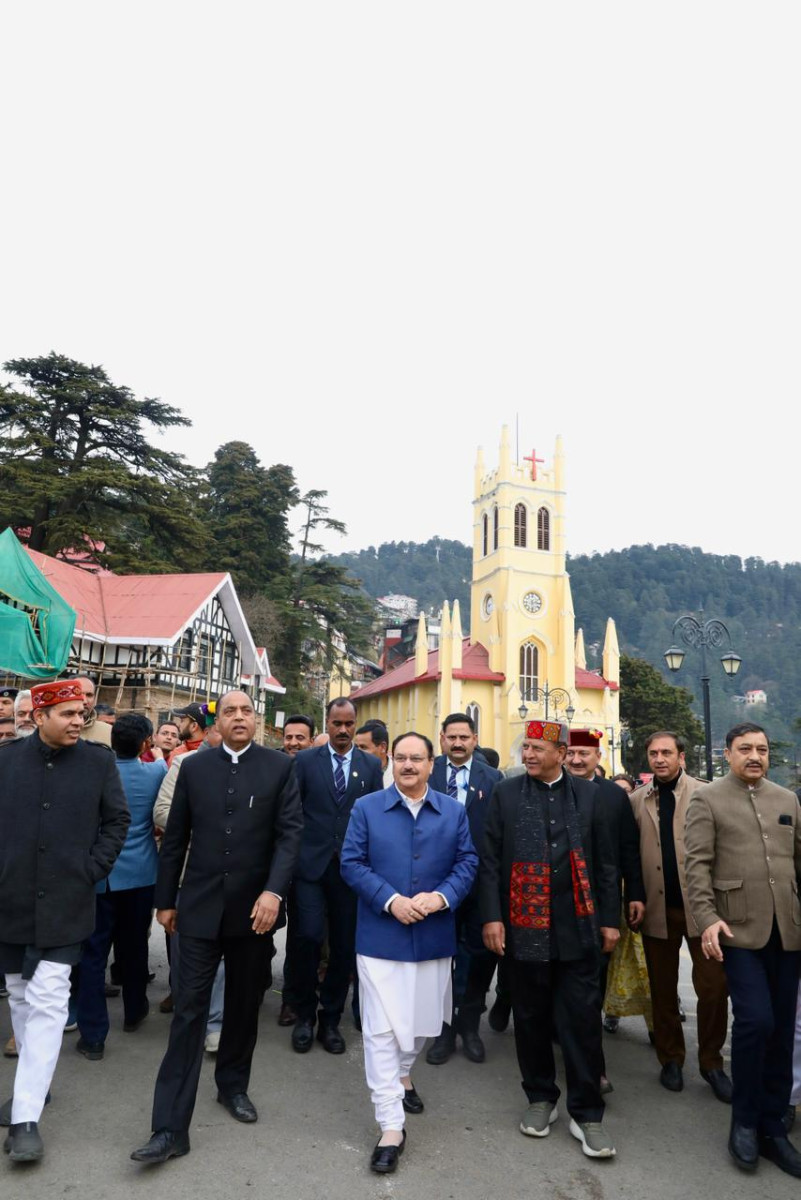
BJP leader J.P. Nadda in Shimla. Photo: X/@JPNadda
Even today, his engagement with Himachal often feels managerial – briefings, reviews, optics – rather than empathetic. Disaster visits are framed as oversight exercises; public interactions feel procedural. The hills demand something else: a leader who absorbs their fragility, not merely audits it.
That gap has never been bridged. And no amount of national stature can substitute for the absence of lived political connection.
The quiet dismantling of rivals
Nadda’s possible return must also be read as the endpoint of a long internal project within the BJP. Over the years, Himachal’s leadership landscape has been systematically flattened. Prem Kumar Dhumal, a mass leader with a distinctly non-Sangh temperament, was first marginalised. Anurag Thakur, despite national prominence, found his state influence steadily curtailed. Jai Ram Thakur rose not as a counterweight, but as a compliant interim arrangement.
What remains today is a party unit with weakened regional anchors and a thinned second line. In such a vacuum, even a leader without deep popular roots can appear inevitable. This is not resurgence – it is default.
Yet, politics built on elimination rather than mobilisation has its own limits.
The myth of inevitability
Nadda’s Shimla declaration leans heavily on a familiar BJP trope: inevitability of return. But Himachal Pradesh has historically resisted political monopolies. It has punished overconfidence and rewarded leaders who remain accessible, vulnerable, and rooted. Power here alternates not just because of anti-incumbency, but because the electorate remains instinctively suspicious of distant authority.
The BJP’s current condition in the state does not resemble a party poised for confident return. It resembles an organisation still searching for a believable narrative, a credible local face, and a moral vocabulary that speaks beyond command-and-control politics.
Projecting Nadda as that face raises uncomfortable questions. Can a leader whose strength lies in compliance inspire a state that values assertion? Can someone who rarely contradicts the centre convincingly articulate Himachal’s distinct anxieties—on federalism, ecology, employment, and fiscal autonomy?
Survival is not leadership
To Nadda’s credit, his political survival in an era of ruthless centralisation is no small feat. But survival should not be confused with leadership. Endurance is not imagination. Obedience is not charisma.
Himachal’s politics has historically been shaped by leaders who argued with Delhi when required, not those who internalised its silences. The hills remember who spoke for them – and those who merely passed through with a microphone and a mandate.
If Nadda’s December visit was meant to signal confidence, it inadvertently revealed something else: a leader seeking relevance outside the shadow of the centre, testing whether a state he once left behind can now offer political refuge.
The hills, however, are not an afterthought. They do not easily become retirement plans or consolidation zones for national careers in pause.
Whether Himachal will accept a leader it never quite claimed as its own remains uncertain. What is clearer is this: power may visit the hills often, but legitimacy must still climb its way up: step by step, memory by memory, election by election.
And that climb has never been easy for those who arrive believing it is already complete.
Tikender Singh Panwar is the former deputy mayor of Shimla, and currently a member of the Kerala Urban Commission.
Raja Awasthi is a senior journalist. Disclaimer: He is also currently the media adviser to the Himachal Pradesh chief minister in Delhi.
This article went live on December fifteenth, two thousand twenty five, at zero minutes past one in the afternoon.The Wire is now on WhatsApp. Follow our channel for sharp analysis and opinions on the latest developments.


