

Never Before Has the Contrast Between Narendra Modi and Rahul Gandhi Been Clearer


The stage is set for an ideological, political and electoral contest of the first magnitude. The joust has begun. The people themselves have arranged the mise en scène. They first made Narendra Modi prime minister – and then went ahead and erected his counterpoint, Rahul Gandhi, who Modi had led the way in first mocking and then traducing and attacking, not only politically, but also at a base, personal, level.
Third-party allegations and legal action surfaced, aimed at trying to get Gandhi thrown into jail with a view to disrupting his public life, a low-grade event after which his household objects being thrown out of his government bungalow in New Delhi practically overnight, hardly seemed a coincidence. Banana republic tactics had not been resorted to before in the country. Personal graces had not deserted the masters of the moment even during the Emergency, or in its aftermath.
Low cunning has not worked, however. It must somewhere hurt the regime, its very structure and foundation, and its carefully choreographed reputation, that thousands – sometimes lakhs – have marched in Rahul Gandhi’s long ‘yatras’ while the PM must rest content with contrived shows of support on television screens drummed up by overdressed people peddling dodgy narratives which from time to time also aim to instigate communal animosities for regime pleasure.
By now it also seems that the movers and shakers are perhaps getting caught with their hands in the electoral till. A long shadow has thus been cast on Modi’s and his party’s electoral victories with “vote chori” becoming the stuff of ‘chaikhana’ conversations, bringing regime legitimacy into question.
Weighed against the economic and political backdrop of the election, the outcome of the parliament poll of 2019 has now become suspect while the one of 2024 had come to be interrogated soon after the announcement of the result, which – in any case, had been well below par for the regime – disturbing the equanimity and composure of the ruling party, above all it leadership.
It is well to keep in mind that in its entirety the Modi persona rests on his perceived capacity to deliver election victories on the strength of vile hate speeches and on the putative organisational capacities of his party and that of the RSS, which underpins BJP.
This persona – and the resultant aura of invincibility – has cracked with serious doubts arising over BJP’s poll victories under Modi. Modi’s own relatively narrow win in Varanasi has also led to a variety of awkward questions being asked, among them about the genuineness of the polling and the counting. His legitimacy as prime minister has been brought under the needle of suspicion.
After the 2024 Lok Sabha poll results, the newly elected BJP MPs were not permitted to meet formally in a session of their Parliamentary Party to elect their new leader, i.e. the next prime minister. The seeds of factionalism among BJP MPs lie germinating, quietly. Green shoots will appear if and only if there is a viable alternative, else retribution can follow.
It has not gone unnoticed that the President of India did not demand to see the resolution of the BJP Parliamentary Party duly electing Modi its leader, on the strength of which he was to be invited to be PM in a coalition situation, and required to prove his majority on the floor of Lok Sabha within a stipulated period of time.
The poll-related data being thrown up by Gandhi at regular press conferences in respect of Maharashtra, Haryana and Karnataka, besides his energetic and impressive campaigns in Bihar on the subject of the 'special intensive revision' (SIR) of the electoral roll, allegedly aimed at deleting lakhs of voter names presumed to help the governing parties, is shaking up the political space across the country.
Gateway to the Lok Sabha
True, on paper, the next Lok Sabha election is still four years away, but the road to it winds its way through several key assembly polls in quick order in 2025 and 2026 – Bihar, Assam, West Bengal, Kerala, and Tamil Nadu, with Bihar being round the corner. It will make or break Modi – or break or make Rahul Gandhi and his cohorts.
Bihar may in fact be seen as the gateway to the next Lok Sabha poll. If Nitish Kumar’s JD(U)-BJP coalition is dislodged there, and this is in the realm of the possible considering the balance of forces and the recent record, a domino effect is likely in Assam, which has a BJP government. In the other state elections of 2026, Modi’s equity is a lot less. A serious disturbance of governing arrangement in Bihar also has the potential to impact BJP ranks in the Lok Sabha, besides the recent tactical patch-up between the prime minister and the Rashtriya Swayamsevak Sangh leadership. On the other hand, a JD(U)-BJP win will likely put a break on opposition’s enthusiasm. There is a lot riding on this one election.
A combat
We are, in fact, at a pivotal moment in political time. As the tempo rises, we find ourselves in the sway of ideological cross-currents and eddies. Here is a play with two protagonists. So polarised is the polity that a single long-drawn political drama gives the impression of operating at two distinct levels and being two separate scripts bearing two protagonists, and not one, as is the norm. In reality, there are two antagonists and everyone knows who they are.
At their cores, Narendra Modi and Rahul Gandhi are ideological adversaries. The rest flows from there. They have two very different visions of India – its past, its present, its future, its Constitution and the working of it – in a nutshell, its soul, and its culture and way of life.
To trace the ancestry of this combat, in their time both V.D. Savarkar and Mohammed Ali Jinnah had called Hindus and Muslims separate and antagonistic “nations”, following the pernicious colonial idea in a 1817 work of the British thinker and writer James Mill.
Strangely, Modi is in thrall of the same idea, believe it or not, having learnt few lessons from history, and none from Pakistan’s experience. He appears to labour under nothing but age-old prejudice. In this scheme of things, Savarkar is idolised and Jinnah despised, though they said the exact same thing!
Jinnah broke away from India on that basis but his creation, Pakistan, itself broke into two a quarter of a century later, demonstrating that Muslims who seceded under his guidance weren’t one nation in any real or practical sense of the word. Indeed, there are said to be more simmering “nations” within the present polity of Pakistan although they may follow the tenets of the same monotheistic creed. The upshot is: Religion by itself struggles to constitute a nation.
On the flip side, the Savarkarite ideology, which was integrated into its own catechism by the BJP’s ideological parent the RSS, expostulates that India is a “Hindu Rashtra” or a “Hindu nation”, in which those of other faiths must accept a subordinate status. The question is: Can Hindus be thought of as one “nation”? Also, can any communities, religious or otherwise, be subordinated in legal or constitutional terms in our era without provoking serious internal divisions and conflict of great magnitude?
To say nothing of sharp and sometimes formidable differences arising from language, region, and caste, the question is – can followers of the broad Hindu faith cohere as a common political and social entity on the basis of a religion? Note that this is a religion which displays deep inner schisms pointing to inequalities, disparities and immutable hierarchies, besides a variety of rituals and practices or religious cultures in spite of some obvious commonness whose most trite forms are flagged as desirable and supposedly uniting factors by the present dispensation.
In the aftermath of the assassination of Mahatma Gandhi, after the bloody Partition riots, the Hindutva forces, for the first time, had fancied their chances to take power. Nehru thwarted their efforts with an emphatic win in the 1952 Lok Sabha election, campaigning on the point of defeating communal politics. Some six decades later, in 2013, the Hindu-first forces saw yet another opportunity.
Thus, by the end of that year, the principal characters of the ideological spectrum were etched clearly in the political battleground, foreshadowing the fight between the resurgent forces of ‘Hindu-first’ ideologues tilting at India’s constitutional democracy – indeed setting the stage even for the battle of today, as it turns out.
In 2013 the incumbent prime minister Manmohan Singh was under concerted attack from the ground (as if on cue) by the now exposed Anna Hazare movement, elements in the top court some of whom would themselves be drawn into ignominy afterward, and of course big business – to say nothing of the airwaves, and social media. It was the run-up to the parliament election of early 2014.
Leading the hostile battalions, the powerful Gujarat chief minister Narendra Modi had beaten back challengers from within his party and – with RSS’ firm backing by then – stood in the centre of the arena.
Neither the imagery nor the ambition was lost on anyone, least of all the major sections of free enterprise and principal elements of big media. The latter emanate from big business anyway. Normal media coverage had begun to go funny even before the battle was joined, a slant from which recovery seems unthinkable, as matters stand.
It’s in fact a valid question: Given Modi’s below-par, decade-long, governance record by democracy yardsticks, would such a leader still be around even as a subject of curiosity, if the grasping minstrels weren’t around? Money does make the world go around, but in our age it is propaganda which makes for the hoopla that completes the loop.
One other key consideration merits mention: After the 2002 Gujarat pogrom, Modi was already the “Hindu hriday samrat”, and no BJP leader stood a chance against him in being anointed to lead the country’s so-called Hindu party and the big business armies.
The future PM had already endeared himself to freebooting capitalism. This was made amply clear when he unapologetically flew into Delhi in the personal plane of Adani to take charge. In doing so, he broke a long tradition. No Indian leader had displayed such unselfconscious cosiness with big biz before.
For Adani, this was naturally the all-important relationship. Rahul Gandhi once explained this pithily in the Lok Sabha when he exclaimed that there was a time when Modi flew in Adani’s plane but now it was the other way round – Adani was flying in Modi’s. The reference was to the tycoon’s place in the Prime Minister’s entourage on foreign trips with an eye to lucrative contracts, with no business competition.
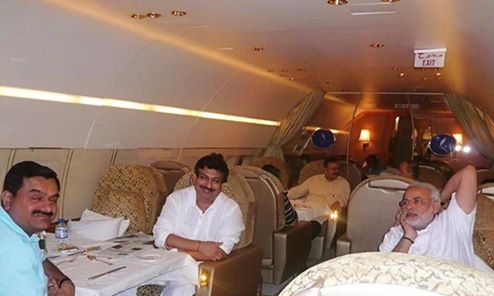
Photo: X/@pbhushan1
In South Asia, and possibly elsewhere too, it is almost a truism that the politics of chauvinism, religious or otherwise, when successfully prosecuted and producing an electoral dividend, attracts powerful sections of business as a natural ally. A key reason for this is that chauvinist electoral victories rely on arousing primordial loyalties and passions, and do not emanate from laying down policies to help different classes of ordinary people. Chauvinist appeals do not hurt the core interests or ambitions of big business.
As in late 2013, so in 2025. Again the field is set on similar ideological lines, although with a primary difference. Back then, the incumbent at the Centre was up against the anointed Hindutva leader who was also an influential chief minister and had the backing of leading sections of business.
Contrasts
The contrast then is sharp. The man holding power at the Centre today also holds power in several states and Union territories while the party of his principal antagonist holds office in only three states. The power differential is stunning. Modi has also practically obliterated the institutions that underpin proper democracies and seems the sole authority in the country. In India, he is truly the God of Big Things.
Quite in contrast is Rahul Gandhi, relying on galvanising citizens’ power against Big Government and Big Business rolled together as a single juggernaut. Such a situation has not obtained anytime in the past. There was a time long ago when the Congress did hegemonies the country. Its political opponents were weak although there were stalwarts amongst them. But they weren’t engaged in a concerted, all-pervasive, ideological battle on the lines we see today, the kind of battle (or was it war?) that took Gandhiji’s life.
It is noteworthy that in the ideological Mahabharat of today, for all the practical handicaps and lack of resources Modi’s key opponent labours under, there is to be seen a glimmer not previously seen, and it won’t do to downplay its political importance – whatever the electoral battlefield may eventually record.
In fact, this element fairly stands out. It is this: The Congress’ political opponents of the past, of diverse shades, whatever their electoral clout today (even where minimal), have kept their differences aside and are in various ways standing on a coordinated wavelength with Rahul Gandhi in the combat against the forces of Hindu-supremacist thought and its leadership, represented by Modi.
Also read: The Sun Is Setting on the Modi-Shah Duo
This may be viewed as a newly crystallised element in India’s political trajectory and has carried over from the unity its components displayed in the last Lok Sabha election, with gratifying results. This is a cause which has grown into being one of noteworthy mobilisation and strength on the anti-Hindutva side, and goes well beyond the electoral quasi-bloc which goes under the INDIA label.
God is on the side of the big battalions, it is said. But the world has also heard of David and Goliath, and of the battle of Badr of Islamic lore. And who has not heard that the Lord Krishna did not choose the side with the big armies?
Nevertheless, it cannot be denied that Modi has made a striking comeback in recent weeks, and has finessed complex issues. Perhaps the most important of these was his difficult track with the RSS chief Mohan Bhagwat. The prime minister has not allowed the problem to fester and has by now evidently re-negotiated his relationship with Bhagwat. This is a big plus for both, at least tactically. It is on the strength of this that the government side has comfortably sailed through in the election of the Vice-President of India after falling into deep political uncertainties following the unexpected and sudden resignation of Jagdeep Dhankhar from that high constitutional position.
There may now be every expectation that the next president of the BJP party will also be smoothly inducted with the RSS leadership on board. The incumbent J.P. Nadda has been in the saddle for an unheard of six years mainly on account of a lack of consensus on the next party chief between Modi and the RSS leadership. That hiatus is presumably now overcome.
The ruling party’s focus is now rightly on the Bihar assembly election, a key stepping stone on the way to the next parliament poll. Rahul Gandhi and RJD leader Tejaswi Yadav have lately run a furious joint campaign on the issue of alleged vote deletions on a staggering scale in Bihar. The Election Commission of India and the BJP are both in the line of fire. The state’s ruling coalition has mounted a counter-attack through an indiscriminate announcement of potential benefits for women, youth and workers, poll-eve announcements being the usual trick of sleepy regimes. But will they have effect?
The prize is greater than the political fortunes of parties in particular states. It is about the future direction and trajectory of this land of many cultures.
Anand K. Sahay is a veteran journalist.
This article went live on October sixth, two thousand twenty five, at thirteen minutes past three in the afternoon.The Wire is now on WhatsApp. Follow our channel for sharp analysis and opinions on the latest developments.


