

Pro-Palestinian Voices Call Out Union Govt’s Action on Protesters, Silence on Israel's Violence


New Delhi: “Ek taraf mazdoor warg Palestine ka samarthan kar raha hai, aur doosri taraf punjivaad apne charam par hain – jiski wajah se aam aadmi har cheez se vanchit hota ja raha hain (On one hand, the working-class population stands with Palestine, while on the other hand, capitalism is peaking – the system is denying ordinary people their rights)”, says Hashim Khan, a silai (sewing) labourer at a jeans factory in Delhi.
“Saamaan ki keemat badhti ja rahi hai, aur agar koi mazdoor kisi bhi zulm ke khilaf awaaz uthata hai, toh use hi deshdrohi keh diya jaata hai (Prices are going up, and the moment a worker raises their voice against injustice, they’re branded anti-national),” he adds, talking about the deepening unemployment, rising inflation and resistance.
Khan, a resident of Khajuri in North East Delhi, has been working with the Indian chapter of the global Boycott, Divestment, and Sanctions (BDS) movement for the past six months.
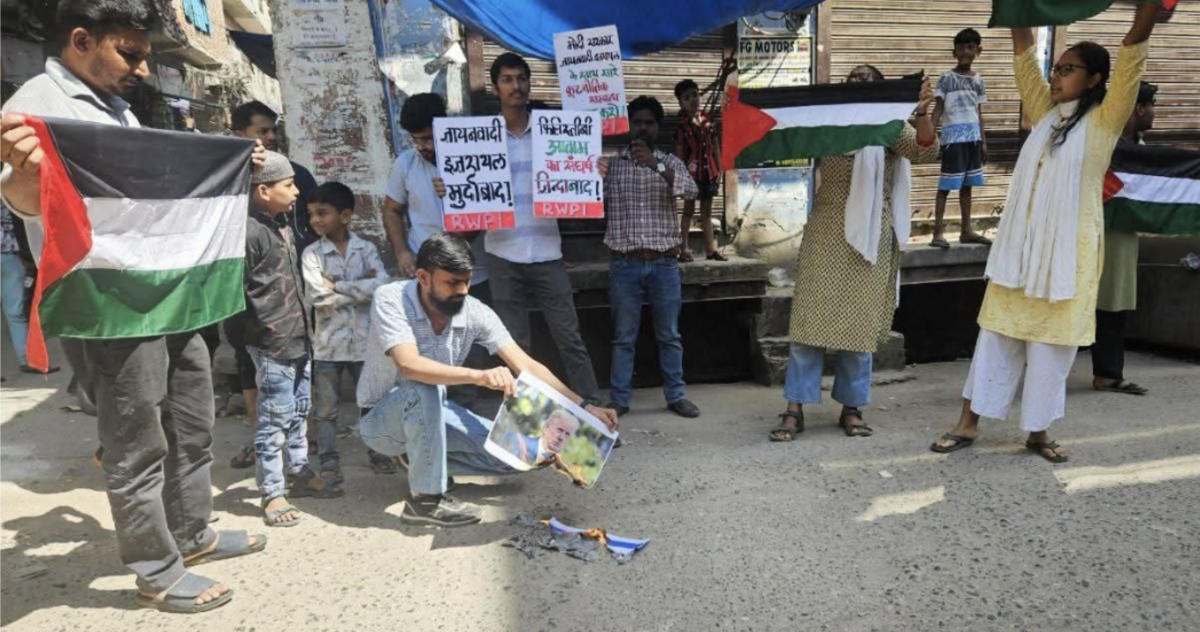
Hashim Khan burns a poster of US President Donald Trump at a protest organised in solidarity with Palestine, Khajuri, Delhi.
But why should the Indian state be so wary of small sections of workers protesting against Israel at Khajuri or the neighbouring Karawal Nagar?
“Yeh darte hain ki kahin yeh jo mehnatkash log hain, yeh ekjut na ho jaayein… aur baat sirf Palestine tak simit na rahe… kisi aur mudde par na chali jaaye… aur yahan ke maslon par baat na shuru ho jaaye (They’re afraid that working-class people might come together… and that the conversation won’t stay limited to Palestine. It might lead to other issues being raised… issues that directly affect people’s lives here),” Khan explains.
Hashim Khan says that it is not just protest that’s being policed. The system is built to extract labour so exhaustively that the very conditions of survival have become a form of suppression, offering workers little choice between relentless toil and alienation.
Labour, exhaustion and the annihilation of thinking
A factory worker and fellow pro-Palestine protester, Shamshed Khan, referring to the proposal to increase working hours for industrial workers, says, “They would want us to work for 14 hours; add to it roughly two-three hours of commute and eight hours of sleep to ward off the exhaustion… this is designed to kill the capacity to think.”
“Yeh chahte hain ki hum aise hi khatam ho jaayen (They want us to fade away like this),” he says.
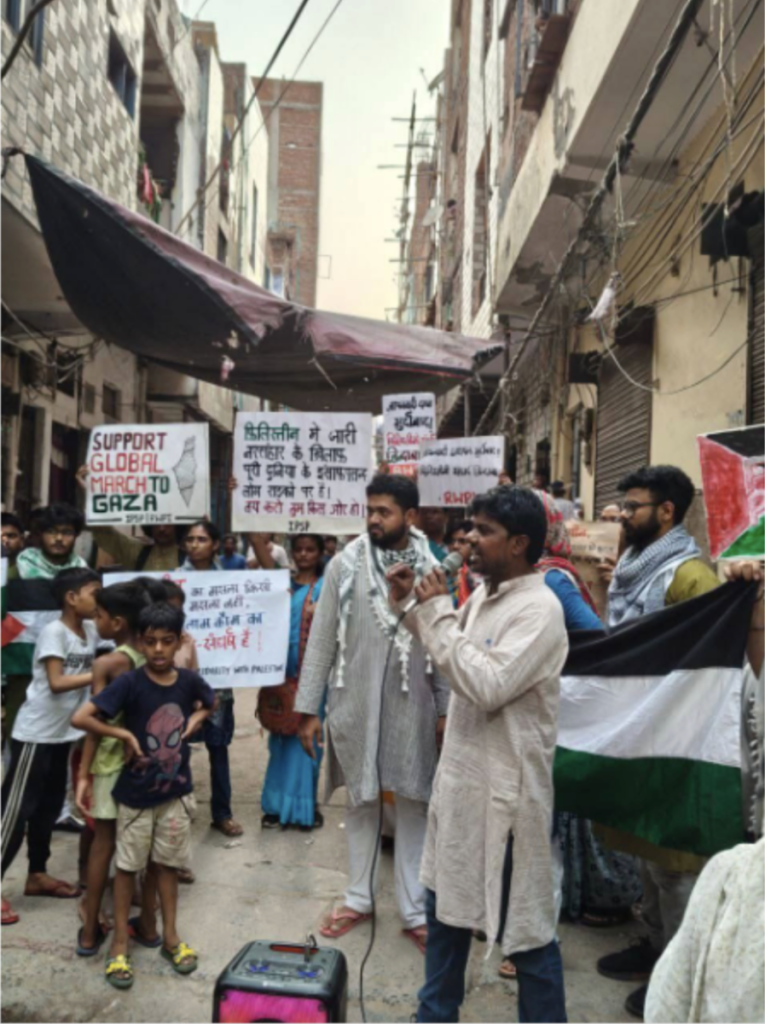
Protesters raise slogans against Israel's actions and in solidarity with Palestine, Delhi.
Yogesh Swami, a member of the Bharatiya Krantikari Mazdoor Party (Revolutionary Workers’ Party of India), notes, “The government and the system, which stand with the capitalists, are afraid because if the people start speaking out against the injustices happening there, they might also start raising their voice against the injustices happening here.”
From Connaught Place to North East Delhi’s Karawal Nagar, Khajuri and Mustafabad, Swami has been distributing pamphlets raising awareness about Israel’s war on Gaza. He says that many have admitted to him that they knew little about the issue.
“The Indian government doesn’t want people to know,” he alleges, adding that his party stands firmly with every oppressed section – be it Dalits, religious minorities, or the poor.
‘A question of humanity’
The death toll from Israel’s war stands at more than 56,000 killed since October 7, 2023. More than 95% of schools in Gaza are reported to be partially or completely destroyed, while 94% of all hospitals in the Gaza Strip are damaged or destroyed.
Yet, in the mainstream consciousness, it has become a “Muslim issue”, with several believing that Palestinians are terrorists. However, the issue is larger than that, explain residents of Khajuri who work with various rights groups.
It is this very narrative of Israel’s self-defence against Hamas that Delhi-based Priyamvada Sharma, an Indian People in Solidarity with Palestine (IPSP) member, tells The Wire has inspired her to work with the group since its formative years.
She says, “There was a gap in the portrayal of the war in Gaza in mainstream media, where the dominant narrative was that Israel was merely acting in ‘self-defence’. It was important to counter this”.
Sharma was one of the organisers of a demonstration in front of the Embassy of Israel in Delhi on June 23 that witnessed a showdown between protesters and police.
However, talking about taking the movement to the ‘mazdoor abadi’ – working-class population – and their issues across Delhi, Haryana, Punjab, Maharashtra and Hyderabad, Sharma says that the themes of dispossession, disenfranchisement and demonisation were deeply relatable.
Agreeing with her, Khan asserts, “Yeh mazhab ka nahi, insaniyat ka masla hain (This isn’t a matter of religion – it’s a question of humanity).”
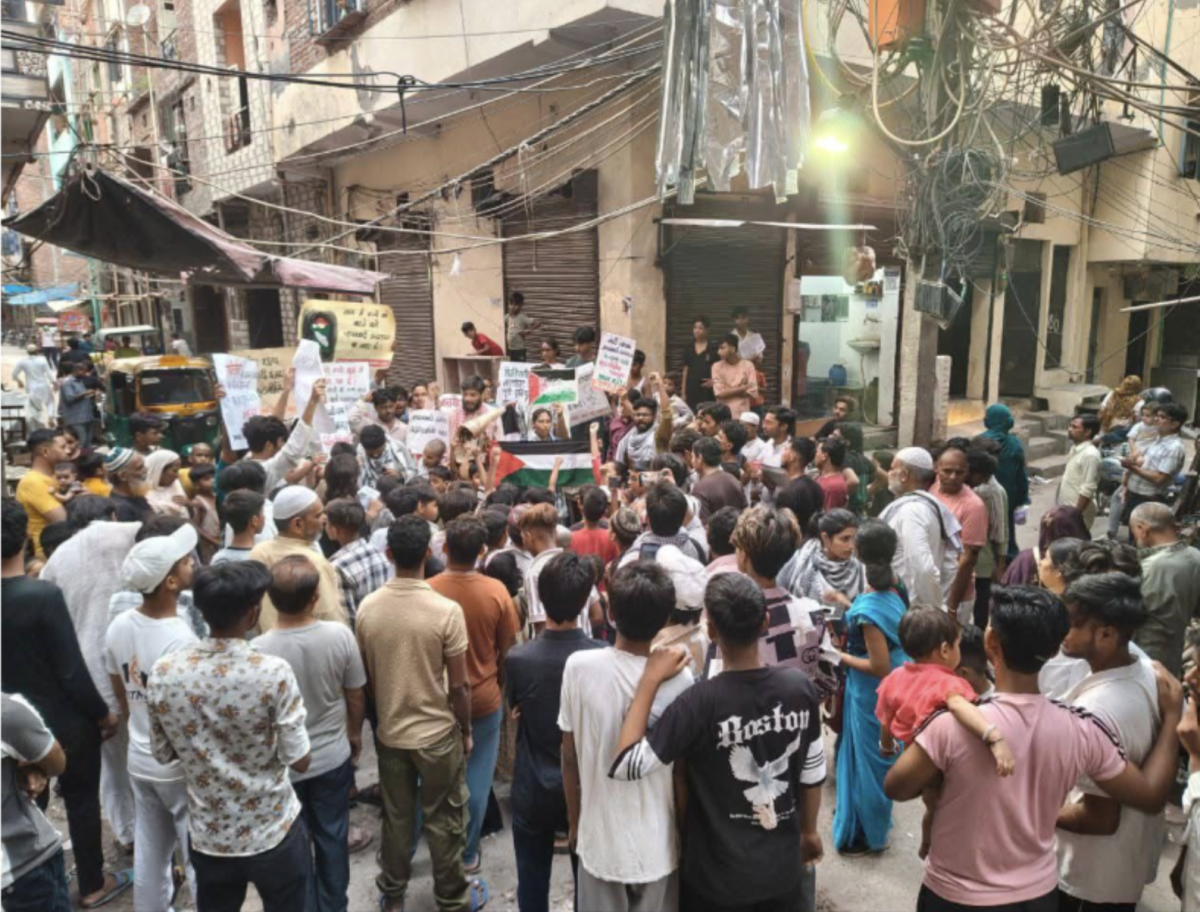
Pro-Palestine protests organised at various points in North East Delhi's Khajuri.
Khalid Choudhary, who runs a shop inside an alley of Chandni Chowk’s Tilak Bazar, echoes Hashim’s sentiments. Reminiscing about how he first came across BDS and IPSP nearly a decade ago, he says, “What moved me the most was this: among all the people in India who were standing with Palestine and against Israel, I saw only a handful of Muslims – everyone else came from different faiths.”
Sharma further reminds that even leaders such as Mahatma Gandhi and Jawaharlal Nehru opposed Zionism on anti-colonial grounds. She says, “Why shouldn’t we be a part of the Palestinian cause? Isn’t this the very legacy of mass leaders, including Bhagat Singh, Sukhdev and Rajguru, who fought to liberate the most oppressed? As citizens of a free nation, how can we agree to the subjugation of Palestine?”
Police crackdown on pro-Palestine protesters
On June 23, the Delhi Police cracked down on agitators who burned the national flag of Israel and the photo of Israel Prime Minister Benjamin Netanyahu in condemnation of the ongoing genocide in Palestine and to express solidarity with the “Global March to Gaza”.
Sharma, who was detained for questioning by the police that day, says, “The police had a problem with us burning the Israeli flag… but they have no problem with the biggest genocide of this century?).”
“Science padh ke protest? (Despite studying science, you are protesting?),” a Criminal Investigation Department (CID) official in civil dress at the Mandir Marg police station had asked, says Sharma. She has a Master’s degree in Physics and is currently an independent researcher in science.
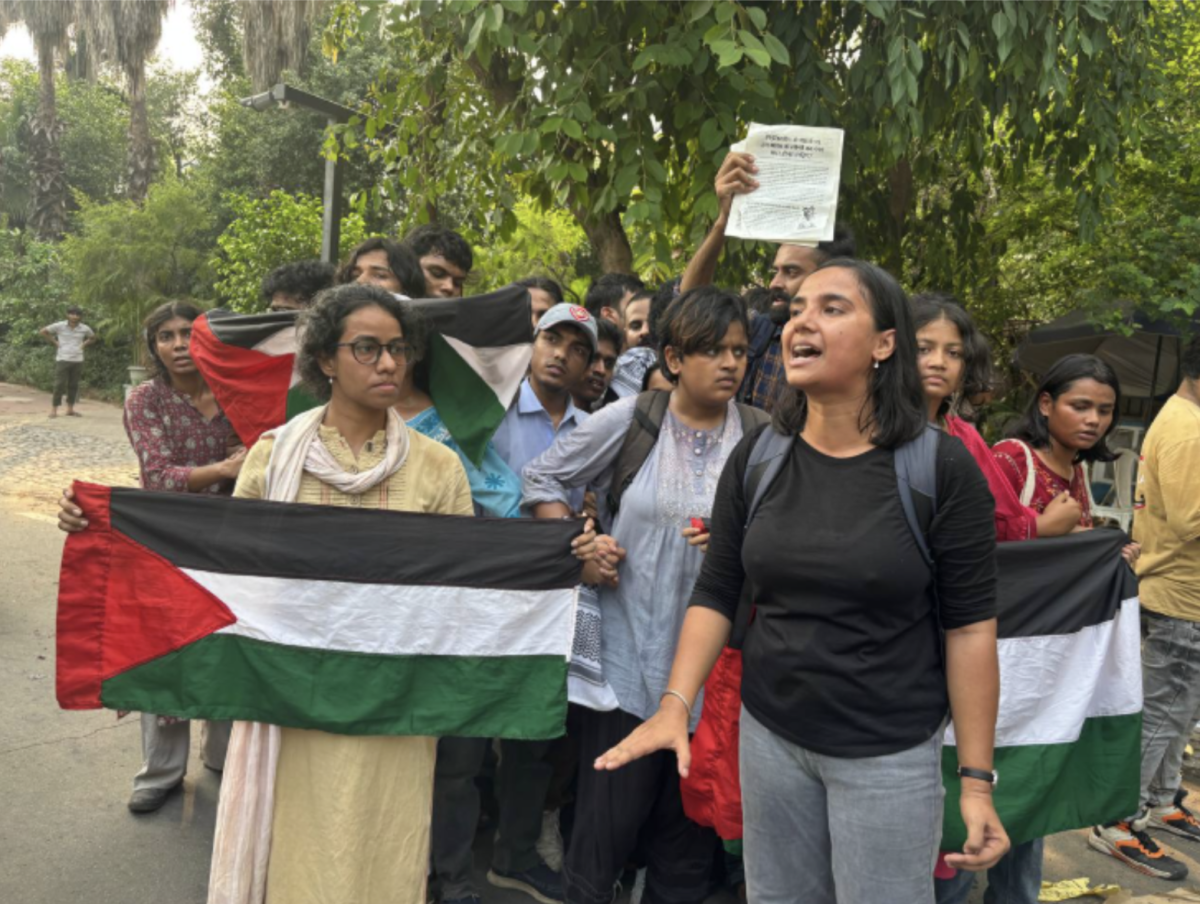
Priyamvada Sharma, an independent science researcher with members of Indian People in Solidarity with Palestine (IPSP), condemn the ongoing genocide in Palestine in a protest outside the Israel Embassy, New Delhi, on June 23, 2025.
The officers not only asked her about personal details, but also filed an FIR against her, including charges under the Bharatiya Nyaya Sanhita (BNS) sections 132 (assaulting or using criminal force against a public servant), 221 (obstructing a public servant), and 223 (disobedience of orders duly promulgated by a public servant).
Vishal Kumar, a fellow protester who was also detained, says, “The police echoed the language of trolls on social media and the larger populist, right-wing narrative of the Indian government and RSS (Rashtriya Swayamsevak Sangh).”
However, he adds, the police need to be reminded that former Indian Prime Minister and BJP leader, Atal Bihari Vajpayee, had also defended the rights of Palestinians.
Nitish Kumar, President of the Jawaharlal Nehru University Students’ Union (JNUSU), adds, “The RSS has historically submitted to colonial powers. Early on, it identified its three key enemies as Muslims, Christians, and Communists.”
In previous protests in front of the Israel embassy and at Jantar Mantar, Neha, a fellow protestor and Jamia Millia Islamia alumni, associated with All India Central Council of Trade Unions (AICCTU), recollects how the Delhi Police similarly rounded them up, with male officers “manhandling” non-male protestors too.
“It’s the same pattern of repression everywhere,” she says, “Anyone who stands against occupation and war crimes is not tolerated by the Indian state.” P. Baruah, Assistant Professor at NLSIU and PhD candidate at NUS, who was physically assaulted by Bengaluru Police during a peaceful pro-Palestine protest in Frazer Town, points to the “shrinking space for constitutionally protected dissent” and the routine violation of due process as signs of a deeper rupture.
She describes the current moment as marking the final emergence of India as “a classical police state”, evident in the systematic crackdown of Article 19, which guarantees the right to assemble.
Shrinking protest venues
For solidarity events other than protest marches – like film screenings, poetry sessions, painting etc – often, the venues, too, become contested.
Vishal, the freelance artist associated with the Delhi-based Progressive Artists’ League (PAL), notes how police often warn venue owners against such events and contact the Resident Welfare Associations (RWAs) so that “permission” is denied.
Shri, a member of Students for People’s Democracy (SfPD) in Bengaluru, says that organising any solidarity event even at an indoor venue is becoming increasingly difficult. “Since we don’t budge under pressure, venue in-charges get harassed and cancel at the last minute,” she says.
In one instance, the SfPD had sought “cooperation” from Bengaluru Police for a Pride event in solidarity with queer Palestinians but the police responded with hostility, questioning the organisers’ patriotism.
Madhulika T, an independent labour lawyer and member of Bangalore for Peace and Justice, adds that even though such intimidation hasn’t deterred protestors, it has effectively resulted in rendering the All India Trade Union Congress (AITUC) office as the only site of protest that doesn’t succumb to police pressure.
Recently, Congress Parliamentary Party Chairperson Sonia Gandhi criticised the Indian government’s silence on Israel’s offensive on Gaza. However, as Madhulika recalls, in September 2024, Karnataka deputy chief minister D.K. Shivakumar, a Congress member, had attended the ‘Haifa Memorial Lectures’ at the Indian Institute of Science (IISc) Bengaluru, where the Israeli flag was hoisted.
The India-Israel axis and the choking of dissent
India has become one of Israel’s largest arms buyers. Between 2001 and 2021, India imported over USD 4.2 billion in arms from Israel, per SIPRI data. On June 6, 2024, after an Israeli strike on a UN shelter in Gaza, footage showed missile fragments labelled “Made in India.”
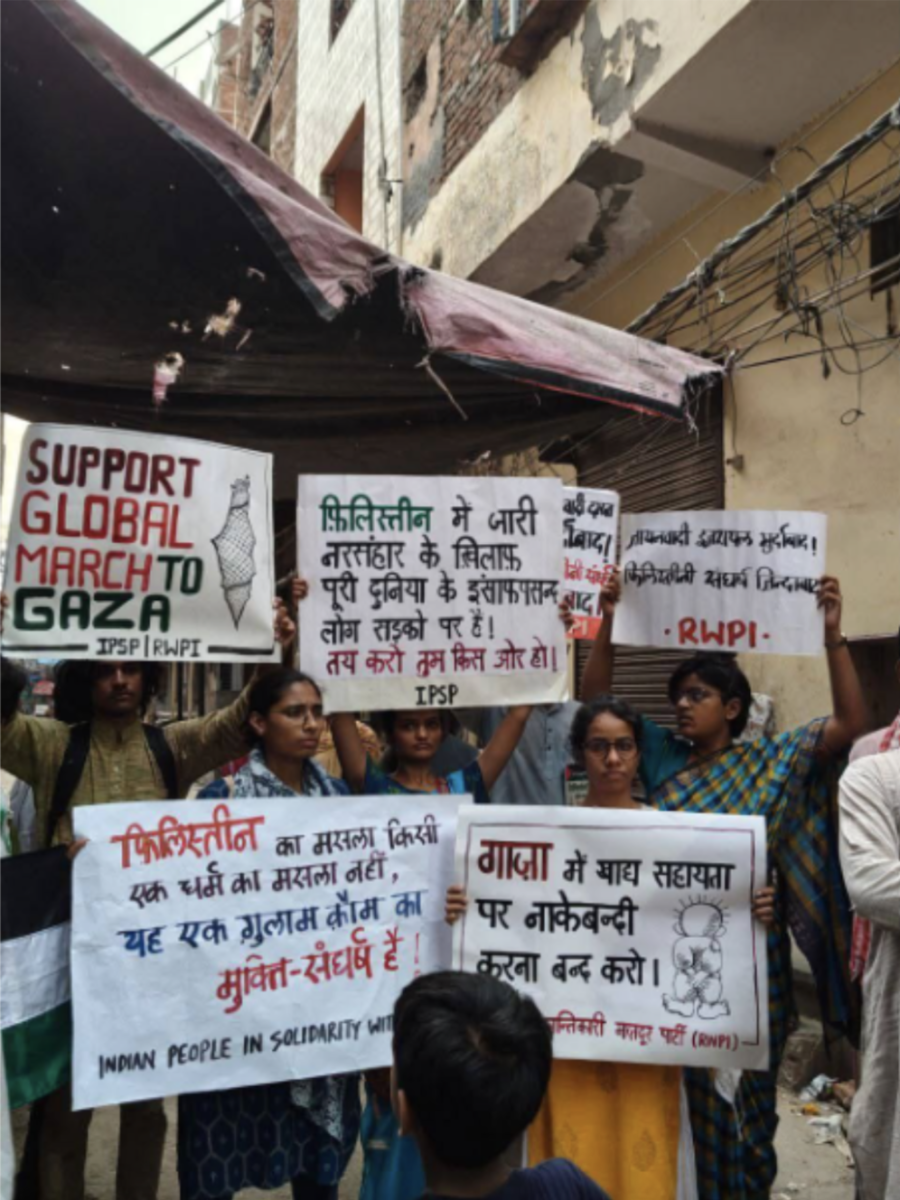
Protesters hold up banners in support of 'Global March to Gaza' and against the ongoing genocide in Palestine, North East Delhi.
An IISc student, requesting anonymity, describes this techno-military normalisation, stating that even as Gaza was being bombed, the campus hosted the India-Israel Business Summit 2024. The institute doesn’t allow Palestine solidarity actions without prior permission; Gaza posters are routinely torn down.
Today, the Zionist-Hindutva ideological agenda is also being exhibited in public endorsements of Israeli-style settler models for Kashmir.
In November 2019, India’s consul-general in New York was seen on video talking about the abrogation of Article 370. Referring to the actions of the Israeli government in facilitating Jewish settlement in the occupied West Bank, he had reportedly said, “If the Israeli people can do it, we can also do it.”
Deconstructing the corporate-state nexus, JNUSU President Nitish Kumar highlights, “Over the past ten years, we’ve seen a consolidation of capitalist and government interests (Modi-Adani). Whether it’s wiping out Adivasis in Bastar or suppressing dissent in JNU and Jamia Millia Islamia by branding them ‘anti-national’, the pattern is clear.”
Political researcher Asim Ali observes that while dissent is suppressed, “Muslim-coded” protests are further reprehended. “Broadly speaking, the instinct of the Indian state to respond to any form of dissent with a crackdown is not new. We have seen the State’s reaction to the farmers’ movement. However, even within that space, if any protest is ‘Muslim-coded’ it invites unwarranted vigilance and suppression,” he says.
He adds,“What we are seeing today is an extension and intensification of this crackdown, where any pro-Palestine protest is being framed through the same lens of sedition and anti-nationalism with which the State has been silencing any resistance to oppression domestically.
“It’s also a way to ensure nobody questions India’s allyship with international imperialist designs.”
Sanhati Banerjee is an independent journalist.
All photos are by Sanhati Banerjee.
The Wire is now on WhatsApp. Follow our channel for sharp analysis and opinions on the latest developments.


