

Simultaneous Poll Panel Cancels 'Informal Discussion' With SC Judges After Opposition Objects


New Delhi: Following strong objections from Opposition members, the Joint Parliamentary Standing Committee examining the Modi government's 'One Nation One Election' (ONOE) Bills has dropped its proposed October 6 visit to the Supreme Court for an "informal discussion" with judges.
Committee chairperson and BJP MP P.P. Chaudhary said the visit had been deferred because of scheduling difficulties. “I also have other commitments to attend to,” he said, the Hindu reports. It also said an opposition member had expressed his objections to the proposed meeting in writing to Chaudhary.
Chaudhary told the Indian Express the meeting was not meant to discuss the proposed legislation. "The study visit was to familiarise the committee members with the Supreme Court including the library as some of the members had never visited," he said.
Senior Advocate and Rajya Sabha MP Kapil Sibal revealed on Thursday (October 1) that the panel was scheduled to meet Chief Justice of India Surya Kant and other Supreme Court judges on October 6 for a one-and-a-half-hour long discussion on the Bill.
"This is unconstitutional. It is contrary to the separation of powers...will any and every committee discussing a legislation now go to the Supreme Court?" he said.
Sibal said he had learnt about the upcoming meeting from a committee member who opposed the decision to visit the top court.
Sibal said a programme has been circulated by the the ONOE panel and that it was titled the "Local Study Visit Programe of the Joint Committee of the Constitution (129th Amendment) Bill, 2024, and the Union Territories Laws (Amendment) Bill, 2024, to the Supreme Court of India". Its itinerary included an "informal discussion" on ONOE from 4:30 pm to 6:00 pm on Tuesday, October 6.
"I have never heard in the history of independent India about any parliamentary group taking a legislation to the Supeme Court to explain to them [judges] what the new law is about," Sibal said at a press conference.
Also read: One Nation, One Election – The Democratic Costs of Electoral Synchronisation
Strongly critical of the proposed discussion, Sibal said that ONOE entailed many complex questions of law, whose constitutionality is ultimately determined by the Supreme Court. Such a discussion would erase the separation of powers.
Sibal pointed out that the questions surrounding ONOE include the term of state assemblies. States might not have elected governments for indefinite periods so that elections could be held simultaneously across the country every five years, he pointed out. Ultimately, a "one-sided briefing" from the government to the top constitutional court would make discussions and debate and even pleas in court on ONOE infructuous, he said.
"Now the government of India's commitee will come to the Supreme Court and explain to it why its legislation is good? The same law against which pleas will be filed before this court and which will have have to decide whether that law should stand or be repealed?" Sibal said.
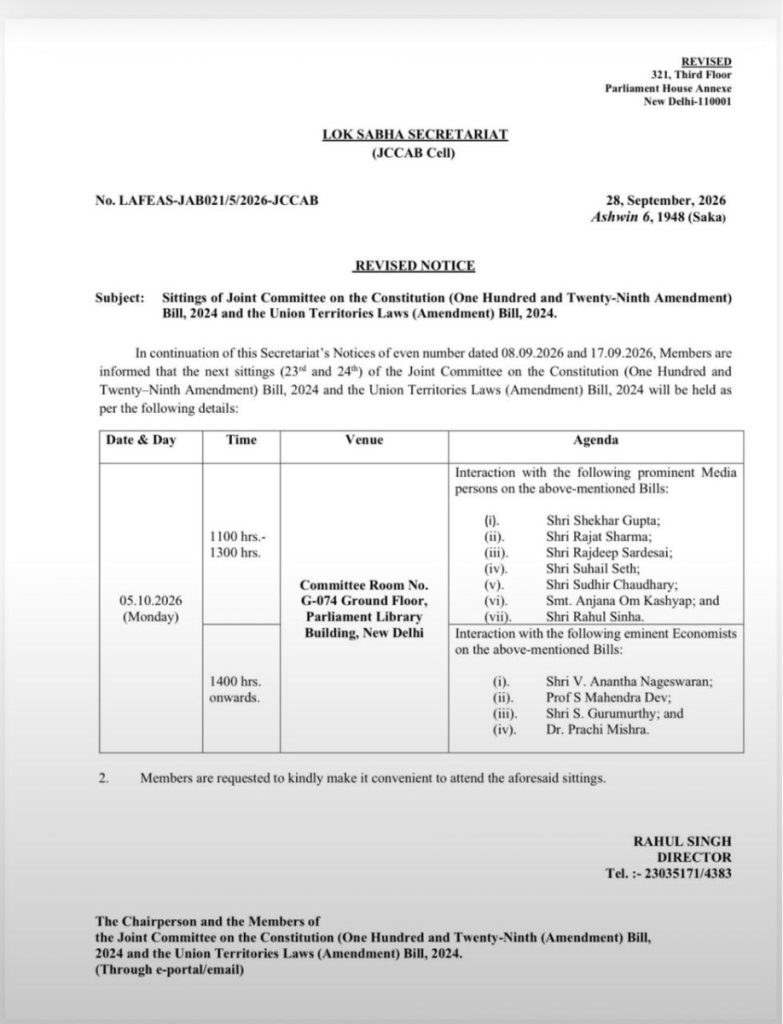
The parliamentary panel is now scheduled to meet journalists and economists on Monday, October 5, at the parliament library. The list of journalists appears to mistakenly include Suhel Seth, businessman and television commentator, though with his name misspelt.
In September 2024, the Union cabinet had approved the report by the high-level committee headed by Kovind on the ‘one nation one election’ proposal that recommended simultaneous polls in the country to the Lok Sabha, state assemblies as well as local bodies (including panchayats and municipalities).
In its 18,626-page report, the committee recommended simultaneous elections in two steps, starting with Lok Sabha and state assembly polls and then to municipalities and panchayat bodies within 100 days.
After the Union government had tabled the Constitution (129thAmendment) Bill, 2024, and the Union Territories Law (Amendment) Bill, 2024, opposition parties had slammed the move and criticised the bills. Thereafter, they were sent to the Joint Committee headed by Chaudhary.
This article went live on October second, two thousand twenty six, at twenty-nine minutes past one at night.The Wire is now on WhatsApp. Follow our channel for sharp analysis and opinions on the latest developments.


