

Suvendu Adhikari’s Religious Wishlist is Hurting Bengal’s Durga Puja – and Making Bengalis Resent it


With Sanatan as the message and saffron as the colour, the Durga Puja festival this year – the first after the Bharatiya Janata Party (BJP)’s election victory and takeover of West Bengal – delivers an unequivocal message: that its all inclusive community, “the best public performance of religion and art”, as UNESCO called it, comprising the 40,000-plus registered Durga Puja pandals, must begin to change.
Instead of maintaining Bengal’s decades of carefully nurtured efforts to erase the “divides of class, religions and ethnicities”, the new dispensation wants tradition to make way for the manufactured codes of BJP’s Hindutva and Sanatan dharma as an integrated ideology.
Vegetarians versus non-vegetarians; conventional clay images of the deity instead of innovative interpretations by academy-trained or self taught artists and artisans; no carnival and no entertainment – chief minister Suvendu Adhikari’s first move to transplant the BJP and Rashtriya Swayamsevak Sangh (RSS)’s Sanatan politics successfully incubated the dystopian agenda of homogenising Hindutva by issuing a code to standardise practice, albeit it was a copy-paste of the North Indian practice onto West Bengal.
At the coordination meeting with community Durga Puja organisers, Adhikari made his wishlist clear. If it was not a diktat, it was certainly a guideline meant to convey the desires of the newly-elected BJP government. Though the party is less dogmatic on the face of it, probably with concerns about alienating voters who have finally been persuaded to choose the saffron colour.
So, ahead of this year’s Durga Puja, after the political conquest of West Bengal, the BJP-RSS has embarked on the climactic push for the cultural capture of the wayward Bengalis and their stubborn adherence to practices that go against the grain of homogenising Hindutva. The reaction is strong but there is also doubt: will the BJP actually disrupt this Durga Puja to drive home the new order?
If it does try to do so, it would be intolerable interference.
Also read: This Durga Puja, Hindutva Has Found its Inevitable Target – Hindus
Bengalis cannot make sense of the contradiction. A member of the Prime Minister’s Economic Advisory Council, Sanjeev Sanyal posted on X: “Meat is core to Shakta Hinduism… Any interference in this sacred ritual will not be tolerated,” in reaction to the Adhikari line, which was loudly proclaimed by self-styled Bageshwari Baba, alias Dhirendra Krishna Shastri, who attacked Bengalis, calling them “pakhandi” or frauds, for eating “dirty things”, that is, meat, during Navaratri.
The media is reporting every day on how bonedi (neo-aristocratic) families would follow tradition in offering fish and goat meat to the goddess. At the other end of the spectrum, Adhikari turned piety into a fish eating event, consuming the bhog at Kalighat temple on September 13, to materially challenge the idea of turning Durga Puja into a vegetarian event.
Further, bizarre as it has sounded to Bengalis and non-Bengalis who set up food stalls, book stalls, sell balloons and a variety of low-priced knick knacks around the Puja pandals, Adhikari declared in the West Bengal state assembly on September 10 that all stalls must identify themselves specifically as part of the ‘Durga Puja Utsav’, and not ‘Sharadotsav’. He wants to project the festival as a religious one, and not as a yearly celebration of communal harmony and bonding around a traditionally religious ritual. The diktat flies in the face of Bengali reverence for Rabindranath Tagore, who popularised it as an annual celebration of the autumn season – sharad – anticipating a rich harvest.
Social media is where Bengalis are venting their disapproval and outrage while louder verbal injunctions are lobbed by Adhikari and a rag tag army of his chosen devouts. The chief minister, meanwhile, has led a ‘Gerua Samman Yatra’ because “in today’s Bengal, there is a spiritual awakening around saffron”.
“We will not tolerate anyone uttering insulting words against or writing derogatory comments about it,” he pitched.
The contradiction between Adhikari’s diktat – “idol, pandal or theme – you must not in any way hurt our religious and cultural heritage” – and West Bengal BJP president Shamik Bhattacharya’s sharp criticism reveals the schism within the BJP and addresses the dilemma of people who had voted for the BJP not expecting the cultural exceptionalism of the community to be attacked.
Bhattacharya said, “What you eat at home, will a sadhu determine that? Will a political party decide that? Bengalis will eat what they always have. Will Bengalis not eat fish? Will Bengalis not eat meat? Even Swami Vivekananda approved of this and who stands above him? The Goddess Kali here consumes mutton. I haven’t found anyone greater than Swami Vivekananda yet. If someone suddenly rises above him, that’s dangerous. So, there is no question of accepting such ideas. This is his opinion.”
Despite the anger he has provoked, Adhikari is determined on his mission to impose the Sanatan ideology on West Bengal. As a consequence, LED-lit billboards are sprouting in Kolkata where puja committees are rushing to announce they are Sanatani – for instance, the first-ever Park Street puja organised by the Kolkata Sanatani Sangha, a new-minted entity led by various BJP functionaries, including a close associate and fellow defector of Adhikari from the Trinamool Congress, Shankudeb Panda.
As a people who love the variety of public art and installations for its ability to raise anticipation in a fascinated and critical manner, the disapproval is creating disquiet.
Also read: Genocide, Migrant Rights, Secularism: Kolkata’s Puja Pandals Have Tackled Uncomfortable Truths
Scholar and author of the Union government’s submission to UNESCO to recognise Durga Puja as a World Intangible Heritage event, Tapati Guha-Thakurta said she was confounded by a question she was hearing from organisers of a small puja within a gated community in the city: “can you please check if our puja conforms to Sanatani codes or does it veer away?”
An 11-armed Durga?
Notwithstanding Adhikari’s fulminations over deviating from Sanatan, the faux pas of his government that released an advertisement of Durga and gave her an extra limb – making her an asymmetric 11 armed image – provoked much scorn and outrage on social media and from the opposition.
The BJP state president, who appeared to have disapproved of Adhikari’s extreme positions, was caustic. The extra hand only makes Durga “stronger”, he said.
Meanwhile, Trinamool Congress-Mamata Banerjee faction’s leader, Kunal Ghosh said, “They talk about Sanatan culture; they say distortion won’t be tolerated, yet they themselves distorted it by showing eleven hands.” Communist Party of India Marxist’s young leader, Shatarup Ghosh snarkily observed, it was a “brilliant” advertisement.
To contain spiralling Bengali indignation, however, Adhikari was compelled to make a public apology. “As the CM of West Bengal, I apologise for the error. The people responsible have received a stern warning. In the future, the government will be careful,” he clarified at a Durga Puja coordination meeting on September 7.
Bengal rejected Sanatan dharma long ago
For many Bengalis, Sanatan as a concept was rejected a long time ago, when reforms won and flourished in the 18th century and Bengal Renaissance became the defining tradition and culture of the bhadralok – the elite, educated, gentry and professionals. It percolated from Kolkata to the districts as education and newspapers, magazines, small magazines, theatre and music widened the sphere of reforms as the dominant culture.
For a long time, Bengalis and visitors of Kolkata have come to expect that pandals and idols during the festival season would deliver what Guha-Thakurta calls “entertainment”.
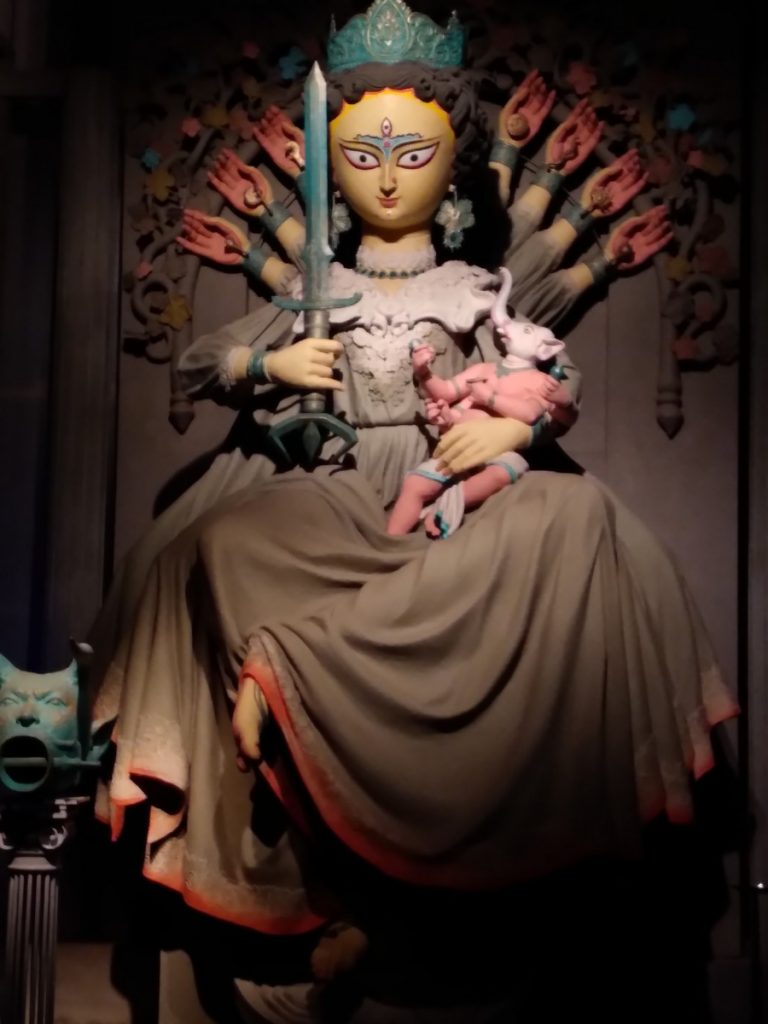
While the era of theme pujas – “the tripartite composition and coordinated production of idol, pandal and lights” – began around 25 years ago, change had begun much earlier, over 50 years back, in 1975, when Bakul Bagan Sarbojonin Durgotsav commissioned Nirode Mazumdar, a first-generation Indian modernist and a key member of the Calcutta Group, to design the image of Durga, which he did.
The Purbachal Shakti Sangha Durga Puja in 2024. Photo: File
Artist Partha Dasgupta, who has worked with teams of other artists, including photographers, sculptors, printmakers, clay modellers, artisans on producing Durga Puja installations for the Purbachal Shakti Sangha Durga Puja, among others, told The Wire that Bakul Bagan set off a trend when it commissioned others from the Calcutta Group and leading academy trained artists to conceptualise the deity. The list pretty much encompasses the who’s who of India’s modernists – Paritosh Sen, Meera Mukherjee, Shanu Lahiri, Sunil Madav Sen, later Bikash Bhattacharjee, Isha Mohammad, Ramananda Bandopadhyay and others.
The idols made by these artists, and their contexts, heralded the transformation of Durga Puja from a spectacle in majestic pandals into products of the imagination.
Installations of public art and cultural performances that integrated the 'new' artistic practices went on to become some of the ‘big spender’ pujas, who are in competition for the highest footfalls, corporate sponsorships and awards. The latter comes from an assortment of manufacturers of consumer goods, from the iconic Boroline to Dabur to ITC, Indian Oil, and of course, Asian Paints, that launched the race for awards in 1985.
Before Bakul Bagan, between 1965 and 1969, Ashok Gupta, a staunch Leftist who was born into a family that practiced ayurvedic medicine, and who learnt with Sunil Pal, a traditional clay image maker, began sculpting in clay the images of the deity for the puja celebrated at Jagat Mukherjee Park in North Kolkata.
One year, the deity presiding over her world, included the iconic Neoclassical style pillars that gave the recently demolished Calcutta University Senate Hall entrance a façade resembling a Greek temple, Dasgupta recounted. The ruins, as designed by Gupta, lay under Goddess Saraswati’s feet, directing visitors to make the connection between the columns and learning.
Accounting for about 3% of the state’s GDP, the estimated commerce generated by the Durga Pujas is over Rs 50,000 crore. No diktat or censorship by a ruling party can afford the risk of seeing a decline in the Durga Puja economy – this includes eating meat and fish and drinking alcohol. It also includes the novelty that theme pujas create.
Dasgupta explained the connection between the deity and the décor. “The theme is a skein that holds it all together – the deity and her family on a visit to a different world,” which is also her natal place, he said.
Also read: With the Return of the Goddess, R.G. Kar Outrage Acquires a Familiar Sequence
As a “son of the soil”, Adhikari seems oblivious to the reactions that his fervent displays of Sanatan faith are provoking on social media and in the public mind. Some have called it “disgusting”, while other Bengalis are using “beef eating” as a metaphor to distance themselves from the Sanatani prescriptions of the government.
Nobody is taking him seriously. As always, the pandals are coming up by occupying road space; work on the theme pujas by various artists, like Bhabatosh Sutar, an iconic creator of “ephemeral art”, are still in full swing. On the ground, very little seems to have changed, other than the loud rhetoric over meat eating and alcohol consumption during Navaratri. Even the people who had – enthusiastically or reluctantly – accepted that the BJP should win, because the Trinamool Congress under Mamata Banerjee had to be ousted from power, and were most confident that Bengali exceptionalism would be respected by the BJP when it came to power in West Bengal are now befuddled by the directives of the “double engine” model.
‘The ground is changing’
Being the first year, the difference and tilt to Sanatan dharma is invisible. “The ground is changing,” said Dasgupta, who has taken a walking tour to explore the preparations for Durga Puja underway across Kolkata. He said he has given himself a year off, to observe the pujas “from the outside”; the noticeable change is the sprouting of “cooperative pujas” within the precincts of gated housing communities and smaller mohallah clubs that have pooled together.
The patrons of the pujas are also changing, Dasgupta added. BJP’s MLA from Kashipur-Begachia, for instance, has become the leading light of a reorganised puja committee for the 100-year-old Tala Prottay, renowned for creating conceptual art venues during Durga Puja.
Oddly enough, the bhadralok and the once reviled “chotolok”, or lower classes/castes, are equally befuddled. In denial, they believe, the BJP cannot be trampling on established practices of Hindu Bengalis by prescribing vegetarianism and banning alcohol sale on Ashtami, the eighth and most auspicious day of the 10-day-long festival.
Leaning into the Sanatan dharma, even as they recognise that this tilt is also a dangerous propaganda, is easier to do for Bengalis who voted for the BJP. But they are exhausted with the relentless rage against Muslims and other minorities. They are uncomfortable with reports of numerous reported and unreported attacks on Muslims and Christians, across South Bengal. They fear the likelihood of a breakdown in the precarious communal equilibrium that has made West Bengal an island of relative calm and harmony. They are also afraid of losing Bengal’s pride in its culture and traditions and modernity that does not fit in with strident Sanatan ideology.
Perhaps, this too contributes to the BJP’s strategy of launching Sanatan as a desirable brand of Hinduism in West Bengal, with newly minted BJP-man, Adhikari, its chief campaigner, and Samik Bhattacharya, Dilip Ghosh and others – all products of the BJP-RSS cadre training system – as a strategic counterpoints, weighing in on the side of Bengali pride in its exceptionalism.
Shikha Mukerjee is a Kolkata-based commentator.
The Wire is now on WhatsApp. Follow our channel for sharp analysis and opinions on the latest developments.


