

The Lingayat Movement for a Separate Religion Is Bigger Than Ever Before


Hundreds of Lingayat leaders, among whom were heads of prominent and emerging monastic institutions, marched across Karnataka in various rallies in September, reigniting the movement for a separate religion.
Led by the powerful Lingayata Mathadeeshara Okkoota, an association of Lingayat leaders or swamis, the campaign mobilised tens of thousands of supporters in all the districts of the state. Addressing massive crowds, they urged Lingayats to identify as non-Hindus, demand legal recognition for their religion, and follow the inclusive, rational and egalitarian teachings of the 12th century teacher Basava and his followers.
Going by the response of the crowds wherever they went, they seem to have driven a point home.
Basava Samskruti Abhiyana
The Basava Samskruti Abhiyana, as the ongoing campaign of Lingayat swamis is called, will culminate in Bengaluru on October 5 in a grand finale where it is expected to draw two lakh Lingayats and 500 swamis from all over the state.
The Abhiyana, which spent a day at each of the 30 districts of Karnataka, was a three-part programme. It included question-and-answer sessions in the morning with students, a huge procession in the afternoon and a convention in the evening where experts spoke on Lingayat faith.
The discussions were free-flowing and at times turned a little uncomfortable for the swamis. In Bagalakote, for instance, a high school girl asked the Swamis why, if Basava campaigned for women empowerment, were only men swamis sitting on the stage. The swamis mumbled a response. Women swamis became more visible in the Abhiyan after that.
At the Chamarajanagara convention, activist Meenakshi Bali chided the swamis for having sat idle for too long and letting the Sangh Parivar gain strength. “If you had done this decades ago, our state would have been a safer place,” she said. The Ilakal swami who spoke after that accepted the criticism gracefully.
The leaders of the Okkoota, many of whom are in their 70s, pushed a punishing schedule. They would take part in 12-hour events and then travel hundreds of kilometres at night for the next leg of the Abhiyana, which would kick off at 10 am the next day. A key organiser, Sanehalli’s Panditaradhya Swami, dreaded for his punctuality, kept the entire schedule on track even if it meant ending a few events abruptly.
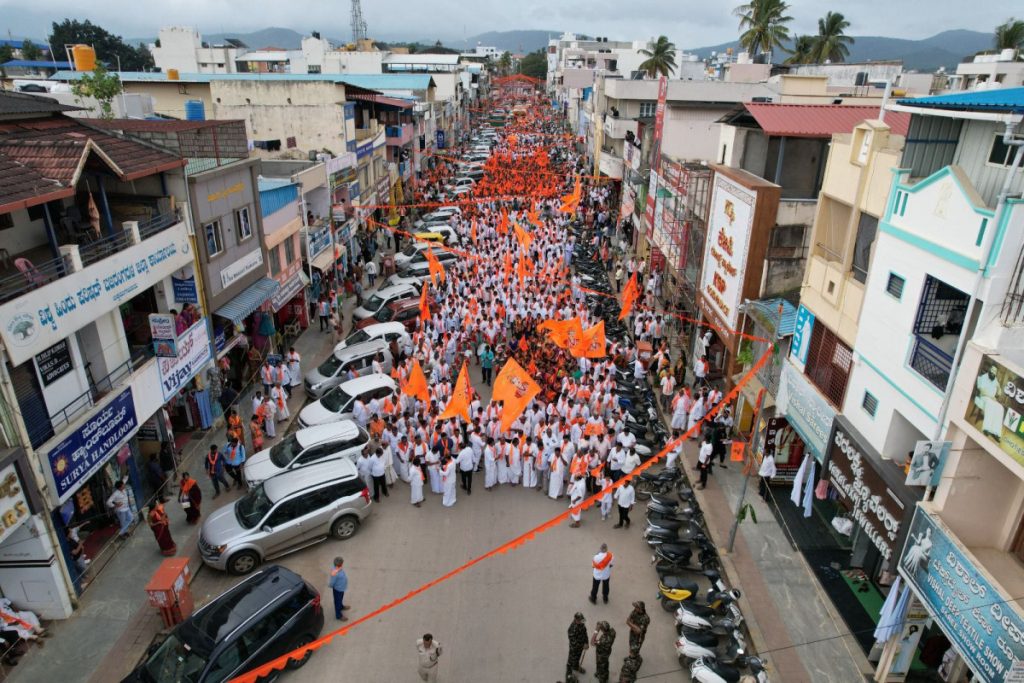
The Basava Samskruti Abhiyana's procession at Shivamogga on September 17. Photo: By arrangement.
Demand for separate religion
Lingayats are followers of Basava and his peers, who rebelled against discriminatory Hindu practices and scriptures, and created a non-Vedic egalitarian alternative in the 12th century. Throughout history, Lingayats were counted as a non-Hindu religious community. The Adil Shahi kings had even imposed separate religious tax on Hindus and Lingayats. The first Mysore census in 1871 listed Lingayats as a separate religion. They were counted as Hindus from 1881 onwards – a decision that came amidst controversy.
Hindu influence had trickled in over the centuries and made Lingayats move away from their rebellious non-Vedic roots. However, in the last 100 years, the growing discoveries of Vachanas (literature that forms the core of Lingayat religious teaching), which were scattered following the Lingayat exodus in the 12th century, started bringing to light the radical aspects of Lingayat religion. Many activists, swamis and scholars like M.M. Kalburgi started campaigning to reverse the Sanskritisation of Lingayats and reclaim the ideals of the original movement.
Lingayats have sporadically agitated to be recognised as a separate religion over the last century. The movement gained ground in 2017-18 in the form of massive rallies in different cities and then entered a lean period, re-surfacing now.
Over the last few decades, nearly a thousand voluntary associations of Basava followers, who work to spread the Lingayat religion, have come up in the state. They hold prayer meetings, debate on interpreting Vachanas and officiate in Nijacharane ('true ritual') ceremonies. The latter are Lingayats' own rites of passage which in contrast with Hindu ceremonies are inexpensive, reject superstition and are based solely on Vachanas.
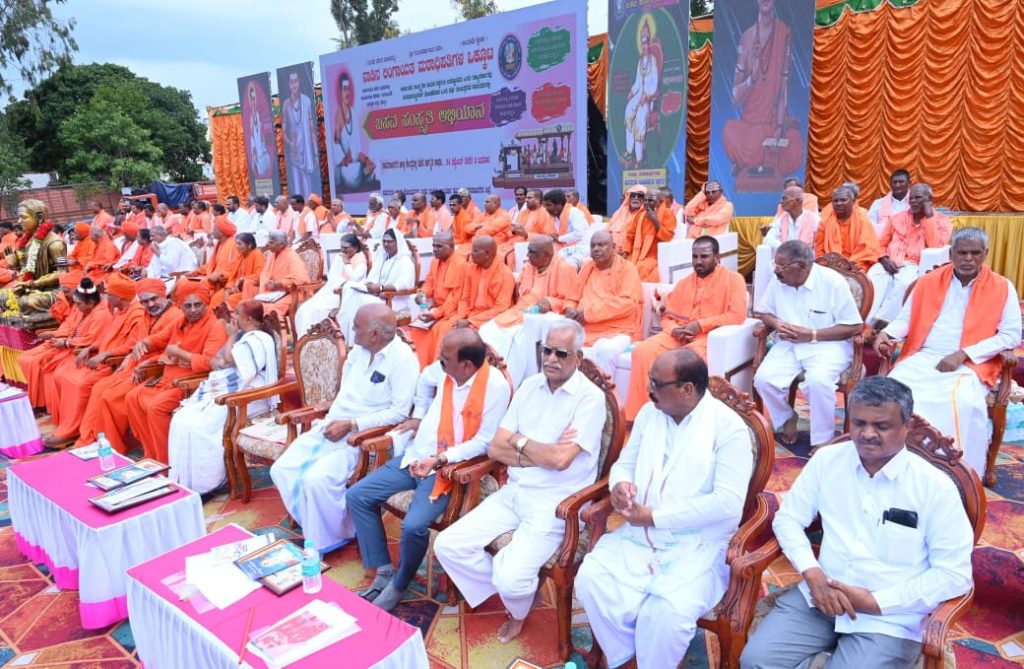
Basava Samskruti Abhiyana's Chamaraja Nagara convention on September 24. Photo: By arrangement.
H.M. Somashekarappa, a retired physics professor, held a house warming ceremony recently according to the Lingayat custom. “I spent Rs 200 for the entire ceremony, while a Hindu version would have cost me Rs 1 lakh,” he says.
The popular rallies of 2017-18 gave Basava followers' organisations the ideological clarity on which they could base the demand for a separate religion. It is these organisations which have now joined hands with the Okkoota to make the Abhiyana such a huge draw.
“The response to the Abhiyana far exceeded our expectations everywhere. In 2017-18 people struggled to understand what we were saying. But since then, awareness has grown phenomenally and the demand for separate Lingayat religion is now a grassroots movement,” said S.M. Jamdar, the general secretary of Jagatika Lingayata Mahasabha, an influential community organisation. A highly respected former IAS officer and a renowned scholar, Jamdar has been spearheading the Lingayat movement.
Escalating conflict
When the talk of the Abhiyana started last December a senior functionary of the Okkoota had told reporters that getting Lingayat youth back from the Sangh Parivar was a key objective of the campaign. But as the Abhiyana approached, the Okkoota decided not to criticise any organisation or religion and keep its message focused on the Lingayat religion to avoid getting distracted or alienating conservative elements in the community.
The Karnataka government declared Basavanna as ‘Cultural Leader of the State’ in 2024, bestowing a status similar to Shivaji’s in Maharashtra. Okkoota swamis say that the Abhiyana will mark the first anniversary of the declaration to remind Lingayats that Basava is their religious guru, Vacahanas are their sacred text, and that they are not Hindus.
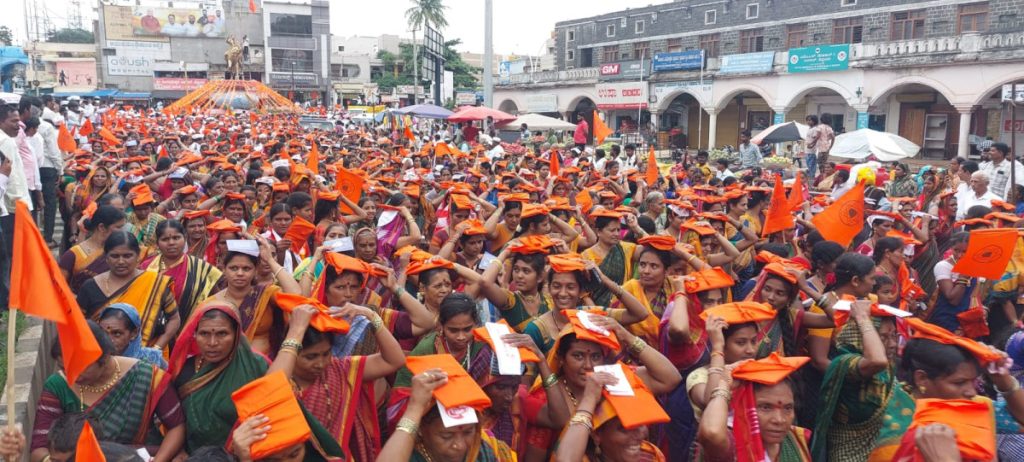
The Basava Samskruti Abhiyana's procession at Basavana Bagewadi on September 1. Photo: By arrangement.
Basava’s inclusive approach and popular appeal works as an antidote to Sangh politics in Karnataka, many feel. The 2024 declaration created huge excitement among Linagayats. Basava organisations stepped up their activities, inadvertently raising the temperature of their tussle with the Sangh Parivar.
After losing Karnataka in the 2024 assembly elections, the Sangh parivar partly blamed the debacle on the loss of the Lingayat vote. To get them back and to check the growing support for a separate religion, it took up many initiatives. It brought out a book, Vachana Darshana, which argued that Basava, Sharanas and Vachanas were just an offshoot of Vedic Hinduism. The book was released at lavish events in cities across the state. A film, Sharanara Shakti, was released, which sought to embed the Lingayat movement in the Hindu tradition.
Lingayats protested, burnt the book and forced drastic cuts in the movie. They also produced two books to counter the Sangh arguments and released them in different cities. In retaliation, the Sangh got those Lingayat leaders and swamis in its camp to coin a new phrase, ‘Basava Taliban’, to describe their ideological opponents.
A swami who is active in the Okkoota said,”The Abhiyana shows our opponents that we have the resources, ideology, and the will to organise on scale wherever we want in the state. We are not against anyone, but we will not stop till we reach our goal.”
Widening gulf with Veerashaivas
The growing support for a separate religion has also widened the gulf with the Veerashaivas, who are led by five ‘panchacharya’ swamis. Veerashaivas, one of the over 100 Lingayat subcastes, trace their origin to a Brahmin group which joined Basava’s movement, which otherwise drew most of its support from backward and Dalit communities.
| What is the panchacharya? The Veerashaiva community is led by five prominent swamis with mathas in Kedarnath, Varanasi, Ujani (Karnataka), Rambapuri (Karnataka) and Srishaila (Andhra Pradesh). They are collectively called pancha (five), acharyas (teachers). These mathas have branches in a few districts of the state. |
Despite coming under Basava’s influence, Veerashaivas stayed true to Vedic practices and used their 'high' social status to form a priestly layer among Lingayats. This happened even though the original movement had rejected such spiritual mediators. Over the centuries they became instrumental in spreading Hindu beliefs and rituals among Lingayats and grew so influential that they even managed to rebrand the whole community as ‘Veerashaiva Lingayat.’
As Lingayats mobilise to return to their non-Vedic roots, they have been pulling away from Veerashaiva influence as well. In recent years, Lingayats are also seen to be clashing with Veerashaiva swamis, who, alarmed by a dwindling number of followers, have been scrambling for ways to keep the communities together and in their control.

Basava Samskruti Abhiyana - Belagavi procession on Sep 11 (1)
Backlash
As the Abhiyana’s emphasis on exclusive Lingayat identity started finding popular support, it drew severe backlash from Hindutva and Veerashaiva supporters. Basana Gowda Yatnal, a Hindutva politician and Lingayat, said Basava did not start any religion. “A few companies have manufactured it,” he said.
Shankar Bidari, a retired director general of police, and state president of the All India Veerashaiva Mahasabha, said diseased minds were trying to break up the society. Veerashaiva Mahasabha, the oldest Lingayat organisation – primarily a body of politicians like Yediyurappa – has been keen to keep the Lingayat and Veerashaiva votebanks together, Bidari, who has shared the stage with RSS, prefers to describe Lingayats as a Hindu sect rather than a religion.
RSS-affiliated writers have expressed concern that a group of ‘communist Swamis’ are taking the community in the wrong direction.
A group of Veerashaiva supporters tried to disrupt an Abhiyana meeting in Bengaluru with both the groups nearly coming to blows. “The godi media is against the Abhiyana. If one blow was exchanged they would have turned it into national controversy and derailed the Abhiyana. We managed to restrain our people,” said Somashekarappa, the physics professor quoted earlier.
The same Veerashaiva group went to Hassan the very next day and disrupted the Abhiyana’s evening convention there. The police and a local Swami managed the situation and the meeting resumed after a break of 15 minutes.
As the Abhiyana progressed, Veerashaiva swamis held a counter convention, ‘Ekata Samavesha’ at Hubli on September 19, to emphasise the unity of the two communities. Though they said they would mobilise a lakh people, only about 7,000 people turned up according to an estimate. Worse, the Samavesha broke into chaos as there was no consensus among speakers. The BJP politicians on the stage asked Lingayats to identify as Hindus while the Veerashaiva Mahasabha leaders insisted on a separate religion tag for ‘Veerashaiva Lingayats’.
Veerashaiva swamis however have relied on their own charisma to bring in the crowd, which is limited to a small 'upper' caste base. The Lingayat swamis represent a broader array of castes, including backward and Dalit groups within the community. They also have the backing of Basava organisations across the state, which lend organisational muscle. “Veerashaiva Swamis have not realised that their show is over. People respond better to Basava philosophy which advocates individual and societal development than sticking to senseless rituals,” said a Hubli-based Lingayat swami.
A new direction for Lingayats
The ongoing caste census in Karnataka has created a competitive mobilisation with Lingayat swamis, Veerashaiva swamis and Sangh supporters, each urging the community to identify as Lingayat, Veerashaiva Lingayat and Hindus respectively.
In this flux, the Abhiyana has empowered progressive Lingayat swamis to emerge as a dominant voice. They have also reached out to non-Lingayat communities to build a broad social coalition.
During the Abhiyana, whenever swamis have come across Ambedkar statues, they have paused the procession and offered flowers. There is consensus among Lingayat swamis that Basava and Ambedkar worked with the same agenda and that the Indian constitution embodies the ideals of the Vachanas. While Lingayats and Dalits are in conflict in many places, this is the message the community is increasingly hearing from its own teachers.
The Abhiyana has also sought to bring backward and Dalit swamis to the fore with the top swamis even opting to take the backseat at times. It is well known that backward caste swamis have an acrimonious relationship with Veerashaiva swamis who are seen as casteist. In contrast they describe the Lingayat swamis as socially inclusive and committed followers of Basava.
In Udupi and Mangaluru where Lingayats are less in number, the Abhiyana was organised with the help of Muslim and Christian groups. This is significant as swamis are often attacked by right-wing groups for taking part in the events and religious processions held by the minorities.
The right-wing eco-system likes to go after two Lingayat swamis in particular – Sanehalli’s Panditaradya Swami and Bylur’s Nijagunaprabhu Swami.
The Panditaradya Swami was in the news two years ago when he had asked Lingayats to stop worshipping Ganesha. He was demonised by the Hindutva media which painted him as a lone ranger lacking support within the community. His organisational skill has now played a huge role in the Abhiyana and he has emerged as an influential Lingayat swami.
The outspoken Nijagunaprabhu Swami is an aggressive campaigner for the Lingayat religion. Though threats to life and litigation have forced him to tone his rhetoric down, he remains a favourite target of Hindutva groups. In this Abhiyana, he has been wildly popular at gatherings.
Gadag’s Siddarama Swami is frequently targeted by the Sri Ram Sene for refusing to keep Muslims out of his matha’s popular annual fair. He took a break from the Abhiyana to address a press conference in Bengaluru, where Sangh supporting journalists subjected him to hostile questioning. He said there was nothing anti-national in seeking to identify as non-Hindus. “Lingayats would contribute to the nation just as Sikhs are doing now,” he said.
Somashekarappa, the physics professor quoted earlier, said that the growing progressive opinion within Lingayats may have serious implications on state politics. "But the Abhiyana at heart is an ideological movement. Lingayats started as a highly inclusive democratic community but have regressed over time. We are trying to reclaim our pluralism and check the spread of hatred in society," he added.
The teacher added a personal anecdote. "On the eve of the Abhiyana at Chitradurga, I saw a group of Muslim women exploring the matha, which is one of the oldest and largest institutions of the community. They were visitors to the city and their host was showing them around inside a prominent Lingayat place of worship. That is the heritage we are fighting to save," he said.
M.A. Arun is the editor of Basava Media.
This article went live on October third, two thousand twenty five, at four minutes past five in the evening.The Wire is now on WhatsApp. Follow our channel for sharp analysis and opinions on the latest developments.


