

The Need for a New Political Rhetoric in Assam: After Zubeen Garg, Before 2026


When Zubeen Garg passed away, Assam lost more than a beloved musician. It lost a cultural metaphor that carried a generation through joy, grief, and contradiction. His voice was not just entertainment, it was a political register of the people’s pulse, a melody that transcended divides and soothed wounds. Mourning him was, therefore, not the mourning of an individual but of a narrative form that spoke what the state often could not.
If politics is about representing collective aspiration, then Assam’s leaders face a crisis – how to fill the silence Zubeen leaves behind. In the run-up to the 2026 Assembly elections in Assam, the ruling dispensation cannot rely on the stale toolkit of populist sloganeering, communal signalling, or generic development talk. Assam today demands a new political rhetoric one that acknowledges that Notun Axom (New Assam) must be a musical Axom.
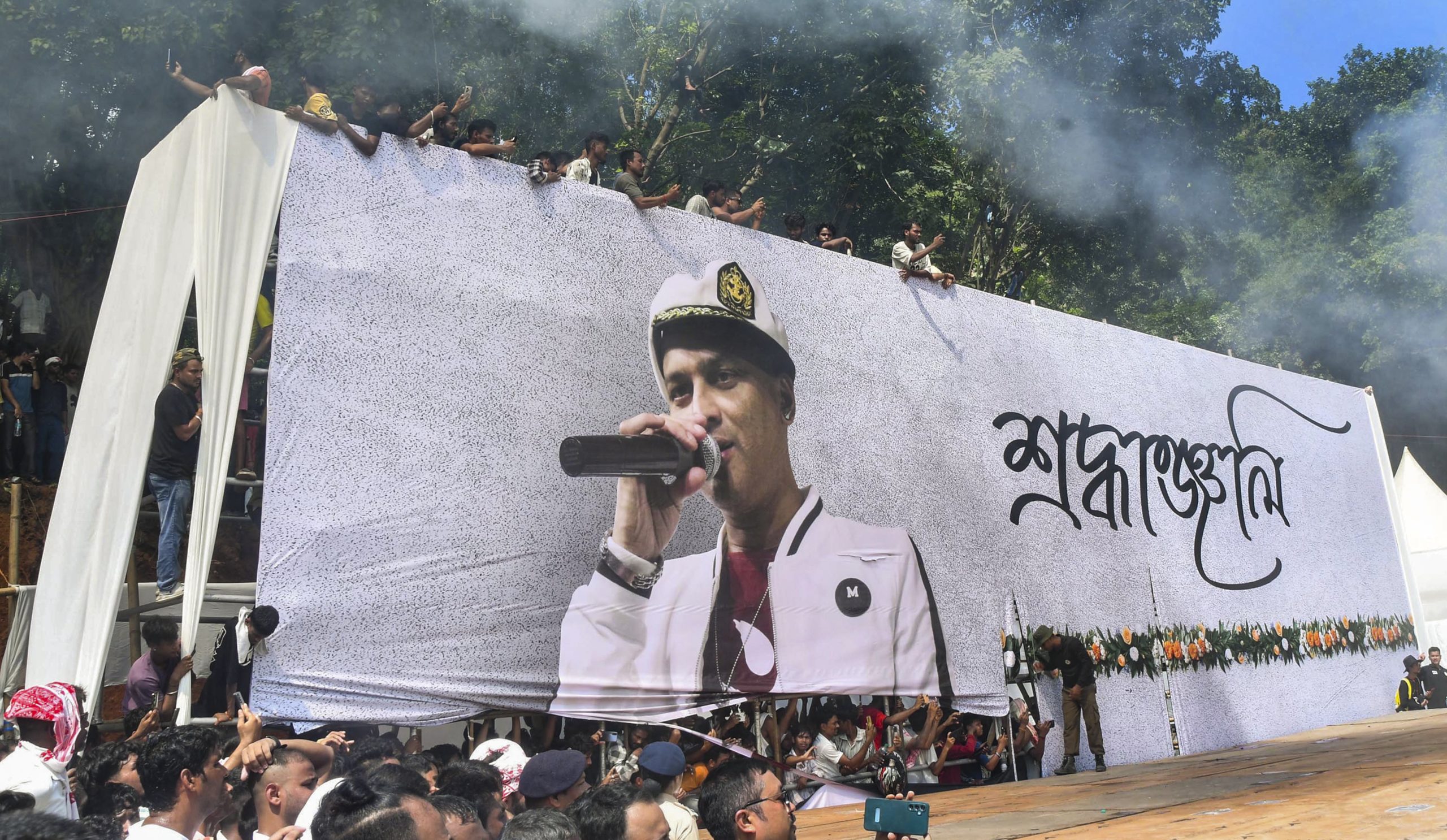
People look from atop a banner during the funeral of singer Zubeen Garg on the outskirts of Guwahati on September 23, 2025. Photo: PTI
Assam’s imagination has always been woven with rhythm and resonance – from the Bihu dhol to Bhupen Hazarika’s protest songs, and now through Zubeen’s legacy. Even nature composes symphonies here, the heat of the day gives way to rain in the evening; floods destroy and then replenish. Climate itself teaches rhythm – dissonance and harmony co-exist, and every ending carries a beginning. Politics must learn from this.
From rhetoric of division to rhetoric of rhythm
The present government, like many across India, has leaned on a rhetoric of division – insiders versus outsiders, identity anxieties, cultural superiority. These tactics mobilise, but they hollow out democracy. They saturate the public sphere with fear and resentment until nothing else can be heard.
But Assam’s cultural history shows that division is not the only register. Its musical traditions demonstrate that resonance, not rupture, can guide politics. In music, the individual voice gains strength only in relation to others; harmony emerges through listening as much as through singing.
Zubeen embodied this. He was contradictory yet whole, mainstream and subaltern, popular and political, rooted and cosmopolitan. He held tensions without collapsing them into antagonism. That fluidity offers a lesson – Assam’s politics must speak the language of rhythm rather than rupture.
Mohabbat ka Dukan in Assam
Rahul Gandhi’s metaphor of Mohabbat ka Dukan (shops of love in the marketplace of hatred) found an unexpected echo in Assam after Zubeen’s death. Strangers gathered in mourning; communities that rarely stood side by side sang his songs together. Guwahati’s streets overflowed not with division but with shared grief.
The ruling party has been reluctant to embrace such a vocabulary of love, fearing it appears “soft”. Yet in Assam, softness is resilience. In a state scarred by conflict, insurgency, and displacement, love is not an excess but a survival strategy. To open a Mohabbat ka Dukan here is to affirm coexistence against all odds. It is to insist that despite histories of violence, a future can still be built together. If the government ignores this undercurrent, it risks alienating the very people whose aspirations it claims to represent.
Towards a politics of listening
Democratic theorists from Hannah Arendt to Chantal Mouffe remind us that democracy is not merely the clash of interests but the cultivation of a shared stage where people can be seen and heard. Assam requires this urgently. Its politics has become monologic, speaking at, not with, the people.
What is needed is a rhetoric of listening. Music again provides the metaphor. A song is not just the singer; it is also the pauses, the instruments, the audience. Similarly, politics must learn to hear the silences left by Zubeen – the silence of tea garden workers whose struggles remain unamplified, of flood victims forgotten once waters recede, of women still pushed to the margins.
A new rhetoric cannot simply trumpet Assamese pride; it must cultivate Assamese humility – an openness to listen to the other.
From developmentalism to cultural economy
Assam demands development in terms of infrastructure, jobs, health care and education. But the idiom of development alone is inadequate. It reduces citizens to consumers of state resources rather than co-creators of meaning.
Zubeen’s life reminds us that Assam’s true economy is also cultural. Songs, festivals, stories, traditions, these are not decorative extras to politics; they are the very fabric of belonging.

Zubeen Garg. Photo: PTI
Thus, the government must weave cultural economy into its political rhetoric. This is not about tokenising icons during elections or building statues after death. It means actively creating spaces for cultural participation – funding grassroots music, supporting local languages online, protecting community media. And crucially, it means resisting homogenisation into majoritarian nationalism, ensuring that Assam’s polyphonic texture is preserved.
Rethinking Notun Axom
The slogan of Notun Axom began as a promise of modernisation and growth. After Zubeen’s death, it demands reinterpretation. The Notun Axom people now imagine is not just highways and investments; it is the rediscovery of the musicality of living together.
Politics itself must follow rhythm. When heat becomes unbearable, rain must come. When hatred begins to spread, love must intervene. Elections in 2026 will not be won by recycling fear or by showcasing bridges and roads alone. They will be won by those who can channel Assam’s mood – its longing for connection, its refusal to suffocate in bitterness, its insistence on singing even in grief.
The rhetoric of hope
The silence left by Zubeen cannot be filled by producing another charismatic figure. Nor should politics try. What is needed is a new rhetoric, one that moves from command to conversation, division to rhythm, resentment to resonance. This does not erase conflict but treats it musically – negotiated, modulated, counterpointed, not bludgeoned.
As Assam heads toward 2026, the ruling party faces a choice. It can persist with divisive rhetoric that exhausts and alienates. Or it can attempt something bolder: to speak in rhythm, to listen as much as it speaks, to nurture Mohabbat ka Dukan across the state. In doing so, it would not only honour Zubeen’s legacy but also craft a genuinely Notun Axom, an Assam that sings its politics instead of shouting it.
For politics, like music, is about how we live together. Both can generate noise or harmony. And both demand, above all, that we learn how to listen.
Alankar Kaushik teaches media studies at EFL University, Shillong Campus.
This article went live on October tenth, two thousand twenty five, at forty-seven minutes past five in the evening.The Wire is now on WhatsApp. Follow our channel for sharp analysis and opinions on the latest developments.


