

‘They Don't Want Dialogue, They Just Want Silence’: Ladakh’s Post-Protest Reality


Leh: The Bharatiya Janata Party's (BJP's) office wears a deserted look in the cold desert of Ladakh. On September 24, the premises of the BJP office witnessed the peak of a protest, wounds, bloodshed and trauma. So today, locals do not even wish to cross the ominous office that they say embodies the brute force used against them.
Two months ago, when Sonam Wangchuk, who sits jailed for being Ladakh’s face for climate activism and constitutional rights, was on a hunger strike along with 12 others, a silent protest turned violent.
That day, when Ladakhis brought their protest to the road, it was no new event – the region had been protesting since December 2019.
Realising that two very elderly protesters on hunger strike were being taken to the hospital owing to unstable vitals, youth leaders began protesting outside the strike's venue, leading others to the Ladakh Autonomous Hill Development Council (LAHDC)'s office and then the BJP's office, where the battle for being heard began.
A clash between the police and protesters began when angry protesters threw plastic bottles and stones; their protest met the police’s tear gas bombs and later bullets, killing four and wounding dozens more.
Longing for lost rights
Six years ago, in 2019, the Modi government arbitrarily revoked Jammu and Kashmir's autonomy and split the former state into two Union territories: Jammu and Kashmir, and Ladakh.
In Leh, the move was first greeted with celebration; many residents believed a long-awaited escape from Srinagar’s political and administrative neglect had finally arrived. But the euphoria was short-lived. People say that while Ladakh now had its own Union territory, it had lost even the limited democratic space and local decision-making that its councils once held.
Activists and elders say what followed has hardened into resentment. According to Chering Dorje Lakrook, president of the Leh Buddhist Association and a former minister, years of unfulfilled promises concerning jobs, constitutional safeguards and protections for resources have eroded trust.
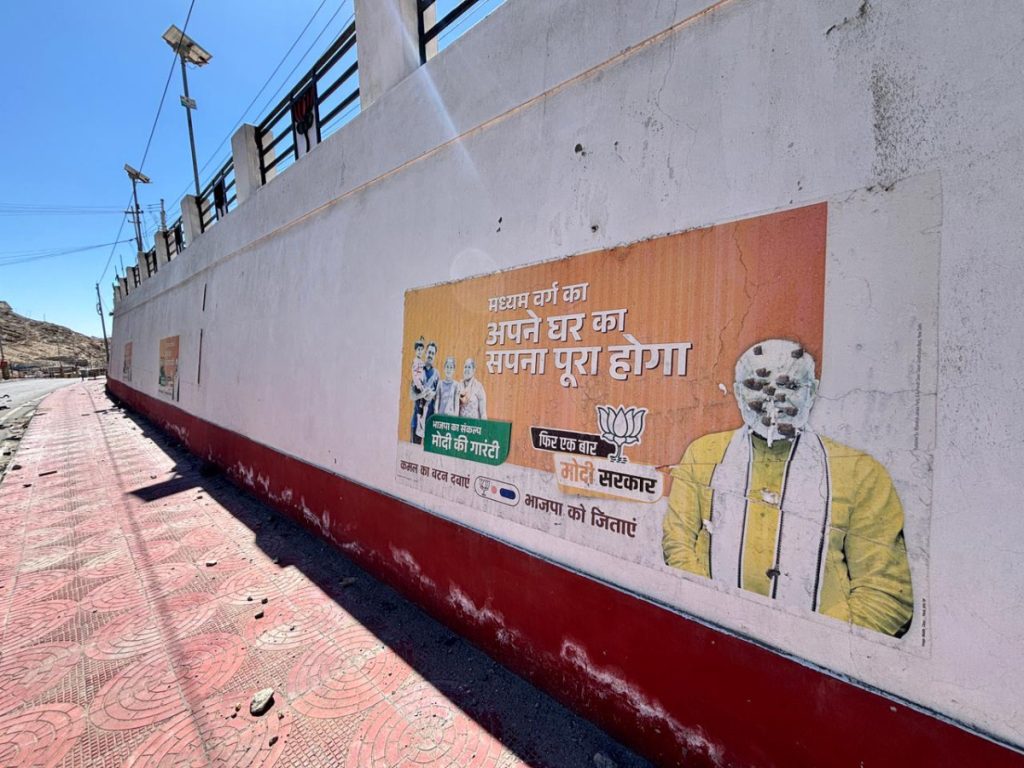
PM Narendra Modi's poster is seen destroyed in part in Leh, after the protests. Photo: Jehangir Ali.
“When protests erupted on September 24, young locals had mobilised around the elderly hunger strikers. Many of us tried stopping the angry protesters, at least 2,000 of them turned up,” Lakrook told The Wire.
Lakrook said that the youth in Ladakh have been frustrated with the way the government has been ‘oblivious’ to the idea of employment generation. “Continuous ignorance and sidelining is what triggered protests, yet Ladakhis have been labelled anti-national, our protest was called a conspiracy and our demand for rights was called politically motivated. None of this is true,” he said.
Several locals who spoke to The Wire said that the way locals were dealt with after the protests exposed how New Delhi's ‘development-driven model’ treats the region as a security periphery rather than a democratic community.
Cost of questioning the state
In the weeks after the protest, Leh did not return to calm – it simply fell quiet. The administration tightened restrictions on movement, imposed curfews, cut mobile data and later prohibited the circulation of “rumours” on social media.
But for locals, the blackout felt less like prevention and more like punishment. People described the town as moving under an invisible weight: conversations softened, phones were switched off amid mounting anxiety and young activists began avoiding the main market, worried about being picked up.
Several residents said they now avoided the LAHDC office unless they absolutely had to visit. In Old Leh, a shopkeeper told me: “They don’t listen, but they watch,” tilting his chin toward a CCTV bolted to a bent lamppost.
On the street, one could see how the mood had shifted, with people lingering less, conversations breaking off when a uniform walked past, that small habit of glancing back even in lanes where neighbours have known each other since childhood.
Many Ladakhis today feel a deeper psychological shift in the way they see the state and the way the state sees them.
For Yangchan Dolker, nightmares have become a constant ever since September 24. Dolker saw people being rushed into the hospital, people yelling, blood dripping everywhere and, allegedly, the way the police stopped people from entering the hospital for donating blood.
“That day, we thought they would make Ladakh another Kashmir,” Phuntsog Angmo, an eyewitness, recalled. “We cry whenever we hear the national anthem, our tricolour is our pride, our eyes and hearts swell with tears when we look at it. But when we demanded safeguards for our Ladakh, we were branded ‘anti-national’, this broke us,” Angmo shared.
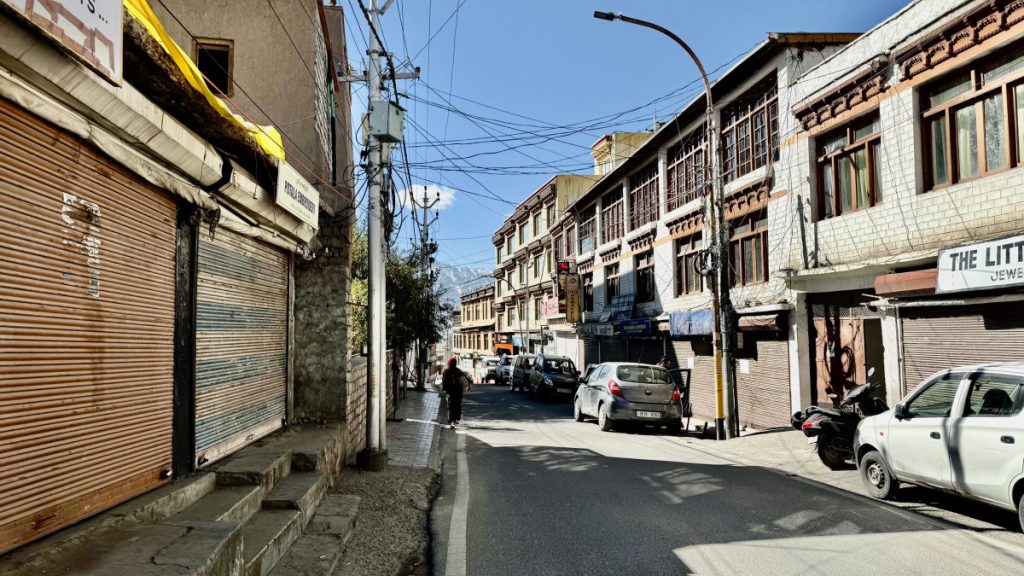
Leh's streets have fallen quiet ever since the clashes of September 24, 2025. Photo: Tarushi Aswani.
Previously, when Ladakh was under the Jammu and Kashmir state system, people through the LAHDC held limited but tangible authority; dissent had a venue, a route, a process. Today, under Union government rule, locals feel that grievances travel upward into a void and instead of receiving answers, residents say they feel the state’s gaze.
Across Leh and Kargil, people feel the loss of representation – Ladakh does not have an assembly and thus no MLAs, while it continues to send one MP to the Lok Sabha – paired with an expanding security presence has left them unsure of what counts as permissible speech, or whether the government sees their demands as democratic claims or as a challenge to authority itself.
Tsering Stobgyal, a local who had previously been a part of Wangchuk’s September 2024 padyatra from Leh to Delhi, the walk that was meant to signal the peaceful nature of their protest, said: “His arrest and the subsequent levelling of an NSA [National Security Act] charge has really shaken people and disturbed them. It is only because of Wangchuk that Ladakhis even know about their rights.”
Wangchuk, who remains in the Jodhpur central jail, contests his detention as illegal and has said his words were twisted in order to detain him under the NSA. His wife, the social entrepreneur Gitanjali Angmo, is fighting for his release.
Stobgyal, who witnessed what unfolded this September 24, said that after that day, “We understood one thing. They don’t want dialogue. They want silence.”
But Stobgyal’s experience isn’t limited to the protests, padyatras and police action. He lost his friend in the turmoil after the clashes that the government deemed a ‘conspiracy. Stanzin Dorje, who was part of the ongoing agitation for constitutional safeguards and democratic rights, died by suicide after apparently being troubled by the events of September 24.
“We have lost pieces of us and our Ladakh during the violent turns of events,” Stobgyal said.
‘We've survived worse things than Delhi's silence, but won't survive without our rights’
In Ladakh today, the question among residents is no longer whether New Delhi will listen, it’s whether ignoring Ladakhi demands has become the default mode of governance. Across Leh, people speak of a political future that feels suspended, neither moving towards genuine representation nor back to the arrangements they once knew.
What remains is a widening gap between the state’s insistence that normalcy has returned and a population that sees every month of silence as confirmation that its democratic rights have been quietly set aside.
The September 24 protest marked a turning point not because it was the first moment of defiance, but because it revealed how brittle the region’s relationship with the Union government has become. Elderly hunger strikers taken away under heavy police presence, teenagers choking on tear gas and residents shot while demanding constitutional safeguards: these scenes have become anchors for a growing belief that Ladakhis are being governed through force, not consent.
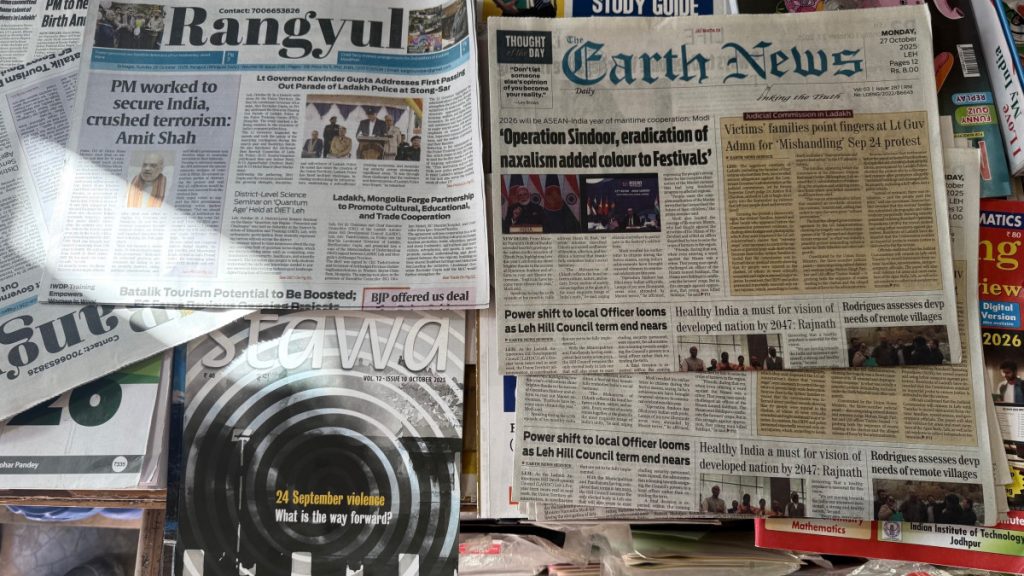
Newspapers and magazines in Leh discuss the events of September 24. Photo: Tarushi Aswani.
Gelek Phunchok, chairperson of the Ladakh UT Development Council at the Associated Chambers of Commerce and Industry of India and a member of the Leh Apex Body, feels that ever since the firing, there has been a heavy silence in the atmosphere in Ladakh.
“We are in a chaotic cycle ever since 2019; while there was more funding received, our representation reduced. Even with the funds received, Raj Niwas [the lieutenant governor's office] was constructed. How has it affected the quality of life in Ladakh? When we look even at the surface, minute things such as the functioning of the PWD [public works department] have reduced, private companies are taking over their job,” he shared.
Phunchok also pointed out that declining tourism has contributed to a dismal state of employment opportunities, which has continually angered youth into protesting.
“Looking at the current status, our growth as a region is stalled, economically and politically. In the last six years we have seen a systematic and unfair dilution of rights and representation,” he added.
The stalemate between the government and disgruntled locals is giving rise to stubborn persistence. The same communities that once celebrated Union territory status are now drafting charters, convening village meetings and standing by each other as the government, they say, stands against them.
Their demands for statehood, Sixth Schedule protections and meaningful local autonomy have grown more coherent, not less, with time. And each protest, even when met with curfews and communications bans, deepens the conviction that Ladakh’s political direction should be shaped from within, not dictated from afar.
Now, Ladakh is looking at what happens next and whether the Union government recognises that a region perched on a militarised, climate-fragile frontier cannot be held together by administrative control alone.
“We’ve survived harsher things than Delhi’s silence,” Stanzin Shayan, a Ladakhi singer and leader, told The Wire. “But we won’t survive without our rights.”
Today, for Ladakh’s residents, the struggle is about insisting on a democratic future that the state appears to them increasingly unwilling to grant, and refusing to let that future be held up indefinitely.
For those who live in Ladakh and those jailed for Ladakh, the September 24 protests matter precisely because they shattered the myth of Ladakhi silence: thousands of young people took to the streets for basic dignity, only to be met with bullets, detentions and a security lockdown more reminiscent of a border crisis than a civic dispute.
People view the state-imposed representational vacuum in Ladakh not just as undemocratic, but as actively manufacturing resentment and instability.
If you know someone – friend or family member – at risk of suicide, please reach out to them. The Suicide Prevention India Foundation maintains a list of telephone numbers they can call to speak in confidence. Icall, a counselling service run by TISS, has maintained a crowdsourced list of therapists across the country. You could also take them to the nearest hospital.
This article went live on November twenty-third, two thousand twenty five, at twelve minutes past eight in the evening.The Wire is now on WhatsApp. Follow our channel for sharp analysis and opinions on the latest developments.


