

Ground Report: In Upper Assam, Voters Are Torn Between Choosing a Candidate or a Party


Golaghat (Assam): Since the time the Bharatiya Janata Party (BJP) announced its first list of candidates for the Assam assembly elections in early March, Moromi Konwar has been busy canvassing door-to-door for the party’s candidate in her constituency, Golaghat.
These assembly elections, the voters of Golaghat, located about 286 km from the state capital Guwahati, are bracing for an unusual political choice. The sitting MLA, Ajanta Neog, a minister in the 2011 Tarun Gogoi government, has recently switched sides to the ruling BJP and has succeeded in getting a party ticket. The BJP candidate in the last polls, Bitupan Saikia – upset with his party for denying him the ticket – has, in turn, shifted allegiance to the Congress, which lost no time in announcing him as the party’s nominee from the constituency.
Though Saikia had given Neog a stiff fight in the 2016 polls as a BJP candidate, he was eventually defeated by a few thousand votes. Neog’s popularity in the constituency helped her overcome the ‘BJP wave’ in the last polls, prodding the BJP decision-makers to hand her a ticket this time. “Aside from her closeness to BJP leader Himanta Biswa Sarma (her former colleague in the Congress government), winnability is often the party’s main criteria in ticket distribution,” a local BJP leader told The Wire. Soon after Neog’s shift to the BJP, there was a stiff protest among the cadres but the leader said, “Eventually, everyone will fall in line. They will support Ajanta baidew (elder sister).”
For Moromi and other voters in the constituency, in these elections, the two top candidates have remained the same – but with their party symbols interchanged. This means they have to decide whether to choose according to the party or the candidate.
“Ei baar amar karone aru party nohoi, parthi he (This time around, it is not the party for us but the candidate),” said Moromi, a resident of Bogorijeng village, situated close to Golaghat town.
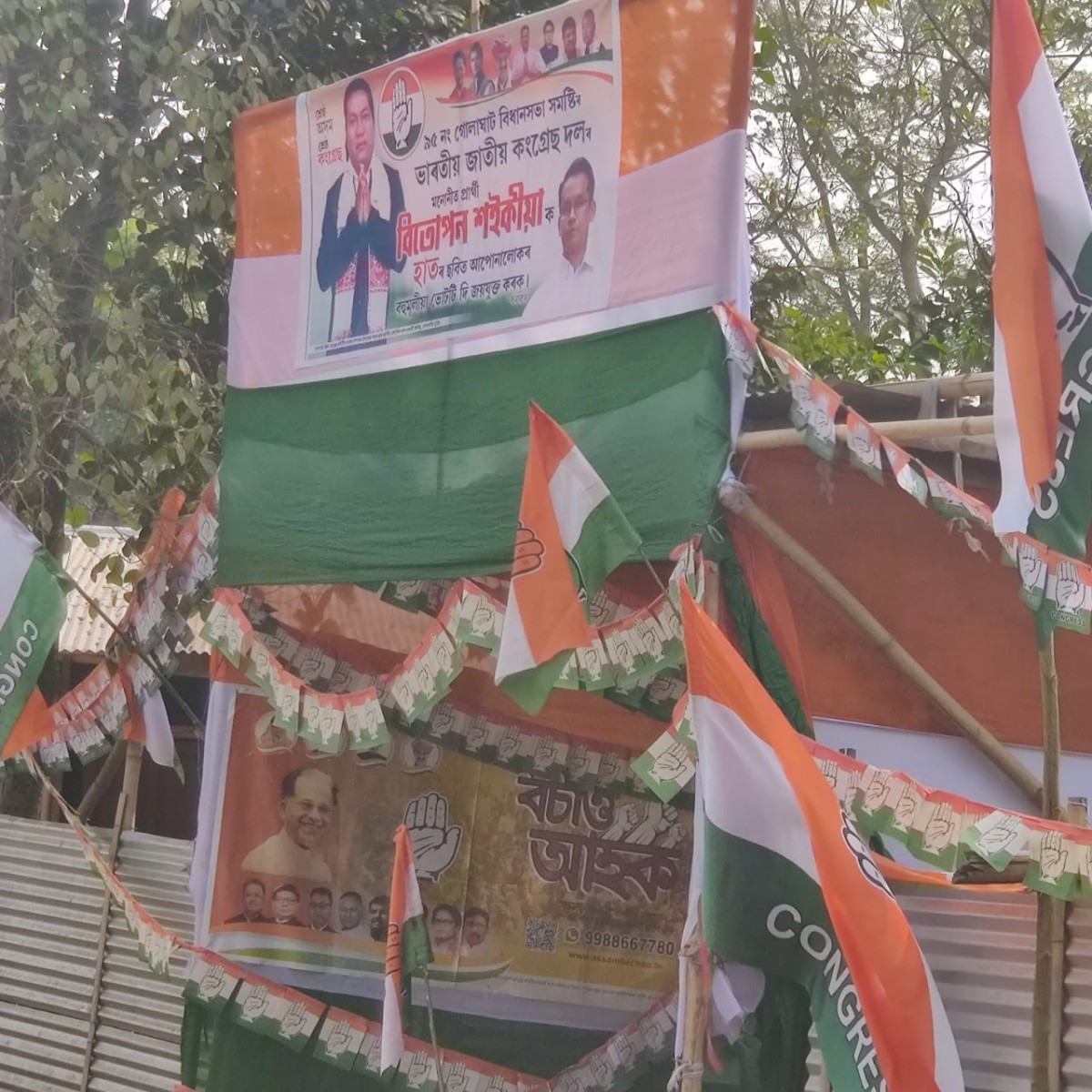
An election booth of BJP-turned-Congress candidate Bitupan Saikia in Golaghat. Photo: Sangeeta Barooah Pisharoty
She and a clasp of 14 women from the area are grateful to Neog for helping them get xonsthan (employment) some years ago. The proof is next to her house – a shed with four looms where the village women, as part of a self-help group, weave a range of textiles – mekhela sador, gamusa, lungi kapor, Eri shawl – and earn a modest living by selling them locally. “As the MLA, baidew (Neog) had provided us all the help to set it up,” she said.
On the front yard of her house is a concrete hall under construction. She pointed at it to say, “Ajanta baidew has funded this from her MLA allowance. Now we can expand our business.” Moromi and fellow self-help group members have been Congress supporters but shall shift allegiance to the BJP this elections because of their camaraderie with the sitting MLA.
About 20-25 km from Moromi’s house is Sherman Ali’s residence, in the constituency’s Komar Bondha area. He too has been a Congress voter but may shift allegiance this time to the BJP. “It is not the party; we have interacted with Ajanta baidew since she became the MLA in 2001. So there is a comfort level with her. This road in front of my house was constructed by her when she was the Public Works Department minister in the Tarun Gogoi government,” Ali said. Saikia has been holding meetings in the Komar Bondha area to canvas for the polls as a Congress candidate. “Till recently, he never thought of reaching out to us as a BJP candidate; so how can people like us all of a sudden vote him just because we have been Congress voters? The comfort level with the candidate also matters,” said Ali, an Assamese Moria Muslim.
Of the 126 constituencies, 47 are going to polls in the first phase of elections on March 27. Other than the Golaghat constituency, voters are not a peculiar situation where the two major parties have given the same choice of candidates to the electorate but with different symbols. However, in several constituencies of upper Assam visited by The Wire, the candidate seems more important than the party in these elections.
In the 2016 polls, voters wary of the three-term Congress government had bitten into the lure of ‘change (poriborton)’ and voted for the BJP-AGP-BPF combine. In upper Assam, which has the largest chunk of the state’s 126 assembly seats, voters chose the party over candidates, except in one or two constituencies. Because of such a voting pattern, the Congress was reduced to 26 seats from the 53 pocketed in the 2011 polls, thus ensuring a historic win for the BJP with 60 seats. Of the 78 seats in upper Assam, Congress could retain only seven in 2016. In 2021 though, there is no such BJP wave, leading voters in several constituencies to weigh between going for a party or the candidate.
Also read: How the Akhil Gogoi Factor May Tilt the Electoral Scales Against Congress in Sivasagar
In the Amguri constituency, whether to go for the party or the candidate is palpable among the voters. “Our MLA, Prodip Hazarika, from the Asom Gana Parishad (AGP), never showed his face in the last five years even though we voted for him. Now, with the elections nearing, we see some roads in our area being repaired. In contrast, Ankita Dutta (the Congress candidate), who in spite of losing the seat in 2016, has remained in touch with us, has been visiting us regularly for over seven months now; she is a porha xuna suwali kintu bhem nai (an educated woman but has no airs), we will vote for her this time,” said Jumoni Das of Saraguri village.
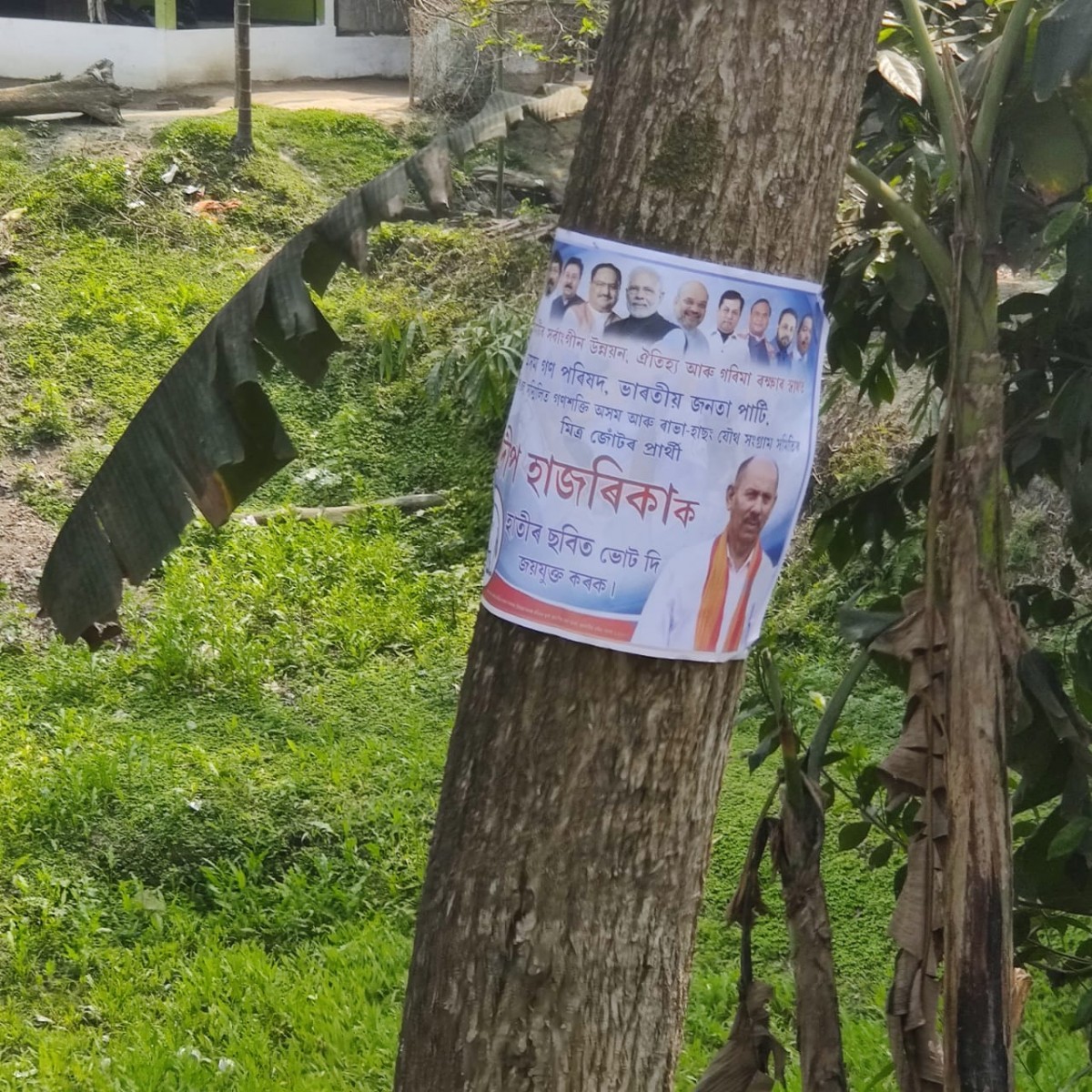
A poster of AGP candidate Prodip Hazarika in Amguri constituency. Photo: Sangeeta Barooah Pisharoty
Close to river Dikhow passing by the village, a set of local youth are busy laying concrete tiles on the mud path. “Most of these boys are higher secondary pass (passed Class 12) and yet working on the road. They need permanent jobs,” she said. A group of women supporters of the Congress has been going door to door in their area to promote ‘five guarantees’ of the party if it comes to power. Two of them are five lakh jobs to youth and Rs 2,000 monthly direct bank transfer to married women to supplement their family expenditure. Jumoni claimed these are factors of attraction for several voters in her village.
Deepak Das, a resident of Lalimsapori mandal of the constituency, however, added, “Anyway, it is Ankita’s turn this time; in our constituency, the MLAs matter but also the party; we keep changing parties; in 2011 it was Congress, in 2016 it was AGP and now it will be Congress again.” Arup Kalita, a paan shop owner at Gaurisagar, agreed, “Ankita’s father and former Congress minister Anjan Dutta had passed away before the 2016 elections; many then thought that Ankita would get sympathy votes in the last elections but it didn’t happen; the tradition of changing parties continued.”
In neighbouring Sivasagar constituency too, the voters are wrestling with the question of whether to cast their vote according to the political party or the parthi (candidate). Though a traditional Congress seat, anti-Citizenship (Amendment) Act activist and incarcerated leader Akhil Gogoi is contesting from the constituency as the candidate of his newly floated Raijor Dal, thus leaving voters in a dilemma – to go with the party (Congress) or choose the candidate.
On March 24, two days before the electioneering is to end in Sivasagar, thousands of people joined a Raijor Dal rally in the constituency, led in Akhil’s support by his 84-year-old mother Priyada Gogoi along with social activists Medha Patkar and Sandeep Pandey. After the rally, a local BJP activist told The Wire, “The contest has now narrowed down to Congress and Raijor Dal. It remains to be seen whether people will ultimately go with the party or the candidate. It looks like our candidate, Surabhi Rajknowar, will come in third.”
While the Congress candidate, Subhamitra Gogoi, is a first timer, Akhil Gogoi is a known face. His family recently shifted to a rented accommodation in the Sivasagar town as several voters have been saying that they would have chosen him had he been a resident of the constituency. “Now they can,” a Raijor Dal leader told local reporters.
Also, looking at the crowd at the March 24 party rally, Akhil Gogoi’s recent appeal to the voters of the constituency that they can help him come out of jail by choosing him as their MLA seems to have cut some ice. That he has public sympathy for being kept behind bars by the ruling BJP-AGP government for taking part in the anti-CAA protests in December 2019 comes across clearly while travelling across the constituency.
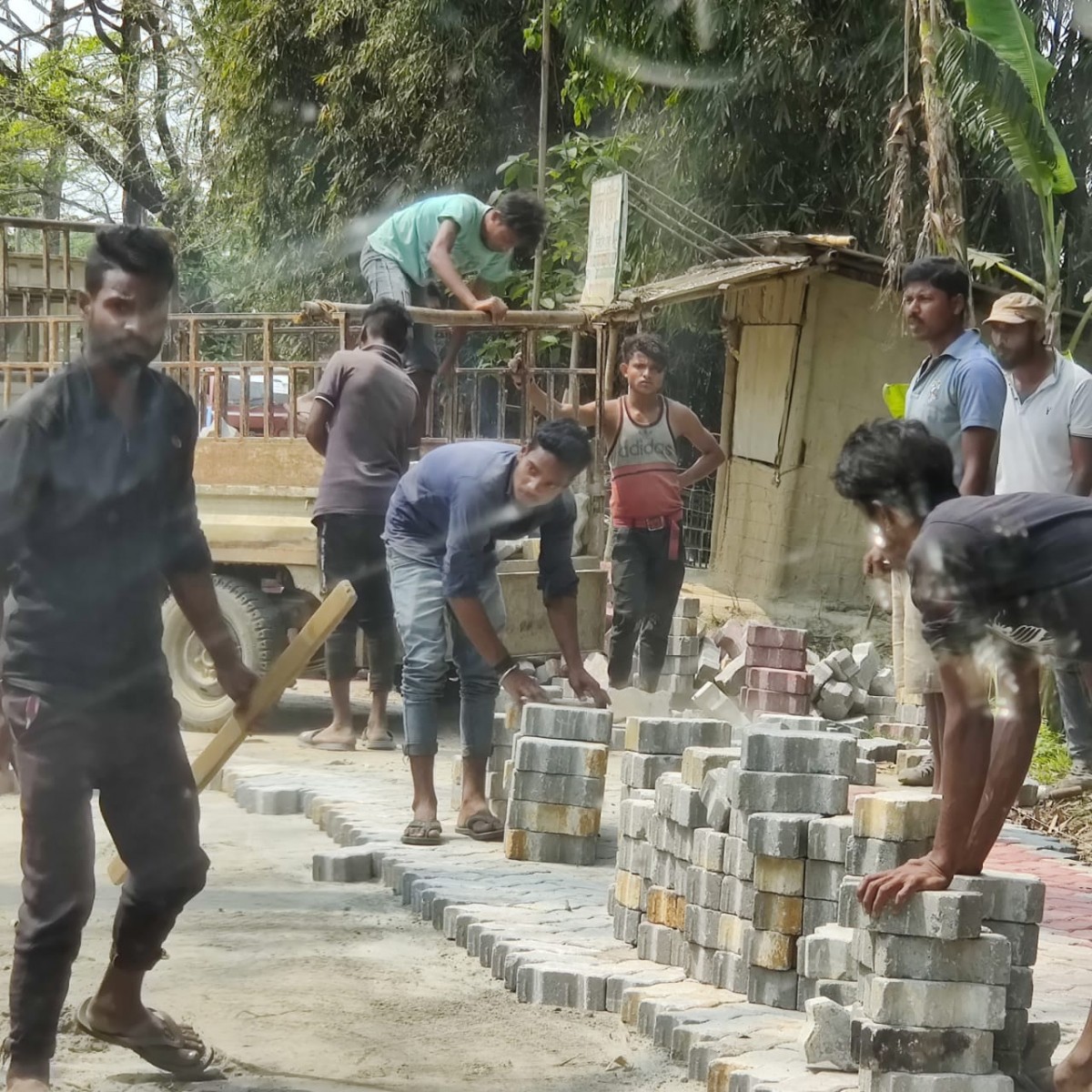
Young men in Saraguri village of Amguri constituency engaged in laying tiles on the road. Photo: Sangeeta Barooah Pisharoty
In the Dibrugarh constituency too, the party or candidate predicament can be spotted. “There is no contest here. Once more the BJP candidate, Prasanta Phukan, will win it hands down simply because the Congress candidate, Raj Kumar Neel Netra Neog, is a lightweight to challenge a three-time MLA. This has not much to do with party, only candidate,” said Nilutpal Bhuyan, a Dibrugarh resident.
Dibrugarh resident Aradhana Kakaty also spoke about denying ticket to sitting AGP MLA from Lahowal, Rituparna Boruah. “The AGP gave away the seat to the BJP; the voters are wondering why. He was a winning candidate from the AGP. Candidates matter,” said Kakoty.
In the Sadiya constituency of Tinsukia district, the eastern most tip of the state, the preference for a party may end up being secondary to that of a candidate. In the 2016 polls, it was the same. “Our sitting MLA Bolin Chetia was from the Congress and won for two terms because he is a good candidate. In the 2016 polls, he moved to BJP and won again. Though there was a BJP wave, still people looked at the candidate too," said Baba Chetia, a voter from the constituency. He thinks this time though the BJP has once again launched himself as the party's nominee from the constituency, the contest on March 27 may tilt towards Jagadish Bhuyan, a former AGP MLA from the constituency who had shifted to the BJP and is now one of the founders of the newly floated anti-CAA party, the Asam Jatiya Parishad (AJP). "It is because if the candidate", he said.
Yet another voter from Sadiya, Ranju Hazarika, categorically stated that he would vote for Bhuyan. “My family had voted for him in 1998 as an AGP candidate. This time too, we will vote for him.” Asked why, he replied, “Bhuyan is a jatiotabadi neta (sub-nationalist leader); we are also jatiotabadi. We had supported the BJP (Bolin Chetia) in 2016 because of its jati mati bheti promise (to protect the Assamese identity from undocumented foreigners) but in return, it imposed the jati-dhonxi (the crusher of the Assamese community), the CAA. AGP and BJP are the same. So this time, AJP zindabad.” Even if AJP fails to corner enough seats to be a serious contender for power, Hazarika said, “In this case, candidate will matter.”
Not just in Sadiya but the jury is out on the fate of the AJP in two other constituencies of upper Assam – Duliajan and Naharkatia. AJP heavyweight Lurinjyoti Gogoi is contesting from both the seats. “If you see local news reports, Lurin’s loss in Duliajan is almost a foregone conclusion but if he wins in our constituency (Naharkatia), he will do so only as a candidate. As a party, AJP will not be a factor in government formation,” said Ranju Chaliha, an AJP supporter in Nahakatia. While Duliajan had gone to the BJP in the 2016 polls, Naharkatiya was picked by AGP.
Srimanta Bordoloi, a senior AJP worker in Dibrugarh, told The Wire that the party is not looking at winning a lot of seats these elections. “To win an election, a party needs to have a proper structure till the grassroots. We didn’t get much time to put that in place and yet we are in the fray because we are here for the long run; we want to send the message to the Assamese community from these elections that AGP may have abandoned you and your issues but we are here to raise them and protect our language, land and identity,” said Bordoloi.
Watch | Assam Elections: Anti-CAA Sentiment Is Not the Only Narrative Against the BJP
Yet another constituency where several voters are weighing their options between the party and the candidate is Bokakhat, where AGP president and state agriculture minister Atul Bora is seeking re-election. “It was a three-corner contest initially but not anymore. Anti-incumbency against Atul Bora is high. His challengers are the former two-time MLA Jiten Gogoi, contesting as an independent, and a first-timer Pranab Doley, also an independent but is now backed by the Congress mahajut (grand alliance). Doley has done work amongst the poor, fought for the rights of the people living on the periphery of the Kaziranga National Park. With Congress backing him, he is suddenly a formidable challenger,” stated Narayan Saikia, a paan shop owner in Bokakhat town. In 2016, Saikia had voted for Bora but is tight-lipped about his choice this time. As against 22,769 votes polled by the Congress candidate Arun Phukan in the last polls, Bora had pocketed 62,962 votes.
Saikia said, “Ei bar eman nepai (This time he won’t poll so many votes).” His reasons are the lack of a good progress report from Bora in the last five years, charges of corruption, the Congress’s promise to hike the daily wages of tea garden workers to Rs 365 as against the present Rs 165, and also Doley’s popularity as an NGO worker in the area. “Doley has gone to jail several times for their rights. He is sincere, people will vote for him. But nothing can be said at this time with surety. Already, BJP workers are among the tea garden workers promising them once more to raise their wage once their government returns to power,” said Saikia. Among the Assamese women voters of the constituency, several are beneficiaries of the state’s direct cash transfer Orunudoi scheme which may help the BJP pull women’s votes. Saikia’s wife has also got the direct cash benefit of Rs 830 from the scheme.
With the fight in Bokakhat turning into a tight contest, Prime Minister Narendra Modi campaigned for Bora five days ago, projecting AGP as the partner of the BJP’s “double-engine” government in the state. A close glance at his speech does make it clear that the Congress-backed candidate is being looked at by the BJP-AGP alliance as the principal opponent. To counter the Congress’s ‘five guarantees’ if it comes to power, Modi picked the term ‘guarantee’ to accuse his opponent of promoting corruption, false promises and gun culture in the state. He not only claimed that his party has succeeded in protecting the one-horned rhino, an asset of the constituency, but also indirectly hit at Doley’s work by calling those people evicted from the extended periphery of the Kaziranga National Park, for whom he has been raising his voice, “encroachers”.
Modi, however, admitted that his party has not been able to solve the tea garden workers’ daily wage issue, as promised in 2016, but added, “Once we are back in power, we will work on it.”
Another word Modi used in his speech was axirbad (blessings) – required from the voters for his party these elections. It is a term already used by the state BJP to promote its beneficiary politics through direct cash transfers and other doles in the state to seek votes for its re-election.
In the upper Assam constituencies like Thowra and Moran where the tea garden workers are in a majority, the Congress and BJP are once again locked in a fight. Though in the 2016 polls, the tea tribe (Adivasi) votes shifted from the Congress to the BJP as the party and RSS workers had promised several facilities to the community including raising their daily wages, this time, the Congress’s clear promise on a wage hike – repeatedly stated by leaders Priyanka and Rahul Gandhi – has put many voters in a quandary.
“In our community, it is never the candidate, always the party. In 2016, BJP’s Kushal Dowari got our votes in the Thowra seat and could wrest it from the Congress only because of so many promises the party had made to us. This time, several people want to vote for Congress but Dowari is frequently entering our residential areas in the evenings with his supporters; people are increasingly getting confused. The Congress candidate Sushanta Burhagohain was also attacked by the rival party,” related Sanjeev Kerketa from the constituency.
On March 22, a night after Dowari came to their area near Thowra tea estate, tea gardens in the entire belt witnessed a shutdown. Workers were demanding a pay hike from the owners, who had gone to the Gauhati high court opposing the state cabinet’s decision to raise the wages by Rs 50. Even though two principal student bodies of the community – the Assam Tea Tribes Students’ Association (ATASA) and All Adivasi Students Association of Assam (AASAA) – had called for the shutdown, AASAA withdrew its call at the last minute.
Unhappy with the two outfits for not being able to stand united on the issue, Jerjeta said, “People among us are playing politics over our rightful demand. Kona hahe aron u khai (A blind hen even pecks on the case of the paddy grain). Our community has come to such a state now."
At the Assam Chah Mazdoor Sangh (ACMS) office in Dibrugarh, the executive members were huddled in a meeting on March 24 over the pay hike case. ACMS has over four lakh members. Just a few weeks ago, its general secretary Rupesh Gowala shifted allegiance to the BJP from the Congress, rattling the party. On asked about the setback to the Congress and the organisation, seen close to the party, so close to the elections, ACMS president and veteran Congress leader of the state Pawan Singh Ghatowar told The Wire, “Rupesh spoke to me; it is his personal decision, nothing to do with our organisation. Also, even if most garden workers had voted for the BJP in 2016, they didn’t join the BJP’s Bharatiya Mazdoor Sangh. They have stuck on to the ACMS. Several of our office bearers may be from Congress but we have people from other parties too. We are now trying to become party to the case in the Gauhati high court as a voice of the workers.”
Ghaotwar, however, added, “The Congress’s promise on the wage hike has attracted attention from our workers but I feel the party should have highlighted it a lot more aggressively than it has done now.”
His son, Pranjal Ghaotwar, is the Congress candidate from Moran. Debera Kheria, a garden worker at a tea estate in Moran, remarked, “In this case, Congress will lose because of the candidate. His family (the father) controlled us for 15 years, we don’t want them anymore.”
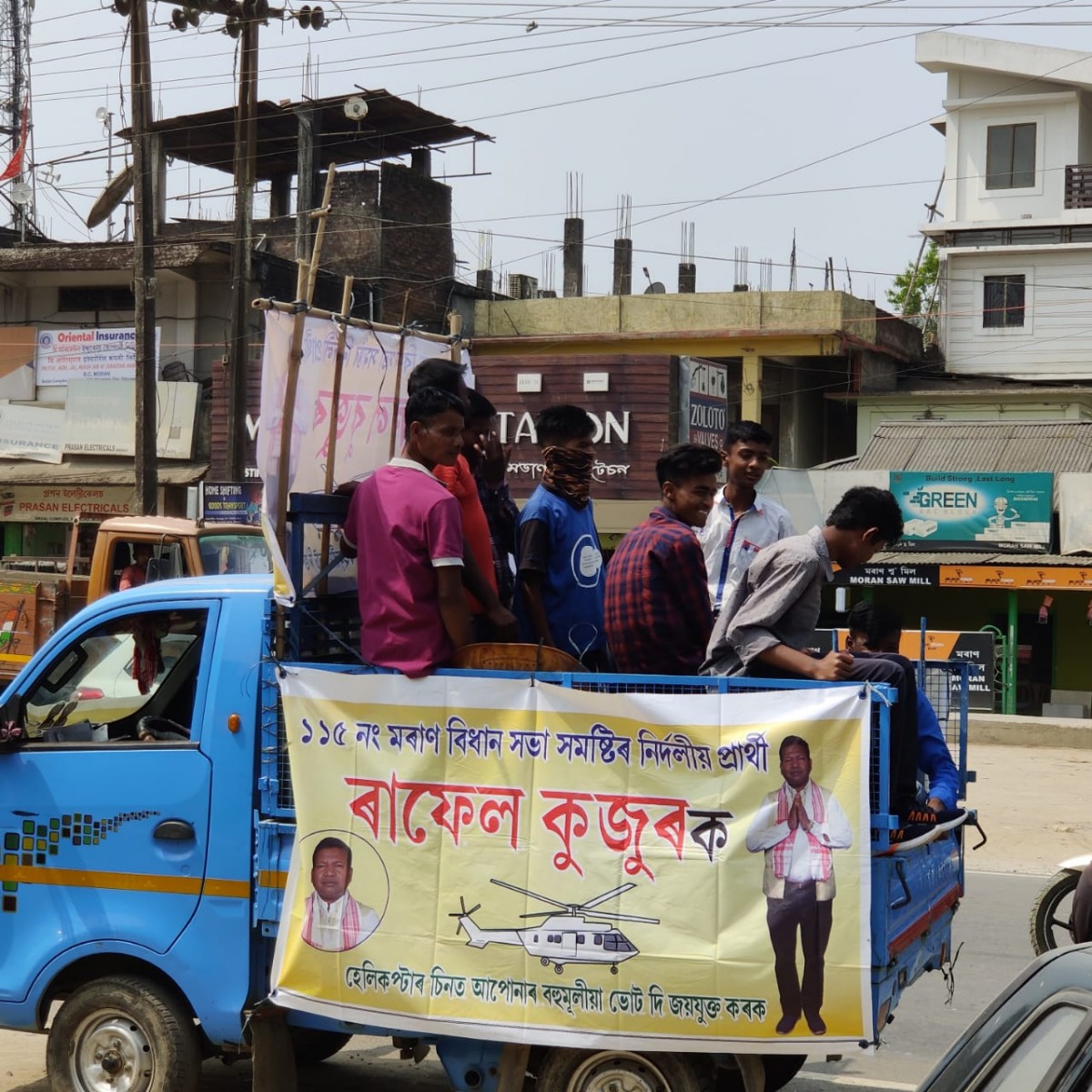
Supporters of independent candidate Raphael Kujur in Moran. Photo: Sangeeta Barooah Pisharoty
On May 22, in Moran town, independent candidate Raphael Kujur was readying himself to lead a road show. A former president of AASAA, Kujur has rolled over from the Congress to the AGP and to AJP before ending up as an independent candidate in these elections. “I had contested the 2016 elections as a Congress candidate from Majbat but lost. I then joined the AGP but they didn’t give me a ticket. Then I moved to AJP but it gave me a ticket only from Chabua (in upper Assam) while I am a local here and want to contest from Moran. So, I have contested as an independent,” he told The Wire.
If he wins the polls, he said, “I will join the party that will form the government.” Reacting to it, a local AJP leader, who didn’t want to be identified here, claimed, “Don’t rule out some independents who have been strategically placed by the BJP either to eat up our votes or to help form the next government if they win.” Though the AJP and the Raijor Dal are in an alliance, in Moran constituency, they have jumped into a ‘friendly fight’.
Though the party or candidate challenge for the voters is clearly running through several upper Assam constituencies, BJP senior leaders that The Wire has spoken to have claimed that their voters would click the button on the EVMs only by looking at the symbol, and not the candidate. “But in Congress, voters shift their allegiance to another party because of a candidate. This helped us in 2016 and will help us in several constituencies this time too,” said a senior party leader.
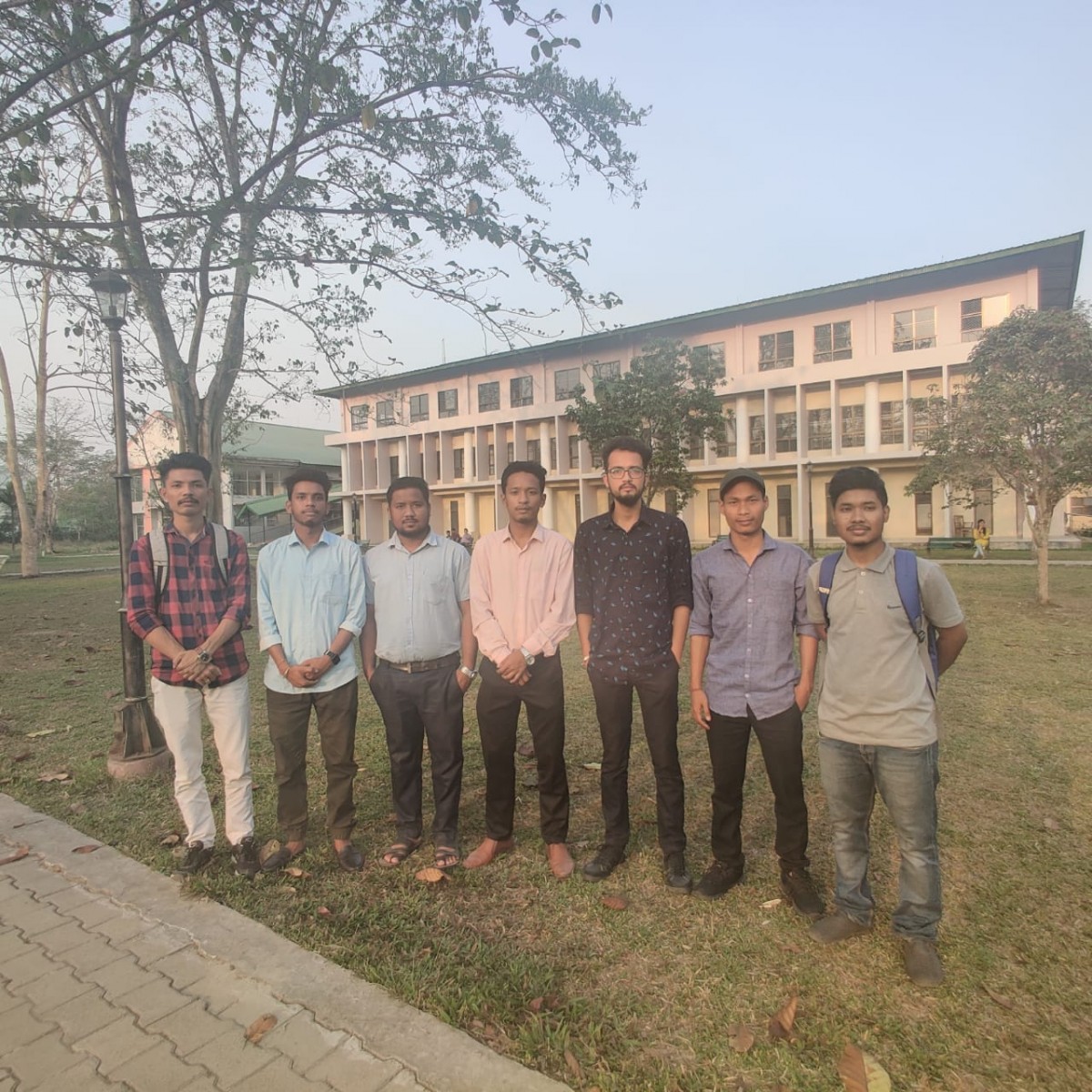
Students of Dibrugarh University. Photo: Sangeeta Barooah Pisharoty
Whether this claim is proved true will be seen on May 2, but conversations with the younger generation of voters, particularly in college and university campuses, make it clear that the BJP-AGP combine has lost its lustre for them. “Assam has over 17 lakh registered unemployed youth. It is impractical to think that only government jobs should be generated to address the issue; we need a multi-pronged strategy. Instead, the ruling alliance is relentlessly trying to pick votes only by religiously polarising the voters, by bringing in the AIUDF factor,” said Kailash Kutum, a postgraduate student at Dibrugarh University. A large chunk of students in Dibrugarh University participated in the anti-CAA protests but the momentum was lost due to COVID-19 restrictions. “Now, the elections are upon us and we have two anti-CAA parties. Some say that we should have had one party as an alternative to the AGP and consolidated the voters but we say, look at states like Tamil Nadu where the primary fight is between two regional parties, the AIADMK and the DMK. Why can’t it be so in Assam too? It is about changing the overall structure of the state’s politics,” he said.
Also read: As States Enter Election Season, Important CAG Reports Remain Unavailable to the Public
“AJP and Raijor Dal have certain differences over issues and therefore it is good that they are different entities from the beginning, rather than just splitting into two some years later. In some issues they can come together, like they have now to oppose the CAA,” he commented.
“Voters in Assam often complain that they don’t have an alternative. Now people do, with these two new parties,” said another student, Srijit Das.
The voting dates are a public holiday, as announced by the Election Commission of India. While the first phase of voting is on March 27, a Saturday, two other poll dates – April 1 and 6 – are in mid-week. This seems to be of concern to the student community. “Only the polling day has been given an off day by ECI. So, those students of Dibrugarh University who have their votes in upper Assam can go home to cast their vote on March 27 and return ti their hostels by Sunday evening to attend the Monday morning classes. But what about students from other parts of Assam who are studying in our university? Since the poll dates are mid-week, they would need more than one day to return from home after casting their votes?” asked Das.
Yet another student added, “Suddenly, even when the COVID-19 rules are in place, the universities and colleges have been reopened. If we were at home, we could have influenced ten other voters to vote for an anti-CAA party. We now wonder if the decision to open the universities before the elections was a calculated move by the ruling dispensation to keep us, the student community, from not only voting in large numbers but also not campaigning for the two new parties.”
This article went live on March twenty-sixth, two thousand twenty one, at zero minutes past five in the evening.The Wire is now on WhatsApp. Follow our channel for sharp analysis and opinions on the latest developments.


