

Nineteen Years After It Rose in Revolt, Nandigram Heads Into a By-Election Marked by Fear


Nandigram: The opposition in West Bengal has been flattened even before the first ballot is cast for the by-polls in Nandigram assembly constituency, scheduled for October 6.
On Monday (September 28), Communist Party of India (CPI) candidate Shanti Gopal Giri, a schoolteacher, was intercepted in the Muslim-majority pocket of Daudpur by a local Bharatiya Janata Party (BJP) leader, Abbas Beg, pushed down and beaten, according to the police complaint. His clothes were torn. Beg filed a counter-FIR the same day at Nandigram police station, alleging that Giri had been “misleading” voters with religious rhetoric. Giri had to be admitted to the hospital with head injuries.
Following an internal split in the Trinamool Congress and the freezing of its symbol by the Election Commission, Mamata Banerjee’s original candidate, Sanchita Pradhan Dey, abruptly withdrew her nomination from the constituency after meeting chief minister Suvendu Adhikari. Left without a candidate, Banerjee extended support to Congress nominee Milan Pradhan.
However, hours after receiving that endorsement, Milan Pradhan was arrested by police on September 18, in connection with a 19-year-old dormant case linked murder and rioting during the 2007 land agitation.
"On September 18, the police arrested me and Pradesh Congress observer Shubhashish Bhattacharya. They blindfolded both of us with gamchas and put us in two separate vehicles. After travelling for quite some time, we were taken to a hotel. It was a hotel in Mandarmani. Police officers came there and said, 'Withdraw your nomination. In return, you will get everything you ask for. It will be in your own interest; otherwise, there will be consequences.' I told them that there was no way I would withdraw my nomination. After that, I had to go to jail,” Milan Pradhan told The Wire.

A campaign hoarding for Congress candidate Milan Pradhan. Photo: Joydeep Sarkar
On September 29, barely a week before the polls, the court granted him an interim bail.
Chief minister Suvendu Adhikari won two seats in May 2026, but chose to vacate Nandigram, the epicentre of the movement against the Left Front government which began more than 19 years ago. As a by-election approaches, the political ground has been systematically cleared.
In 2021, after Adhikari won Nandigram against Mamata Banerjee by 1,956 votes, expanding that margin in May 2026 to 9,665 votes against TMC’s Pabitra Kar.
An election conducted in fear
Under the Special Intensive Revision (SIR) of electoral rolls, 3,461 names were marked not eligible to vote in judicial review in Nandigram, 94% of them Muslims, in a constituency where Muslims account for 23% of the population. Another 10,499 voters were deleted during the preparation of the draft roll.
The tribunal numbers raise a separate question. While 3,461 electors in Nandigram were found “not eligible” during adjudication, the ECI’s latest counter-affidavit records 6,443 tribunal appeals from the constituency. The number of appeals is therefore substantially higher than the number of electors excluded through adjudication, indicating that the tribunal caseload also includes appeals challenging inclusion.
CPI candidate Shanti Gopal Giri alleged that the state machinery has created an atmosphere of fear to ensure the chief minister’s party – the BJP – wins.
“Civic volunteers are going from house to house telling people that they must not become booth agents for the Left Front,” Giri said. “People are being told that in booths where the Left candidate receives votes, government schemes, allowances, drinking water and electricity will be stopped. In minority-dominated areas, people are being told directly that their future will depend on the election result.”
There are a few Congress hoardings, but no visible posters or hoardings for the Left. Despite the lack of active opposition campaigning, BJP candidate Hasirani Rath continues to urge vigilance.
“We have to win by more than 1.5 lakh votes,” she said during campaigning. “But you must remain vigilant against conspiracies.”
On Saturday afternoon, the BJP candidate held a roadshow from Chunumor to the Gangamela ground in Kendamari.
Rath stood at the back of a small toto rickshaw. On the concrete village road, the vehicle nearly overturned three times on the cracked, poorly constructed surface.
Hasirani Rath was previously a Trinamool functionary and karmadhyaksha (elected chairperson) of the Chandipur Panchayat Samiti. Long regarded as close to the Adhikari family, Rath came into focus after May 6, when her son Chandranath Rath, who served as Suvendu Adhikari’s personal assistant, was murdered.
Adhikari then gave her the BJP ticket for the by-election.
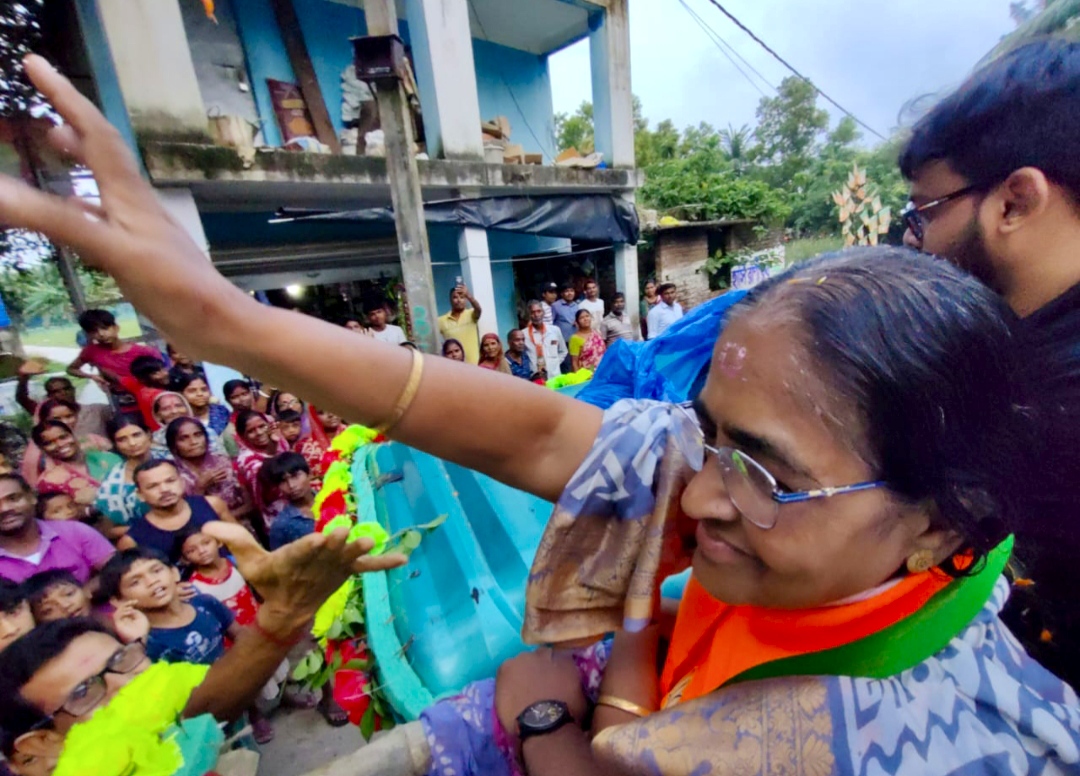
BJP candidate Hasirani Rath’s roadshow in Kendamari village on Saturday. Photo: Joydeep Sarkar
However, long-time BJP workers in Nandigram have questioned her nomination, placing senior leaders in an uncomfortable position. As a result, the chief minister’s brother, Dibyendu Adhikari, has taken charge of ensuring the party's victory.
Questions also emerged over apparent inconsistencies in Rath’s election affidavit.
The Congress even moved the Calcutta high court seeking cancellation of her candidature. Senior advocate Riju Ghosal argued on behalf of the Congress that Rath had stated she was over 60 years old while also declaring that she had passed her secondary examination in 1965.
However, a single-judge bench of Justice Krishna Rao dismissed the plea and upheld Rath’s nomination papers.
At meetings, Rath appears worried and often asks supporters to remain alert to “conspiracies”.
Dibyendu Adhikari told The Wire, “We are not worried about victory. We want to set a record for the victory margin. This is the chief minister’s constituency. There is no point telling stories about terror.”
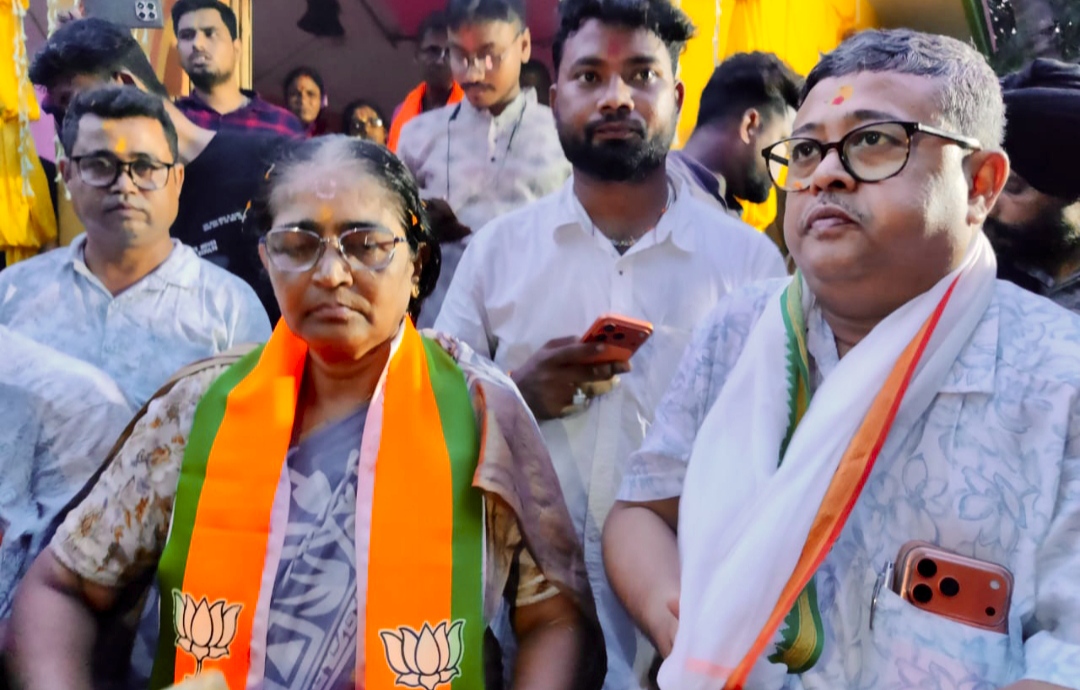
Chief Minister Suvendu Adhikari’s brother, Dibyendu Adhikari (right), campaigning with BJP candidate Hasirani Rath. Photo: Joydeep Sarkar
Across the constituency, Rath does not speak about seeking justice for her son’s murder. Instead, her message as a candidate is, “Remember the terror of the CPI(M) and vote for me to strengthen the hands of Suvendu Adhikari and Modiji. Do not fall for rumours or conspiracies. Trinamool is campaigning with us.”
Speaking to The Wire, Rath said, “The BJP government, which has been in office for only four months, has already allocated Rs 300 crore for Nandigram. I need to win by a record margin. The honour of Nandigram’s yuvraj, Suvendu Adhikari, and Prime Minister Modiji is tied to this.”
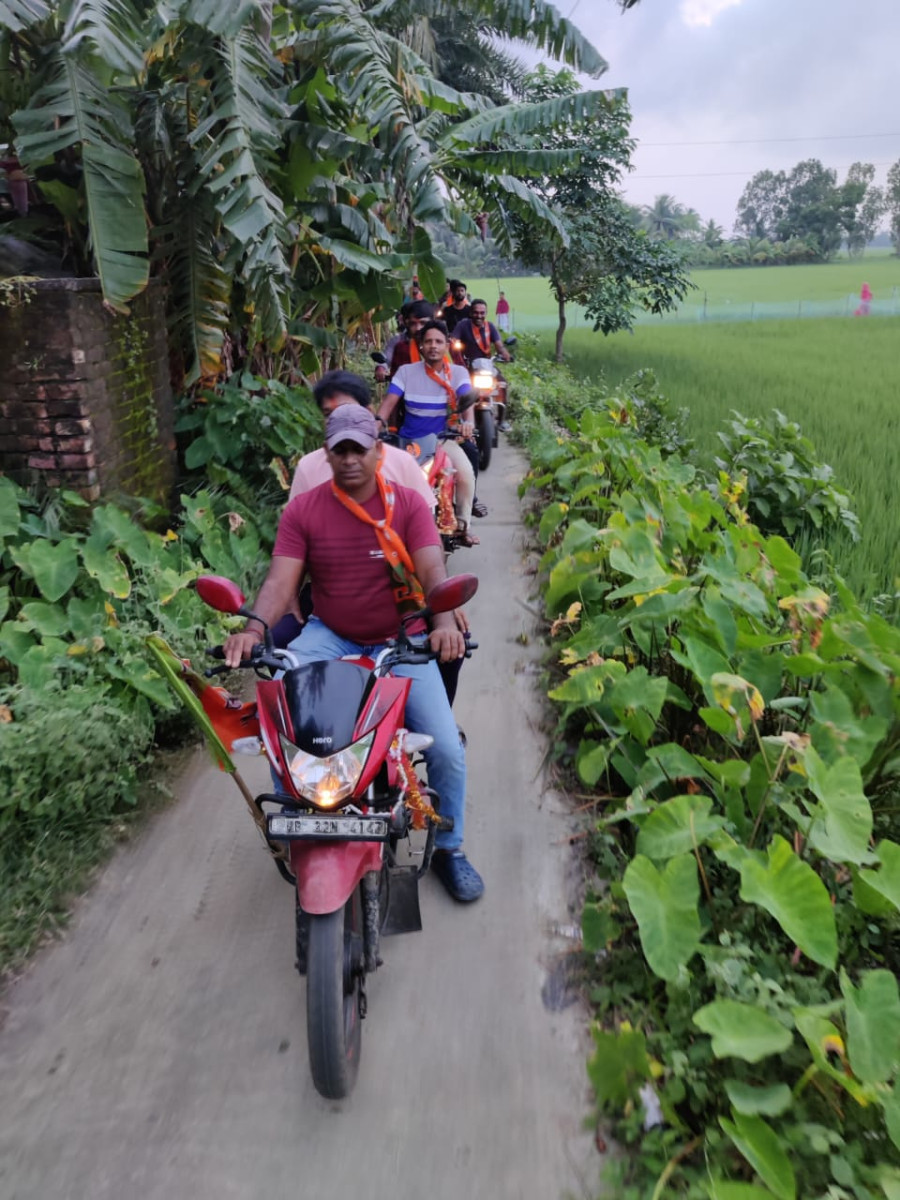
A BJP motorcycle procession in the Gangamela area on Saturday. Photo: Joydeep Sarkar
In Kendamari, Mohammadpur and Samsabad areas with substantial Muslim voter populations, people are hesitant to speak publicly about whose names remain under adjudication. Motorcycle processions run through these villages from late afternoon into the night.
At Gangamela, a BJP leader participating in a procession told the visiting reporter, “Your home is not here. You cannot leave Nandigram after 6.30 PM. There is nowhere here for outsiders to stay. Leave the area quickly.”
It sounded less like a threat and more like an instruction. A few new shopping arcades light up the market, but after 6.30 PM, the streets fall silent except for the motorcycle processions.
The movement that changed Bengal
In 2007, when the Left Front government proposed a Special Economic Zone and new industries across 10,000 acres in Nandigram and nearby Nayachar, an uninhabited island on the Haldi river, various anti-Left forces formed the Bhumi Uchhed Pratirodh Committee (BUPC) to launch an agitation against the state.
The movement had turned violent. On March 14, 2007, police firing claimed 14 lives, and scores of people on both sides died in the months that followed. Armed outsiders established bases alongside state police.
The Krishi Jami Bachao Committee, led by Mamata Banerjee and Suvendu Adhikari, took the agitation statewide. Nandigram became the foundation on which Banerjee built her rise to power, drawing support from various parties, including the BJP.
The rise of Adhikari, now West Bengal’s first BJP chief minister, remains tied to Nandigram.
Twenty years later, what did Nandigram get
Nandigram has changed beyond recognition. Many activists of the Krishi Jami Bachao Committee came from poor families. Its convenor was Trinamool leader Sheikh Sufian, chosen by Banerjee and Adhikari.
Over the years, allegations grew regarding Sufiyan’s takeover of fisheries, irregularities, and corruption as his wealth expanded. He dominated local politics for nearly 15 years.
After becoming chief minister, Adhikari held a rally in the area and declared that the owner of the “Jahaj Bari” would be “dealt with”. On Monday, there was a police raid on Sufiyan's house.
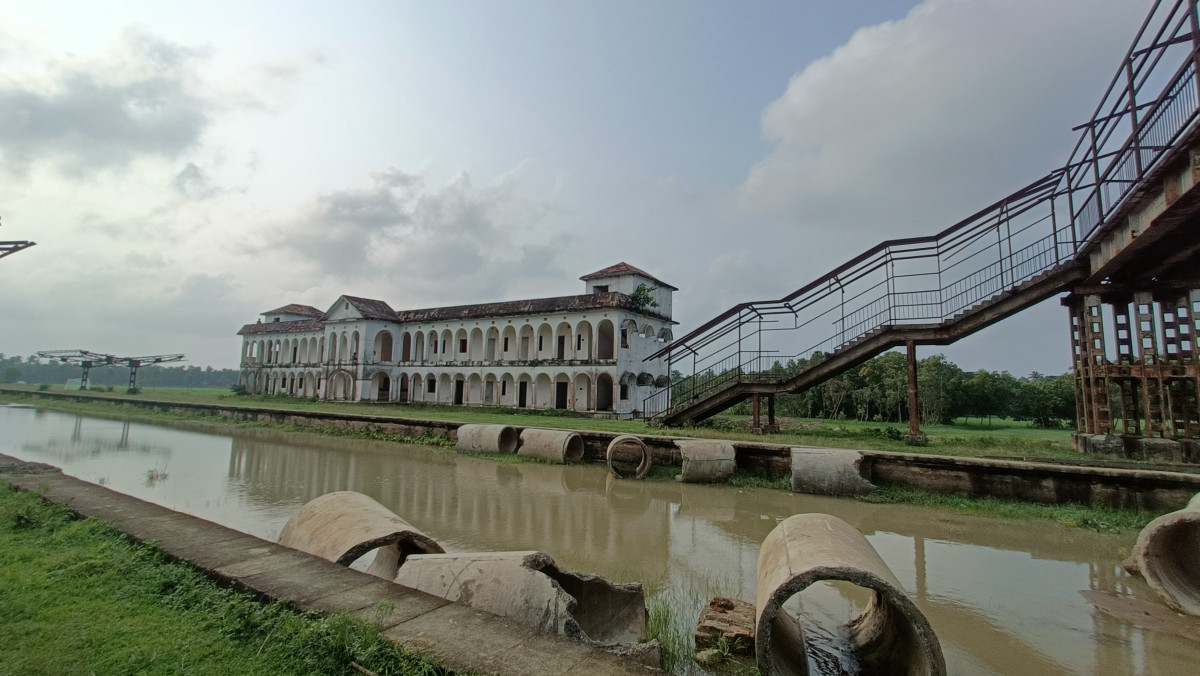
The Nandigram railway station. Photo: Joydeep Sarkar
“We have become the victims of the very politics that began in the name of protecting agricultural land and opposing industry,” said Ganesh Giri, a farmer from Sonachura.
“Twenty years ago, Nandigram was a fertile agricultural region along the Haldi river. After the Left government was voted out, leaders of the Krishi Jami Bachao Committee began converting agricultural land into fish farms. Farmers who did not agree with them had their irrigation water cut off and saline water was allowed into their fields.”
Sirajul Islam, who owns a fishery, said, “There has been profit from fisheries this year, but fish farmers suffered heavily during the previous two years because of viral infections.”
For some farmers, returning to farming is no longer possible.
“Today, one group of people from Nandigram travels to Haldia every morning looking for work. Another group works as tailors in Kolkata and Jaigaon in north Bengal. Others work in hotels in Kolkata. This is the paribartan, the change,” said Sadananda Bera, a small farmer. “Now I sometimes think it would have been better if the industry had come. We might at least have had permanent jobs.”
Converting agricultural land into fisheries requires government permission, which cannot legally be replaced by political influence.
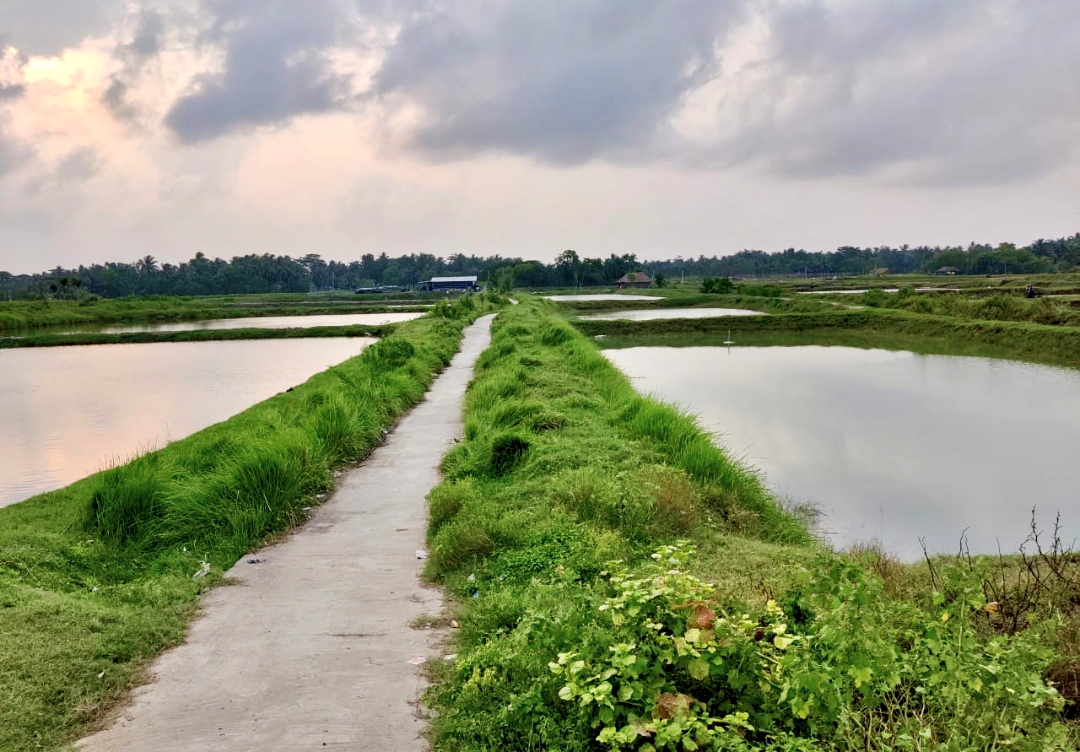
Around 90% of the agricultural land in Nandigram’s two blocks has now been converted into fisheries, where shrimp farming is allegedly being carried out through benami operations. Photo: Joydeep Sarkar
Abu Bakkar Mondal described what remains of the movement nearly two decades later.
“Do you know what has changed after almost 20 years of the Nandigram movement? My village is called Bhangabera, and it has remained bhanga, broken,” Mondal claimed. “The Adhikaris have become kings. And we have become like that Nandigram railway station, there is a railway station, but there are no railway tracks.”
In March 2007, Mamata Banerjee announced that Nandigram would receive a rail link. A large station building, staff quarters, and an overbridge were built but railway tracks have still not reached the station.
“Travelling by bus to Kolkata, which is nearly four hours away, costs Rs 460,” said local businessman Sukdeb Mondal. “Now the same party is in power at the Centre and the state. Yet even during the election, I do not hear anyone talking about this project.”
Nandigram, once defined by widespread protest, is now quiet.
In 2011, Firoza Bibi, mother of Imdadul, who was killed during the 2007 agitation, became the MLA from Nandigram on a Trinamool ticket following the cash-for-query sting video that unseated the sitting CPI MLA, Md Ilyas. The video later proved to be framed. Sankudeb Panda, who shot the video, is now a senior BJP leader.
Firoza Bibi is no longer active in local politics. In her former neighbourhood in Kalicharanpur, residents say she now lives in Panskura.
A neighbour said, “After the Trinamool lost the election, various allegations were made. She too left the area out of fear.”
“The party eventually forgets even the martyr, and this is Nandigram, the land of the martyrs,” said Madan Jana, a local driver, with a bitter laugh.
Note: An earlier version of this report had mistakenly identified the Nandigram station as a residential home.
This article went live on September thirtieth, two thousand twenty six, at fifty-six minutes past four in the afternoon.The Wire is now on WhatsApp. Follow our channel for sharp analysis and opinions on the latest developments.


