

Arvind Panagariya as Chancellor of Nalanda University Will Only Intensify Saffronisation


Many Bihar-based economists and observers believe that former NITI Aayog vice-chairman Arvind Panagariya’s appointment as the chancellor of Nalanda University will only intensify a process of saffronisation of the university that had begun soon after Amartya Sen stepped down as its head in 2016.
Panagariya – an economist, liberalisation theorist and professor of Indian political economy at the Columbia University, on Friday, April 28, replaced Vijay P. Bhatkar as the NU chancellor. Bhatkar – who is based in Pune, was president of the Vigyan Bharti, an arm of the Rastriya Swayamsevak Sangh, while continuing as the NU’s chancellor.
Bhatkar, who was appointed as NU’s chancellor on January 25, 2017, was known for justifying Prime Minister Narendra Modi's assertion that the elephant head of the deity Ganesha was a “testimony to the existence of plastic surgery in ancient India”. The same line of thinking has also held that the pushpak viman (flower plane) and arrows used in the Ramayana and Mahabharata battles are testament to the knowledge of aircraft and missiles in ancient times.
“Arvind Panagariya is a right winger and an economist known at the global level. He is not as shallow as Bhatkar. But the powers that be have a gravitational pull – Modi government can make historians rewrite history to suit its politics,” said Professor N.K. Choudhary, reputed economist and former head of the department of economics, Patna University.
“Panagaria, in spite of his repute, has responded to the regime’s efforts to legitimise its unabashed process of saffronisation. He is in the prime minister’s good books and is doing what pleases Modi," says Choudhury.
The NU administration received the notification to this effect on April 28.
NU vice-chancellor Sunaina Singh profusely congratulated Panagariya and said, “The University will benefit immensely from his scholarship, experience and academic erudition”. But many Patna and Delhi based academics and professors described Panagariya’s appointment as another step in the process of tightening Hindutva’s grip on it.
“The vision with which Nalanda University was conceived stands obliterated. The University was conceived as a true international centre of learning with 18 countries including China, Japan, Sri Lanka, South Korea and Singapore as its stakeholders under the supervision of India's Ministry of External Affairs (MEA). Several countries have withdrawn from it now,” economist and former director of the A.N. Sinha Institute of Social Sciences, Patna, D.M Diwakar, said.

Nalanda University. Credit: Nalanda University Blog
Global vision
Soon after becoming the Bihar chief minister in November 2005, Nitish Kumar is believed to have planned the revival of the Nalanda University that existed for 750 years from 5th century to 13th century, inviting students and scholars from across the world. Chinese traveller and philosopher Huyen Tsang was believed to have been a teacher at the ancient seat of learning. Its ruins are still a treasured international heritage.
The CM mooted the idea to the then president A.P.J. Abdul Kalam, himself a scientist of global repute, seeking the latter’s support. Subsequently, Bihar witnessed the creation of history of sorts with the President coming down to address its state legislature and proposing the revival of the Nalanda University in his address on March 28, 2006.
Nitish headed the National Democratic Alliance government in the state but the Union government had the United Progressive Alliance (UPA) in power, with Manmohan Singh as the Prime Minister. PM Singh, an economist of repute, supported Nitish and gave him a free hand in the affairs of the Nalanda project.
Nitish roped in the Nobel laureate Amartya Sen and with the latter’s support he involved many academics from China, Japan and Singapore. Nalanda became a centre of rendezvous for academics and scholars from across the world. Following up on the president’s address the Bihar legislature passed the Bill for the creation of the Nalanda University. The Union government too followed it up by getting the appropriate Act of Parliament in place to formally open the University on November 25, 2010.
Sen – appointed as the chairman of the governing board with the unanimous acceptance of the representatives from all the 18 countries – became its first chancellor. The governing board also appointed Gopa Sabharwal, a professor at Lady Shriram College of Delhi University, as its first vice-chancellor. The University attracted students and scholars from China, Japan and Sri Lanka in the beginning.
Hindutva
The RSS-BJP’s moves on the University began after Narendra Modi took over in 2014. As soon as Modi became PM, some newspapers and TV channels began carrying stories that Sen had appointed Gopa Sahbarwal as the VC because the latter was his “daughter’s friend”. They also accused her of incompetence and carried out a smear campaign against Sen accusing him of “financial irregularities” without evidence.
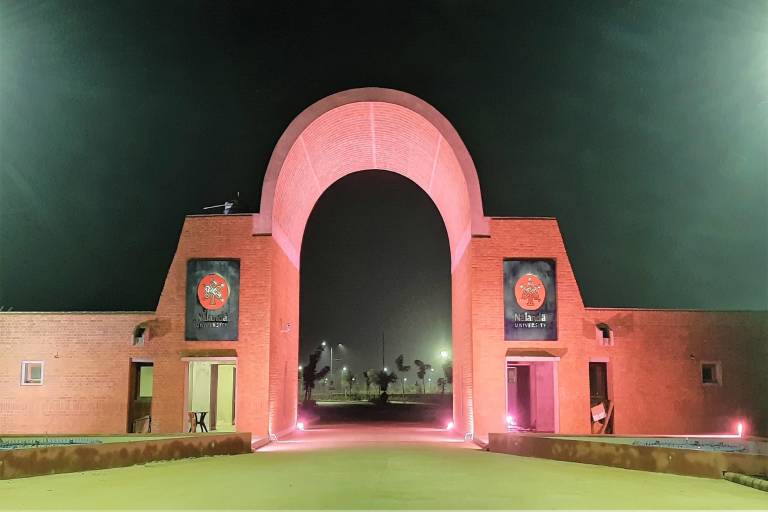
The main gate of Nalanda University in Bihar. Photo: University website (https://nalandauniv.edu.in/)
Sen completed his term in 2015 and the representatives of the 18 countries in the governing body unanimously recommended a second term for him as the Chancellor of the NU. But Sen quit, “citing political interference”.
Then the president, in the capacity of the University’s visitor, appointed George Yeo – a reputed educationist and education minister of Singapore – as its chancellor. The newspapers and channels – apparently at RSS-BJP’s behest – ran articles about “communists’ control” of the University through Yeo. Yeo, raising questions about the “autonomy of the institution” and citing “political interference in academic matters” also quit soon afterwards.
As Ramnath Kovind was nominated as the President, replacing Pranab Mukherjee in 2016, the Modi government got Bhatkar – an RSS functionary – as the third chancellor of the NU.
“Needless to say that Panagariya will perpetuate what Bhatkar has done rather than try to do what the University was originally conceived for," said Manoj Jha, professor of social work at Delhi University and Rashtriya Janata Dal MP.
Sources at the NU said that the Ministry of External Affairs had been “handling the affairs of the university in the very opaque manner”. A faculty member, requesting anonymity, also pointed out that external affairs minister S. Jaishankar has not visited the campus once.
Nalin Verma is a senior journalist, media educator and independent researcher in social anthropology.
This article went live on May second, two thousand twenty three, at twenty minutes past five in the evening.The Wire is now on WhatsApp. Follow our channel for sharp analysis and opinions on the latest developments.


