

At Niyamgiri, Policing is Paving the Way for Mining


A meeting was held on September 27, in Bhubaneswar, between the Odisha chief minister Mohan Majhi and the Vedanta chief Anil Agarwal. The two, according to reports, discussed the bauxite reserves in South Odisha. Unsurprisingly, Vedanta’s interest in accessing the Niyamgiri bauxite reserves was a key point of talks. This meeting was followed by a press conference in which Agarwal indicated that long-pending issues surrounding Vedanta's proposed bauxite mine in Kalahandi and Rayagada districts could be resolved by November. He said: “I have full trust in the present state government. By November everything will be settled. I do not see any resistance from anywhere. I have been in Odisha in my youthhood and people have showered their love on me.”
In 2003, a Memorandum of Understanding was signed between the Odisha government and Vedanta through its subsidiary Sterlite Industries for the proposed bauxite mining project in the Niyamgiri Hills and the alumina refinery at Lanjigarh. While the refinery began its work, bauxite mining in Niyamgiri was withheld because of sustained people's resistance that led to the gram sabha process and the 2013 Supreme Court order.
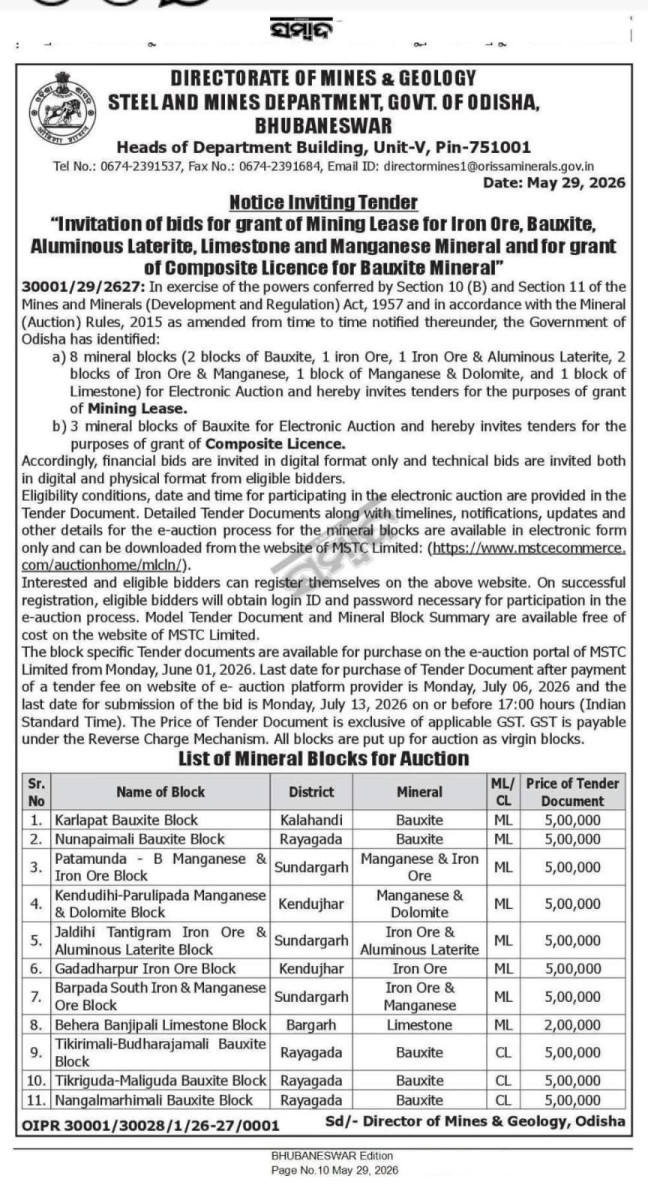
A May 2026 Odisha government notice inviting mining tenders.
This strategic meeting happened soon after the arrest on September 10, of the Dongria Kandha leader Lada Sikaka, who heads the Niyamgiri Suraksha Samiti (NSS), a broad platform of 112 villages of the Niyamgiri active since 2005 to protect the Niyamgiri hills from mining. Thousands of Adivasis of the region gathered at the Kalyansinghpur police station despite the heavy rains on the day, amid chants of ‘Release Lada Sikaka’, and ‘Vedanta, Go Back!’. Such protests had no presence in mainstream media.
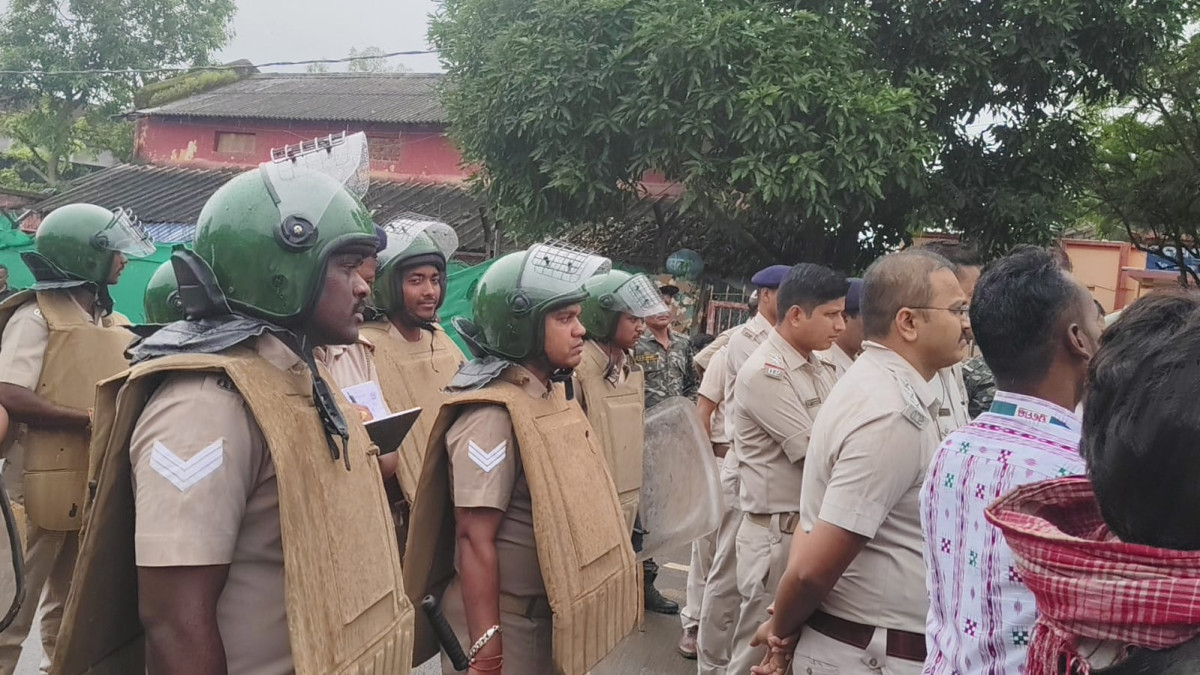
Security forces gather as tribal people protest against the arrest of the Dongria Kandha leader Lada Sikaka. Photo: By arrangement.
On April 18, 2013, when the Supreme Court of India delivered its landmark judgment in Orissa Mining Corporation v. Union of India and empowered the Gram Sabha to decide on a bauxite mining project in the Niyamgiri hills, all 12 designated gram sabhas of the 112 villages held referendums between July to August 2013, and voted against the proposed bauxite mining project by Vedanta and Odisha Mining Corporation. The historic Supreme Court judgement had upheld the cultural and religious rights of not only the Dongria Kandhas (also spelt ‘Kondh’) but also the Kutia Kandhas and Desi Kandhas who inhabit the foothills of Niyamgiri along with pastoral communities.
What has changed today, so that the religious and cultural rights of the Adivasis can be sacrificed in this Fifth Schedule area?
The NSS leader Lada Sikaka’s arrest is a good opportunity to read this change.
Niyamgiri has been sizzling with tension despite the passing of the 2013 Supreme Court order. Combing operations by the CRPF, random arrests and foisting of innumerable cases on tribal people was particularly intense right after the passage of the judgment, between 2014 and the pandemic, and, again, now. During the pandemic, locals said that hundreds of trees were felled and wide roads constructed from the foothills to the mountain top.
The Arrest of Lada Sikaka
Lada Sikaka’s case sits within a much longer history of policing, criminal cases, UAPA charges and security operations in a region where indigenous communities have repeatedly asserted their rights over land, forests and self-governance.
Advocate Narendra Mohanty, who was present on the spot of the arrest of Lada Sikaka, reported the following in a public meeting in Bhubaneswar on September 12. On September 10, around 4.30 pm, Lada Sikaka was returning to his village with Mohanty and six associates after securing bail in one case from Lanjigarh Court when their vehicle was intercepted near Kalyansinghpur by an armed police team. The Judicial Magistrate First Class (JMFC), Lanjigarh, on March 9, had declared Lada Sikaka an absconder in connection with a nine-year-old case (number 349/2017) and directed the IIC of Kalyansinghpur police station in Rayagada district to initiate proceedings for the attachment of his property.
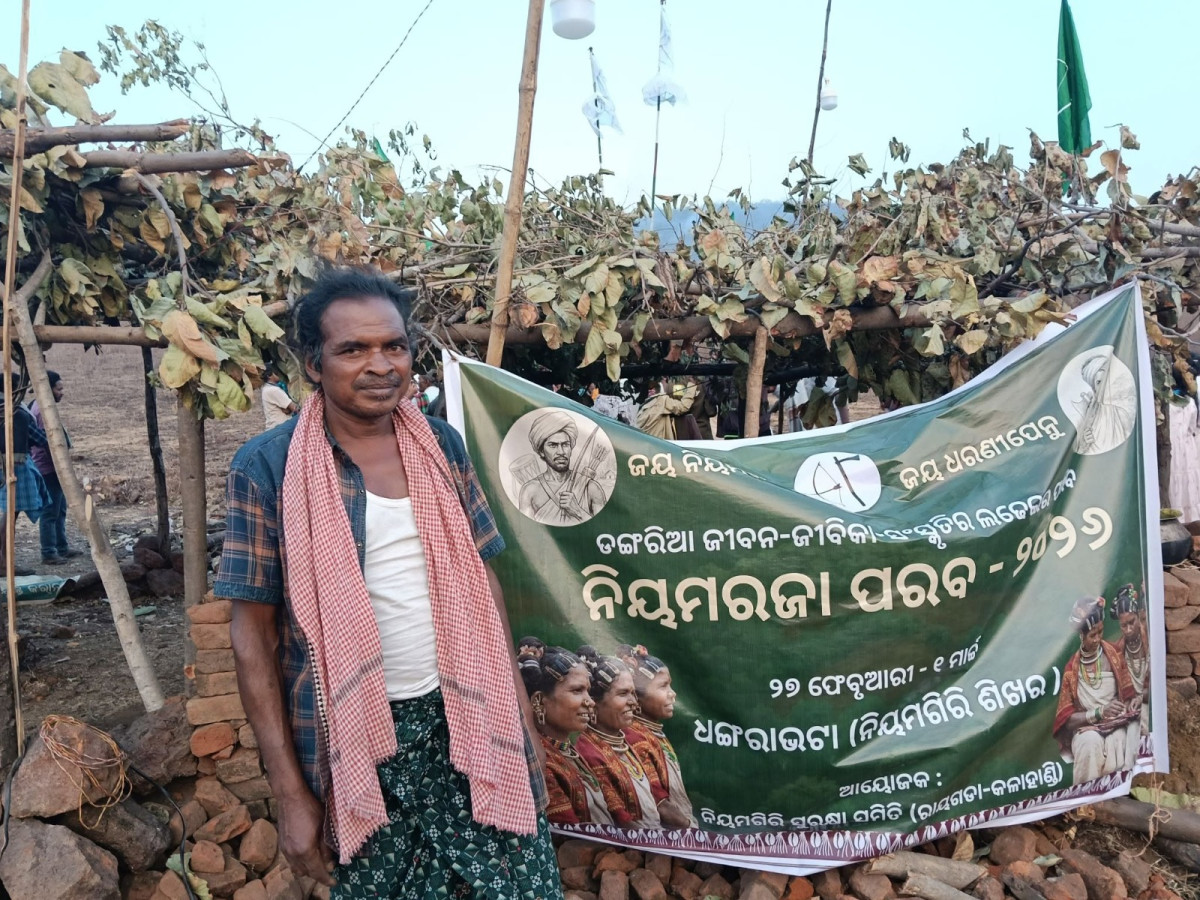
Dongria Kandha leader Lada Sikaka. Photo: By arrangement.
Lada Sikaka had approached the Orissa High Court against this. The court quashed the warrant and the property attachment order. Along with the bail, the court gave instructions for him to appear in the JMFC court and “surrender” in order to realise his bail order. The notice for the attachment of the property of a leader of the community that has been fighting for locals’ rights to the Niyamgiri hill was ironic, and it was not lost on Lada Sikaka and his associates that the objective was to make him appear in court.
The Raygada police were waiting for his return journey to his village. The police team led by the Kesinga SDPO Sandeep Kumar Majhi, along with the inspector-in-charge of the Kalyansinghpur PS, Ajay Kumar Parida, and the inspector-in-charge of the Biswanathpur PS, Kalpana Behera, allegedly took him away by force. Mohanty demanded a warrant to be shown. He and others contacted the police stations and reached Raygada seeking information about Lada Sikaka’s whereabouts.
Mohanty told this writer that there was no information released about where he was being held. Mohanty submitted a written complaint to the Rayagada SP but says he was kept waiting all of the next day at Raygada Court. Then, Mohanty notes, the news came that Lada Sikaka was moved between several locations and ultimately presented in court at 10.30 pm, after which he was sent to Raygada jail.
Advocate Biswapriya Kanungo, a legal advisor and human rights activist in Bhubaneswar, said that the court records show that the Dongria Kandha leader was taken into custody on the basis of a court warrant and an arrest memo and also a lawyer representing Lada Sikaka. He expressed apprehension whether the advocate that the police arranged would have really spoken in Lada Sikaka’s defence. Lada Sikaka’s own advocate along with his family and members of the community got to know about his whereabouts almost 24 hours later, they say, despite having been in the court premises all day and having called the SP and the IICs several times.
The episode becomes even more consequential when placed alongside the succession of cases against Lada Sikaka, as well as the earlier arrests and disappearances of other Niyamgiri activists. For communities already living under the shadow of prolonged security operations, the invocation of laws carrying grave allegations of terrorism and sedition-like offences have consequences far beyond the courtroom: it transforms daily life, and turns political dissent and community mobilisation into questions of criminality and national security.
Perhaps Agarwal reposes trust in the Odisha government because in the years before and after the landmark 2013 Supreme Court judgement, mining concerns were able to make full use of the criminal justice system. Dozens of FIRs are lying in wait for future arrests: it is the way of criminalising a people’s movement struggling to save its land, forests, mountains and supreme deities.
The Use of Draconian Laws
After being arrested, Lada Sikaka was produced in court on the basis of a 14-year-old case with sections of the UAPA in it (GR case NO 565/12 corresponding to Kalyansinghpur PS case no 75/12). He was arrested on charges claiming he was a member of a Maoist organisation. Police cited an incident of 2012 when tension was at its peak with the unyielding resistance of the Adivasis against Vedanta – the very resistance that led to the landmark Supreme Court judgement of 2013. Since then, Niyamgiri has never been free of surveillance. In its annual report, the Ministry of Home Affairs linked the Niyamgiri Surakshya Samiti (NSS) with ‘Maoist’ organisations stating that Maoists ‘guide’ the activities of the NSS.
Sections of the UAPA have been repeatedly used in the years following the Supreme Court judgement of 2013. For example, in a case naming Lada Sikaka and other leaders (FIR 26/17), police allege that unknown people broke up a country liquor outlet and put up a Maoist poster there. This FIR names section 121 of the Indian Penal Code, a section that criminalises waging, attempting to wage, or abetting war against the Government of India. It is punishable with death or life imprisonment. This includes organising, joining, or attempting an insurrection against the Government of India to achieve any public objective through violence.
On August 5, 2023, Krushna Sikaka of Patangpodar and Bari Sikaka of Lakhpadar village in the Niyamgiri region were abducted by plainclothes policemen at 9 am from the Lanjigarh weekly haat while they were giving a call to celebrate World Indigenous Day. Members of the Niyamgiri Surakshya Samiti went out to seek information about their whereabouts from four different police stations of Kalahandi and Raygada districts, but all four police stations denied having arrested them. A complaint for missing persons was filed at Lanjigarh police station by his brother and four others from the Niyamgiri region and the Samiti.
These are not covered by mainstream media.
Samiti members raised a protest, while carrying their traditional weapons, outside Kalyansinghpur PS, against the disappearance of Krushna Sikaka and Bari Sikaka and the refusal of the police to provide information on their whereabouts. The Kalyansinghpur PS requisitioned two platoons of armed police, including an Executive Magistrate, to maintain ‘law and order’. While he was returning from the protest, police attempted to take away Drenju Sikaka, another leading member of the NSS, but were prevented from doing so by protestors. The Kalyansinghpur PS in FIR No. No.87/ 2023 declared this to be an unlawful assembly, and filed it against Lada Sikaka, Lingaraj Azad and seven other prominent NSS activists. It invoked allegations under Indian Penal Code sections 147, 148, 109, 294, 188, 353, 332, 307 and 149, UAPA sections 16, 17, 18, and the Criminal Law (Amendment) Act’s Section 7. These pertain to unlawful assembly, disobeying and causing hurt to public servants, attempt to murder etc.; as well as terrorist activities, raising funds for terrorist activities, and conspiracy under UAPA. Thus, demanding the whereabouts of two villagers was tantamount to terrorist activities.
However, the protests that spread across the region, especially because of the movement in Sijimali that is opposing a mega bauxite mining project by Vedanta, led to these UAPA charges being dropped when the chargesheet was produced by the Raygada police in court.
Niyamgiri has thus witnessed a potent weaponisation of the law against a community struggling to protect a mountain. The charge of being a terrorist or a Maoist became the state’s modus operandi in those years. A 16-member fact-finding team All-India Coordination of Democratic Rights Organisation (CDRO) and the Odisha-based Ganatantrik Adhikar Suraksha Sangathan (GASS) investigated the violation of human rights in the region, and noted they have increased since the 2013 gram sabha verdict. They spent three days traveling to villages in the region and writing people’s accounts of the events. The investigation was prompted by the death of a worker and a security personnel in the course of a lathi charge on villagers gathered at the gate of Lanjigarh Alumina Refinery at the foothills of Niyamgiri.
In its report of July 2019, the team concluded that the people of Niyamgiri fight twin battles: one against the label of being Maoist activist, sympathiser or providing assistance to Maoists in the area; and another, against Vedanta, which they assert is a major threat to the ecosystem of Niyamgiri.
The need and greed for Bauxite
Lada Sikaka’s arrest on September 10 was followed by protests in Bhubaneswar and in the Niyamgiri region. The Concerned Citizens Committee, a broad coalition of trade unions, civil rights organizations, environmentalists, youth activists, lawyers, writers and poets, expressed its deep concerns on the targeted attacks on Adivasi and Dalit leaders in bauxite-rich areas. In a press statement it pointed out how “the arrests of Lada Sikaka, Lingaraj Azad and Hiramal Naik, or imposing a siege on villagers of Kantamal and Talaampadar are not disparate or isolated incidents; rather, the criminal justice system is being used to push through mining and industrialization in Odisha by hook and by crook.”
In recent months, both the Union and state governments have been leasing bauxite mines of the Eastern Ghats mountain range to different companies one after another — the Balda bauxite mine in Nandapur block to Adani; the Karnpodikonda mine in Narayanpatna block and Karlapat mine in Thuamul Rampur to Vedanta; and the Pattangi Serubandha mine to NALCO. Another four bauxite mines are in the process of being auctioned in Kashipur-Tikri area of Rayagada district. In Odisha’s aluminium sector, there is a big push for Adani’s plan to invest Rs 1.10 lakh crore.
Simultaneously, local communities, especially Dalit and Adivasi groups, are resisting these mining companies, to protect their livelihoods, homes, and cultural heritage, and in many places, have successfully stopped mining. Environmentalists, various political groups, trade unions, democratic organizations, and even retired bureaucrats are also urging the Odisha government to stop mining operations. Therefore, the state administration, in aid of the mining companies, have launched the arrests of local leaders and imposed siege on villages that are particularly strong sites of struggle, like Kantamal and Talaampadar. The clear purpose appears to be to kill the movement against mining and simultaneously lay the ground for a rapid advance in the logistical infrastructure – roads, railway, etc – to facilitate the current spurt in mining.
Advocate Kanungo, who notes that the story of Niyamgiri is not simply a story about one arrest or one set of FIRs but about what happens when a community's resistance to the loss of its land and way of life encounters the coercive power of the state.
Within two hours of the arrest of Lada Sikaka, armed police teams were deployed in the two main villages opposing the Sijimali Bauxite Mining Project of Vedanta – Kantamal in Kashipur block and Talaampadar in Thuamul Rampur block. It is now going to be three weeks that the police have been camping in Kantamal.
On October 20, 2018, Lada Sikaka was forcibly dragged from the weekly haat and taken to Muniguda police station. At a public meeting in Bhubaneswar he narrated how he was asked by the Tehsildar to call off the mass protest demanding the withdrawal of CRPF forces from the area. When the Tehsildar said he could come to them for anything as he is in charge of the pattas, Lada Sikaka had replied: “If you can give titles then give us one title. Give us a title for the whole of Niyamgiri.”
Ranjana Padhi is an author and feminist activist. She has authored Those Who Did Not Die: The Impact of the Agrarian Crisis on Women in Punjab (Sage Books) and co-authored Resisting Dispossession: The Odisha Story (Aakar Books, Palgrave Macmillan).
This article went live on October fourth, two thousand twenty six, at six minutes past one in the afternoon.The Wire is now on WhatsApp. Follow our channel for sharp analysis and opinions on the latest developments.


