

Fear, Mistrust Grow as India Collects Biometrics From Myanmar Refugees


On an early November afternoon, as winter started to lightly settle in, the sun blazed high enough over Bethel hill for a small group of men to pull out a rusty board for a game of carrom, a favourite local pastime in the Northeast Indian state of Mizoram. But these men, seated around the board on low wooden chairs, were not ordinary locals; they were displaced Burmese living in a sprawling hilltop refugee camp housing nearly 98 families in makeshift huts built of bamboo and tarpaulin.
The camp lies just 15 minutes uphill from the Indian border town of Zokhawthar. Normally quiet, its stillness was interrupted recently when village council leaders arrived with an Indian government mandate to enrol residents in a biometric identification process.
Siamliana,* a 57-year-old resident, pocketed a coin from the carrom board as he shared his thoughts on the biometric enrolment, loosely referred to as a “refugee ID.”
“We do not know what use it will have for us, but we are afraid to refuse the mandate,” he said, adding that they were not informed about the “refugee ID” or why it was being created.
“I think it is basically a tactic to ensure that we do not create an identity card here in Mizoram,” he guessed.
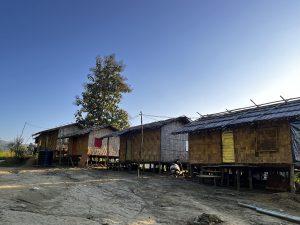
Typical house structures at the camp. Photo: Kimi Colney / Myanmar Now
Like him, other refugees in the camp also said they were not given a choice, but were warned that those who refused would be questioned and detained. On what grounds was not clear, but the prospect of being rounded up was enough to make most sign up.
Ruata, the camp leader, was quick to deny that the biometric enrolment was being forced on the refugees.
“We were told by the community leaders that after enrolment, we would be given a paper, and that it would be difficult to move around Mizoram without it,” he said.
All the refugees had their pictures taken and fingerprints recorded. For many, it was the first time they had ever had their biometrics collected. Their data has been uploaded to the Foreigners Identification Portal and Biometric Enrolment System, operated by India’s Ministry of Home Affairs (MHA). Each participant was given a slip containing their photo and details such as their father’s name, date of birth, gender, place of origin, and present address, as well as the date of issue.
For over 30,000 refugees from Myanmar’s Chin State and Sagaing Region taking shelter in Mizoram, which shares a 315-mile-long border with Myanmar, the biometric exercise once again reminded them of their precarious status in their host country. As India is not a signatory to any international treaty on refugee protection, and has no internal policy relating to those forced to flee their own countries due to persecution or conflict, they are officially designated as “displaced” Myanmar nationals, rather than as refugees. While they are merely tolerated by the federal government, the state government, at least, has shown them some compassion on humanitarian grounds, treating them as temporary guests.
But nearly five years into Myanmar’s civil war, many of the guests have become increasingly aware that they have overstayed their welcome. In the 2023 election, the old guard of the Mizo National Front (MNF), led by Chief Minister Zoramthanga, was replaced by the Zoram People’s Movement (ZPM), a regional political party led by Lalduhoma. The new guard was just as much against biometric collection from refugees as Zoramthanga, who once said it would amount to “discrimination against people who are of our blood and kindred brothers and sisters.”
But by May of this year, MHA officials said they were ready to start the biometric enrolment process following changes to the format of the website portal, which until then had been designed to facilitate the deportation of illegal immigrants. In a review meeting held on November 19, chaired by the chief minister, it was revealed that enrolment had been completed for 58.15% of Myanmar refugees and 10.84% of Bangladesh refugees.
Myanmar Now visited six refugee camps in Lawngtlai, Champhai and Aizawl districts, of which residents in three had already completed the biometric enrolment process. Many who had gone through the procedure and others still waiting to do so expressed fears about the collection of their data and the absence of informed consent.
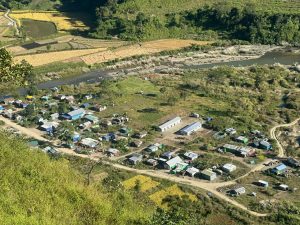
The Melbuk refugee camp, near the Indian border town of Zokhawthar (Photo: Kimi Colney / Myanmar Now)
Fear, more than choice
Thangkima, 45, who manages about 94 refugee families in Sihmmui camp, about 15 miles from Aizawl, told Myanmar Now that most refugees who took part in the enrolment process did so more out of fear than by choice.
Thangkima, who escaped Matupi Township in Chin State, has now been living in Mizoram for four years with his wife and four children. They live in a makeshift hut near the sewage dump site of Sihhmui village. While far from idyllic, refugees like him are grateful to have found a sanctuary in a place that isn’t looking to expel them any time soon. This makes it all the more crucial for them to dutifully comply with orders from the village council.
“We used to make a living by selling bamboo shoots collected from the jungle, but the village council told us to stop, so now we are trying to find other ways to survive,” he said. Thangkima and others now depend on scarce daily-wage work. “Those with contacts in Aizawl can find field work, but the rest of us go to Sihhmui to look for labour jobs, where jobs are limited because there are so many of us,” he said.
The biometric enrolment was also presented by the village council as mandatory, and residents complied without protest. “They said we should do it, so we just did it. It’s to identify us as refugees, so it’s good,” added Thangkima, showing the slip with his daughter’s identification details.
However, many refugees were not as willing to comply given the security risks associated with identification, including some families in Theiva camp who moved out of the camp after refusing to enrol.
Sanga, a resident of Sihhmui camp, said his fears about his data being recorded were related to the junta-backed general election slated to begin at the end of this year. The last time Myanmar went to the polls, in 2020, the military rejected the landslide victory of Aung San Su Kyi’s National League of Democracy and seized power in a bloody coup. The upcoming election is widely seen as an attempt to legitimise this power grab, with rights bodies calling it fraudulent.
Aware that Indian leaders have maintained close relations with the Myanmar regime, despite its numerous war crimes against civilians, many refugees don’t trust the government in New Delhi with their information. This is especially true among those who are part of the Civil Disobedience Movement (CDM).
Liana served in the Myanmar police force for 10 years before joining the CDM. He told Myanmar Now that the Young Mizo Association, a volunteer-driven civil society organisation that oversees all community work in the state, had called him and others together to assure them that sharing their data with the government would not put them at risk.
“They said [the Indian government] only wanted the data to know how many of us are here. As CDM members, we are not like other refugees, so we are more afraid, but we obeyed only on the assurance that it would not lead to our expulsion,” he said.
”But even then, our minds are not at peace.”
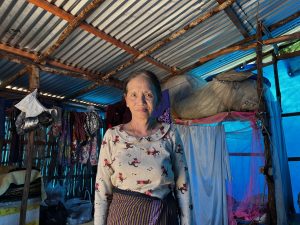
An elderly woman inside her makeshift shelter at the Lipui refugee camp in Zokhawthar Photo: Kimi Colney / Myanmar Now
Dividing ethnic brethren
While there is real fear that registration could have grave consequences, including death, for any refugee forced to return to Myanmar, there are also concerns about how it will impact those allowed to remain in India.
Hostility toward the refugee community has grown over the past two years as the state’s limited resources come under pressure. Earlier this year, a Mizoram-based activist wrote to the MHA warning that the unchecked entry of refugees was raising concerns about national security, demographic change, and the strain on resources.
There’s an underlying fear among refugees that being forced to register and provide all their data could lead to further profiling, widening the divide between them and native Mizos, despite their close cultural ties.
Siang Pi, a resident of Lipui camp in Zokhawthar who has been enrolled in the biometric exercise, said that it felt like Burmese nationals were being placed in a separate bracket, apart from their ethnic brethren.
“If we continue living here, we will always be regarded as foreigners,” he said. “But in the end, it is their decision to make.”
Many who spoke to Myanmar Now felt that if anything, the exercise might have been more fruitful if it were incentivised with practical benefits for refugees, such as opportunities for further education. Although children are allowed to study for free in government schools up to Class 10, continuing beyond that requires a government-issued ID.
“We sent our daughter to live with relatives in Tahan in northern Myanmar so she could continue her education. But we often wonder whether it would be better for her to sacrifice her education rather than risk her safety,” said Siang Pi.
The topic has divided an otherwise united civil society front in Mizoram, which appears to be split in two on the need or justification for biometric collection from vulnerable migrants.
Lalramdinliana Renthlei, the general secretary of the Zo Reunification Organisation, an organisation that aims at unity and solidarity among all Zo/Mizo/Kuki-Chin tribes, called it a tool to separate these groups from each other. “We were opposed to it from the beginning, but the ZPM government has taken a different route to the matter,” he said.
“We do not want to see our brethren as foreigners.”
A ZPM legislator from Mizoram, Lt-Col Clement Lalhmingthanga, who serves as vice-chairman of the High-Level Committee on Displaced Persons, said the biometric enrolment is a central policy. He added that maintaining proper records is necessary, noting that “even though they are our brethren, it is important to have a systematic way to trace them.”
While some officials say that India is not a signatory to the UN Refugee Convention and that refugees therefore have no right to ask for consent, critics of compulsory enrolment point out that Article 21 of the Indian Constitution guarantees fundamental rights, such as the right to life and the right to privacy, to all “persons,” not just citizens.
According to Apar Gupta, founding director of the Internet Freedom Foundation (IFF), a digital rights group, the State is required to meet the tests of legality, necessity, and proportionality even when dealing with refugees.
“Collecting biometrics through executive directions, without a clear, narrow law and safeguards, is on weak legal footing even when the subjects are non-citizens,” he said.
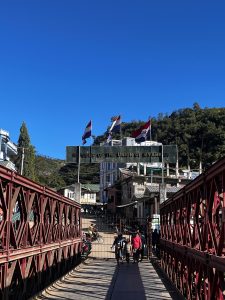
The Indo-Myanmar border gate at Zokhawthar. Photo: Kimi Colney / Myanmar Now.
Enforced orders from the centre
The biometric enrolment process in each district is overseen by the Office of the District Commissioner. According to Lalhriatpuia, the Deputy Commissioner (DC) for Aizawl District, the process is not mandatory. He also noted that Mizoram’s approach to the influx of Myanmar nationals has contrasted markedly with that of neighbouring Manipur State.
Manipur, ruled by the Hindu nationalist Bharatiya Janata Party (BJP), has seen a bloody civil war since 2023, much of which is centred around a largely propaganda-driven allegation of “illegal immigrants” from Myanmar. Unlike Mizoram, the Manipur government has opposed sheltering refugees and has facilitated their deportation from their border as recently as January.
(Kuki Zo tribes in Manipur—which also borders Myanmar—have collectively been profiled as “illegal immigrants” due to their ethnic kinship with the refugees. Other ethnic groups, such as the Meiteis and the Naga tribes, are also domiciled on both sides.)
On November 21, former Manipur Chief Minister Biren Singh took to X to praise Mizoram’s rapid progress on biometric enrolment, arguing that Manipur has “gone quiet” on the illegal immigrants issue despite raising it first. He urged both the state and central governments to stay focused on detecting and deporting “illegal immigrants.”
According to Aizawl DC Lalhriatpuia, the crackdown in Manipur has fuelled a surge in transnational criminal activity in Mizoram.
“With Manipur closed, the route used by smugglers and arms traffickers is now being diverted through Mizoram, where drugs and firearms are coming in,” he said, noting a huge increase in the amount of explosives flowing through the state compared with the situation in the 1990s.
Parliamentarians from Chin State who are currently taking shelter in Mizoram said they approached the Aizawl DC’s office for clarity about the need for a second round of identification, when they already hold temporary IDs. Those IDs, issued in 2022, were recorded manually by each district’s DC office and were not entered into any digital portal.
One exiled MP who spoke to Myanmar Now said they were told that the first ID had been issued by district authorities, while the new biometric enrolment was being conducted at the state level. “They said the portal is only for registering Myanmar refugees to know the numbers, not to send us back,” he said.
“Still, concerns linger,” he added.
The parliamentarian added that in a system where the central government’s decisions carry significant weight, the state has limited room to act independently. “The state has to follow the Centre’s rules,” he said, noting that decisions must account for all communities, not only the Chin population.
However, activists have raised serious concerns about biometric data given that it can be linked across databases and over time, making it easy to track people for purposes far beyond welfare or protection, including deportation, policing, or political profiling.
Gupta, the IFF director, warned that once this information enters security databases, “it becomes extremely difficult to erase or limit, which can entrench refugees as a risk group in the eyes of the state and justify future restrictive policies.”
As India has no specific laws relating to refugees or the protection of their data, Gupta said there are wide exemptions for the State and national security, with weak independent oversight. “In practice, there are few effective remedies if biometric data of refugees is misused or shared across agencies without their knowledge,” he added.
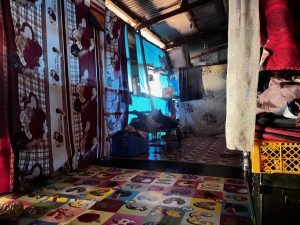
Inside a shelter housing dozens of families at the Bethel refugee camp in Mizoram Photo: Kimi Colney / Myanmar Now
A shift in politics
However, political analysts and activists argue that the administration’s stance deserves scrutiny. When Mizoram earlier rejected the enrolment, it was widely praised, raising the question of what prompted the chief minister to relent. The current chief minister’s sunny disposition with the Hindu nationalist BJP government, compared to Zoramthanga’s fiery rebellion, has not gone unnoticed.
Mizoram, which has limited capacity for generating its own revenue, relies heavily on the central government to fund most of its major projects. In the 2024–25 budget, Mizoram’s total estimated revenue receipts were over US$1.3 billion, of which only 20% was expected to come from the state’s own resources, with the rest from the central government through the Ministry of Development of the North East Region.
A government official who spoke to Myanmar Now on condition of anonymity noted that the chief minister shifted his position after meeting with the Union Home Minister Amit Shah, a BJP legislator who once equated infiltrators crossing the border with “termites”.
“The state depends on central approval for key projects. There may have been a need for trade or negotiations that influenced the decision,” the official said.
Opposition parties were critical of Lalduhoma for backtracking on several important battles with the federal government, such as biometric enrolment, that were seen as essential to protect Mizo interests.
“He was once a staunch critic of biometric enrolment, emphasising that ‘we are all human’ and that isolating our fellow humans was wrong. Yet now he has accepted the very policy he condemned, seemingly to stay in the good books of the central leadership,” said Robert Romawia Royte, a local legislator with the MNF and president of Mizo National Youth Front.
A political analyst, who did not want to be identified due to the sensitive nature of the subject in the state, explained that tensions have periodically surfaced between the Centre and state governments since India’s Ministry of Home Affairs issued its March 2021 directive instructing Northeastern states bordering Myanmar to deport illegal immigrants.
But she noted that the centre’s leverage has grown significantly this year. Mizoram, which relies heavily on central financial assistance and has limited internal revenue, has seen its negotiating power steadily weaken. In September 2025, Prime Minister Narendra Modi laid the foundation stone for development projects worth over US$1 billion, spanning railways, roads, sports infrastructure and schools.
“With constrained funds, the state government has been unable to introduce major schemes or new initiatives. The current government is too weak to negotiate and has even abandoned the positions it once held while in opposition,” she said.
The MP in exile said that everyone in the state, from officials in the administration to those in the ruling government, has assured them that the enrolment process was not aimed at pushing out refugees.
However, India’s increasing engagement with Myanmar’s junta leader Min Aung Hlaing makes him feel “anxious” nonetheless. Unforeseen outcomes of geopolitical games could put refugees at risk if the data were to end up in the wrong hands, he explained.
“That is what we fear,” he said.
*Refugees’ names have been changed to protect their identities.
This is part-I of a series on Myanmar refugees being co-published with Myanmar Now.
This article went live on December fourth, two thousand twenty five, at sixteen minutes past four in the afternoon.The Wire is now on WhatsApp. Follow our channel for sharp analysis and opinions on the latest developments.


