

In Bengal’s Darra Village, How the Absence of a Bridge Cut Off a Lifeline – and Cost a Man's Life


Darra (West Bengal): Forty-five-year-old Sunil Shabar, who belongs to the primitive indigenous Shabar community, died without medical treatment after being confined to his dilapidated house due to the absence of a bridge connecting his village to the rest of the district. The incident took place at midnight on Sunday, August 24, at Darra village.
The village is nestled in a hilly area in Bengal’s Jangalmahal, and falls under Sendapara gram panchayat in Binpur-II Block of Jhargram district, about 207 km west of Kolkata.
For seven hours that day, Sunil Shabar realised how death was gradually consuming him. His helpless wife, Minu Shabar, witnessed her husband’s indescribable cries of pain as he slipped away forever.
“Nodite jodi sanko thakto, tahole amar swamike abhabe dhunkte dhunkte morte hotona. Amader ai Darra ganyer lokjon bohubar panchayatke sanko bananor jonyo bolechhi. Nodite jol beregele amader perote osubidha hoy, kintu panchayat amader kotha soneni (If there was a bridge to cross the river, my husband would not have died in this painful way. We, the people of Darra village, have asked the panchayat many times to build a bridge, because when the water level rises in the Dulung river, it becomes difficult for us to cross, but the panchayat has not listened to us),” laments Minu Shabar, speaking to The Wire.

Sunil Shabar's widow Minu Shabar and their younger son, Jeet, in Darra village, Jhargram district, West Bengal.
Belpahari is an area that falls under Jhargram district and is surrounded by hills. The Belpahari police station area falls under Binpur-II Block and is the nearest police station to the village. Belpahari is also where the nearest hospital is. A water source emerges from the nearby Simulpal hill and flows in the form of a small river, locally called Dulung.
Along the way, the river is joined by additional streams carrying huge amounts of water from surrounding mountains and forests, before flowing southwards and merging with the Subarnarekha river at Gopiballavpur, about 80 km away from Simulpal.
The Dulung river does not flow throughout the year. During winter and summer, it dries up, and people face no difficulty in crossing it. But during the monsoons, it transforms into a raging stream. Though the river is not wide, the water level rises rapidly and violently.
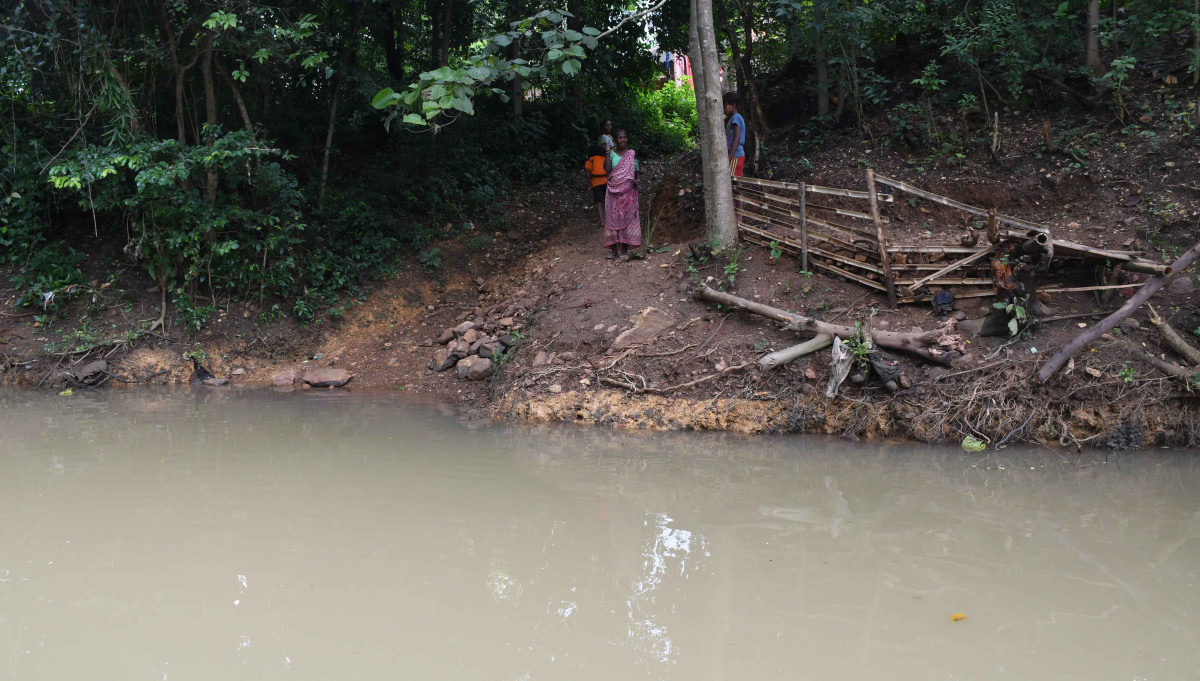
Dulung river in the monsoon. Due to the absence of a bridge, people cross the river by swimming.
Darra village lies on the western bank of the Dulung river, with houses built just 10 feet away from the riverbank. A total of 29 members of the Shabar tribal community, who are recognised under the Primitive Vulnerable Tribal Group (PVTG), have been living here for centuries. In addition, eight families from the Munda tribal community also live in this village.
Residents from these two communities need to travel about two kilometres to the nearest Rangamati village to buy essential goods, visit the Anganwadi (ICDS center) and take their children to school, which requires crossing the river.
“During the monsoon, the water level in the river rises up to seven or eight feet. Until the water recedes, we have no choice but to swim across by tying towels around our waists. The elderly and children cannot manage it,” say Bapi Shabar, 25, and Gurupada Shabar, 30, both residents of Darra village. They added that due to continuous rainfall this year, the water level rose to more than ten feet.
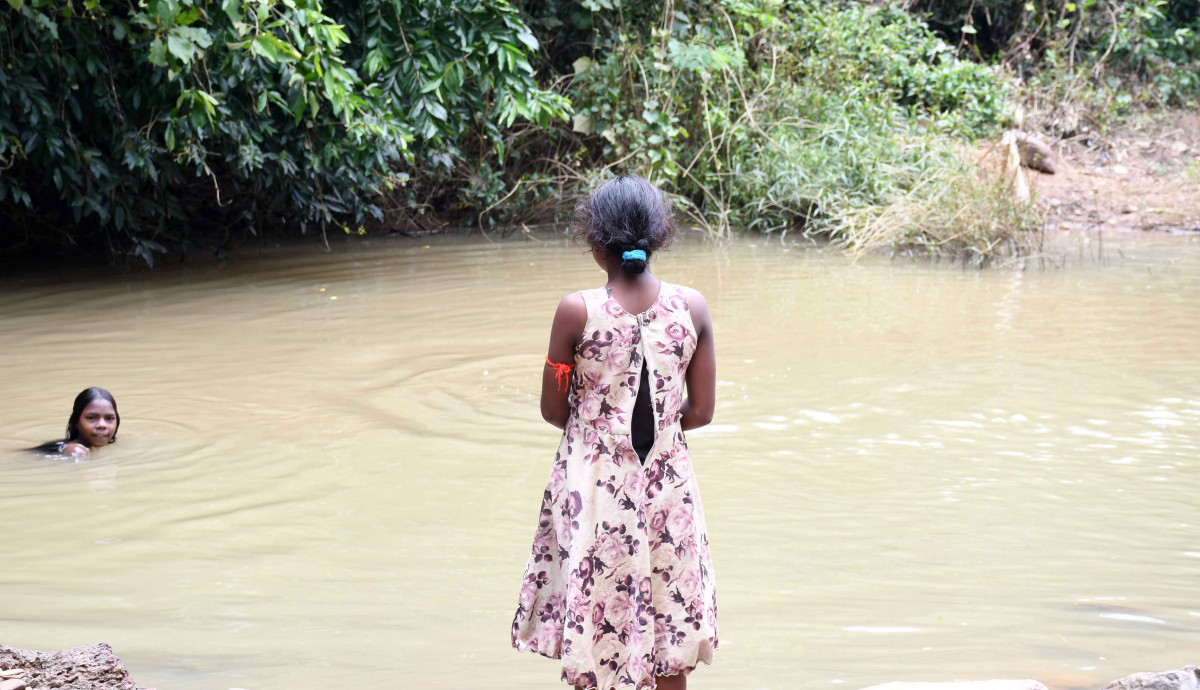
People swimming across the Dulung river to get to other villages for everyday essentials.
This harrowing situation remained unchanged on Wednesday as well. When the reporter visited, the water level in the Dulung river stood at eight feet. To reach Darra Shabar Palli, the reporter too had to swim across with a towel tied around the body.
On visiting Sunil Shabar’s house, his widow, Minu, and their younger son, Jeet Shabar, were seen sitting in front of their dilapidated home in a state of deep despair.
“My husband Sunil began having breathing problems on Saturday afternoon. He started shaking as well. As time went on, his breathing became more difficult, and the shaking worsened. It was raining heavily without pause. Rainwater had entered our house too. There was no one else with me. I did not know what to do,” says Minu.
She goes on, “In that situation, people from the village came to our home. Seeing my husband’s condition, they arranged for a Toto (e-rickshaw) to take him to the hospital. The toto had come but was waiting on the other side of the riverbank. With continuous downpour and rising water level of the river, how could we cross and take my husband to Belpahari hospital, which is 7 km away. My husband died before everyone’s eyes, confined to our house, failed to receive any treatment.”
Bela Shabar, 65, an elderly woman from the village, says, “When someone from our Shabar community dies, the body is cremated. But no one in the village had dry wood at home. It was raining heavily. So Sunil’s dead body had to be buried a short distance away.”
The people of Darra village have blamed the Sendapara gram panchayat and administrative negligence for Sunil’s death. “We have repeatedly asked the panchayat to build a bridge here. But they did not listen. We, the villagers, collected wood and bamboo from the forest and built a temporary bamboo bridge. But ten days ago, it collapsed due to heavy rain and the pressure of the river water,” says Hridoy and Bapi Shabar.
They levelled serious allegations against the panchayat and administration, noting that only Shabar and Munda tribes cross this river. “Are we not human beings in the eyes of the government or the panchayat?” asks Jharna Shabar, a middle-aged woman.
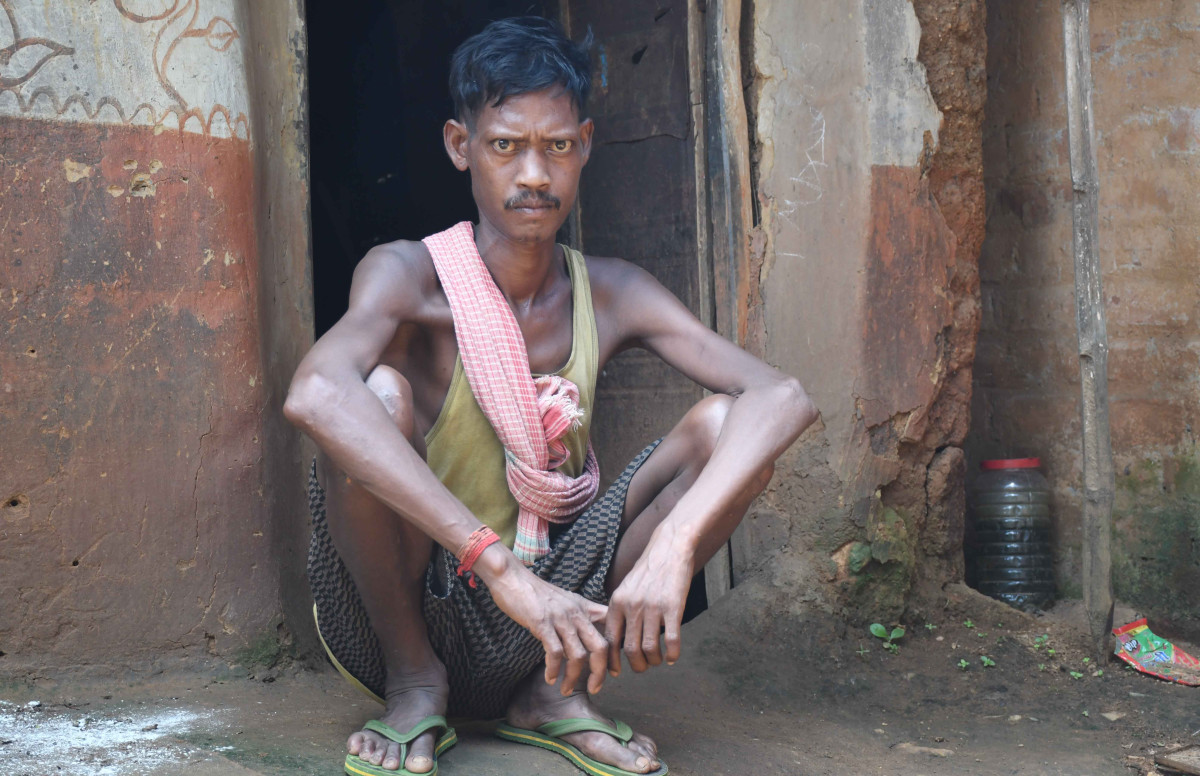
Gurupada Shabar, a resident of Darra village, says he is suffering from malnutrition.
Sunil’s son, Jeet Shabar, says that if there had been a bridge, his father might have survived as he could have been taken to the hospital. Women of the village – Golapi, Jharna, and Niyati Shabar – raised further concerns: “There are several pregnant women in Darra village. With these continuous rains and the rising water level of the river, how can we take them to the hospital to deliver their babies?”
Speaking to The Wire, Santana Hembram of the Trinamool Congress (TMC), an elected leader of Sendapara gram panchayat, admits, “I could not build the bridge despite informing the Pradhan (chief of the gram panchayat) and the Block Development Officer (BDO) of Binpur-II several times.”
She adds that the people of this village are still forced to swim to cross the river.
Meanwhile, Sumon Ghose, BDO of Binpur-II Block, says that he has already informed higher authorities about the need to construct a bridge in Darra village.
“Not only this tragic death, but the people of Shabar Palli in this village are practically living in a state of slow death. They are deprived of everything – from work to food, shelter and health services,” says Mangal Karmakar, a Sunil’s neighbour in the village.
Several women in Darra village, including Golapi Shabar, do not receive Lakshmir Bhandar money while elderly women, like Sukhi Shabar, have complained that they did not receive their old-age pension.

Sukhi Shabar, an aged resident of Darra village, says she did not receive her pension yet.
Meanwhile, Lalu Shabar, an elderly man, says he does not get to eat properly every day. His two sons remain unemployed. “Who will feed me? And even if there is food, it is only rice and boiled vegetables,” he said.
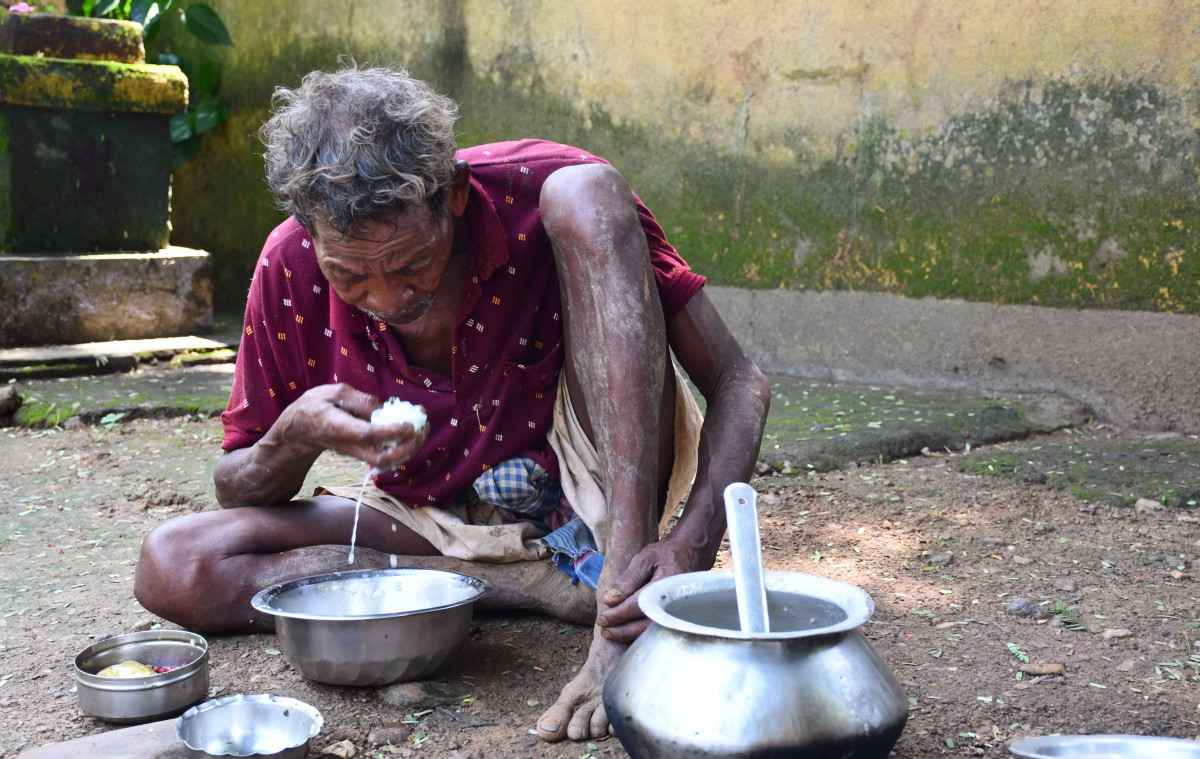
Ladu Shabar having rice and boiled vegetables for lunch.
Minu Shabar echoes this despair: “My husband had no work. Even with ration rice, we could not afford two meals a day for our family of four, including our two children. He developed multiple diseases. I myself do not receive money from Lakshmir Bhandar (the women’s social security scheme of Bengal).
To get out of this family situation, my elder son, Biswa, 19, migrated to Andhra Pradesh, while my younger son, Jeet, 16, worked in Cuttack, Odisha, as a migrant labourer. Jeet returned home after hearing the news of his father’s death, but my elder son has still not been able to come home.”
The condition of many houses in the village is also dire. One such house, belonging to Dipali Shabar, and another belonging to Gurupada Shabar, have collapsed. Despite repeated appeals to the panchayat, they received no assistance.
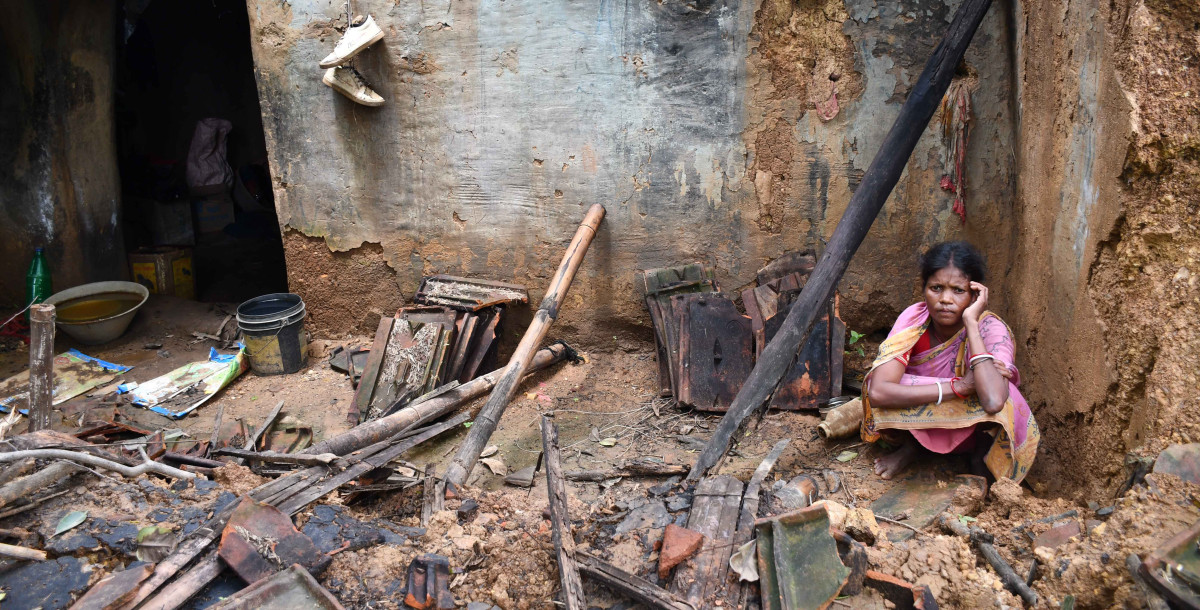
Dipali Sabar sits outside her broken house at Darra village.
“There are no piped drinking water facilities in the village. There is only one well and a tube well, and both the Shabar and Munda families rely on these two sources,” Bela Shabar says.
“Because of the heavy flow of the river water, expecting mothers and children cannot bring food from the ICDS center in Rangamati village. Children are also unable to go to school. Since their parents have no work, teenage girls are forced to take up labour by crossing the river,” she adds.
On Wednesday, three teenage girls – Uma, Mangala and Barsha – were seen returning from work. They said they earn only Rs 120 for a day’s work of picking grass in paddy fields.
The community has clearly not seen any benefits of the Pradhanmantri Janjati Adivasi Nyaya Maha Abhiyan (JANMAN) project, as announced by Prime Minister Narendra Modi on November 15, 2023. The scheme had promised a series of measures for the social and economic development of 75 identified tribal communities under the PVTG category, including the Shabar-Lodha tribe.
While West Bengal chief minister Mamata Banerjee often claims that the ‘Jangalmahal is smiling,’ the death of Sunil Shabar, is a stark reminder of the region’s grim reality where the lack of a bridge to be able to reach basic amenities cost a person’s life.
All photos are by Madhu Sudan Chatterjee.
This article went live on September second, two thousand twenty five, at zero minutes past six in the evening.The Wire is now on WhatsApp. Follow our channel for sharp analysis and opinions on the latest developments.


