

In Delhi’s Sunder Nagar, a Rushed Demolition Drive Allegedly Paid No Heed to Protocols


New Delhi: When Fatima’s house in the Sunder Nagar basti was bulldozed, on November 21 at around 3 pm, her husband was on duty. A driver for a tourist taxi service, he had left for Agra in the early hours of the morning. He was supposed to come back after having shown tourists the Taj Mahal. But when he did, he would find his home turned to rubble.
Meanwhile, Fatima (20) sat on the pavement, cradling her four-month-old daughter, the path behind them strewn with household items. Beside her was her sister-in-law, who suffers from a speech disability and partial paralysis of the limbs. “When the bulldozers came, my first thought was to keep both of them safe. Everyone was busy clearing out their own houses. Who could I have asked for help?” she said.
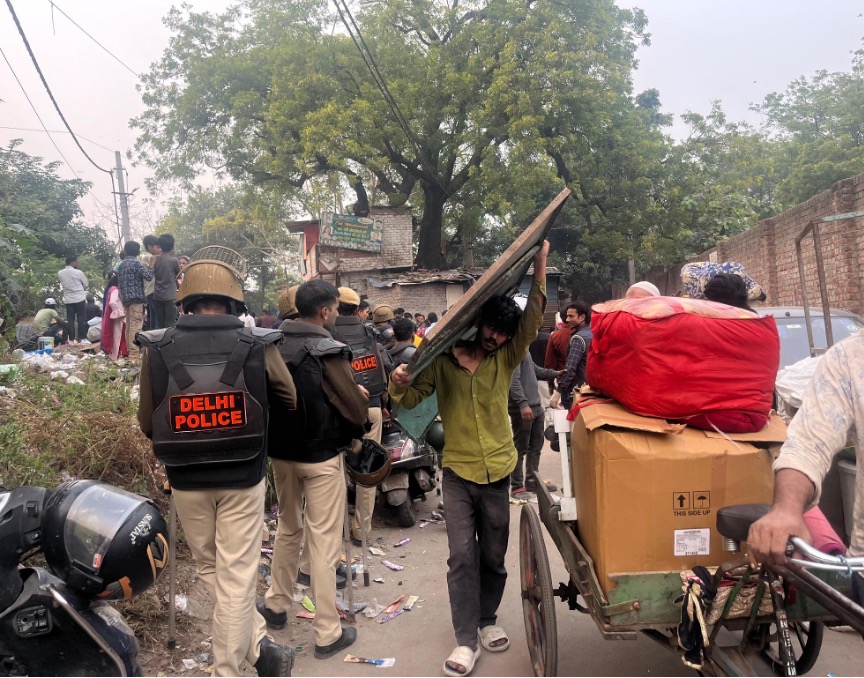
People clearing out their homes at the eleventh hour, either on foot or on small vehicles that were allowed to pass through by the Delhi Police. Photo: Sukanya Roy
With Delhi’s freezing temperatures around the corner, this demolition affects the lives of more than 200 displaced families of Sunder Nagar. Their homes were bulldozed, by the Ministry of Housing and Urban Affairs (MOHUA), and the Delhi high court refused to stay the demolition drive. Just across the road from the iconic Sunder Nursery, flanked by the World Heritage Site Humayun’s Tomb, this basti features on the Delhi Urban Shelter Improvement Board’s (DUSIB’s) list of 675 ‘protected’ jhuggi-jhopdi clusters. While demolishing these settlements, authorities must comply with protocols drawn out in a 2015 policy called the ‘Delhi Slum and JJ Rehabilitation & Relocation Policy’.
However, the Land and Development Office (L&DO) allegedly flouted several protocols while carrying out the demolition. The 2015 policy mandates that alternate rehabilitation must be provided 15 days prior to demolition. Pyare Lal (52), a resident who works as a scrap dealer, said that notices announcing the demolition were pasted only three days earlier, i.e. on November 18. “First the notice sent us into panic, then we heard rumours that the demolition would be stayed. And then suddenly the bulldozers came. We had no time to find a house,” he said.
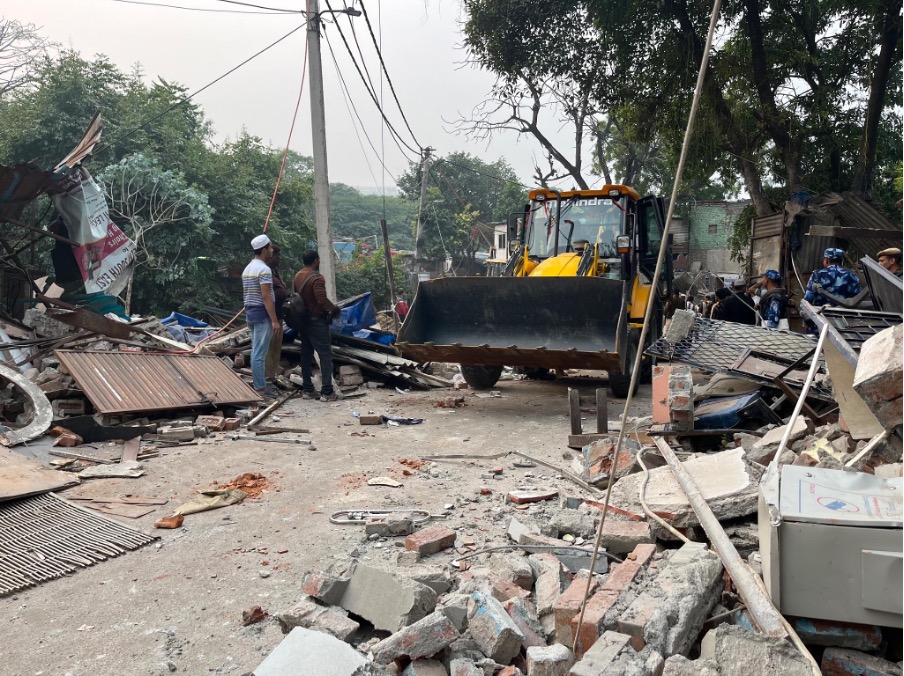
Residents and policemen look on, each with different emotions, as the bulldozers wreak havoc on the basti. Photo: Sukanya Roy
Many residents added that they did not possess the financial means to rent accommodation at such short notice. A majority of them are daily-wage earners, domestic workers and scrap collectors. The DUSIB has failed to provide alternate rehabilitation to even a single displaced family. The policy also mentions that alternate rehabilitation must be provided within five kilometres from the site of a demolition.
Regularity of livelihood and education are crucial to the displaced families of Sunder Nagar. Nasira Bibi (33) works as a domestic worker in a posh bungalow nearby. She said, “If we move far away, I can’t continue working, and I was earning decent money here.” Her children study in the Delhi Public School, Mathura Road, which is around the corner. “I shouldn’t have to choose between them losing a year, and paying increased travel expenses,” she explained.
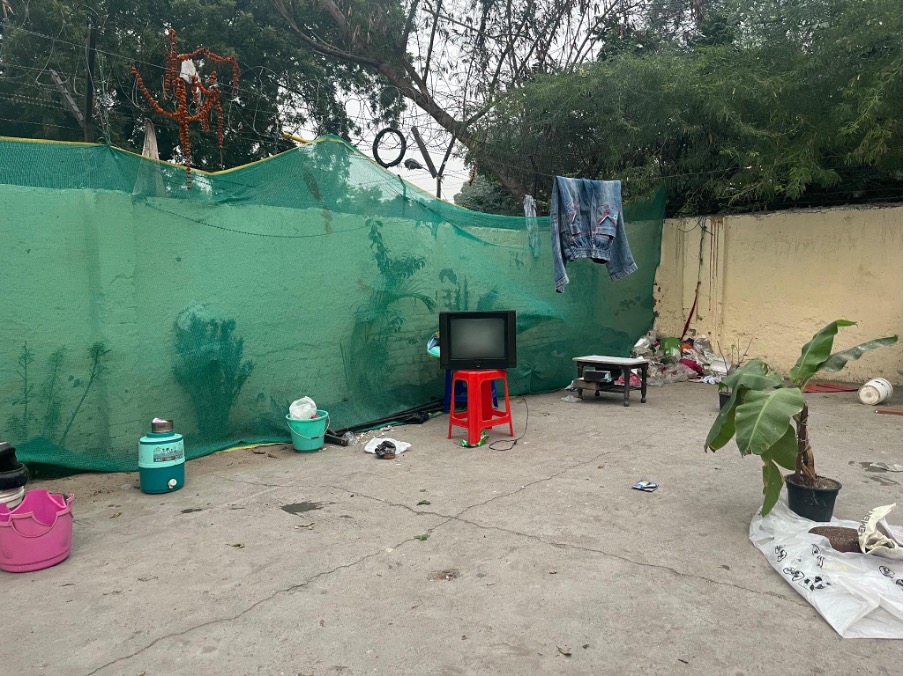
Photo: Raj Kumar, a resident, cleared out possessions like the TV and the water filter from the house into his garden. Photo: Sukanya Roy
The policy also states that demolitions cannot be carried out while school and college examinations are taking place. Falak (17), is a 12th standard student, whose pre-board exams are due next month. “I have a weekly practice-test tomorrow. There’s no way I can study today, I have no peace of mind,” she said. At the demolition site, it was common to see children wearing their school uniform. Priya (38) wiped her tears with her dupatta, and pointed towards her son rummaging through the rubble. “My poor boy did not get time to even change clothes or eat lunch. What consolation could I possibly offer him? His future, all our futures seem bleak now,” she said. Chandni (14) echoed a similar sentiment. “My mother is saying that we will go back to our village after my final exam… and you know what will happen there… I will have to quit my studies, and soon, relatives will get me married off.”
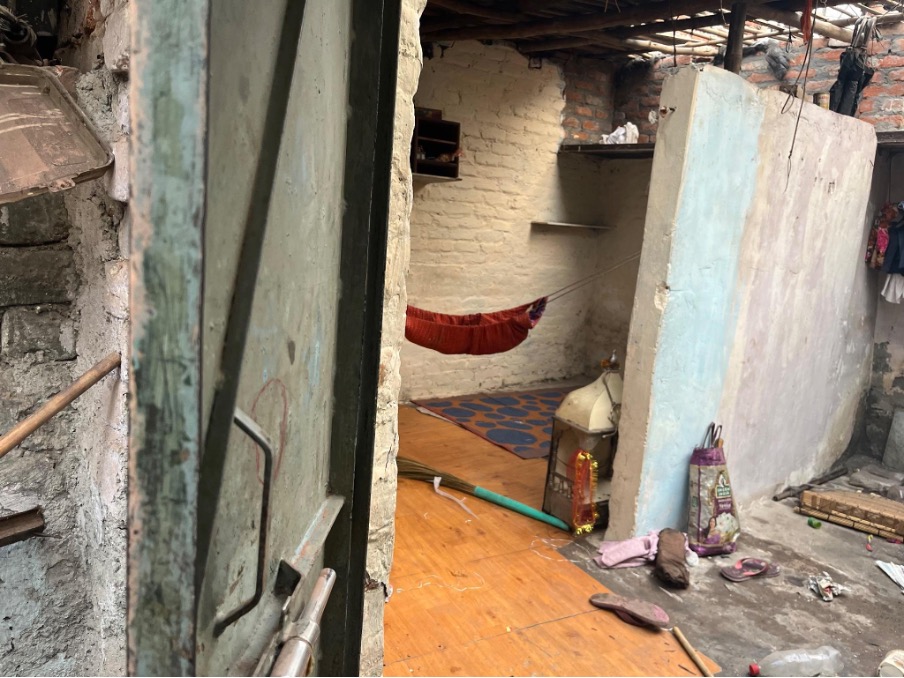
A child’s cot lies empty in a house that was due to be demolished the next day. Photo: Sukanya Roy
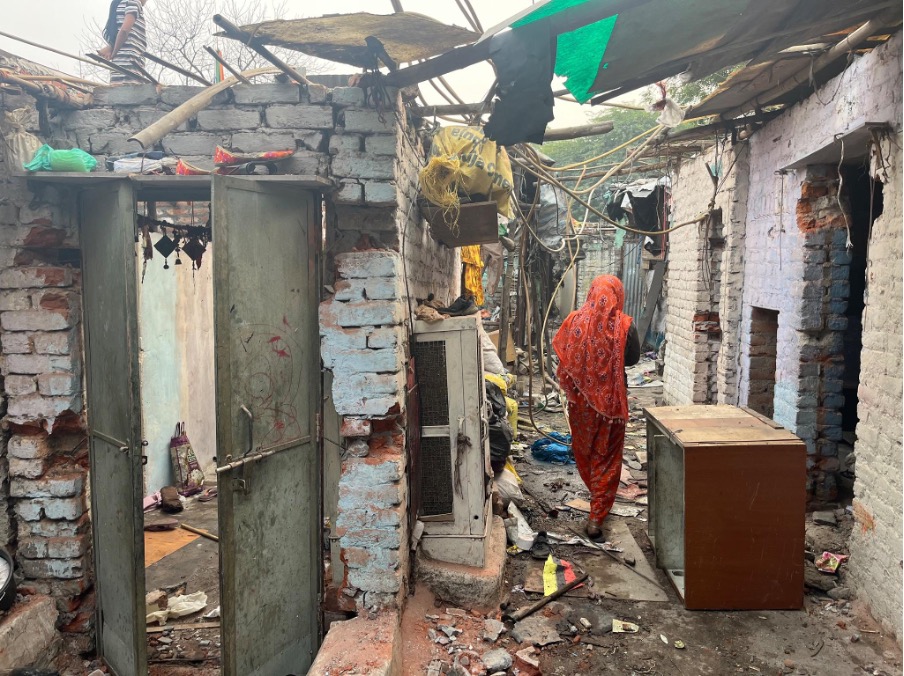
Mohsina Bibi walks towards her demolished house at the beginning of the lane. Photo: Sukanya Roy
Karuvaki Mohanty, lawyer from iProbono India Legal Services, is representing some of the displaced residents. She questioned the apparent urgency behind these demolitions. The high court had been hearing a recall plea for a February 2019 order which had authorised the demolition, and refused to grant a stay on the demolitions. Mohanty said that satellite imagery and the inability to furnish electricity bills by residents had been relied upon to make the decision. However, residents allege that electricity was obtained through official channels only in 2008, and they had voter ID cards and Aadhar cards predating 2006. “That, combined with the protected status under the DUSIB list, should have been enough to provide rehabilitation to the residents,” said Mohanty. She added that based on legal precedents, a more liberal interpretation of the 2019 order was required of the court.
Scores of armed policemen dotted the demolition site. Fariha (29), a domestic worker, said, “We know that the police are just following orders. We want to question the higher ups. Do we have no rights?” Rani (26) objected to this, saying, “We have a problem with the police too… they badly beat up a woman a few galis down. Male policemen cannot hurt a woman, no matter what.” The policy explicitly forbids violence against women and disabled people during the process of a demolition. It also mandates the DUSIB “should ensure safe and affordable access to essential services - potable water, sanitation and health”. Mohanty said that none of these services had been present, and temporary shelter and relief was “the need of the hour”.
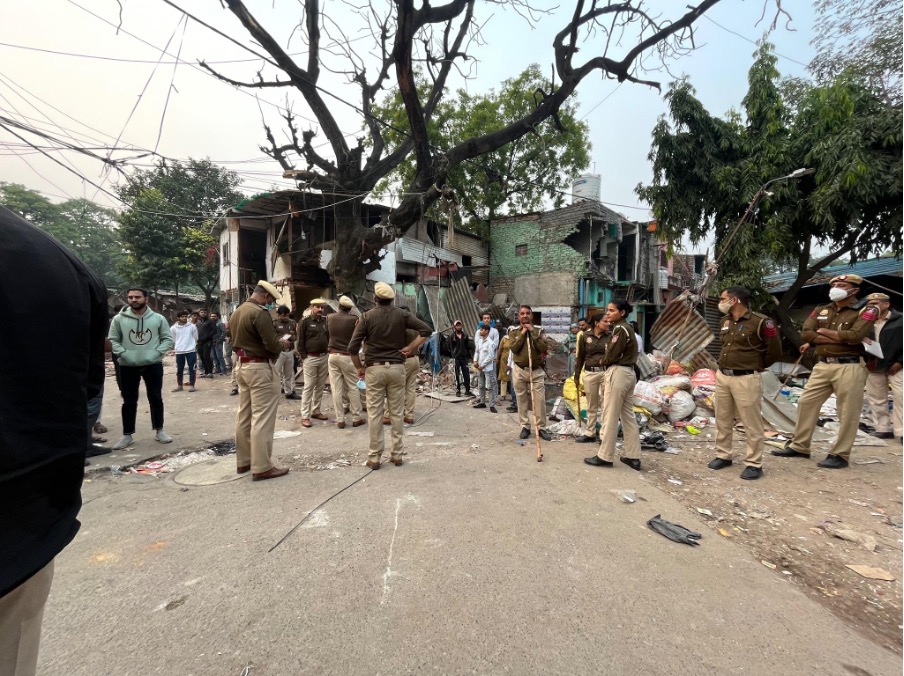
Police personnel supervising the demolition keep a strict check on people going into and leaving the basti. Photo: Sukanya Roy
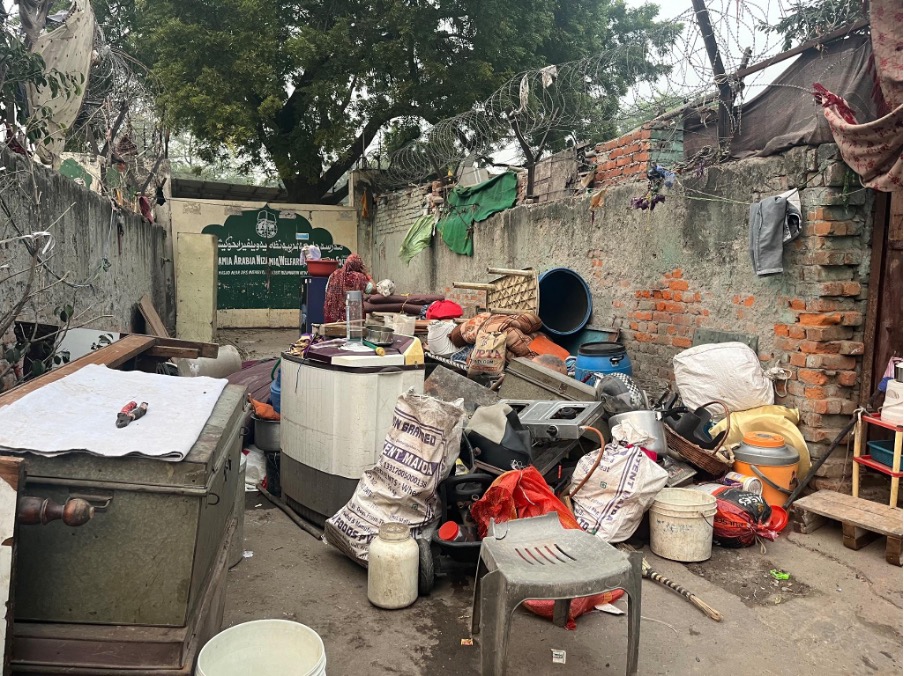
Piles of household items left out on the road, in the wake of the demolition. Photo: Sukanya Roy
The minister of state for housing and urban affairs, Kaushal Kishore, refused to comment on the matter when called on the phone. The Wire also reached out to P.K. Jha, director of rehabilitation at DUSIB. He deemed rehabilitation to be solely the responsibility of the Delhi Development Authority (DDA). However, the DUSIB Act of 2010 says otherwise. Sections 10 and 12 of the Act say that DUSIB has “the power to prepare a scheme for the removal of any jhuggi jhopri basti and for resettlement of the residents thereof”, adding that it may also “work out schemes for collective community rehabilitation, relocation or in-situ upgradation…”
As night fell, a street light at the entrance of Sunder Nagar was being repaired to serve as the sole source of light. Electricity had been cut off during the demolition, and will likely never be restored. Mona (20), Falak’s sister, sat in their car with her mother and sister, cramped in with all the things they could manage to pull out from their house. It was due to be demolished the next day. “It’s my birthday tomorrow,” she said, “and I could not have expected a worse birthday gift.” Falak added, “To us, Sunder Nagar was the epitome of a peaceful world… people of all religions lived in harmony here. They may have broken our houses, but they can never demolish our dreams.”
All names of residents interviewed have been changed to protect their privacy.
Sukanya Roy is an independent journalist, and a Village Square fellow at present, who has reported on urban and rural issues across a number of themes.
This article went live on December eighth, two thousand twenty three, at thirty minutes past four in the afternoon.The Wire is now on WhatsApp. Follow our channel for sharp analysis and opinions on the latest developments.


