

Testing the State of Constitutional Democracy in India Through 'Assemblies of Freedom'


Thus so long as the name of freedom was respected and only its actual realization prevented, of course in a legal way, the constitutional existence of liberty remained intact, inviolate, however mortal the blows dealt to its existence in actual life.
— Karl Marx, 'The Eighteenth Brumaire of Louis Bonaparte'
What is the state of health of the Indian Union? Is it wounded, “eroding”, breaking down, breaking up, “backsliding”, critical? How can we know whether we are still living in a constitutional democratic system constituted by our consent? Is there still a constitution of India?
These are the questions for which we should take responsibility and act in politics according to the ratio between the answers received and what they reveal about the future of India. These essential questions cannot be answered through the newer phrases borrowed from the international media such as “erosion” and “backsliding” which are meant as “all the perfumes of…”.
We can check the liveliness of our constitutional democracy only by testing the constitution through thoughtful political acts. Of these tests, the most important ones for this situation are the freedoms of association and assembly. Further, if these freedoms are opposed by the upper caste supremacist militias, or the police, which is at times indistinguishable from such militias, we should urgently seek the opinion of the judiciary: Are we still a constitutional democracy, your honours?
As the physicians of democracy, we administer these tests while granting our assent to constitutional democracy. Without the manifestation of such tests of freedoms, the constitution is a crumbling parchment written in an indecipherable script.
Who is opposed to constitutional democracy?
Today there effectively is no freedom of association and assembly, especially for the lower caste majority position in India. At the same time, the RSS, the supremacist organisation of the minority upper castes (less than 10% of the population of India), and its (conveniently disavowable) offshoots are at liberty to violate all constitutional and international norms to take out armed processions, attack mosques and churches. We should consider the differences in the political lines of demarcation between the associations and the assemblies of the lower caste majority and of the upper caste minority.
The most recent hate campaign of the RSS mafia famiglia began in the Nuh district of Haryana in July 2023 against Muslims. If we perceive it and speak of it the way they want us to – in terms like “Hindu majority” versus “Muslim minority” – we will be morally responsible for the crimes against humanity which await us in a future of India. Most conflicts in India, political and of other kinds, including the events in Nuh are concerned with prolonging the caste-ordered society. The mafia-like organisations of the VHP and Bajrang Dal, involved in the worst events of terror in India, were created to counter lower caste assertion and to prevent “caste wars” of the kind witnessed in Bihar and Gujarat in the last century.
In Haryana, the BJP has been facing the anger of the Jat community. The now historic farmer protest of 2020-2021 was organised predominantly by the Jat farmers of several states, including Haryana, against the farm Bills introduced by the Union government. It has the rare reputation of succeeding against the government, as the farm laws were repealed. These associations and assemblies of the farmers were criminalised by the BJP, and at the end of it, over 750 farmers had died.
From January this year, the wrestler’s protest which saw a host of national athletes alleging sexual harassment by a prominent BJP member of parliament and “strong man” was suppressed several times using the police and the media, even in the face of international condemnation. These ongoing protests too are led by the Jat community as “most of the female wresters who have accused Bhushan Singh of sexual assault and harassment are Jats”.
The BJP in Haryana is also struggling to contain the conflict between the upper-caste Rajput leaders of their party and the Gurjar community over the contestation of the caste of a 9th-century ruler. All these divisions of caste never provided a favourable ground to the BJP and other upper-caste political organisations in modern India’s history. Such contestations will again raise new, towering figures of lower caste politics as Kanshi Ram, Mayawati, and Lalu Prasad Yadav had been in the past.
The Hindutva organisations often countered such situations through violence against Muslims, Christians and Sikhs. In Nuh too, it has been observed that “Hindu consolidation may paper over such cracks” among castes and it requires directing mobs and media towards Muslims, while the judiciary watches, without yet watching over.
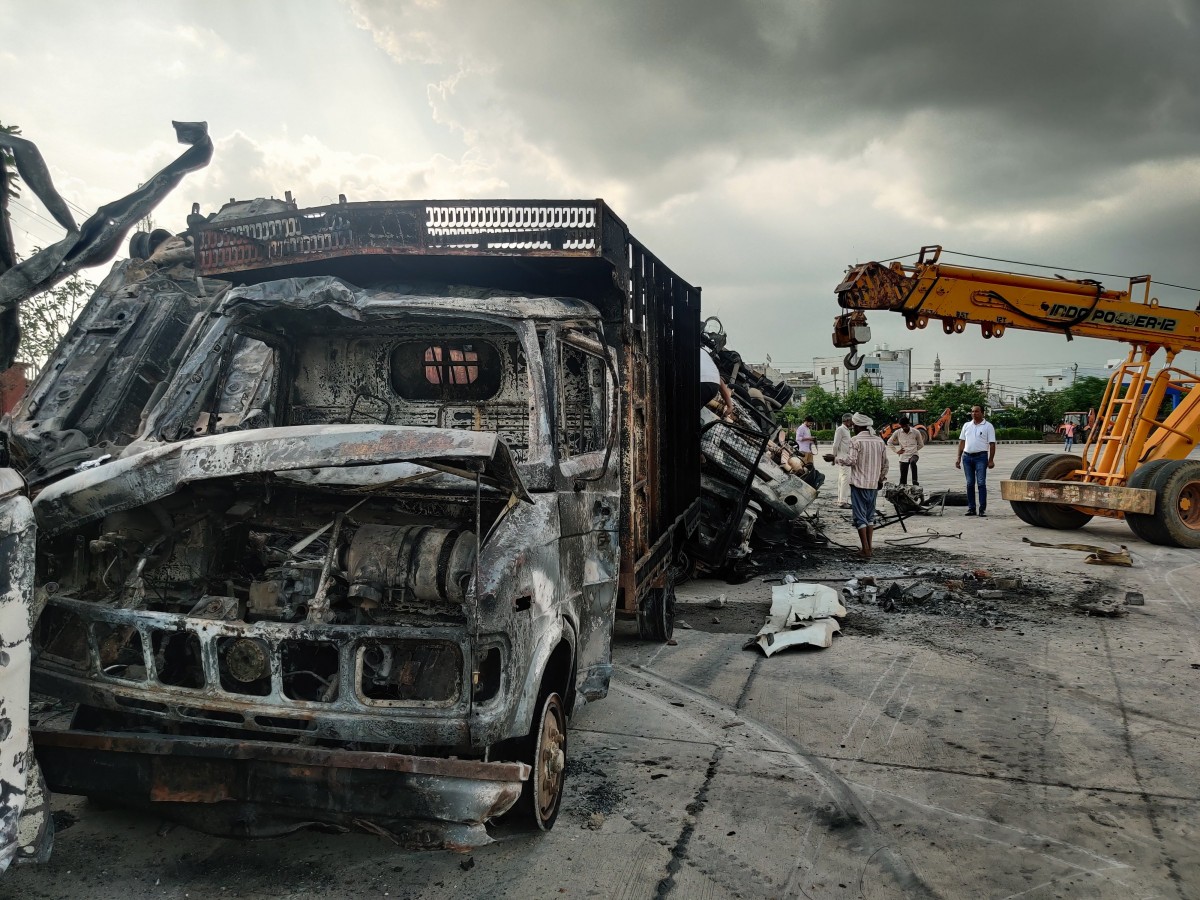
Vehicles torched by the mob are being collected at the bus stand in Nuh. Photo: Atul Ashok Howale
The constitutional sense of association
The International Covenant on Civil and Political Rights finds in the rights to associate and assemble the fundamental political right which is essential for all people “in shaping their societies”. These rights constitute “the very foundation of a system of participatory governance based on democracy, human rights, the rule of law and pluralism.” Article 20 of the Universal Declaration of Human Rights states that “Everyone has the right to freedom of peaceful assembly and association” and “No one may be compelled to belong to an association”. The Indian constitution under Article 19(1) (c) guarantees freedom of “association or unions” with a few restrictions which are public order, decency, and the sovereignty of India. We should note that it is the people who are ‘sovereign’ and that “a judicial decision or order which violates a fundamental right is void”.
Freedom of association is most commonly the freedom, and the power, to form organisations including political parties. Freedom of association is also the power that grounds our freedom to love, to create languages, to marry, to educate each other, to convert to religions and to form communes among friends. Caste order is explicitly opposed to freedom of association and it has been subverting the constitution. B.R. Ambedkar gave the clearest explanation in Annihilation of Caste:
"What is your ideal society if you do not want caste is a question that is bound to be asked of you. If you ask me, my ideal would be a society based on Liberty, Equality and Fraternity. And why not? What objection can there be to Fraternity? I cannot imagine any. An ideal society should be mobile, should be full of channels for conveying a change taking place in one part to other parts. In an ideal society there should be many interests consciously communicated and shared. There should be varied and free points of contact with other modes of association. In other words there must be social endosmosis. This is fraternity, which is only another name for democracy. Democracy is not merely a form of Government. It is primarily a mode of associated living, of conjoint communicated experience. It is essentially an attitude of respect and reverence towards fellowmen."
Caste order and its ethos prevents the people of the lower caste majority and other religious groups (especially the lower caste majority of those groups) from associating with one another through love, living in shared neighbourhoods, sitting at the same table, studying in the same classrooms, presiding on judgment in the courts of India, in the parliament, and in the media. There are new laws, with unpronounceable Hindi names, which are opposed to the right to associate freely and they are a bad omen for the more evil transformations of the state after the 2024 national elections.
Today, the restrictions on freedom of association are often imposed by the media and the mafia famiglia of the RSS. The state too is clearly intervening in the domain of religious freedoms, especially the freedom to associate with any religions and the negative freedom to dissociate from religions. This is a subversion of the constitution. For understanding negative freedoms, the iconic example is the religious conversion of Ambedkar, who did not wish to associate with the “Hindu” order and hence chose Buddhism in a mass religious conversion event on October 14, 1956.
The 22 vows taken by the father of the constitution of India at that mass conversion event say much about the conflict between the constitution of India and upper caste supremacism which directs itself as the interest of the state. We must recall three of the vows,
- I believe in the equality of men.
- I will try to establish equality.
- I renounce Hinduism which is harmful to humanity and hinders the progress and development of humanity because it is based on inequality, and adopt Buddhism as self-religion.
Both 1 and 2 are consistent with the constitution of India, while 3 points to the serious threat posed by upper caste supremacism to the constitution of India. These threats are becoming more alarming as the caste order is surreptitiously introduced into the education system, in the name of encouraging “traditional” crafts and jobs.
Nearly all religious groupings and many political parties of India are in violation of the freedoms of the constitution, as can be seen in recent incidents where the freedoms of expression and association appeared in conflict with religions. A lower caste leader of the AAP and a former minister of the government of Delhi, Rajendra Pal Gautam, converted to Buddhism in October 2022 in a mass conversion event “where hundreds of people denounced Hinduism and adopted Buddhism”. After several ‘legal complaints’ by the BJP and the refusal of the AAP leadership to defend him amidst reports that “chief minister Arvind Kejriwal 'is extremely displeased' with Gautam”, he had to resign from his ministerial position.
The real restrictions to freedom of association are imposed through the brutality of mafia organisations which spring up often as paramilitary wings of the RSS, an organisation banned thrice since 1947 for operating against the constitution. These restrictions are supported and aided by the police and other state institutions, and occasionally by the judiciary, which indicates that an upper caste supremacist ‘state machinery’ is about to wriggle out of the chrysalis of the Indian constitution.
Of all kinds of associations that are being challenged and suppressed, the most alarming and revealing suppressions are of the associations that oppose the caste order to lead towards a society assuring Justice, Liberty and Equality which are the promises of the constitution. That is, these three values are both the principles, understood as ground, and the telos understood as that towards which all the activities specified by the constitution should strive.

On 20 May 1951, Dr. Ambedkar addressed a conference on the occasion of Buddha Jayanti organised at Ambedkar Bhawan, Delhi. Photo: Wikimedia Commons - CC0 1.0
Who are the ones unable to associate and assemble
On August 20 this year, a collection of organisations called We20 met in Delhi’s “HKS Surjeet Bhawan, which is owned by the Communist Party of India (Marxist)”. The We20’s declaration ‘People and Nature over Profits for a Just, Inclusive, Transparent and Equitable Future’ should be most welcome. However, the police denied them permission to gather through an irrational statement—“non availability of the vital information pertaining to the gathering, visitors etc. which is needed as per oredor (sic) of the Hon’ble High Court of Delhi…[permission for] program is hereby rejected”.
In 2018, scholars, activists, academics, former judges, and people from all walks of life gathered to commemorate the 200th anniversary of the victory of a lower caste army over a Brahmin kingdom in Maharashtra. Then the worst violations of human rights, international law, and the constitution of India were unleashed in order to imprison many who participated in these events and some who did not. The evidence was found to have been planted on the computer of an accused and the statements of this spurious evidence are ludicrous and juvenile.
The slow judicial process in this case and the death of Father Stan Swamy in prison serve as intimidation and warning to all those who seek an egalitarian polity from the point of view of the lower caste majority position. Those who speak, associate, and assemble from this position are considered “anti-national” by the Brahminical minority position, as asserted by the Akhil Bharatiya Brahmin Mahasangh. But this is not so from the point of view of the constitution of India, not yet.
Soon, negative freedom of association may appear as it did in Nazi Germany, everyone may be made an automatic member of the RSS. Before that comes about, we should breathe life back into the constitution through the exercise of the rights guaranteed by the constitution.
The fitness test of the constitution
The health of the constitution must be tested on the streets and in the halls of justice, and these tests are the responsibility of everyone, not just the activists and lawyers. We should gather over a cup of coffee under an idea whenever possible. We should form newer associations in the mode of weekend clubs to educate one another about the political history of India, mourn its present, and draft its future. We should associate and share books, articles and other resources so that we become the egalitarian gathering of an effervescent power opposing an evanescent force composed of barely literate goons and clowns. We should also visit those neighbourhoods within our neighbourhoods that are kept apart under caste and religious apartheid. Above all, associate in the greatest of numbers for egalitarianism as such.
These acts will be policed, mobbed, and terrorised with the connivance of some office bearers of the institutions of the constitution of India and by the cowards who walk the streets in large numbers to terrify everyone in the name of a recently invented religion. The RSS, as we have known them in the history of the anti-colonial movement and since 1947, are cowards who operate in the dark, in the safety of the crowds or, today, in the security offered by high ranking policemen.
Therefore, we should freely assemble in the open in order to open politics again as the quest for freedom; bearing moral courage and the creative power of lamentation within; and must return again and again in greater numbers festively and peacefully so that we become the kinesis of freedom ourselves.
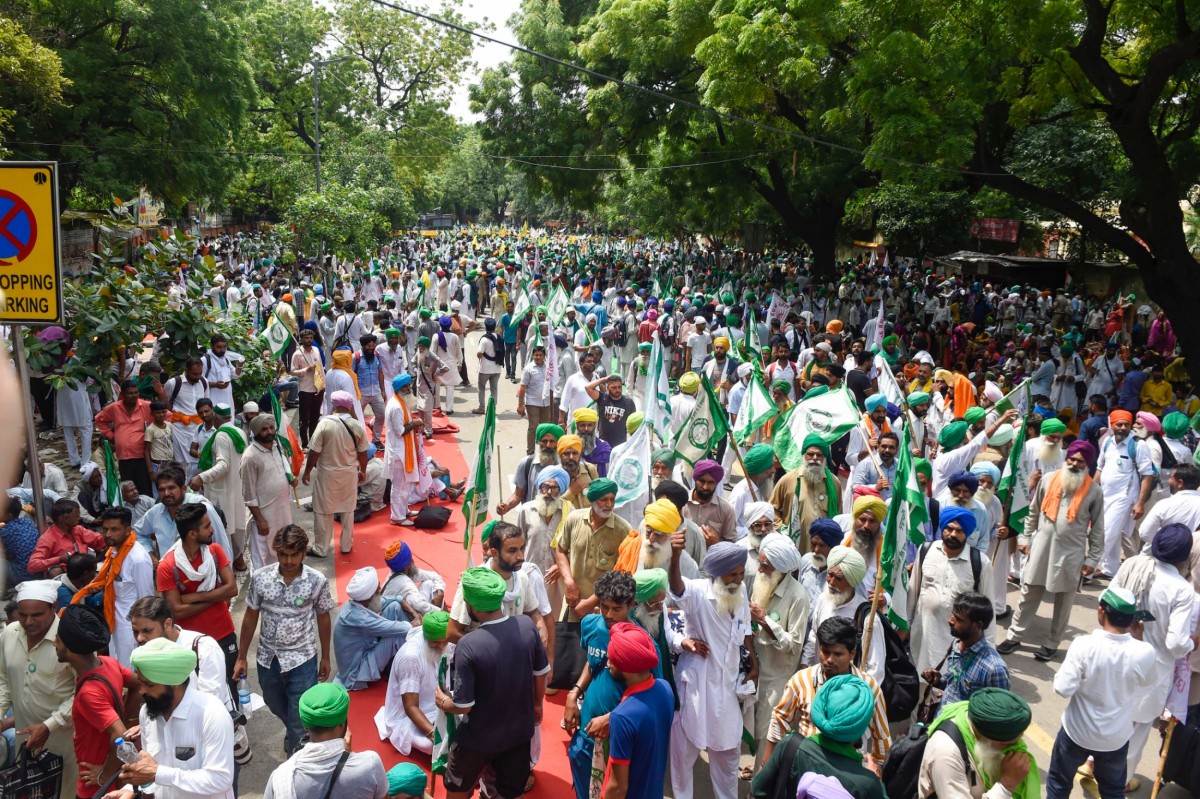
Farmers assemble at the Jantar Mantar following a call by some farm unions to stage a protest to press for a legal guarantee for MSP and other demands, in New Delhi, Monday, Aug 22, 2022. Photo: PTI/Atul Yadav
While assembling and gathering we should study the judgment of the two-judge bench of Chief Justice Prashant Kumar Mishra and Justice D.V.S.S. Somayajulu of the high court of Andra Pradesh in May this year. They said:
“historically, culturally and politically, the tradition of public meetings, processions, assemblies etc., on streets, highways etc., have been recognized in this country. These meetings, processions etc., constitute an important facet of our political life. The freedom struggle is replete with examples of processions, dharnas, satyagrahas etc., conducted on the roads which lead to India’s tryst with destiny on 15.08.1947.”
The constitutional court acted according to the principles and the telos (the goals) of the constitution and, against the trespass on it by the executive. Further, the judgment gives an argument for the rights to associate and to assemble: since the constitution is itself a product of free associations and assemblies, it cannot be used to suppress these rights.
The constitution itself says that these articles of freedom have been put in place “to protect these rights against State action”. If there are restrictions and challenges, including the criminal mobs directed by the upper caste supremacist organisations or the police then one must test the constitution’s health at the courts. These judicial tests may be disappointing. Romila Thapar and others moved the Supreme Court with a public interest litigation questioning the arrests of activists and academics in the Bhima Koregaon case and sought an independent enquiry into the events. Her plea was dismissed by the Supreme Court.
It is only through the ratios discovered between the free associations and the assemblies for an egalitarian world, and the opposition to these actions by the mafia famiglia and the state institutions that we can diagnose the health of the Indian Union. In the same way, the ratio of the outcomes of the petitions placed before the judiciary and the guarantees of the constitution alone can tell us of the salubriousness or otherwise of the institutions of the constitution. Or help us gauge the length of time that the present fascistic political situation has borrowed from the deferred revolution of the lower caste majority for an egalitarian world.
Shaj Mohan and Divya Dwivedi are philosophers based in the Subcontinent.
This article went live on August thirtieth, two thousand twenty three, at fifteen minutes past four in the afternoon.The Wire is now on WhatsApp. Follow our channel for sharp analysis and opinions on the latest developments.


