

India's Political Freedom Has Seen ‘Plummeting Trend’ Since 2014: Atlantic Council Index


New Delhi: What is the real advantage of being a democracy? Can it make a difference to the prosperity and material well-being of citizens? Do autocratic countries see more economic progress? Most importantly, where does India stand?
The Atlantic Council’s latest Freedom and Prosperity Indices attempt to answer these questions and more with empirical research.
Report flags India's ‘plummeting trend in political freedom since 2014’
The Freedom Index measures three kinds of freedoms through three equally weighted subindexes: political, legal and economic. The Prosperity Index ranks prosperity based on income, health, inequality, environment and the condition of minorities.
Overall, India scores below average on both freedom (61.7) and prosperity (55.6) and remains in the bottom 40% globally.
In terms of its ranking, it stands at 95 out of 164 countries on the Freedom Index and 111 out of 164 on the Prosperity Index, placing it firmly among the ‘less free’ and ‘less prosperous’ nations, according to the US-based think tank.
The worrying fact, going by the report, is the sharp decline in freedoms that Indians enjoy. Between 2014 and 2024, India witnessed a decline of 14 points under the Freedom Index's political subindex (denoting political freedom), one of the sharpest falls globally.
The report notes that the precipitous decline in political freedoms experienced by the average world citizen when weighted by population is largely attributable to India due to its being the populous nation in conjunction with its “plummeting trend in political freedom since 2014”.
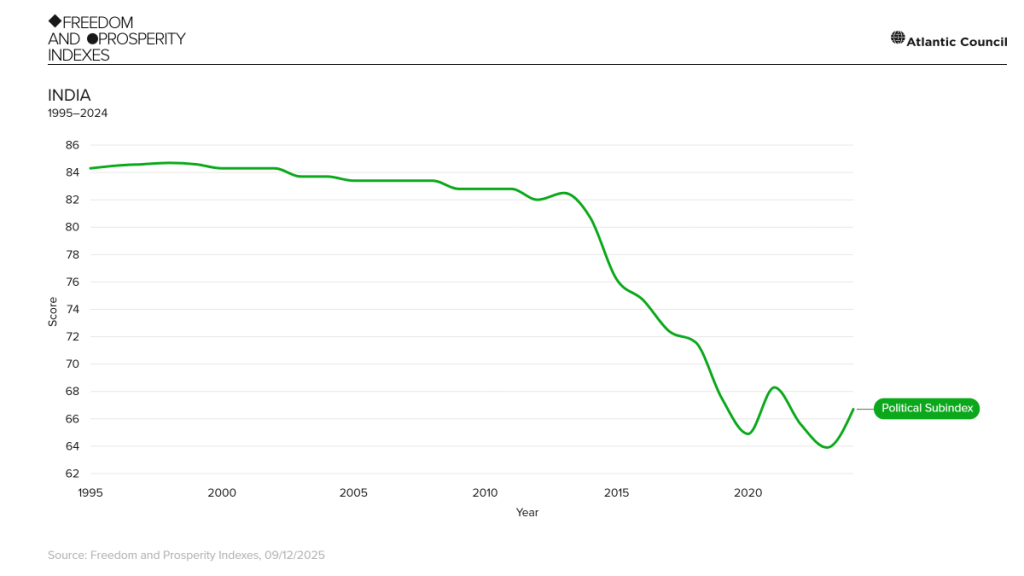
Chart: Atlantic Council.
As in much of the rest of the world, the ‘political rights’ component – denoting “freedom of association, expression and access to independent information” – of the political subindex in India saw the heaviest decline over time compared to this subindex's other components.
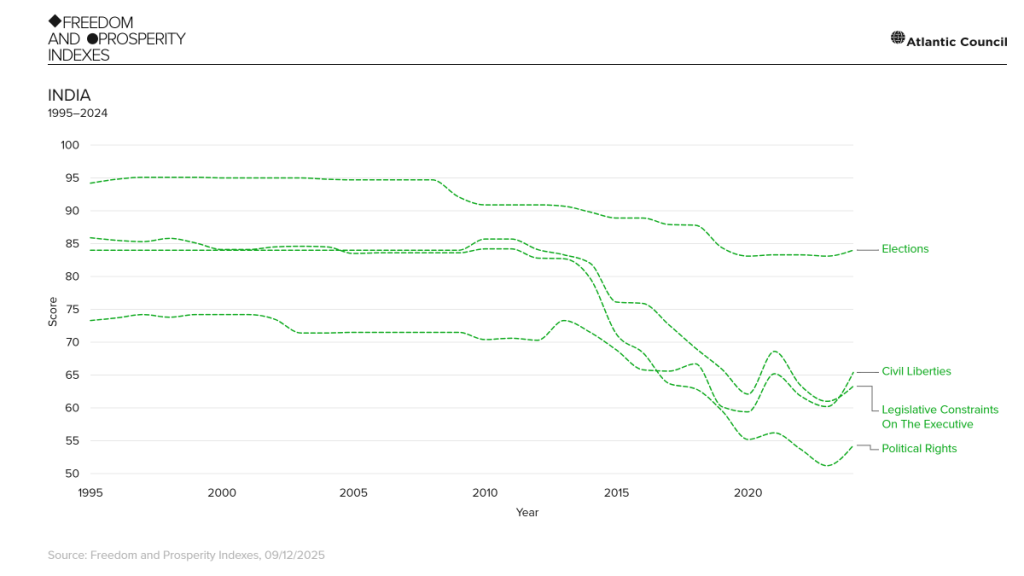
Chart: Atlantic Council.
The report notes that the status of minorities has worsened world over; however, the decline in South and Central Asia is particularly salient.
Data from the Council's website shows that under the minorities component within the Prosperity Index – which aims to measure discrimination in or exclusion from public services or work opportunities along gender, political, linguistic, religious, caste and other lines – India's score remained in the low 50s from the late 1990s but declined to the high 40s between 2018 and 2020, before ultimately declining a little further and settling at 47.4 in 2024.
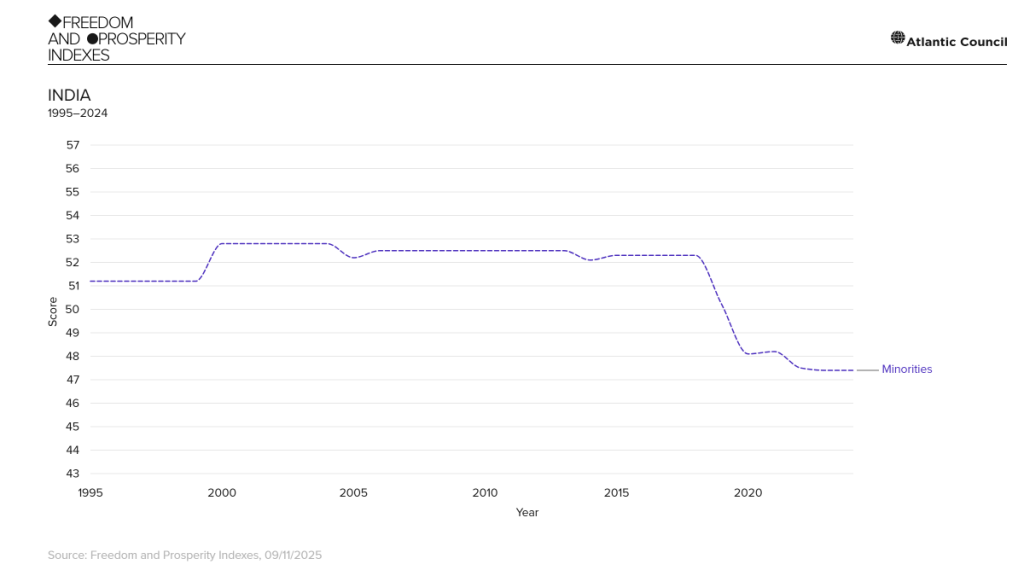
Chart: Atlantic Council.
The report also covers the role of the rule of law (the legal subindex under the Freedom Index), showing it correlates most strongly with prosperity compared to other freedom sub-indexes. The enforcement of laws, judicial independence and anti-corruption mechanisms remain central to freedoms as well as prosperity.
The Council has measured India’s legal freedom over time. Its score under the ‘legal subindex’ that is part of the Freedom Index has generally risen since the mid-2000s (excepting a fall here and there) and has plateaued over 2023 and 2024. The Council however has previously noted that India does poorly when it comes to the accessibility and affordability of its civil justice system as well as in the delivery of criminal justice in a timely fashion.
Contrary to growing global narrative, ‘political freedom does lead to stronger growth’
Challenging what it terms a dangerous global narrative, the report says that “political freedom does lead to stronger long-term growth. In fact, the process of democratisation alone provides an average 8.8% boost to gross domestic product per capita after 20 years compared to its autocratic peers”.
The index points out that strong democratic institutions bring great economic benefits for countries transitioning towards a stronger rule of law. This means that freedom is the surest path to long-term development and well-being.
Globally, freedom’s distribution remains uneven, with Denmark scoring the highest on the Freedom Index at 93.8 and Afghanistan the lowest at 16.9.
The last 12 years have seen political freedom decline worldwide, sharply declining further during the COVID-19 pandemic and reaching the lowest point in 25 years since 1999. Even in 2024, the big “year of election”, freedom continued to decline globally. “Political rights, judicial independence and checks and balances” kept eroding.
Freedom delivers
The report has a message for both developed countries and developing countries. For the former, “Wake up to the seriousness of the threat. Democratic erosion is not innocuous and consequences will compound over many years.”
For the latter, “Strengthening the rule of law and political freedom are the next logical steps to cement the gains made by increasing economic freedom.”
The main message from the data is clear. Prosperity may take time, but freedom delivers.
This article went live on September twelfth, two thousand twenty five, at twenty-four minutes past seven in the evening.The Wire is now on WhatsApp. Follow our channel for sharp analysis and opinions on the latest developments.


