

Nepal’s Gen-Z Movement and the Ghostly Afterlives of Revolution


After the end of the decade long People’s War in 2006, mostly based in the hinterlands, one of the key Maoists leaders was asked by the media, “Now that you have moved to the city, what kind of a city is your ‘dream city’?” Pat came the reply – Bangkok-like shopping malls, roads as wide and shiny like that of the West and so on. The imagery that these words sketched together was a mimicry of a city, whose making would only be possible through large-scale investments of unregulated financial capital.
Ironic as it was, coming from a revolutionary figure, the outline of the dream was a revelation of a desired future, one whose arrival had begun to take shape in Kathmandu, particularly following the 2015 earthquakes.
High-rises carrying global five-star luxury brands, boutique hotels, exquisite cafes, hotel-like hospitals now line the cityscapes of Kathmandu. In this rise of “urban gigantism”, the recently constructed Hilton Hotel in the north end of the city stood tall, broad and excessively large compared to the adjoining minnows of houses and buildings surrounding it. The stuff of the Nepali Maoist dream was more or less being realised, it seemed. Except, there is now a glitch in the system.
On the 9th of September, 2025, alongside many similar structures, the Gen-Z movement set Hilton on fire, and burned it down to the ground. For now, the dream has derailed.
How did it all begin?
It all began with a few like-minded individuals in their early to mid-20s, who had formed a Viber group to plan for a series of protest programs, peaceful and creative. The rallies would be filled with poetries and such. As protest plans were underway, on September 4, the Nepal government imposed a ban on social media, including Facebook, TikTok, YouTube and so on. The announcement served as a trigger as what was initially a Viber group of 15 to 20 soon expanded to include over 300 or more individuals of similar age.
On the September 8, they set out on to the Maitighar Mandala, a government-designated protest zone. From there on, the plan was to march toward the Parliament in over 3,000 in numbers. However, halfway through the march, few of the peaceful protestors began to notice something troubling – sight of other protestors in hundreds – and soon in thousands – the “infiltrators” representing the “invisible forces”, who were not part of the Viber group’s plan nor communication.

Imprints that the Gen-Z left behind in Kathmandu, Nepal. Photo: Sabin Ninglekhu
One can assume that the “infiltrators” could have been anyone from the disgruntled Gen-Z or Gen-Y members of the major political parties dismayed at their archaic and corrupt leadership; social media users to whom the digital platforms could have been a source of livelihood beyond serving “social” purposes; activists for whom TikTok videos, instagram posts and Facebook reels are archives of “evidence” of corruption and state-sanctioned violence; or, the “infiltrators” could as well have been the far right monarchists and Hindu fundamentalists rubbing their hands at the opportunity to trouble the system after a failed attempt last March.
It could have been any or all. Sensing a riot, the Gen-Z protestors began to exchange messages on Viber, alerting one another of the simmering danger of the protest getting out of hand. They abandoned the streets with the plan to regroup in some other space and time. But by that time, the streets of Kathmandu were filled with the Gen-Z movement in thousands. Designated zones were traversed. Walls and gates of the parliament halls forbidding entrance were brought down. In a matter of hours, the protestors claimed every inch of the city as a protest zone.
The protests were now in full force in cities beyond Kathmandu, across Nepal. The police fired back. Toward the end of the day, 19 young individuals, men and women, were declared to have been killed by bullet wounds – 72 total deaths at the time of writing – with several hundreds being treated in hospitals, many in serious conditions. The day ended on a tragic note. But nobody was even remotely prepared for what was to come the following day.
Early next morning, defying curfew orders, people had started gathering burning tires and blocking the roads, with chants carrying themselves to the next day, “Oli Chor, Desh Chhod” – "Oli (the prime minister) you thief, leave the country” – being the primary slogan. Even at this point, it did not look like the carnage would immediately unfold in the manner that it did. In a matter of hours, three of the major buildings representing the Nepali government were set on fire – the parliamentary, the legislative and the Supreme Court. Private houses, many mansions, of the parliamentarians, primarily belonging to the three major parties, the Communist Party of Nepal, United Marxist Leninist (UML) and Nepali Congress, the ruling coalition, as well as the Maoists party, were destroyed and set on fire.
The prime minister, Oli, also head of the UML party, resigned and fled in the early hours that day, with his whereabouts still unknown to the public. Videos of protestors dragging Sher Bahadur Deuba, the head of the Congress party, and Arju Deuba, the serving foreign minister and Deuba’s wife, widely known as a corrupt figure, out of their houses went “viral”, all the while screaming into their ears: “Do you now see the power of the people?!”.
The newly constructed “Minister Quarter”, a residential neighbourhood housing ministers and parliaments, constructed after claiming a large swathe of open land in one of the most expensive real estate locations, too went down in flames – all residents evacuated in helicopters. Alongside these structures, what also went down were hotels, shopping malls and cable car companies, those that carried the imprints of political parties, largely through a new version of public-private partnership (PPP), a working model for crony-capitalism, that has become rampant in Nepal within the last decade or so.
Unlike the 1990s PPP model introduced to institutionalise “good governance”, today’s morbid version casts business conglomerates as the “private sector”, while the politicians – whether in power or opposition – are the “public” increasingly under the sway of private capital, bending laws and bureaucracy to billionaire interests. As such, to the protestors, the Hilton hotel was an in-your-face physical manifestation of this Faustian pact.
Hilton Hotel: A perfect target
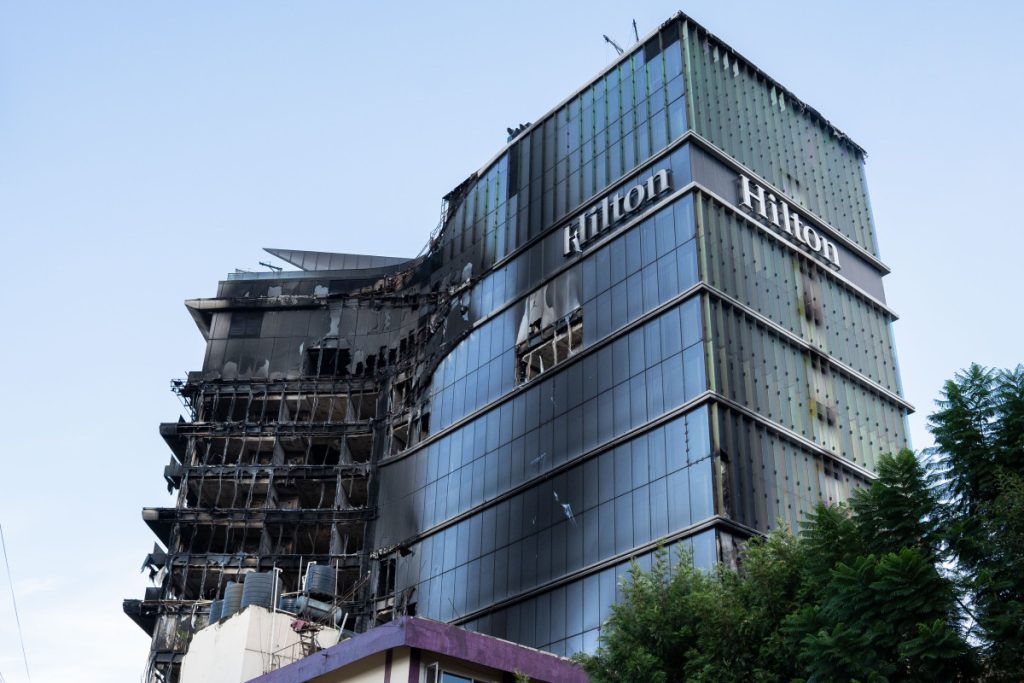
Hilton hotel in Kathmandu after protestors set it on fire. Photo: Manjit Lama
On June 11, 2025, one of Nepal’s prominent journalists, Dil Bhusan Pathak, was issued an arrest warrant for committing a cybercrime. It was clear that the arrest warrant was a retaliation against Pathak’s expose through his highly popular YouTube media channel “Tough Talk”. The particular episode focused on Jayveer Deuba, the powerful Deuba duo’s son, and his purchase of Hilton Hotel’s share valued at around 177 million USD. Alleged to have bought the share at a much-reduced price, Jayveer Deuba is said to own expensive real estate businesses in Dubai, expanding in Australia and Canada, in partnership with other business conglomerates of Nepal.
While foregrounding Deuba junior as the protagonist of his story, Pathak’s take-home message was clear and concise: that politicians and businesses are increasingly operating as a single well-oiled machine holding the federal republic and citizens hostage, while their children are groomed to inherit the entrenched power, thereby permanently perpetuating the crony-capitalist order. It mattered little that in February, 2025, the international body, Financial Action Task Force (FATF) grey-listed Nepal for its failure to combat money laundering and illicit financing.
The two messages that the particular episode of “Tough Talk” carried were two central targets of the Gen-Z movement: #NepoBaby and #Corruption. And Hilton Hotel was an outcome and an incubator of both nepotism and corruption, and hence was a perfect target. Needless to say, like the rest of Nepal, journalist Pathak had very little inkling of the fate that the Gen-Z movement would hand out to Hilton, and many other structures like Hilton financed through unregulated capital, and the Deuba family, like many other “legacy family” like them, only three months after his episode went live.
To note, the arrest warrant issued against Pathak lays bare not just the corrupt political-business nexus, but also the increasing trend of press freedom being trampled the moment it threatens the powerful.
Ghosts of futures past
The three major political parties now representing “the old guard” have done little to give a hint of “reform” that the Nepal populace at large demands of them. If anything, the fact that the parties’ collective issuance of a press release condemning the appointment of the current prime minister Sushila Karki, ex-chief judge of Nepal known for crackdown against corruption during her tenure, as unconstitutional, simply means that old guard is still unable to feel the pulse of the changing time and sort their act accordingly.
Karki is a popular figure in Nepal who has now been appointed as Nepal’s prime minister after the Gen-Z protestors voted her as their leader through a public meeting on Discord, a digital communication platform primarily used by gamers that anyone can “infiltrate”, including Gen-Y and Gen-X, just like the protest itself.
There are individual instances of growing anger among the young communist and congress party cadres at the grassroots level as the patronage politics they have relied on for as long as they have been “doing” politics has suddenly derailed. Mahesh Basnet, one of the prominent leaders of CPN-UML, recently shared a video of him going around visiting destroyed houses, with a gang of his physically well-sculpted sycophants, one of whom was recorded uttering a famous Bollywood line, “chun chun ke maarenge” – will target the Gen-Z selectively. There are reports of a young man, part of the Gen Z movement, committing suicide after succumbing to harassments from party workers.
The “other” Gen-Z communities – the Indigenous, the Madhesi bordering India, the Dalits, including the landless Gen-Z, all part of the Gen-Z movement – have been organising to sketch their own outline of a vision articulating their claims over the promise of an uncertain albeit a new future. There appears to be a gap of communication between the “other” Gen-Z and a selective group of Gen-Z that have now become the official face of the Gen-Z movement, and in close proximity to the interim government. Therefore, Nepal continues to live in an uncertain time even if the interim government is in order while the streets have begun to carry a semblance of normalcy.
Of the many buildings – public, commercial, and private – one of those that stands derelict and decrepit after arson, was that of Prachanda, the chief architect of the People’s War. It is a property that belongs to a private businessman that is spread across a relatively large parcel of land in one of the expensive real estate locations of the Kathmandu Valley. Many say that Prachanda lived there rent-free. A journalist shared, on the day of the arson, that Prachanda was the one of the first key leaders that was out of contact from early in the day. The author of “Prachanda-Path”, pathway of Prachanda, essentially a doctrine to end monarchy, fight capitalism and set Nepal on its course to socialist utopia, had been forced to run away from the revolutionary “moment” that had engulfed Nepal that one historic day.
Not too far away from where this event unfolded, the Gen-Z protesters left an imprint behind that reads, “Revolution is contagious”. The rapid slide of the Maoist politics into a crony-capital-driven pool of ignominy, following the end of the “People’s War” in 2006, is a testimony to the fact that the contagion stands true for counter-revolution too. The dead remains of Prachanda’s residence now represent the ghostly “afterlife” of the Maoist revolution that was once deemed the permanent harbinger for transformative change. The Maoists, like the congress and the communists before them, not only failed to avoid the “afterlife”, but in many ways helped create themselves.
When in prison during Mussolini's fascist regime in the 1920s through the 30s, the Italian philosopher Antonio Gramsci wrote, "The crisis consists precisely in the fact that the old is dead and the new is yet to be born; in this interregnum, a great variety of morbid symptoms appear". In the wake of the Gen-Z movement, Nepal now has a critical task at hand: To prevent the historic outcomes of the new revolutionary “moment” from being devoured by the “morbid symptoms” creeping back – threatening to revive the ghosts of futures past; the dead remains of broken promises from revolutions long gone.
Sabin Ninglekhu is a researcher studying urban politics and social movements, and is currently leading an international research project, ‘Heritage as placemaking: The politics of erasure and solidarity in South Asia’.
This article went live on September twentieth, two thousand twenty five, at twenty-four minutes past two in the afternoon.The Wire is now on WhatsApp. Follow our channel for sharp analysis and opinions on the latest developments.


